
Monthly Archives: September 2011

Calvin, Kmart and the Blue Light Special

For some of us of a certain age and with a good memory, that “Calvin and Hobbes” strip — in which Calvin’s dad tells him he came not only from a store, but from Kmart, where he was a Blue Light Special — is particularly funny. Because some of us grew up at least within earshot of the Blue Light Special.

For a kid growing up south of Muncie, the center of  my shopping universe was the Southway Plaza, where I bought comics and had my first — and only — shoplifting experience (a story for another time).

But right up there with the Southway — figuratively and geographically — was the nearby Kmart.

Considering the sad state of Kmart today — struggling financially and spurned by even discriminating Walmart shoppers — it’s hard to imagine that Kmart was once the retail powerhouse that it was.

But my whole family shopped there. My toys came from there, I bought records there — vinyl LPs — and a lot of our clothes came from there.

And if you went to Kmart often enough, you were familiar with the Blue Light Special.

At random times during the day, the management decided it was time to push some slow-moving product. An employee was assigned the task of rolling out the Blue Light Special, which was a metal cart with a pricing gun and a metal pole with, literally, a blue light at the top. The lights were not unlike those at the top of a police car.

Some store employee would get on the P.A. system and announce, for example, a Blue Light Special on baseballs in the sporting goods department. A special price on baseballs would be available for the next 15 minutes, they would note. Customers who wanted to buy baseballs — or ham sandwiches from the deli, or sneakers from the shoe department — would make their way there and fill their carts.

I don’t remember my family often buying Blue Light Specials and to this day it seems like a curious marketing strategy. While the promise of a Blue Light Special might draw shoppers to Kmart, there was little to attract them but the hope that sometime while they were there a random item might go on sale. It was kind of like an internal Kmart lottery.

Apparently the Blue Light Specials, introduced in 1965 — during my early Kmart shopping experience — held on until 1991. A couple of years ago, the retailer tried to appeal to Baby Boomer memories by referencing Blue Light Specials and adopting a blue lightbulb mascot. But it was a little like when KFC made Colonel Sanders a hip-hop granddad; it’s hard to imagine who they thought they were appealing to.
Where have you gone, Mike Nomad?

I was a newspaper fan from childhood, years before I would have guessed my writings would appear in print on a nearly daily basis. Decades before the Interwebs made it possible to connect with the big, wide world on an instantaneous basis, TV, radio and newspapers were my connection, my contact, to everything out there that was bigger than me.

Just as Johnny Carson’s “Tonight Show” was the avenue for a kid from Central Indiana to learn about the finer points of Jewish comedians and great jazz, so newspapers were a way for a Cowan elementary-schooler to begin to form a rudimentary grasp of current events.

And newspaper comic strips were the icing on that cake of information.

I read virtually all the comic strips, from the beautifully drawn but kind of impenetrable, plot-wise, “Prince Valiant” Sunday strips to the bread-and-butter comedy of “Hagar.” I read the comics page from the top down every day.

I can’t say I loved every single one — sorry, “Andy Capp” — but some of the strips I savored like cold Chocola on a hot afternoon. Even well into my adulthood, “Calvin and Hobbes” was the highlight of my day. I probably should have saved it for late in the evening so the day didn’t peak too early. I still mourn Dec. 31, 1995, when Bill Watterson ended his strip. I don’t think the comics page has been the same since.

But while the funny strips were probably the most enjoyable and the most accessible, I loved the drama strips. Well, I can’t say I spent a whole lot of time dawdling over “Mary Worth” or “Apartment 3-G,” but I read them.

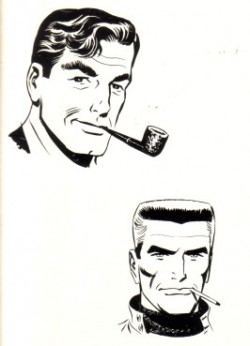
The adventure strips, though, are another matter. A particular favorite was “Steve Roper and Mike Nomad.”

The strip began in 1936 — back then it was “Big Chief Wahoo” — which was well before my time. Journalist Steve Roper was introduced in 1940 — still well before my time — and eventually took over the strip. Adventurer Mike Nomad was introduced in 1956.

Roper and Nomad were the kind of duo that remains popular to this day, particularly in mystery novels that feature a more cerebral lead character and his quick-with-his-fists buddy. Roper was, fittingly for a journalist, the kind of guy who could not only investigate a crime but think his way out of a tight spot.

Nomad, with a flat-top haircut that looked like you could drive a pick-up truck across it without mussing a single hair, was the funnier, flashier character. He was known to hang out in Chinatown or down at the docks and usually ran afoul of some bad guys who wanted to prove they were tougher than Nomad. They weren’t.

I have to admit I lost track of Roper and Nomad after the duo disappeared from our local papers. I reconnected with their adventures, in a daily, incremental way, when I was out of town and picked up a newspaper that still carried the strip.

And I’m a little surprised that the strip continued until the day after Christmas 2004. By that time, the strip had allowed Roger and Nomad to age gracefully, although Nomad could still get into and out of a scrape or two.

He couldn’t get out of the slow fade of adventure comics as published in newspapers, though. While a few daily action strips remain, most have gone the way of Roper and Nomad.


What’s on your nightstand?

We’ve got books all over our house. In bookcases and in boxes and filling those handy folding shelves that Target used to sell. I’ve got boxes of old comics and monster movie magazines in the garage (which themselves will one day be the topic of a blog entry or two).

But most of the book action in my household is on the nightstands.

All of us have a few books within reach, ready to be read in the few minutes each night before we (I, really) crash into fitful sleep.

The nightstand is where I put my glasses and my keys and my iPhone each night, but the two stacks of books, teetering a little precariously over everything, is what makes me feel comfortable.

The stack of books at the back of the nightstand is shamefully neglected. Some of those books have been there for a couple of years. They’re books that have been recommended, gifts that I’m meaning to get around to, books that I bought on sale just because I could and books that I’ve actually read before but want to keep handy. “Gregor the Overlander,” by “Hunger Games” author Suzanne Collins, is one that has been highly recommended to me. “Devil in the White City” by Erik Larson is one that I’ve already read and highly recommend.

On top of that stack is a small legal pad, complete with Harry Potter pen, that I keep handy just to jot down notes.

The front stack on my nightstand sees the most action. That’s where you’ll find my latest library books. On top of that stack right now are three books in Craig Johnson’s series of mystery novels about Wyoming sheriff Walt Longmire. If you haven’t read Johnson’s books, you should because they’re great. Good stories, even better characters and a great take on life from his crusty old sheriff protagonist. And you can say, “Oh, I’ve read those books” in case a proposed A&E cable TV series about Longmire is a hit.

Also prominent on the front stack is “The Encyclopedia of Appalachia,” a hefty reference book with a depth of knowledge that matches its weight. Anything you want to know about that region that’s so dear to my heart can be found in that book.

We’re trying to corral our books in this household, figuring out if we want to get some new bookcases. If we do, how we store our books will probably change.

I can’t imagine any change, however, that will rob my nightstand of books.

Geektastic: Jonny Quest stop-motion animation

This makes me all geeky goosebumpy.

A stop-motion animation artist named Roger Evans has produced a two-minute-long-or-so version of the opening credits of the classic 1960s animated series “Jonny Quest.”

Yes, this talented man has produced a stop-motion animated version of an animated cartoon, but if that stumps you, you’re missing the point. And probably checking out the wrong blog.

If you’re an old school “Jonny Quest” fan, you’ll appreciate the behind-the-scenes details of how Evans accomplished this. Here’s the webpage with the info.

And if you don’t get a tingle every time the Quest jet cuts through the clouds, I’ll double your money back.