Thanks to my Constellate Creatives cohort Jill Blocker for reminding me that it’s almost THAT OCTOBER.
I mean, we’re speeding toward October with a strong tailwind and it’s a good time to remind people that my 2025 novel, a YA thriller that I’ve more often than not referred to as a high school crime novel, is out there in the world. Poor little THAT OCTOBER, which has been out for 15 months-plus now, has taken a backseat to my promotion of SEVEN ANGELS, which came out three months ago.
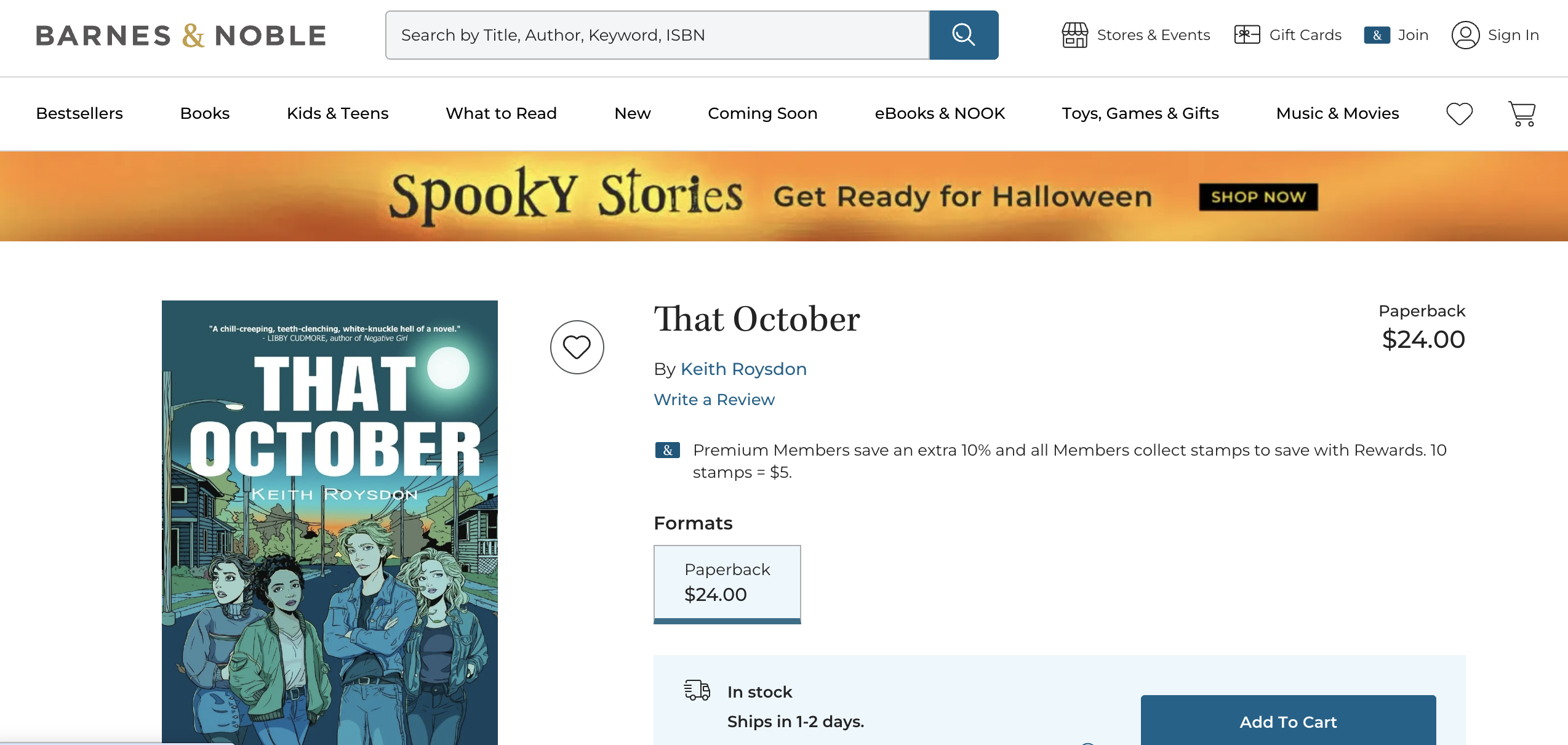
But THAT OCTOBER – set in October 1984 – is a good fall season read, with Halloween, Elvira Mistress of the Dark on MTV, football, the TERMINATOR and peak 1980s pop music as the mood overlaying the crime story at its heart: When a classmate is killed and another disappears, six high school friends – frustrated by how lackadaisical the adults in town are acting – decide to investigate on their own with the hope of solving their friend’s murder and bringing another friend home.
Along the way, they stumble upon dark secrets not only in their town but also in their own families.
The wonderful author Heather Levy said THAT OCTOBER was “perfect for fans of STRANGER THINGS,” although the only monsters in my novel are the human kind.
You can find THAT OCTOBER literally anywhere books are sold. Here are some salient spots:
Ink Drinkers Anonymous, the Black-woman-owned bookstore in my hometown of Muncie, Indiana, through bookshop dot org.
So does Amazon, which offers it in paperback or ebook.
And The Hive Bookshop, my friendly neighborhood bookstore here in town. The Hive has signed copies, as does Ink Drinkers and Aw Yeah Comics, the latter two in Muncie, Indiana.
For most authors, especially indie authors, getting your books on bookstore shelves is a huge end goal.
It can seem like an impossible goal because brick-and-mortar bookstores have only so much shelf space. Your book is competing for space with books by masterful writers and the most hyped – many times rightfully so – books in print.
So as someone who’s recently placed my second crime novel, SEVEN ANGELS, on the shelves of the Hive Bookshop, a local woman-owned store here in Knoxville, I can tell you what steps I took that might have paid off and landed a spot on those shelves not only for SEVEN ANGELS but also my first crime novel, THAT OCTOBER.
(And yes, I say “might have paid off” because, ultimately, who can say why a bookstore owner or manager decides to stock the books they stock? I’m sure there are as many reasons for carrying a book as there are books.)
First, write your book. Finish your book. And work on it, with friends who are willing to read it – not to mention a pro editor, if you can afford it – until you’ve got a good book. Yes, I know that’s highly subjective, but in my case, the Hive owners asked if I could drop off copies of my two books so they could check them out. A few weeks later, they let me know they wanted to stock the books. One of the owners apparently read them, or at least enough of them to know a few customers might consider buying them.
And when I say “work on your book,” I’ll note that I outlined SEVEN ANGELS around 2009 and then returned to that outline to write the novel in 2019, after I’d taken a buyout from the daily newspaper business and could devote time to writing it. I added major characters and subplots years later, in 2022 and 2023 or thereabouts, that made the book more well-rounded. This isn’t a typical book-writing timeline for me, although it did take me about a year and a half to write THAT OCTOBER.
Secondly, timing is important. The Hive is literally a new bookstore, as opposed to the long-established other local indie bookstore that didn’t even respond to my request – in person and through their formal process – that they carry my work. Is a new bookstore less hidebound? Is a new bookstore more willing to take a chance on a new author? Certainly the Hive emphasizes that they’re very focused on community and local authors. Maybe your bookstore is new or they have a new decision-maker or they’re just willing to take that small gamble.
Third, cultivate relationships. I didn’t do a lot of that with the Hive, but I don’t think it hurt that I visited their store during their soft opening and bought a book, DUNGEON CRAWLER CARL, which I’d been wanting to read. Nothing’s better than when your bookstore knows you’ll not only support their store but also recommend their store to others.
Fourth, be understanding and don’t be pushy. Understand what an investment opening and maintaining a good bookstore is. As much as I wanted to, I didn’t “circle back” to the bookstore during the weeks after they had copies of my books and before they notified me they’d carry my books. I figured the owners had enough on their hands without having to respond to multiple email inquiries with an “are we there yet?” type message.
(I have traditionally been pushier with two stores back in my hometown of Muncie, Indiana. The wonderful folks at Ink Drinkers Anonymous and Aw Yeah Comics have been receptive not only when I ask if they’ll carry my books but also when I ask if they need more copies.)
Fifth, have good packaging and presentation. My cohort Jill Blocker and I published THAT OCTOBER and SEVEN ANGELS, the latter through Constellate Publishing, Jill’s book imprint spin-off of her Constellate Creatives company. (Link to Constellate is at the end of this piece.)
Sixth: Try to copy edit to avoid typos – we didn’t manage to have no typos, but I see professionally published books that have typos – and have someone – Jill in this case – who can format the book in an eye-pleasing manner.
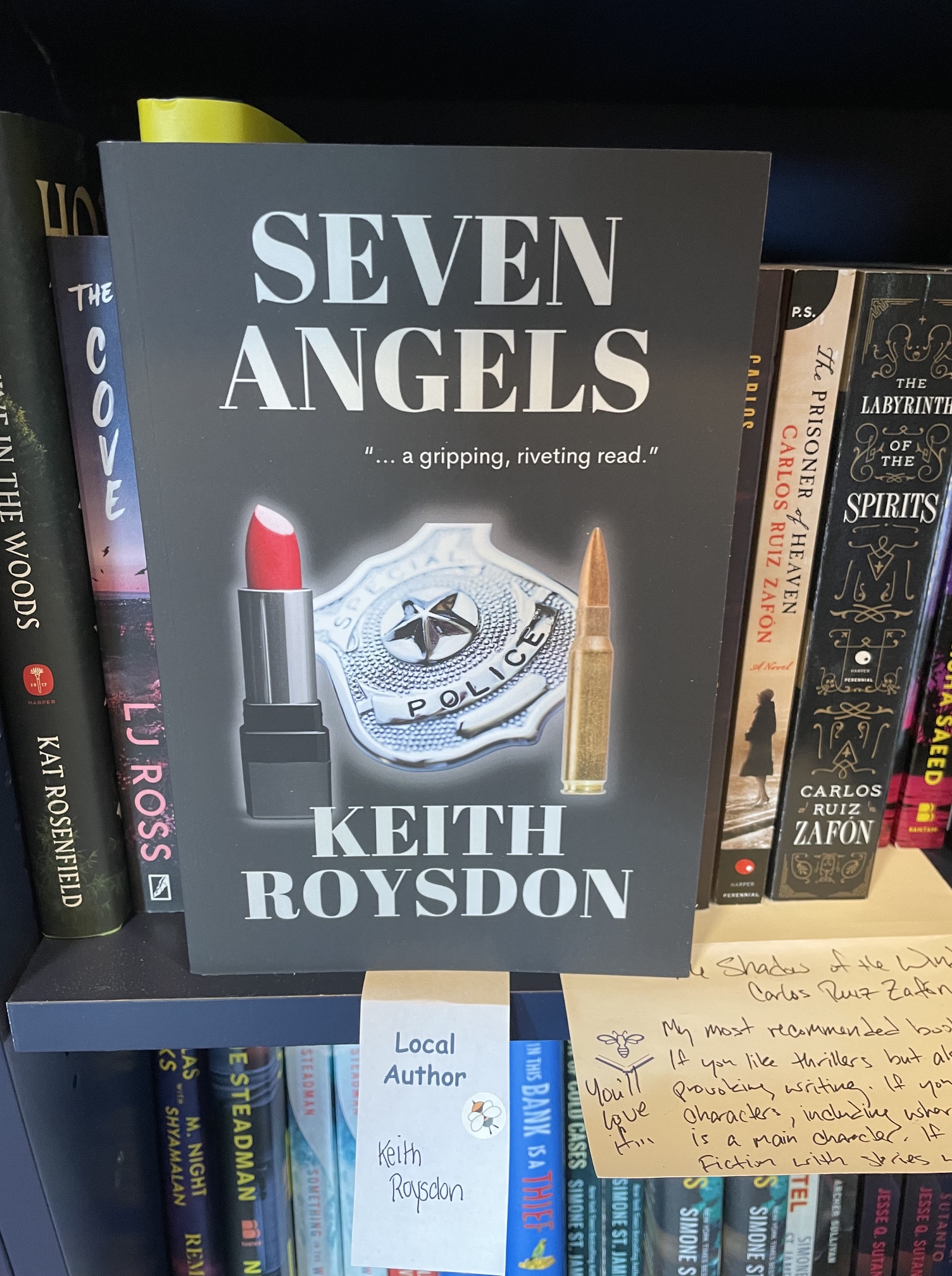
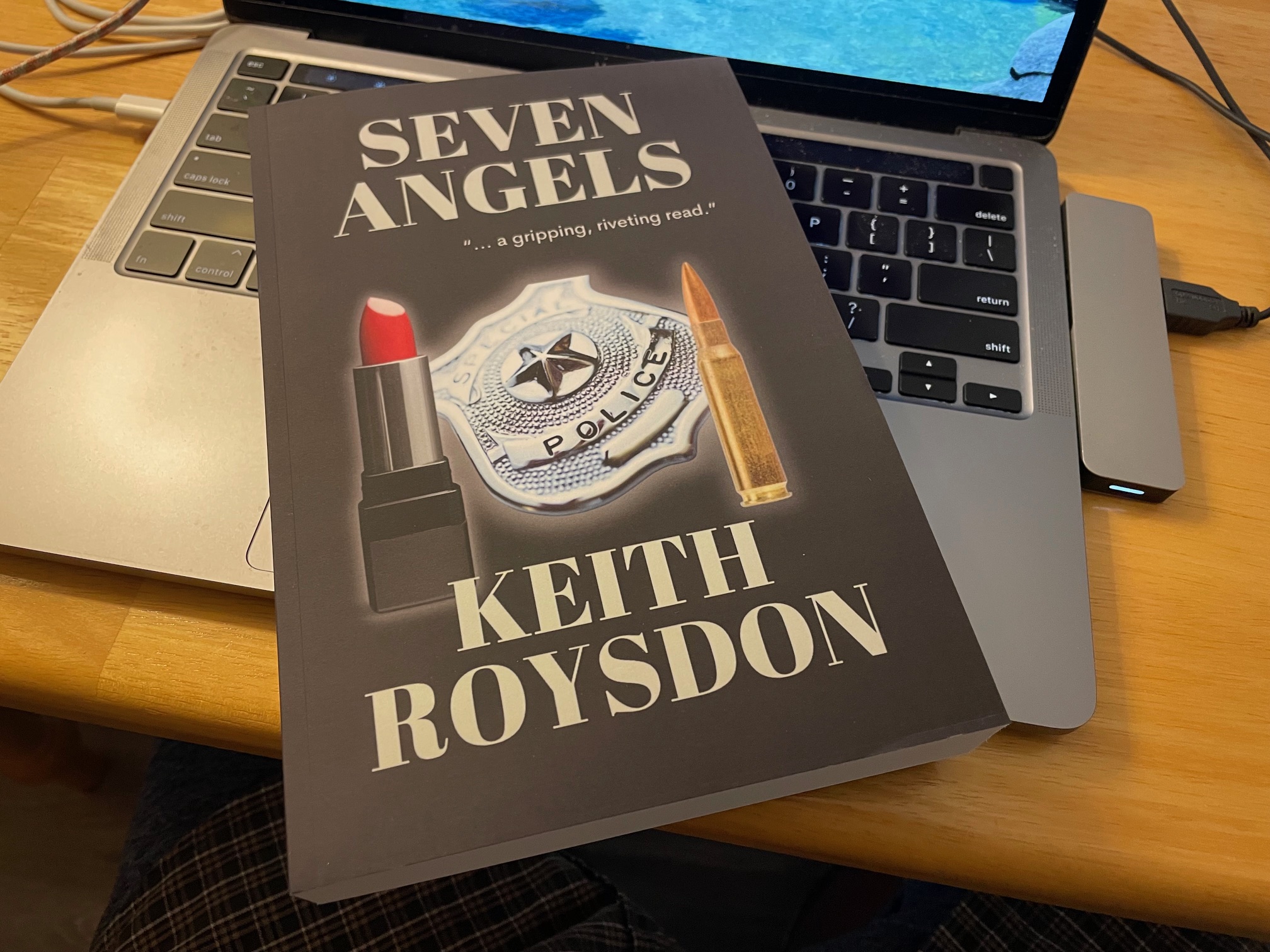
Seventh: Have a good cover. I’m lucky that my artist friend Sara McKinley drew the cover for THAT OCTOBER based on my suggestion that I wanted something reminiscent of a dramatic X-Men comic book cover pose for the young protagonists. With SEVEN ANGELS, I knew I wanted a cover that paid tribute to those Robert B. Parker covers for the Spenser books that had one or two or three elements on a background. I found the three elements – a lipstick, a bullet and a badge – and Jill executed the cover.
Eighth: Your book might be totally bookstore-worthy but never find its way onto shelves. I thought that would be the case with mine. I didn’t give up, but I was pretty resigned to never seeing my cover in a bookstore.
And I was doubly thrilled when it happened and hope it happens for you if that’s your goal.
I had the coolest experience I’ve had in a long time on Saturday: I signed copies of my novels SEVEN ANGELS and THAT OCTOBER for a bookstore. And not just any bookstore, but my local indie bookstore The Hive, which opened this spring.
(Link to the Hive site at the end.)
I’ve had books in local bookstores for 10 years now, since 2016, when the first of my co-written true crime books, WICKED MUNCIE, was published. Each of the three true crime books that followed were also placed in Muncie bookstores (and in displays at Walgreen’s and other stores) by the History Press. Whatever else you might say about History Press, but they have the juice to get books in stores in and around the area that’s depicted in the book.
Since publishing my first novel, THAT OCTOBER, in June 2025, I’ve tried to get it in stores here in Knoxville, where I’ve lived for not quite four years. The long-established indie bookstore here turned up its nose at my request they carry that first novel. And by turn up its nose, I mean that I brought the book to that store and went through their formal online process for requesting that the store carry a book. I heard crickets back. They just never responded, and it’s been 16 months.
And yes, I know all about how much of a premium shelf space in bookstores is. Spare me that factoid, please. Because even though Barnes & Noble replied to my request that they carry the book locally with a refusal to do so, at least THEY REPLIED. (They carry my books online, as does virtually every other bookseller, so I appreciate that.)
So I didn’t have high hopes for the Hive, even though pretty early on it was obvious how they liked to focus locally, with space on shelves and book clubs and talks and signings. I asked.
So when the Hive responded a few weeks ago with a “we’d be happy to carry your novels” and this past week said, “Your books have arrived, would you like to come in and sign copies?” I was just incredibly, pleasantly surprised.
(When I vague-posted on social media about this, some people thought I had interest in my books from TV or movies and, yeah, I have gotten a nibble in that regard but I’ve yet to see follow-through and yet to ensure it’s legit. So we’ll see.)
I’ve been lucky since THAT OCTOBER came out that not only libraries back in Indiana but two of my hometown bookstores, Ink Drinkers Anonymous and Aw Yeah Comics, have been happy to carry my novels. And it was a hell of an experience in 2025 when THAT OCTOBER was carried in the bookstore at Bouchercon in New Orleans.
So the Hive carrying my novels and asking me to sign them and even marking them with a “local author” tag was the best thing yet.
In this “all about me” celebration and back-patting here, I’ll note that there’s a slightly larger issue here. I self-published, through the good work of my friend Jill Blocker, THAT OCTOBER and Jill and I published SEVEN ANGELS through Constellate Publishing, the indie publishing imprint and spinoff of Jill’s company, Constellate Creatives.
So three things can be inferred from my personal victory of The Hive carrying my books: Indie bookstores are the best. Decisions about what books to stock are best made locally.
And indie authors and small imprints should be heartened by the fact that small potatoes book publishing can get your book into bookstores.
Some of you are old enough to remember July 24, where on this very site I said that I’d unsubscribed from a “help for authors” newsletter because they’d pushed out 14 newsletters in a month and that seemed like a lot.
How many newsletters is too many? Well, we’re about to test that number. This entry that you’re reading now is the eighth new piece I’ve posted here since that July 24 column. Those posts have been fueled by a lot of commentary on AI and some book self-promotion.
Each new item I post results in an email to those of you who subscribe, so it’s almost as if I was sending out some kind of … well, newsletter.
So I’ll be keeping track of how many I post and we’ll see if I exceed 14 in a month. And y’all can keep track too and blast me in comments or social media if (when) I blow past that milestone of 14 in a month.
But today, here’s some housekeeping stuff. As Carl Kolchak of “The Night Stalker” fame always says, item:
Item: Shoutout to Andrew Careaga, in the latest edition of his newsletter today, for citing my August 5 piece on the blog here about AI. You should subscribe to Andrew’s newsletter, Friday Five.
Item: The Publishing Confidential newsletter by Kathleen Schmidt has rapidly become one of my favorite newsletters.
Item: Also essential are the various daily newsletters for subscribers to Publishers Marketplace. There’s an expense to the subscription – basically a dollar a day – but I’m feeling more plugged in to the industry as a result of Publishers Marketplace, newsletters like Schmidt’s and Careaga’s and some others I’m going to cite here from time to time.
Item: As someone who has maintained a Facebook page, Wicked Muncie, for 10 years and this site, which began life as a WordPress blog something like 15 years ago and has now amounted up more than 1,100 posts about pop culture, books, Halloween vintage costumes and a bunch of other stuff, I wanted to mention that it’s hard to maintain an active site or blog or social media account and in particular I wanted to cite Mark Evanier’s News from Me site. Evanier, a veteran writer of comics, TV and books, posts pretty much every day, sometimes more than one post a day. He knows a lot about entertainment and he knows a lot of old Hollywood types and his annual Mel Torme Christmas post is reason enough to check out his site. I’ll include a link at the bottom of this post.
Keep me in your thoughts. I’m editing manuscripts from friends and upcoming books from us at Constellate Publishing and I’m doing a lot of reading for a super-secret project that I’ll detail around the middle of 2027.
And yes, I’ll post here this weekend or early in the week because something very cool is happening in regard to my novels THAT OCTOBER and SEVEN ANGELS. No it’s not a movie adaptation. (Although … no, I’ll tell you that story someday.)
I’ve noted in this space before that most of my books and short stories occupy the same universe that mostly varies from the town of Seven Angels, Tennessee, to the small city of Middletown, Indiana. The former is the focus of my newest novel, SEVEN ANGELS, and the latter is the setting of my 2025 novel THAT OCTOBER.
I’ve plotted references to those locales in most of my fiction, including my upcoming novel GHOST SHOW, which is set in Middletown in 1948 (THAT OCTOBER was set in Middletown in 1984).
And there’s been a few times I’ve had characters cross over from stories to novels. I’ve previously mentioned here Butcher Crabtree, who pops up in SEVEN ANGELS and a few stories.
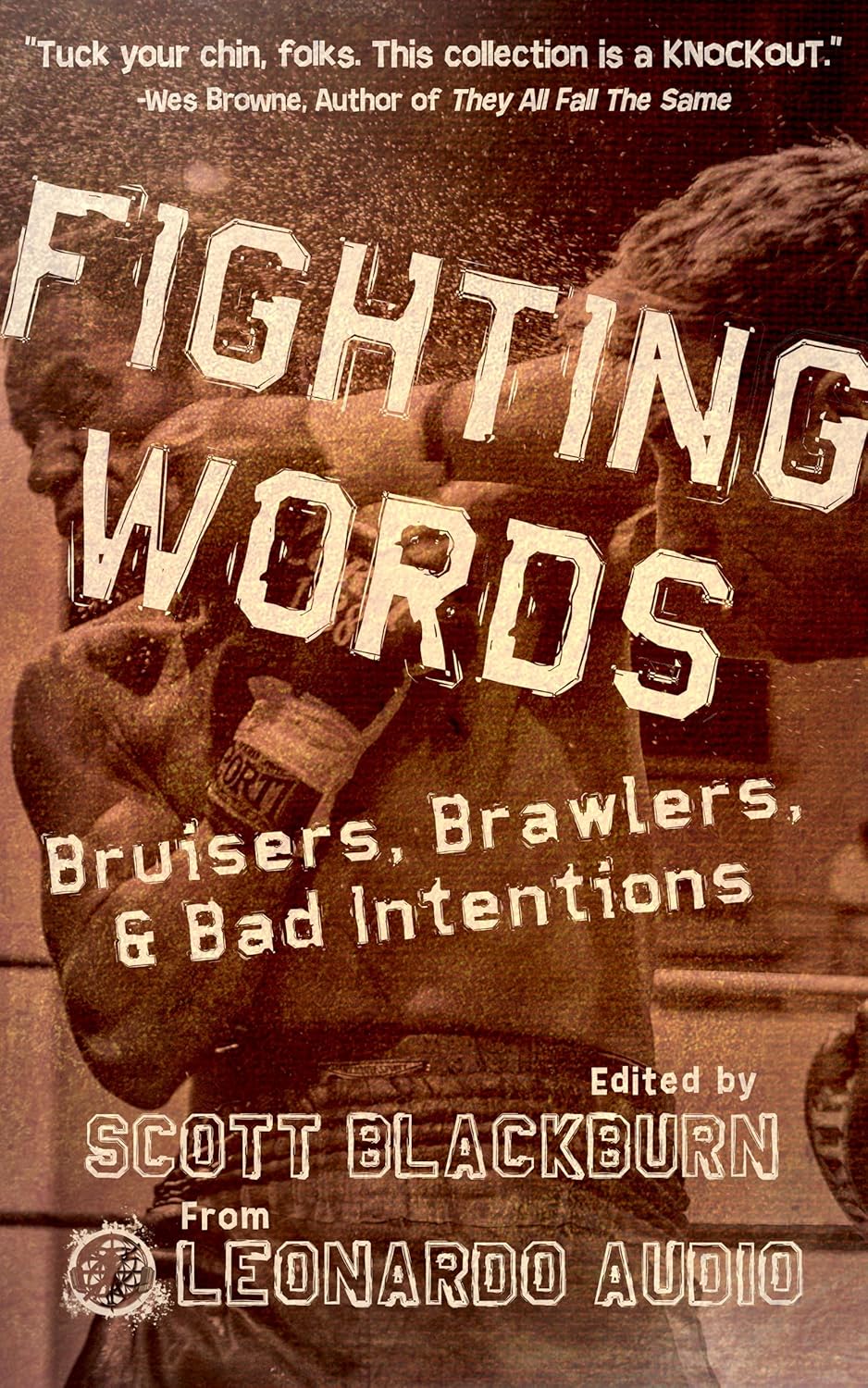
But in GHOST SHOW, when it shows up this winter, you’ll see some characters I introduced in “A Fighting Life,” a short story in the 2025/2026 anthology FIGHTING WORDS, edited by Scott Bradburn and published by Leonardo Audio.
Four of the Anderson siblings, who are the focus of GHOST SHOW, are in “A Fighting Life,” which is also set in Middletown in 1948.
They’re pretty different characters in some ways, and very much the same characters in other ways. In “A Fighting Life,” siblings Marie, Saul and Peter get into vacant-lot-punchfests when the three, all of them teens or pre-teens, discover they can make money by letting other neighborhood kids fight them for nickels. They’re foul-mouthed little bastards, as Courtney Fabrizio, the marvelous narrator of my story for Leonardo Audio, alludes to. (You should read the story, but you really should get the audio version of the anthology, particularly for the amazing work of Courtney.).
In the story, Marie, Saul and Peter take on all comers – and get rescued by their big sister Rachel as they’re about to be busted by the cops – and it’s a story that is, by turns, fun and dire.
In GHOST SHOW, Marie, Saul and Peter are still the youngest members of the Anderson family and Rachel sometimes rescues and sometimes needs rescuing. GHOST SHOW is a story that’s very, very loosely based on my mother and her siblings when they were young, and the four are based on one of my aunts, two of my uncles and my mom. There wasn’t as much mayhem in real life as I injected into either the short story or the novel.
I’d encourage you to buy FIGHTING WORDS not just for my story “A Fighting Life” but also for the really crisp and tough writing by the other writers in the anthology. And it might tide you over until GHOST SHOW arrives.
Okay, so this post won’t make any sense because even though I had a good night’s sleep I’m still kinda brain-fried. So prepare yourself. Head-scratching is not only likely, but recommended.
My longtime friend and fellow author Jill Blocker – she’s one of the masterminds behind Constellate Creatives and Constellate Publishing – just held two days of book talks and signings in Muncie, Indiana. We’re still groggy, and Jill has only just begun her extended book tour.
Two days, you scoff. That’s barely any tine at all.
On the contrary, we packed five book talks and signings and an afterparty event at a local martini bar, RoHo’s, into those two days. We spoke at the Ball State University-affiliated EB and Bertha C Ball Center, Carnegie Library, Ink Drinkers Anonymous Bookstore, Aw Yeah Comics and the Orchard Shop at Minnetrista, all in Muncie, where I was a newspaper reporter and editor for 40 years and Jill attended Ball State and interned at the newspaper. That’s where we met, a little less than 20 years ago, and we kept in touch. When we published our novels WHAT WAS BEAUTIFUL AND GOOD, THAT OCTOBER, SEVEN ANGELS and HAPPILY AFTER EVER – the latter two newly out this summer – we decided we’d publish books by other authors who wanted to work with us. We’ve published one other so far and have others in the pipeline – and we’re looking for more authors. Go to the Constellate Creatives website for more. (Link below.)
Anyway, the sadist who set up the Indiana portion of our book tour (raises hand) didn’t leave much room for seeing family and friends or even breathing while we were in the Hoosier state, yet we somehow managed to.
Now Jill is off to Seattle and NYC and back to her home base of Zurich, Switzerland.
At a couple of events, we were joined by our talented friend Sara McKinley, who painted the beautiful cover for THAT OCTOBER. That’s Sara on the right there.
And we’ll be doing all this again, probably next year. Hopefully with even more books by other authors.
I think there are few writers who enjoy asking other writers and book influencers for blurbs, quotes and reviews.
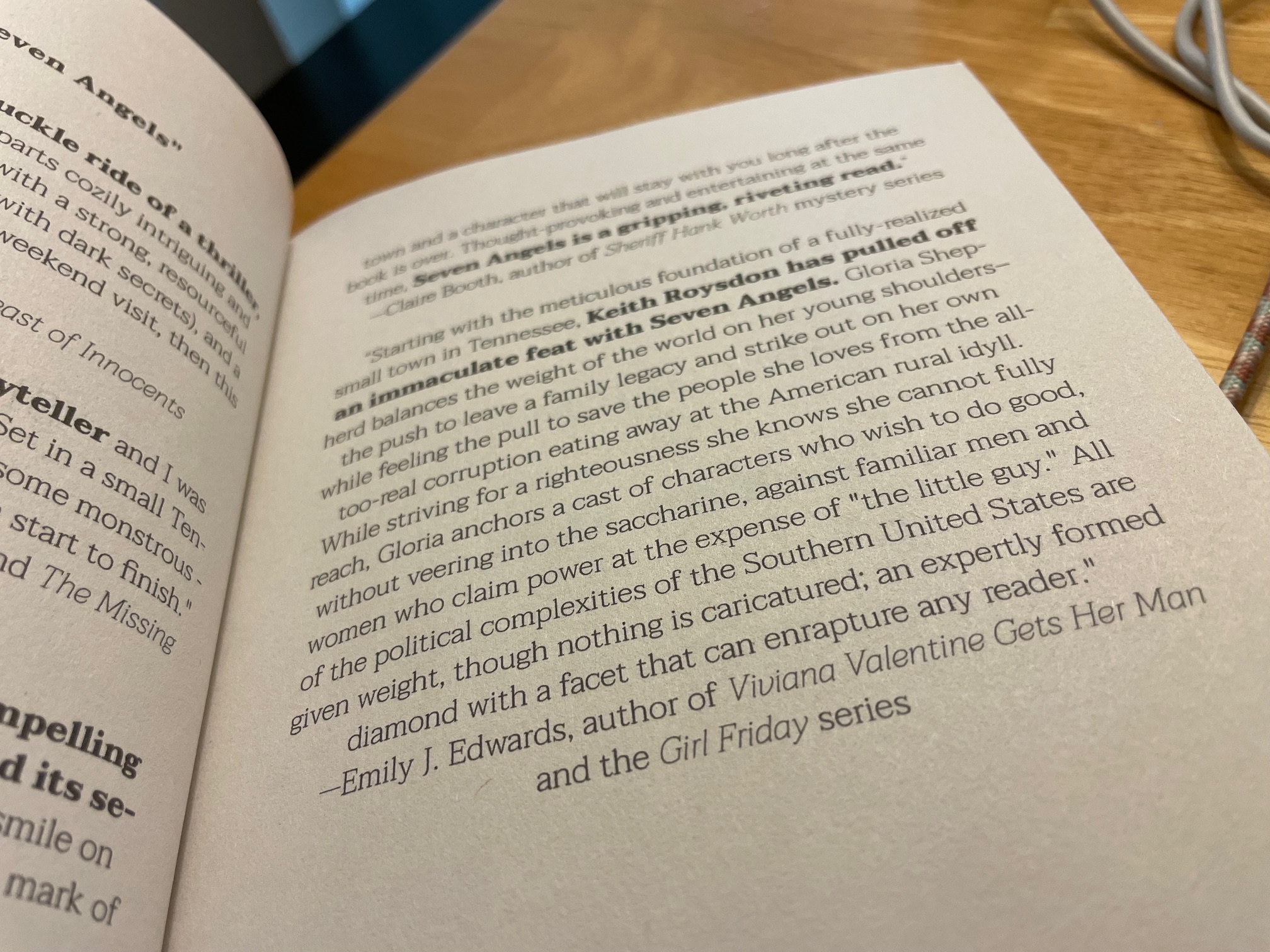
I don’t know that I’ll continue to seek out marketable opinions of my books, if I continue to write books, but I’ve been blessed with insightful comments from people who’ve had a chance to read my books – in advance for inclusion as blurbs like the one shown above by wonderful author and friend Emily J. Edwards – and after the books are published as the most marketing-heavy element of book marketing.
I’ve had only one author say they’ve been too overwhelmed with their own work to take the time to read the book for a blurb or review.
How this process went for me:
Of course, we all know what reviews are, but blurbs are those little snippets of opinion – inevitably praising – that you see on book covers and inside. They attest to the value of the book and, sometimes, of the author.
With my first published novel, THAT OCTOBER, I waited until almost too late to ask. The book was slated for self-publishing on June 1, 2025 and I probably didn’t ask people until March or April. Every person I asked except for one hugely busy person was able to read the book and provide a blurb.
With SEVEN ANGELS, I was a little more organized and asked weeks, months, earlier, well before its June 1, 2026 publication date. I did so politely and with the understanding that they were probably too busy to do it, but they all did. One author who’d said she wouldn’t be able to blurb the book emailed later to say she’d begun reading it and wanted to blurb it. I’m not sure I got a higher compliment than that.
Each of the authors got a copy of the manuscript and I told them that there would be no substantial changes to come that might affect their opinions.
The blurbs were included in the book, most inside and one by Claire Booth on the back cover. My friend and cornerstone of Constellate Publishing Jill Blocker decided the positioning.
Afterward, when I had copies of the book, I asked a handful of people, friends and online tastemakers, who I provided either copies of the proof or copies of the book to. I stepped gingerly with my request here: “If I sent you a copy, would you consider reading it and possibly posting about it?” This was a step I didn’t take with THAT OCTOBER.
In the five days (as of today) since SEVEN ANGELS was published, I’ve encouraged people to post reviews on Amazon or other sites like Goodreads. And of course people I don’t know who might read the book might do the same.
It’s a ticklish process, for sure. You have to assume that the people you’re asking MIGHT like the book and be willing to say so publicly. If they don’t, though, at least they gave it a shot and shared their honest opinion.
Because years from now, if I’m lucky, someone might have an opinion. If it’s positive or negative or mixed, it’s still a sign that someone found the book and connected with it.
Okay, I should just acknowledge that when you’ve published a book, the promotional push for it is never over.
But it feels like we’ve reached something of a milestone as my new crime novel SEVEN ANGELS is published tomorrow, June 1, 2026, by Constellate Publishing, a publishing imprint of Constellate Creatives, a company founded by my longtime friend Jill Blocker and for which I do some editing and other work.
By way of noting that promoting a book is never ending, I’ll say that I’ll be darkening your doorstep plenty even after the book is published.
A few quick words on how I got here:
I wrote a few crime novels back in the early 2000s that weren’t completely baked and I didn’t pursue publishing them. A few years later, sometime before 2010, I outlined a book called SEVEN ANGELS, a crime story about a fictionalized version of the little town in Tennessee where my parents grew up.
(I was still about 14 years from being a Tennessee resident myself, but I’d been down here plenty of times, visiting family.)
After I outlined SEVEN ANGELS, I set it aside. I didn’t write a book-length project again until my first true crime book, co-authored with Douglas Walker, was published in 2016. Three more true crime books followed. It turns out that writing and co-writing and editing those books was essential for me in figuring out how to write a book-length manuscript. I’m a plotter and outliner, and turning out an outline – one paragraph per chapter, outline length in total 15 or 16 pages or more – is a step I can’t imagine skipping.
In 2019, I took a buyout from my newspaper job and finally felt I had time and focus to write novels. In a few years, I’d written SEVEN ANGELS, GHOST SHOW and THAT OCTOBER. The latter was the first to be published (self-published) in 2025.
I’d gone back to SEVEN ANGELS almost every year since 2019, fleshing it out with new characters and I hopefully made it better.
The blurbs and comments and reviews have been laudatory and I appreciate it.
For a few months now, I’ve been actively compiling ideas for a new novel, including using some elements from an aborted novel from 2025. (I’ve mined those early 2000s books for a number of ideas and characters, and I’ve done the same with GHOST SHOW, so nothing ever entirely goes to waste.)
So here I am with a promise: I’ll be working on the next novel, along with articles and short stories.
And I’ll be promoting it all, so forewarned is forearmed.
For writers and screenwriters of crime and mystery stories, cellphones pose some problems but also some solutions.
Two of the three novels I’ve written have been set pre-cellphones, in 1984 and 1948. I really enjoyed writing scenes for THAT OCTOBER and GHOST SHOW in which the characters have to urgently contact or find each other and can’t communicate via cellphone like my characters in SEVEN ANGELS – set in 2019 – can. It’s a great exercise in how your characters can problem solve.
Cellphones are so handy to modern-day stories that they can pose a problem writers must work around: They’re so handy that you have to find a way to circumvent them, like no cell service or a broken phone or a lost phone. Kind of like how the writers of the Superman comics, radio show, TV show and movies had to find a way around Superman’s godlike powers. The dude is hugely powerful, so you introduce Kryptonite or block him from the rays of the yellow sun, two things James Gunn used in his excellent 2025 film.
But one way that cellphones change everything is surveillance in thrillers, cop stories or spy stories.
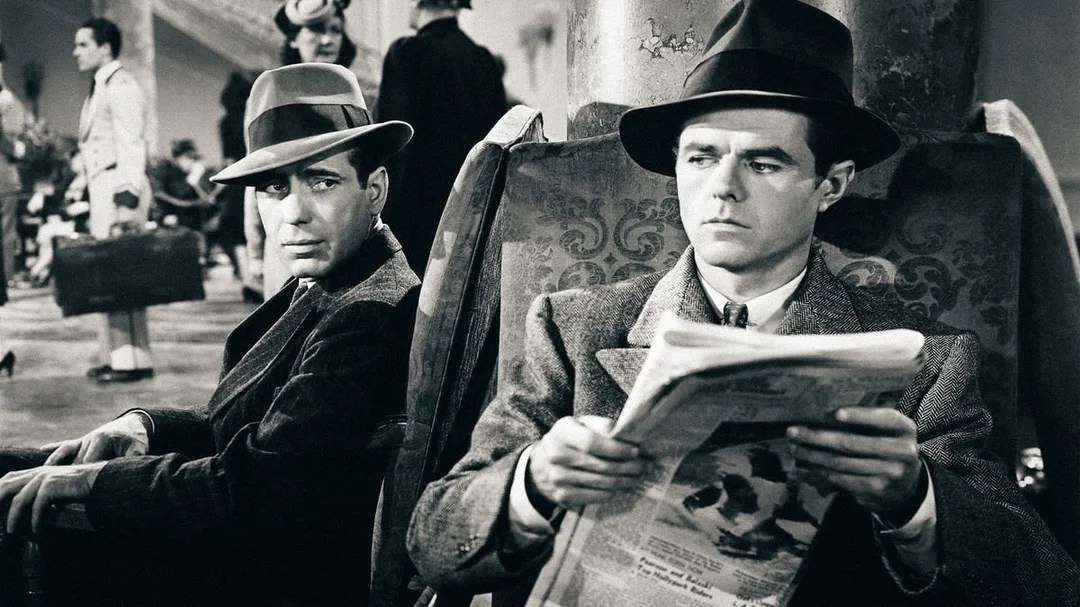
No long would a gunsel like Elisha Cook Jr. in “The Maltese Falcon” have to sit in a public place, pretending to read a newspaper, looking so suspicious that Humphrey Bogart clocks him.
These days, a shady type can simply sit or stand and look at their phone, or pretend to. Think about it: How many times a day do you see someone looking at their phone and assume they’re scrolling social media or watching Korean pop music and never think they’re surveilling someone? Surveilling you?