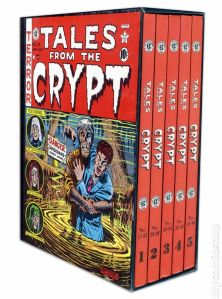
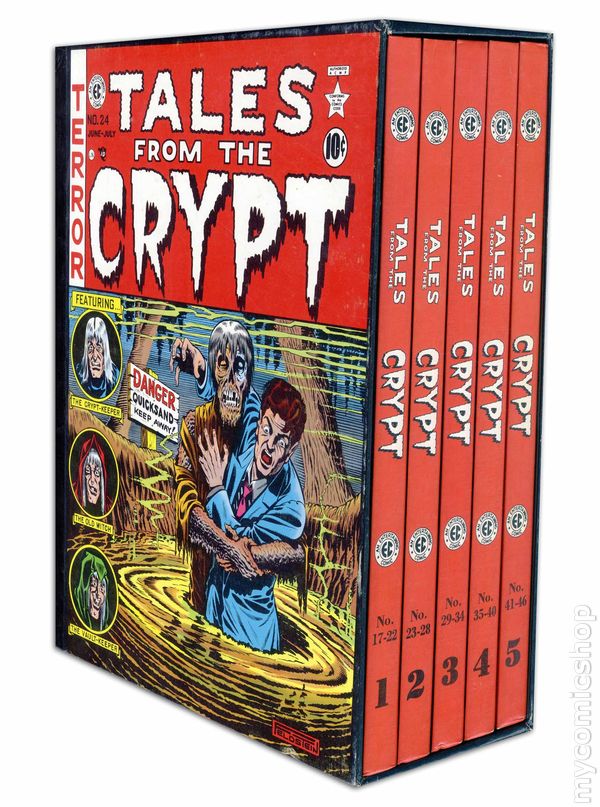
They sat there, on a high shelf of the comic book shop, calling to me.
It was the late 1970s or early 1980s, I don’t remember exactly when, and my friends and I were regulars at Comics Carnival, a comic book shop in the Broad Ripple neighborhood of Indianapolis. We were all college age with too much time on our hands, too much of the geek in us and not enough money.
The store had thousands of geek-pleasing items for sale, from comics to genre film magazines to posters and superhero statuettes.
Besides going to school, I was writing freelance for a Muncie newspaper and a couple of free monthlies in Indy. Freelancing didn’t — still doesn’t — pay a lot; I never got paid for at least one article for the latter of the free monthlies.
So I didn’t have a lot of money to spend. What I wasn’t spending on hanging out with my friends, going to movies and, you know, living, I spent on the finest geekery.
But I couldn’t afford those books on the high shelf.
Russ Cochran, a small-press publisher, had undertaken, in about 1978, an ambitious effort. Cochran set out to reprint the classic EC Comics of the 1950s.
If you’re familiar with EC, you know that they were sister publications to Mad magazine but for the most part focused on cleverly written, beautifully drawn and incredibly lurid tales of horror, science fiction, the supernatural and suspense. Artists like Graham Ingels and Wally Wood adapted classic tales by Ray Bradbury as well as illustrating new stories.
ECs were before my time, but I grew up reading about them. They were Exhibit A in Fredric Wertham’s crusade against comics. Wertham was a quack psychiatrist who wrote a 1954 book, “Seduction of the Innocent,” and testified before Congress about what a horrible influence comic books were on children.
Although superheroes were among Wertham’s targets, EC Comics — with their funny but ghastly tales of zombies, killers and gruesome revenge — bore the brunt of the scrutiny of Congress. Outrage over stories of bloodthirsty creatures and strewn body parts radiated out of Washington.
Virtually overnight, EC’s “New Trend” line of horror comics was shut down.
While horror comics finally struggled their way back onto spinner racks in the 1070s, when Marvel introduced titles like “Tomb of Dracula,” EC passed into the realm of legend.
Until Cochran began his ambitious plan to reproduce virtually every EC Comic.
Cochran started reprinting the classic EC books with the company’s horror comics — “Tales from the Crypt” and “The Vault of Horror,” to note the most familiar titles — and moved on through science fiction, westerns, detective tales and the rest.
The comics were reprinted not in color, as they were originally released, but in clear, beautiful black and white. Several issues were collected, in order of publication, between colorful hardcovers.
The guys who ran Comic Carnival were nice geeks who, on more than one occasion, allowed me to gingerly look through the bound and slip cased EC collections. They did this despite knowing that I was unlikely to have the $100 or so for each multi-volume collection.
I looked at several volumes but could never bring myself to spend the money.
Today, of course, I wish I had. The long-out-of-print boxed sets sell for hundreds of dollars online — I saw one set for as much as $900 — and are much too expensive to try to collect now.
If I win the lottery or fall under the patronage of a benevolent billionaire, I’ll go looking for Cochran’s EC reprint volumes. Until then, they’ll remain on my geek wish list.


 keithroysdon