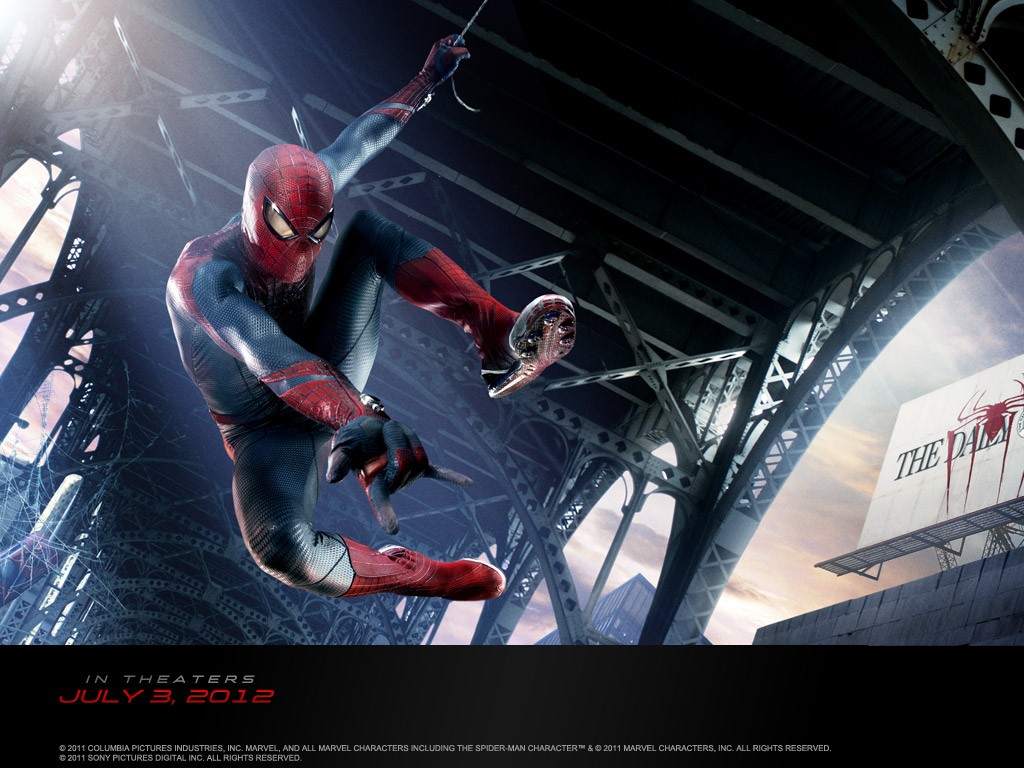
There’s apparently a pretty crass motive behind the fact that “The Amazing Spider-Man” is playing in theaters around the world this week, and I know that you would be as shocked as I am to learn that money has something to do with it.
Only about a decade ago, of course, Sony/Columbia Pictures started releasing Sam Raimi’s “Spider-Man” movies and the first two entries in the three-film series are pretty good. Since that time, however, Marvel Comics has gone into the movie business itself – you might have heard about that – and, as Hollywood tells it, Sony decided to hang onto the rights to stay in the Spider-Man movie business so the rights to the character didn’t revert to Marvel.
This means, for the time being, no Spidey in “Avengers” movies.
It also means, because the producers decided against letting Raimi continue his series, that Spidey got a reboot in the hands of director Marc Webb (heh).
Webb’s movie, “The Amazing Spider-Man,” would be closer to amazing indeed if so much of it didn’t feel like the reboot that it is.
That’s because Webb seems to have a pretty good handle on the movie and strikes the right tone. But a big chunk of the movie seems just too familiar, as Webb presents a slightly altered version of Spidey’s origin again.
Can we all agree that we don’t need to see future superhero movies spend quite so much time on the origin of its hero? Especially if we’re seeing a reboot?
Spoilers ahead, by the way.
Anyway, Andrew Garfield stars as Peter Parker, NYC high school student who’s something of a high-school outcast but nowhere near as much of a hapless nerd as Tobey Maguire’s “puny Parker.” He stands up for a kid bullied by meatheaded classmate Flash Thompson and catches the eye of beautiful Gwen Stacy (Emma Stone) even before he gets super-powers.
In the new outing, Peter is driven by the mystery of what happened to his parents, Richard and Mary Parker, who left him in the care of his Uncle Ben and Aunt May when he was a child. Peter finds his father’s Oscorp briefcase, which leads him to contact scientist Curt Connors (Rhys Ifans), a scientist colleague of his father.
After that injection of mystery, the rest of Parker’s story unfolds fairly normally. Peter gets bitten by a very special spider and gains its powers. His Uncle Ben gets killed (in a manner that seems much more random and less effective than in the comic and Raimi’s movie, frankly) and Peter decides to become a vigilante, hunting his uncle’s killer.
In the meantime, Peter and Gwen fall in love – kind of quickly, really – and Peter helps Connors single-handedly pursues his dream of manipulating genetics.
Of course, things don’t work out for Connors and he turns into the Lizard, a development that was teased throughout the Raimi films as actor Dylan Baker popped up, in a one-armed lab coat, only to never see the conclusion of his story reached.
There are some really good elements in Webb’s version of the story … and some that don’t work out all that well. Here are a few:
The mystery of Richard and Mary Parker: To make this reboot seem a little different, Webb and the screenwriters sow through the movie seeds of a the mystery of what happened to Peter’s parents. It’s implied that something untoward happened to them. But it’s just a tease so far.
Spidey the smart-ass. Here’s one thing that works really well. In the comics, Spidey is a jokester. He quips and hurls insults about as often as he spins webs. The movie does a good job with this aspect of Peter’s personality.

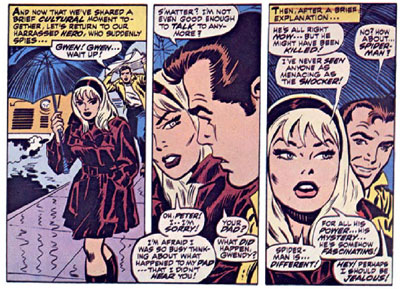
The Stacys are perfect. Emma Stone is perfectly cast as Gwen Stacy, Peter’s first big love in the comics. The Raimi films reversed things by giving us redhead Mary Jane before Gwen. Aside from being adorable, Stone is quite good as Gwen. And comic and actor Dennis Leary is very good as her father, NYPD Capt. George Stacy. True to the comics, Capt. Stacy eventually learns Peter’s secret.
The bad guy is … eh. Movies always run a risk when they make the bad guy a sympathetic character. Raimi danced on the edge of disaster but triumphed with the often-sympathetic Dr. Octopus in “Spider-Man 2.” But there’s not much to Curt Connors here and what there is is sympathetic or even pathetic. He really feels like a minor Spider-Man rogue.
The little things are good. Besides Spidey’s penchant for wise-cracking, one of the nicest touches in the film was bully Flash Thompson’s end-of-the-movie admiration of Spider-Man. In the comics, Flash was Spidey’s biggest fan at the same time he hated his secret alter ego.
The stinger doesn’t work. In Marvel’s owned-and-operated movies, beginning with “Iron Man,” there’s a credits or after-credits stinger, or extra scene, teasing developments in upcoming movies. Those scenes worked perfectly. In “The Amazing Spider-Man” – here are those spoilers I warned you about – the mid-credits scene shows Connors, incarcerated, being confronted by a shadowy figure. I think we’re supposed to assume it was the mentioned-but-unseen Norman Osborn, but the payoff fell flat with a mention of the “secret” about Peter’s parents. Uh, really? You’ve just spent two hours telling us there’s a secret about Peter’s parents, then you tell us, in the surprise secret scene, that there’s a secret about Peter’s parents? I guess the scene is there in case we were out at the concession stand during that part, huh?
There’s nothing in “The Amazing Spider-Man” that can top the average Marvel movie or Raimi’s first two tries at the character. But there’s nothing offensive either. It’s worth seeing if your expectations are low or manageable.

 keithroysdon