Monthly Archives: January 2013

Michael Carroll’s ‘Superhuman’ series worth exploring

michael carroll superhuman

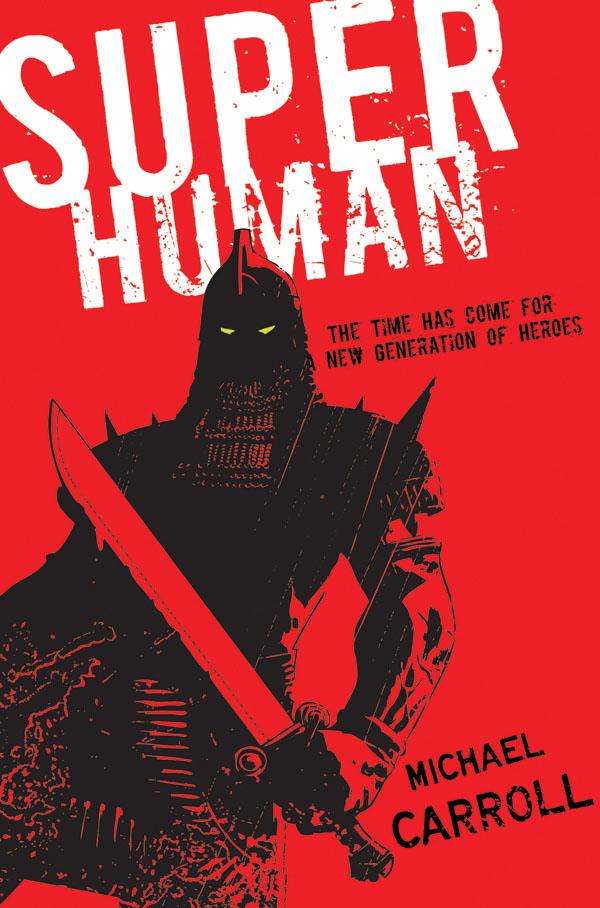
If you – or your son or daughter – love superheroes but aren’t finding the stories you want in comics right now, you should check out Michael Carroll’s series of young adult novels about a brave new world of teenage superheroes.

Because Carroll’s books – some imported from the UK – have appeared in slightly different form and, apparently, under different titles, I’d suggest you start where I did, with “Superhuman,” his novel about a group of young heroes who assemble to fight a threat from the distant past.

In Carroll’s world, super-powered individuals, both heroes and villains, have been a presence on Earth for years. But at some point many of the adult superheroes disappear, just as a new generation of heroes are discovering their powers, ala “The X-Men.”

With little help from experienced heroes, the teenagers – many of them still figuring out their powers – must stop a group of evildoers who have brought to the present a super-powered, invincible warrior from thousands of years in the past.

Follow-ups to “Superhuman,” including “The Ascension” and “Stronger,” continue the story of the newly super teens. And earlier books, grouped in a series called “The Quantum Prophecy,” explore many of the same characters and situations in interesting variations.

Carroll’s books have some humor but play their stories straight, with real, dire consequences and cliff-hanging action.

Classic comics: ‘Fantastic Four’ Galactus Trilogy plus one

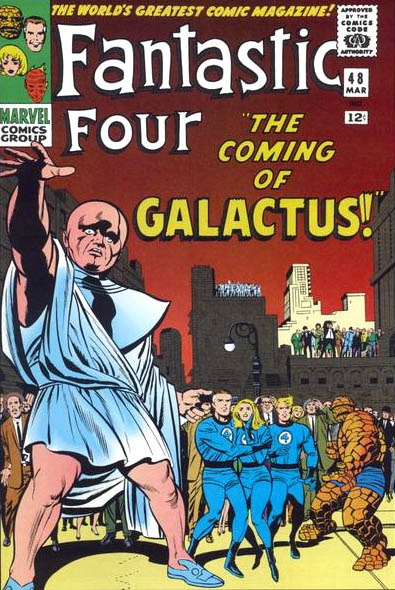
fantastic four 48

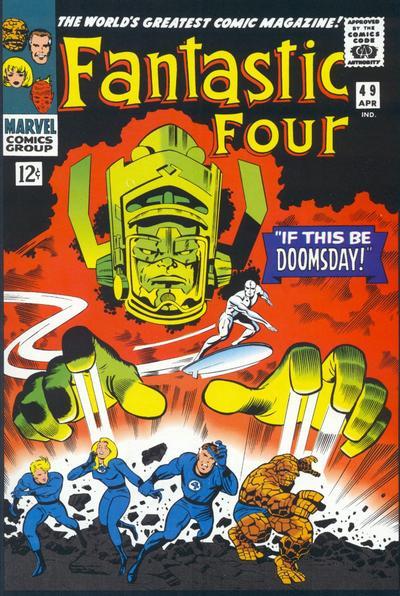
Has there ever been a greater run of creative energy in comics than the four issues of Fantastic Four that begin with issue 48?

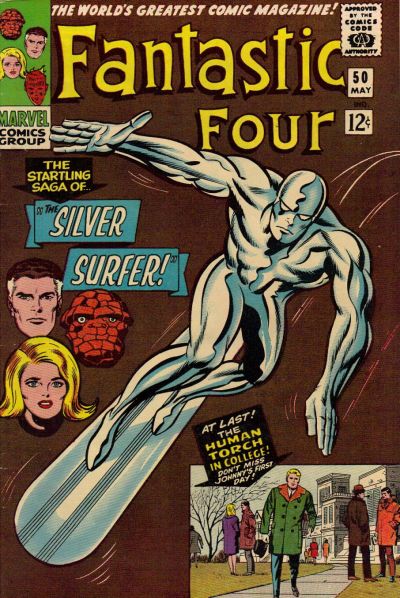
Geeks know that particular issue kicks off what has become known as the Galactus Trilogy. The three-issue series, written by Stan Lee and drawn by Jack Kirby and released in the spring of 1966, launched the Marvel Comics universe into the universe, literally, by expanding the role of “cosmic” characters like the Watcher and introducing the Silver Surfer and Galactus.

If you’ve seen the second “Fantastic Four” movie, you’ve seen a somewhat lackluster version of the story that played through issues 48, 49 and 50. For the purposes of ground-breaking drama and cosmic feel, I’m also throwing the next issue into this review as well.

The story, for those who don’t remember, follows the FF back to New York after they’ve had an encounter with the Inhumans at their isolated fortress.

The mood is somber. Johnny (the Human Torch) has been separated from his girlfriend, Crystal, one of the Inhumans, after the mysterious beings retreated behind an impenetrable barrier. Ben (the Thing) is dealing with the horrified reactions of New Yorkers who spot his rocky visage and feeling sorry for himself. Reed (Mr. Fantastic) has withdrawn into his lab. And Sue (the Invisible Woman) is complaining that Reed isn’t paying enough attention to her. Yes, I know. It was the 60s and women didn’t fair so well in comics. The treatment of Sue makes her out to be a fairly humorless harpy.

Anyway, the FF return to New York and find a series of strange happenings, including fire and boulders filling the sky from horizon to horizon. They quickly learn it is the work of the Watcher, the other-worldly observer of the Earth who isn’t supposed to get involved in the planet’s travails. But in this case he’s trying to hide Earth from the Silver Surfer, who, he explains, is the herald of Galactus, fearsome eater of planets. The Surfer finds suitable planets for Galactus to consume.

fantastic four 49

The FF battle the Surfer, who falls from the top of the Baxter Building and, coincidentally, into the apartment of Alicia Masters, Ben’s blind girlfriend.

As Galactus arrives and begins erecting the machinery of Earth’s destruction on top of the Baxter Building, Alicia helps the Silver Surfer learn the value of the people Galactus is about to kill. And the Watcher sends Johnny on a galaxy-spanning quest to find a weapon that can stop Galactus.
fantastic four 50

There’s a lot of plot, a lot of dialogue and a lot of action in these three issues. Lee and Kirby had a curious habit of beginning and ending plots in the middle of an issue, so Galactus is foiled before issue 50 ends and we get a hint of the next story – as well as Johnny’s first day at college.
this man this monster

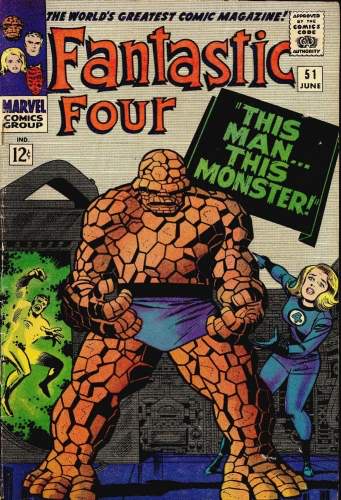
Issue 51 follows the Galactus trilogy with a story that is both cosmic and personal and remains one of my favorites to this day. “This Man, This Monster” lets Ben Grimm (and readers) wallow in his grotesque appearance and substantial self-pity as he wanders the streets of New York in the rain. He encounters a man who takes him home, drugs him and hooks him up to machinery that causes Ben to revert back to his human form. The man – whose identity we never learn – gains the appearance and strength of the Thing. His plan is to infiltrate the FF and destroy Reed Richards, a man whom he considers a hated rival.

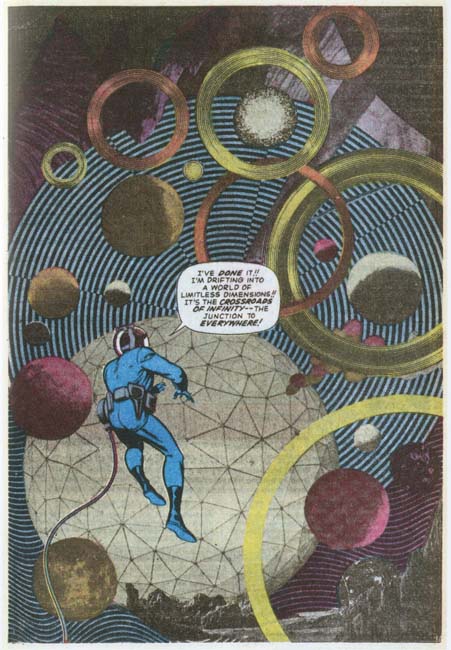
Reed is in the middle of an experiment, traveling to a cold and hostile parallel world and, thinking the stranger is Ben, asks him to hold his lifeline. The man does so, overwhelmed by not only the daring and brilliance of Richards but also the trust placed in the Thing.
this man this monster pop art

Something goes wrong, of course, and Richards is lost in the parallel dimension. The stranger, with all of the Thing’s strength, goes in after Reed. Ultimately the man sacrifices himself to save Reed. When the stranger’s life is lost, Ben reverts to his Thing form. The timing is, as usual, awful for Ben. He had been standing at Alicia’s door, ready to share his life-changing news with her.
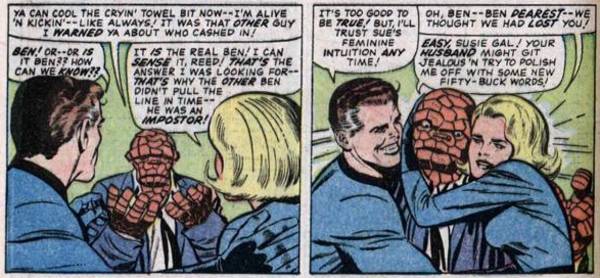
this man this monster reunion

The bittersweet ending: Ben returns to the Baxter Building to find Reed and Sue mourning his loss. They’re overjoyed by his return, an affirming moment for Ben.

Tribute should also be paid to inker Joe Sinnott and letterers S. Rosen and Artie Simek, who made Kirby’s pencils come to life. Has the Thing ever looked better than during this period? I don’t think so.

Someday it would be cool to see a full-blown big-screen movie version of the Galactus trilogy, not the half-baked version we saw a few years ago. (Galactus as a cloud. Hrmmph.) Maybe someday we will.

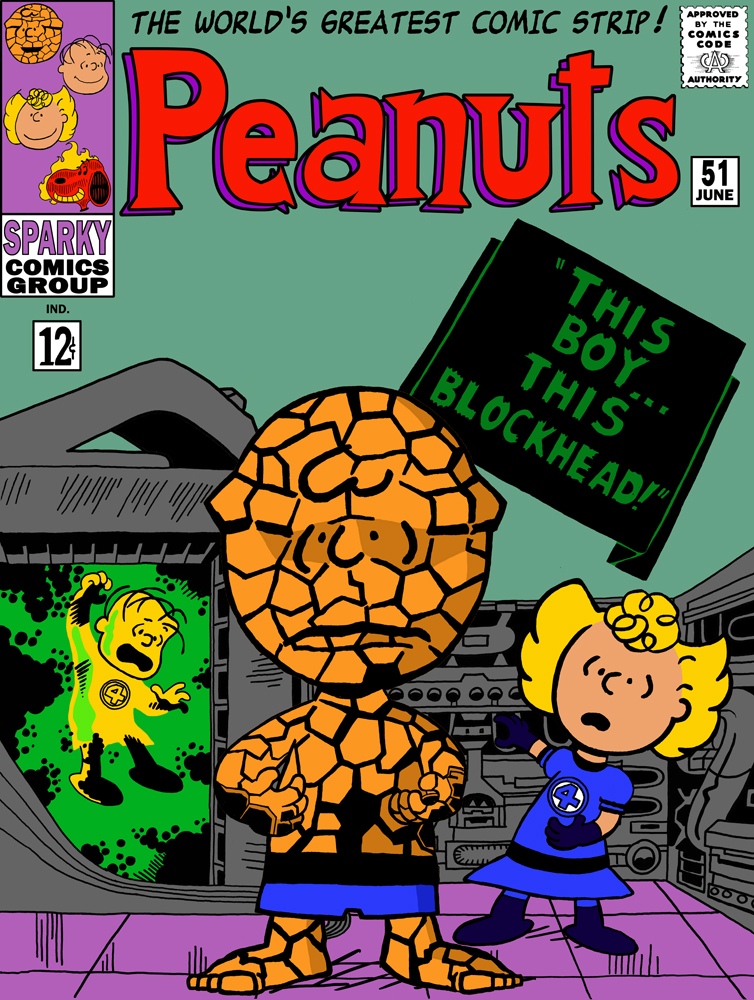
This Boy This Blockhead by jess harrold

By the way: The pop-culture impact of “This Man, This Monster” remains strong, as you can see from Jess Harrold’s art above.
Oscar catch-up: ‘Zero Dark Thirty’

zero-dark-thirty

In which I try to see a few Oscar nominated movies before the Oscars roll around.

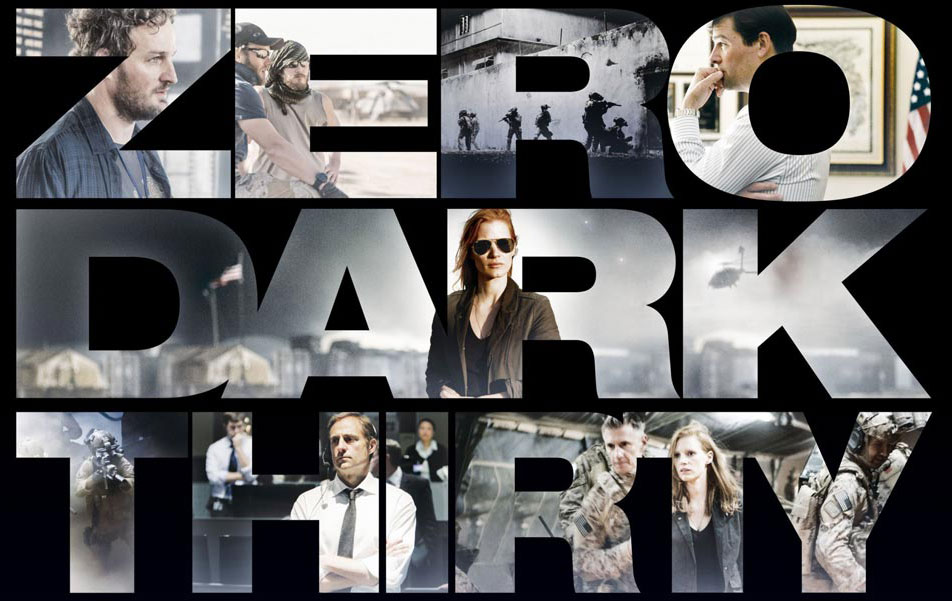
Director Kathryn Bigelow’s “Zero Dark Thirty” has picked up a lot of political baggage, much of it centered around the film’s early scenes of CIA operatives using waterboarding and other means of torture to try to extract knowledge of the whereabouts of Osama bin Laden from low-to-mid-level al Qaeda operatives.

The scenes are pretty harrowing and few moviegoers will go away without an opinion of the use of torture. Suffice it to say the scenes also set the tone for the movie even as they serve to introduce Maya (Jessica Chastain), a CIA analyst who goes from standing by and watching colleague Dan (Jason Clarke) administer torture to ordering punishment herself.

Maya’s quarry is bin Laden and, over the course of the next two hours, she pursues not sightings of the al Qaeda leader – there aren’t any legitimate ones – but the identity and whereabouts of people who might have contact with him.

Over the course of several years, Maya and fellow operatives like Jessica (Jennifer Ehle) interrogate those with knowledge of bin Laden and those protecting him, cultivate sources and begin to focus – obsessively, at times, for Maya – on a courier who is reportedly bin Laden’s connection to the outside world.

As most of the world knows, the CIA finally finds the courier and tracks him to a Pakistani town and fortress-like compound where bin Laden has been hiding … well, not in plain sight, but in a far more likely location than a remote cave for the leader of an international terror organization.

Bigelow and screenwriter Mark Boal let the story unfold at a deliberate pace but pepper it with suspenseful scenes, including Jessica’s meeting at an Afghan base with a potential informant as well as the tracking of the courier.

It surprised me, somewhat, to see “Zero Dark Thirty” described online as a spy thriller. It is, certainly, but aside from the raid on bin Laden’s compound the movie came across most like a political thriller as Maya pushes her way through CIA bureaucracy, the doubts of her superiors and what seems like a more urgent mission for many in government than finding bin Laden: preventing future terror attacks.

Chastain is quite good as the smart and dedicated Maya, a character based on the woman who led the decade-long pursuit of bin Laden.

The movie features a cast of familiar faces, from Mark Strong (“Green Lantern”) and Harold Parrineau (“Lost”) to Chris Pratt (“Parks and Recreation”) and Joel Edgerton (the “Star Wars” prequels). Luckily, they don’t pull the audience out of the story.

“Zero Dark Thirty” is a first-rate political and historical thriller.

TV crush: Darleen Carr

darleen carr

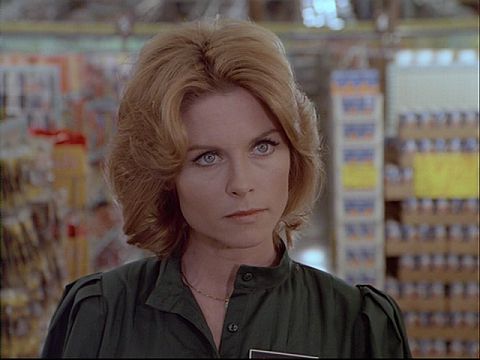
You couldn’t watch TV in the 1970s without having a little crush on Darleen Carr.

Carr, born in 1950, came from an acting family. Her older sister, Charmian, played the oldest girl in “The Sound of Music.”

Darleen Carr herself had musical talent, contributing her voice not only to “The Sound of Music” and “The Jungle Book” but releasing an album of music in 1988.

Although Carr appeared in movies and guest starred on many TV shows in the 1970s and 1980s, she was best known for a couple of parts.

darleen carr long

She was a young temptress in the very strange Clint Eastwood Western “The Beguiled,” a 1971 classic.

She played Henry Fonda’s daughter in “The Smith Family,” an odd 1971 TV series that was a mix of family comedy and police drama starring the veteran film actor.

And she played, Jeannie, Karl Malden’s daughter on “The Streets of San Francisco,” that ’70s Quinn Martin production that co-starred Michael Douglas.

When Malden’s Mike Stone wasn’t worried about the latest killer to stalk the city by the bay, he was worried that his adorable daughter was dating a guy who wasn’t good enough for her.

And who can blame him? Carr was one of TV’s classic sweethearts.

According to the Interwebs, Carr is married to Jameson Parker, the now 65-year-old (!) former co-star of “Simon and Simon.”

In the 1990s, Carr kept busy doing voice acting for animated shows and video games.

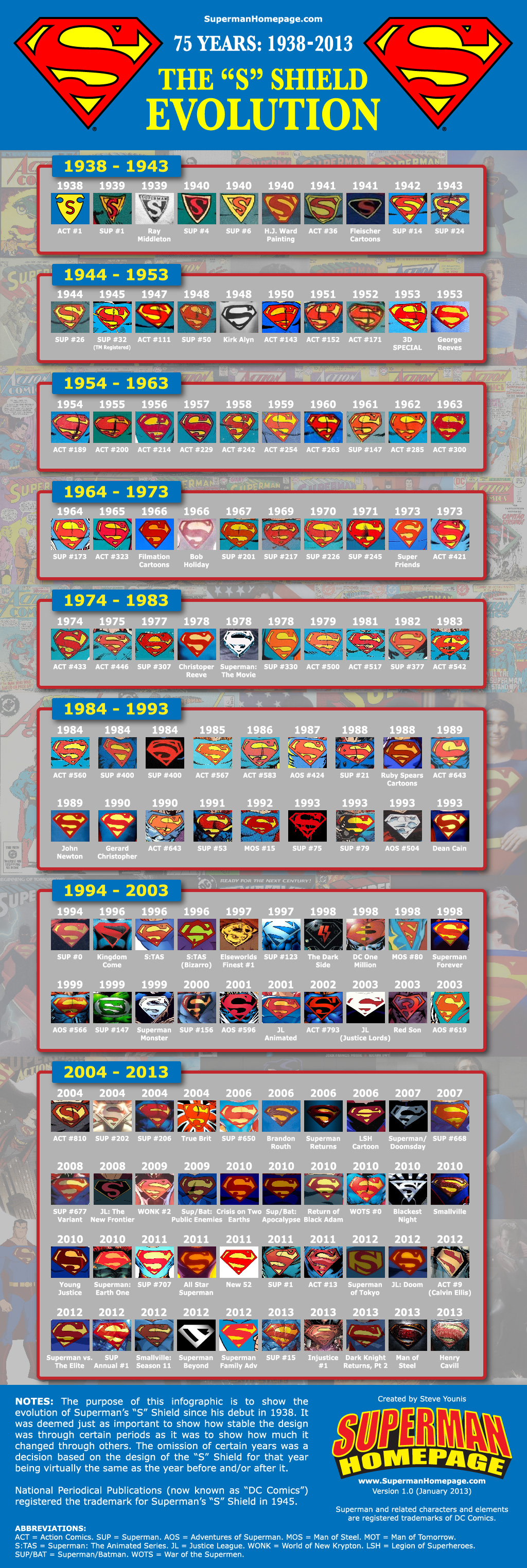
Superman’s ‘S’ shield through the decades

Superman Shield-Poster

Here’s a cool graphic, from Steve Younis and the people at the Superman Homepage, recalling the dozens of variations on Superman’s “S” shield over the decades.

From the original one, interpreted by Superman’s creators Joe Shuster and Jerry Siegel, as a kind of crest, to later movie and TV versions to more sophisticated interpretations of recent years, there’s a lot of Super here.

The … different version from this summer’s “Man of Steel” movie is here too.

‘Alphas’ omega: SyFy cancels show

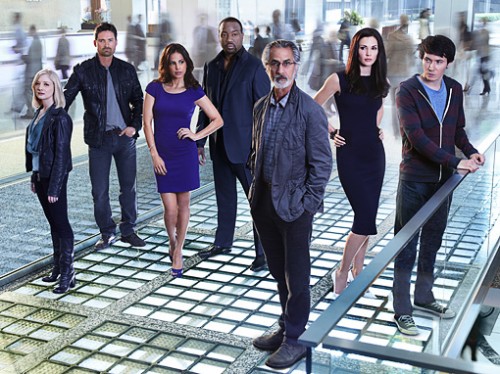
alphas cast

“Alphas,” a nicely written and serious-minded “real world” take on “X-Men,” is no more.

The show has been canceled by The Channel Formerly Known as Sci-Fi, according to news reports. It will not return for a third season.

“Alphas” was an intelligent and well-written show about a scientist (the Professor X type, played by David Straithairn), who works with the government to assemble a group of people with mutant powers, including Bill, a cop with super strength (played with nice gruffness by Malik Yoba), a young autistic man, Gary (played to perfection by Ryan Cartwright) who can read read electronic signals in the air, Nina (the seductive Laura Mennell), who has the ability to emotionally “push” people and bend them to their will, and others.

Each episode played on a number of levels: The Alphas would investigate crimes or acts of terrorism committed by other Alphas, including some who belonged to a renegade group led by a seemingly immortal Magneto-type charismatic leader. They also reached out to other Alphas, including some played by fan favorites like Summer Glau (“Firefly”) and Sean Astin (“Lord of the Rings”).

The show also built in clever and absorbing character stories, including Gary’s socialization and Nina’s fall from grace and tragic backstory.

To nobody’s surprise, TV can be an ultimately heartbreaking place to discover favorite science fiction and fantasy storylines and characters. It’s always been the case, but the last few years have seen brutal ends – and misguided handling when they were airing – of some really good shows.

It goes without saying that there’s little remaining on SyFy I’ll watch. The channel has increasingly concentrated on “reality” shows and competitions and, inexplicably, wrestling.

We’ll miss “Alphas.”

‘Arrow’ has real geek appeal

arrow cast in green

If you were like me, you got pretty frustrated during the early seasons of “Smallville.”

For what it was, the series about Clark Kent’s early years – before he became Superman – was mildly entertaining. But developments seemed to move at a glacial pace. It seemed like it took forever for Clark to develop familiar super powers like X-ray vision and super-hearing. And I think he flew only at the very end of the 10th and final season, true to the producers’ mantra of “no tights, no flights.”

But the CW series “Arrow,” about the formative years of Superman’s fellow DC hero Green Arrow, has already explored a lot of the character’s mythology – and that of DC comics – in the first nine episodes and is likely to explore more when it returns this Wednesday.

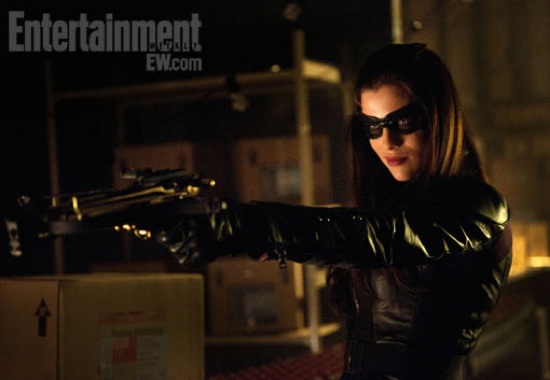
arrow huntress

In just a few episodes, the show introduced not only Oliver Queen/Green Arrow and his immediate circle, including possible future Black Canary Dinah Laurel Lance but also bad guys like Deathstroke, the Dark Archer and the Royal Flush Gang. Batman family member Huntress – seen above – also appeared in a couple of episodes.

But the show’s casting also holds a lot of appeal to geeks, with actors from some favorite TV shows and movies playing characters on “Arrow.”

They include John Barrowman, Captain Jack from “Torchwood,” as Malcolm Merlyn, Kelly Hu from “X-Men” as China White, Jamey Sheridan from “The Stand,” in flashbacks as Oliver’s father and Tahmoh Penikett of “Battlestar Galactica.”

“Arrow’ has captured my attention and held it with its serious nods to comic book lore.

Oscar catch-up: ‘Lincoln’ deserves the praise

Daniel-Day-Lewis-as-Abraham-Lincoln-634x445

The other day I noted I hadn’t seen a single one of the major Academy Award contenders and hoped to do so before Oscar night.

Last night I finally had a chance to see “Lincoln,” Steven Spielberg’s big-screen treatment of events surrounding the passage of the 13th Amendment to the constitution and the wind-down of the Civil War.

Considering the praise that’s been heaped on the film – and the 12 Oscar nominations, including Best Picture – it’s no real surprise that the film is so good. But what’s best about the movie is that it doesn’t sanctify Abraham Lincoln. Yes, Spielberg emphasizes the 16th president’s determination to do what’s right in all things, as well as his kind soul.

But the best things about “Lincoln” are the ways it humanizes Lincoln, a man given to folksy stories and metaphors, so much so that he quips at one point that it’s good to be comprehended.

Daniel Day-Lewis’s Lincoln – and Day-Lewis disappears into the role; I rarely thought of the actor himself at any point during the movie – is a mix of grim humor and pathos, a towering man bowed by tragedy.

As the movie opens, in early 1965, it’s assumed that the war is coming to an end after four bloody years and more than 600,000 casualties. But Lincoln is determined to push the 13th Amendment, outlawing slavery and involuntary servitude, through Congress. Democrats in the House oppose the move and Lincoln’s own Republicans are torn between strident abolitionists like Thaddeus Stevens (Tommy Lee Jones) and moderates who want to end the war as quickly as possible. If that means maintaining slavery, then so be it, they reason.

The movie – written by Tony Kushner and based in part on Doris Kearns Goodwin’s “Team of Rivals” – shows Lincoln trying to accomplish the balancing act of trying to get the amendment passed but maintaining the urgency of the war as a motivator for Washington’s politicians.

The idea that Lincoln is prolonging the war, even by a few days, weighs heavily on him and the film. The president visits a battlefield strewn with bodies as well as a Union hospital to talk to young soldiers who lost limbs. There’s a horrible moment when Lincoln’s oldest son, Robert (Joseph Gordon-Levitt) watches as hospital orderlies dump arms and legs into a pit. Robert desperately wants to enlist. His mother, Mary (Sally Field), plagued by memories of the death of another son as well as depression and headaches, threatens to hold her husband personally responsible if Robert dies.

Don’t assume that “Lincoln” is somber throughout, however. Lincoln is himself a wry and funny presence and a major subplot – in which three Republican operatives (James Spader, Tim Blake Nelson and John Hawkes) go around soliciting the votes of outgoing Democrat representatives to support the amendment – is consistently amusing.

I have very few quibbles with “Lincoln,” although a major one is an unnecessary scene near the end. The war over and the slaves freed, Lincoln continues to meet with his cabinet to plan his second term. He’s reminded that he’s to go out with his wife for the evening. He dons his coat and hat and leaves the White House. The iconic shots of Lincoln walking away would have sufficed to emphasize the man’s passing into history.

I didn’t even mind a scene that followed, with young Tad Lincoln (Gulliver McGrath) watching a play, only to be heartbroken when an announcement is made that his father had been shot.

I just wish that Spielberg had omitted a bed scene, with Lincoln being pronounced dead from his wounds. It is the least subtle moment of the movie, complete with the phrase, “Now he belongs to the ages.” The movie was more than strong enough to do without it.

“Lincoln” is a smart, heart-breaking and sometimes wryly humorous look at a pivotal moment in our nation’s history and the man at the center of it.

The Oscars? I love ’em. But …

the-simpsons-3d-animated-short-maggie-simpson-the-longest-daycare-ice-age-4

When the Academy Award nominations were announced this morning, I stopped what I was doing and watched a few rounds of the nominations. I didn’t study them and dissect them the way I would have for about a decade when I wrote about movies and actively saw everything I could possibly see.

Looking at the list now on the Academy’s website, I’m just a little shocked that I haven’t seen a single – not one – of the movies nominated for Best Picture.

I want to see “Lincoln” and “Zero Dark Thirty.” I’d probably enjoy “Django Unchained” and “Silver Linings Playbook.”

As I’ve noted before, I sometimes miss the days when I saw everything that came out – with the exception of a few art films that didn’t make it to a screen in my area – and I would obsess over my favorite movies’ chances.

Despite my relative ignorance of the Best. Movies. Of. The. Year. as defined by the Academy’s membership, I’ll be watching on Oscar night. I’ll enjoy the glimpses of the lesser-known categories – there’s a “Simpsons” short nominated for Best Animated Short Film? – and marvel over the outfits and hairstyles.

And, hopefully, I’ll have seen some of the movies by then. So I can, you know, judge them adequately.


Justified 4th season premiere: ‘Hole in the Wall’

Justified Hole in the Wall Timothy-Olyphant-and-Patton-Oswalt-in-JUSTIFIED-Episode-4.01-Hole-in-the-Wall

I’m hard pressed to name a series that I enjoy more than Graham Yost’s “Justified.”

The series, which returned for a fourth season on FX, recounts the adventures of Raylan Givens, a U.S. marshal assigned to mid-Kentucky, the place of his birth and his longtime home. As he deals with all manner of fugitives, thieves and drug dealers, Givens (Timothy Olyphant) is forced to acknowledge not only with his criminal father, Arlo (Raymond J. Barry), but his longtime frenemy, Boyd Crowder (Walton Goggins).

The show is badass, funny and full of backwoods low-life characters for Raylan to wryly bring to justice.

Because the show is based on the works of writer Elmore Leonard, there are plenty of oddball characters on both sides of the law.

As the show returned tonight, with the episode “Hole in the Wall,” Raylan finds himself trying to make a little money on the side – he and ex-wife Winona are expecting a baby – by working for an attractive bail bondswoman.

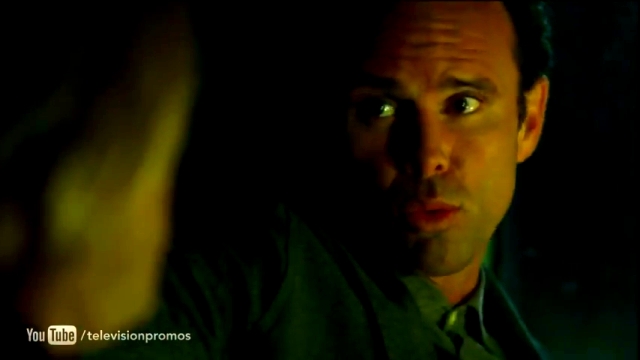
justified hole in the wall boyd crowder

Meanwhile, Boyd has been running the drug business in Harlan, Kentucky, and is dismayed to find that his OxyContin sales have dropped significantly. One of his dealers tells him it’s because so many local residents have been redeemed through the works of a traveling evangelist.

And meanwhile, we’re introduced to Constable Bob, played by comedian and writer Patton Oswalt, who meets up with Raylan when petty thieves break into Arlo’s house. Raylan has hired Bob to keep an eye on the place while Arlo is in jail for attempted murder.

And meanwhile meanwhile, Ava Crowder (Joelle Carter), Raylan’s sometime girlfriend, is still running the local whorehouse and continues to be as badass as Raylan and Boyd.

Constable Bob comes in handy when Raylan’s car gets stolen, and an old buddy of Boyd’s, played by Ron Eldard, shows up unexpectedly.

“Justified” is so quick, so funny and so brutal. It’s unlike anything else on TV right now.

After three good to great seasons with memorable bad guys, “Justified” seems to be playing the long game this season, introducing some winning characters, bringing back others and peppering clues to a 30-year-old mystery throughout the witty, sharp stories. I’ll be watching.