Monthly Archives: August 2013

RIP Elmore Leonard, king of hardboiled crime

Elmore Leonard

Sad news today: Elmore Leonard, author of such crime novels as “Get Shorty” and “Glitz,” has passed away at 87 after recently suffering a stroke.

I won’t pretend to be an expert on Leonard. I’ve read a few of his books – I reviewed his final book published before his death, “Raylan,” in February 2012 – and I appreciated his knack for making his bad guys as interesting as, or more interesting than, his good guys.

I also appreciated Leonard’s nurturing of “Justified,” the FX series based on his short story “Fire in the Hole,” about Raylan Givens, a deputy U.S. marshal working in Kentucky.

As he finds himself up against meth dealers and murderers, Raylan was cool and compelling, especially when dealing with lifelong antagonist Boyd Crowder.

Leonard didn’t have  a lot of love for movie and TV versions of his work, but he liked Graham Yost’s “Justified” and had some kind of synergy going with it, contributing story ideas and writing an episodic novel (the aforementioned “Raylan”) drawn from the same setting.

We’ll miss you, Mr. Leonard.

‘Longmire” hews closer to Johnson’s books

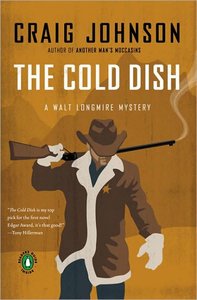
craig johnson longmire the cold dish

When I wrote about the first season of A&E’s “Longmire” in June 2012, my natural inclination was to compare the books and TV series. I’d been enjoying the books for a couple of years and hoped for the best for the series. The best I could say – I mean that sincerely – was that the show captured the characters and flavor but not the plot integrity of author Craig Johnson’s mysteries, set in a rural Wyoming county.

I noted some differences between the series and the books. The series omitted a few characters – Sheriff Walt Longmire’s predecessor in office,  crusty old retired sheriff Lucian, notably – and added a few, including Lucian’s nephew, ambitious deputy Branch Connally, who wants to unseat Walt in an election.

Missing was the forged-in-Vietnam bond between Walt and pal Henry Standing Bear, leaving the Bear’s motivations sometimes in doubt.

Also absent were a Philadelphia connection – deputy Vic is from there, and it is home to Walt’s daughter Cady’s law practice – and the sense of the mystical and spiritual, as Henry nudges Walt toward a deeper connection with the Native American spirits of the Wyoming countryside. Also absent, to some extent, were the Crow and Cheyenne supporting characters that filled the books.

Maybe the most egregious variation from the books is how the series has dealt with the death of Walt’s wife. In the books, she died before the first story began after a battle with cancer. Martha Longmire likewise died before the TV series began, but it’s implied she died at the hands of a drug dealer in Colorado and Walt (and perhaps Henry) then killed her killer.

longmire logo

I’m glad to say, most of the way into the second season of “Longmire,” that the series has greatly improved.

Sure, star Robert Taylor and supporting cast like Katee Sackhoff were always good. But the second season – perhaps with input from Johnson himself, perhaps from a realization on the part of show creators Hunt Baldwin and John Coveny that Johnson gave them excellent material to work with and they should take advantage of it – has seen the show capture the spirit – and sometimes the letter – of the books.

The first episode of the second season, “Unquiet Mind,” echoed the “prisoners on the loose in mountainous countryside” plot of the seventh book, 2011’s “Hell is Empty.”

The third episode of this season, “Death Came in Like Thunder,” explored the Wyoming Basque community that’s a big part of the books. One of the characters omitted from the TV series is Basque deputy Santiago.

And the second season even returned to two major plotlines of the books: Cady Longmire’s serious injury at the hands of an attacker – although in the books it happens in Philly, where’s she’s practicing law – and deputy Vic’s history on the Philly PD.

The Native American spiritualism that seemed so missing from the first season was greatly felt in the second, climaxing in a scene where Walt – to atone for the killing of his wife’s killer – hooks his chest in “Man Called Horse” style and suffers in the blazing sun.

And although I haven’t seen it yet, I’m told an episode even features the TV series version of Lucian.

I can’t think of a recent TV series that improved so markedly from the first season to the second. I think if you’re a fan of the books, you’ll find more to like than just the character portrayals and tone this season. If you’re not a reader of the books, you’ll find an enjoyable crime drama unfolding on a weekly basis.

‘The Bridge’ – Murder from both sides

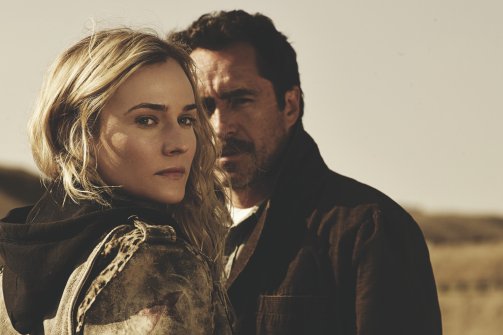
the bridge leads

We’re living in a golden age of cable TV. Starting with “The Shield” and continuing through “The Walking Dead,” “Breaking Bad,” “Justified” and other series, what was once “basic” cable has in recent years given us serial dramas that rival novels for their depth, complexity and characters.

“The Bridge” is the latest episodic drama that fits that mold.

Based on a Danish/Swedish series, the FX series plays out on two sides of the Bridge of the Americas, between Juarez, Mexico, and El Paso, Texas.

An El Paso detective, Sonya Cross (Diane Kruger), and a Chihuahua detective, Marco Ruiz (Demian Bichir), are called in when a body is found in the middle of the bridge. To their horror, they discover it is actually two bodies: One half is Mexican, the other American.

In service of its gruesome plot, the series launches into a mix of politics and murder, with a serial killer who seems to relish making statements about the disparities between American and Mexican life and justice as much as he enjoys killing.

The cops struggle to keep up as they deal with not only political considerations but a killer who sets out to shock. One episode puts the detectives in a race against time as they try to find a woman staked out in the desert, her slow death being shown via a webcam.

Kruger’s character is especially interesting: She has Apserger’s Syndrome and is prone to tactless pronouncements. Ruiz is a family man who, nevertheless, goes astray from his moral roots.

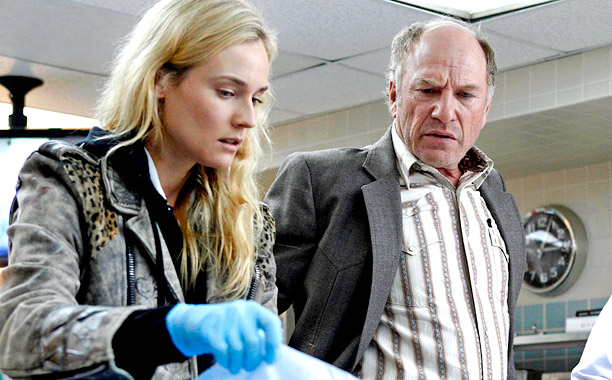
the bridge ted levine

There’s a good supporting cast, particularly Ted Levine (the killer from “Silence of the Lambs”) as Cross’ crusty cop superior. Annabeth Gish – looking very different from her “X-Files” days – is good as a widow with a secret.

the bridge street

The promos for the series were dark and macabre, focusing on gravesites and dark alleyways and remote haciendas in the desert. The promos sucked me in.

And the series followed through on that imagery. Each week, the story moves back and forth from the mansions of Texas to the seedy streets of Juarez to the dusty desert expanse. The tourism boards from El Paso and particularly Juarez can’t be any more thrilled with this depiction of the area than the chamber of commerce from Lexington, Kentucky is thrilled with the endless parade of meth heads, hookers and small-time criminals on “Justified.”

“The Bridge” is a little more than halfway through its first season and the early episodes are available online and on demand. It’s definitely worth the effort to try to catch up.

‘Fool Me Twice’ carries on Parker tradition

fool me twice robert parker brandman

With 70 books to his credit, masterful crime writer Robert B. Parker passed away in 2010. It might have seemed, for a few moments anyway, that classic detective characters like Boston PI Spencer, tough investigator Sunny Randall and New England small town police chief Jesse Stone might have died with him, along with the leads of other Parker series.

Then the Parker estate picked crime writer Ace Atkins to continue the Spencer series and Michael Brandman, a writer and producer who worked with Parker on adapting the Jesse Stone stories into a successful series of appropriately somber TV movies, was tapped to continue Stone’s adventures.

Brandman’s second Stone book – titled, somewhat unwieldingly, “Robert B. Parker’s Fool Me Twice,” takes us back to the small town of Paradise and not one, not two, but three storylines for Stone to unravel.

Stone, a recovering alcoholic and former LA cop, has settled into his job as small-town police chief but isn’t any less anti-authoritarian. Stone clashes with town council members as well as other law enforcement officials on a couple of the matters he faces here. Paradise is host to a movie production company and its troubled lead actress, Marisol, who is being menaced by her estranged husband; there are also complaints by town residents that their water bills are mysteriously high; and Stone butts heads with a rich family and their privileged teenage daughter.

Brandman is a writer gifted at telling his tale in Parker’s voice, and he does so quite well here. One of the plotlines feels kind of abrupt and another – Stone’s response to the troubled teen – is familiar to fans of Spencer, who showed the value of tough love to a couple of errant young people in that series.

As with all of Parker’s creations, the heroes are more than capable – so much so that there’s very little credible threat to their safety or their plans.

But Brandman, like Atkins, knows what Parker fans want: A strong but soft-spoken hero who can handle any number of tough guys and guys who think they’re tough.

In Brandman’s hands, I’m hoping Jesse Stone will be around for years to come.

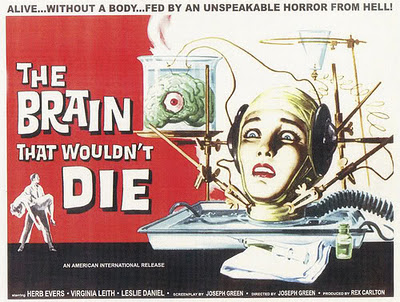
Classic schlock: ‘The Brain That Wouldn’t Die’

the brain that wouldn't die ad

Believe it or not, I hadn’t seen “The Brain That Wouldn’t Die” in its entirety until just recently.

It is, after all, one of those classic schlocky horror movies, those cult drive-in classics, that everybody is familiar with even if you haven’t seen it. It was the first Mike Nelson “Mystery Science Theater 3000,” for pete’s sake.

Yet I managed to never see more than random clips until I sat down to watch it on DVD the other day.

And what a treat.

Filmed in 1959 but not released until 1962, the movie’s original title was “The Head That Wouldn’t Die,” who was probably more accurate.

The movie stars Jason Evers – a familiar face from the “Star Trek” series episode “Wink of an Eye” – as Dr. Cortner, an arrogant surgeon who is secretly experimenting, Frankenstein-style, on creating life after death. He’s been saving random body parts and assembling a creature that’s kept in the laboratory closet downstairs in his family’s summer home.

Early in the movie, even Cortner’s surgeon father criticizes his lack of humility and unpleasant ambitions.

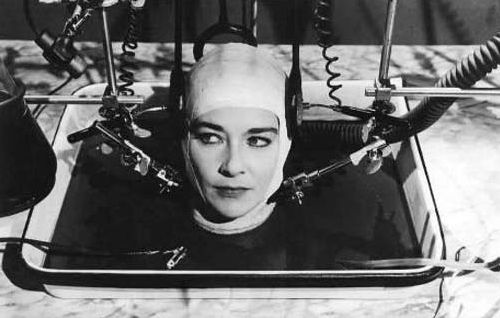
Then Cortner and girlfriend Jan are in a auto accident and Jan is decapitated. Jan is beheaded in the kind of car crash that is usually found in low-budget movies: Lots of shots of the car careening along a country road, then quickly approaching a guard rail. The crash itself isn’t seen. Neither is Jan’s head, which Cortner wraps up in his sportcoat and rushes from the scene (with as much footage of him running, bunched up jacket in his arms, as there are shots of the car speeding down the road).
the-brain-that-wouldnt-die

So Cortner put’s Jan … in a pan … at least her head … in his basement lab. Then he begins scouting out a replacement body.

The movie certainly seems to have inspired scenes in “The Re-Animator,” with its head in a pan motif. And “Jan in the Pan” is apparently the nickname for the female lead once she’s … in a pan.

brain that wouldn't die monster in closet

Every cheap horror movie needs a monster and a woman’s head in a pan just wasn’t going to cut it. Hence … the stitched-together monster in the closet.

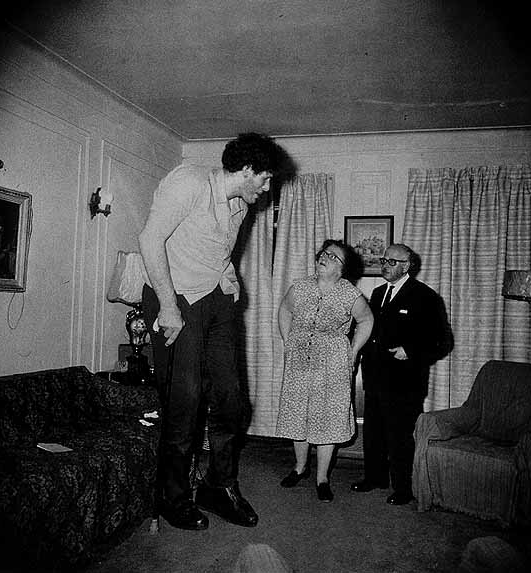
diane arbus the jewish giant

The creature, the result of Cortner’s previous experiments, is played by seven-foot, six inch Eddie Carmel, subject of a photo by renowned photographer Diane Arbus that depicts Carmel as “The Jewish Giant at Home with His Parents.”

As Cortner goes to a burlesque house to pick out a new body for Jan, he doesn’t seem like a tortured soul looking to save his girlfriend. He seems to be enjoying the view a little too much.

Adding to the overall aura of sleaze: Two dancers get into a catfight, boobs jiggling. Cut to drawings of two cats and a dubbed meow.

Jan, meanwhile, wakes up – well, her head wakes up – and she immediately begins talking to the still-unseen monster in the closet, talking up their mutual need for revenge.

There’s some choice dialogue:

“An operating room is no place to experiment.”

“Very well. The corpse is yours.”

Said during operation: “I’ve been working on something like this for weeks.” Well, tons of research then.

“I love her too much to let her stay like this.” Well, a disembodied head in a pan, yeah.

“The line between scientific genius and obsessive fanaticism is a thin one.”

“Horror has its ultimate … and I’m that.”

And cackling by Jan in the pan. Lots of cackling.

The end credit slide on the copy that I watched still had the original title: “The Head That Wouldn’t Die!”

Great comic book covers: Avengers 57

avengers 57

Behold, a beautiful cover.

From time to time here, I’ll note some of my favorite comic books covers. They’re not necessarily the covers of milestone comic books. They’re just covers that I loved.

By default, most of the covers will be from the 1960s and 1970s, when I was actively buying, reading and collecting comics. They had their maximum impact on me back then.

I’ll start off with this one, Avengers 57, from the Marvel comic of my favorite superhero group, introducing one of my favorite characters, Vision (or the Vision, to some). The cover date was October 1968.

The android creation of homicidal robot Ultron, Vision was sent to kill the Avengers but, maybe improbably, became part of the team.

To this day, the cover by John Buscema sets the standard for comic book covers. Striking composition? Yes. Heroes in peril? Yes. Mysterious and undeniably important new character causing chaos? Yes.

I couldn’t spend my 12 cents fast enough for this one.

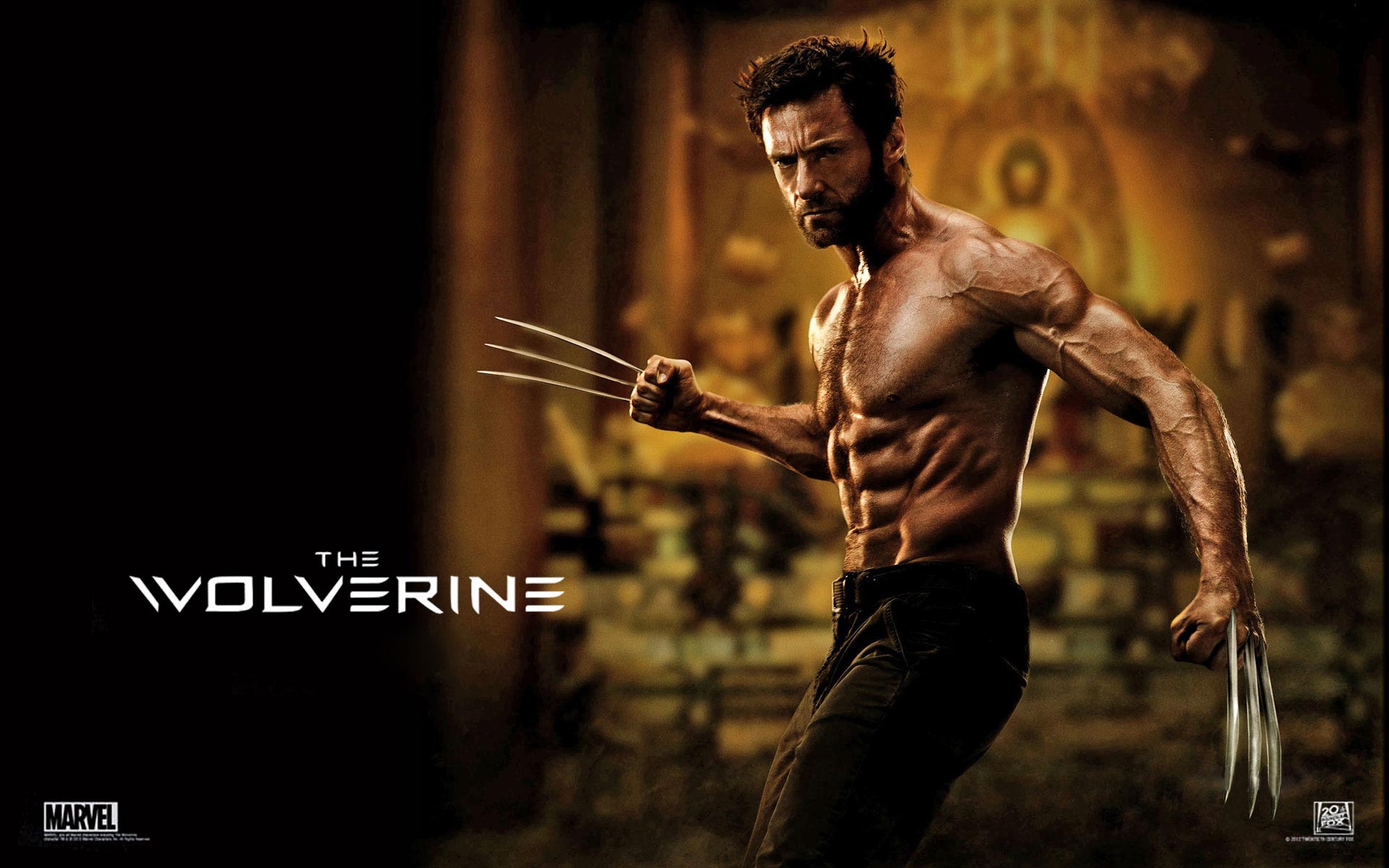
Late to the party: ‘The Wolverine’ good mutant action

the_wolverine_2013

I didn’t expect to like “The Wolverine” as much as I did.

I grew up loving “The X-Men” and other Marvel comics, although I had mostly exited before Wolverine made his entrance. Of course, the “X-Men” movies put the antagonistic outsider front and center and made him a leading man and household name.

Of course, with the charismatic Hugh Jackman in the role, who could argue that approach?

After “X-Men Origins: Wolverine,” though, I wasn’t sure I needed to see another Wolverine movie. Jackman redeemed the character with one line, however, in “X-Men: First Class.”

So with Jackman returning to the screen next summer, with much of the cast from the original “X-Men” trilogy as well as “First Class,” “The Wolverine” seemed like a natural intermediate chapter in the story.

Since the movie came out a couple of weeks ago – and I just got around to seeing it today thanks to vacation time and work demands – I’ll skip most of the plot recitation. Suffice it to say that Wolverine goes to Japan, accompanied by a winsome and deadly young mutant named Yukio (Rila Fukushima) sent to fetch him by a man whom we see Logan saving at the time of the atomic bombing of Nagasaki in World War II.

Logan gets an offer: If he’s tired of life – especially life alone – the young Japanese soldier he saved (now grown into Asian tech titan Yashida, played by Haruhiko Yamanouchi) promised he can make him a mortal man.

The rest of the movie finds Logan playing tag with an assortment of mutants and ninja warriors, in an effort to protect Yashia’s granddaughter, played by the lovely Tao Okamoto.

I think the movie benefits from being a fairly straightforward story punctuated by lots of cool action scenes. There’s not a lot of cross-cutting to other locations or storylines. Not even a lot of set-up for future movies (more on that later).

Random observations: I didn’t expect the end-credits scene, or “stinger,” to be so on-the-nose as far as its lead-in into “X-Men Days of Future Past.” (Spoilers if you haven’t seen it yet.) The scene takes place two years after the events of “The Wolverine,” and Logan is going through an airport, asking to be patted down rather than setting off ever metal detector in the place. Playing on a TV nearby is a commercial for Trask, the company that created the mutant-hunting robots the Sentinels in the comics and next summer’s movie. As Logan moves through the TSA checkpoint he realizes that coins and other metallic objects are moving around on the security tray. It’s Magneto (Ian McKellen) behind him in line. Wolverine pops his bone claws but Magneto tells him that “dark forces” are brewing and that he needs his help.

Why would I trust you? Logan asks, held in place by Magneto because of the remaining adamantium in his body. Magneto notes that he wouldn’t, but …. at that point, Patrick Stewart rolls up as Charles Xavier. Logan is startled to see Professor X alive. “You’re not the only one with gifts,” Xavier says.

Also about that end credits scene: Has anyone noticed that nobody is waiting until after the credits to play out their super-secret scene anymore? For most of the early Marvel movies, the scene (Nick Fury shows up in Tony Stark’s house, Agent Coulson finds Thor’s hammer in New Mexico) touting the coming of the next movie was after the credits. But beginning with “The Avengers” and the woeful version of DC’s “Green Lantern,” the scene has been partway into the end credits, usually right after the principal credits are done.

A couple of exceptions, of course: “Iron Man 3” and its love letter to the Stark/Banner bromance comes at the very end of the credits. And, as we know, “The Avengers” had two credits scenes.

Maybe filmmakers don’t have much faith that we’ve learned by now to stick around until after the last caterer, effects guy and music credit is listed.

Did anybody keep track of how many times Hugh Jackman gets knifed, sliced, skewered with swords and arrows and otherwise pierced in this movie? Surely that number is out there somewhere, Internet?

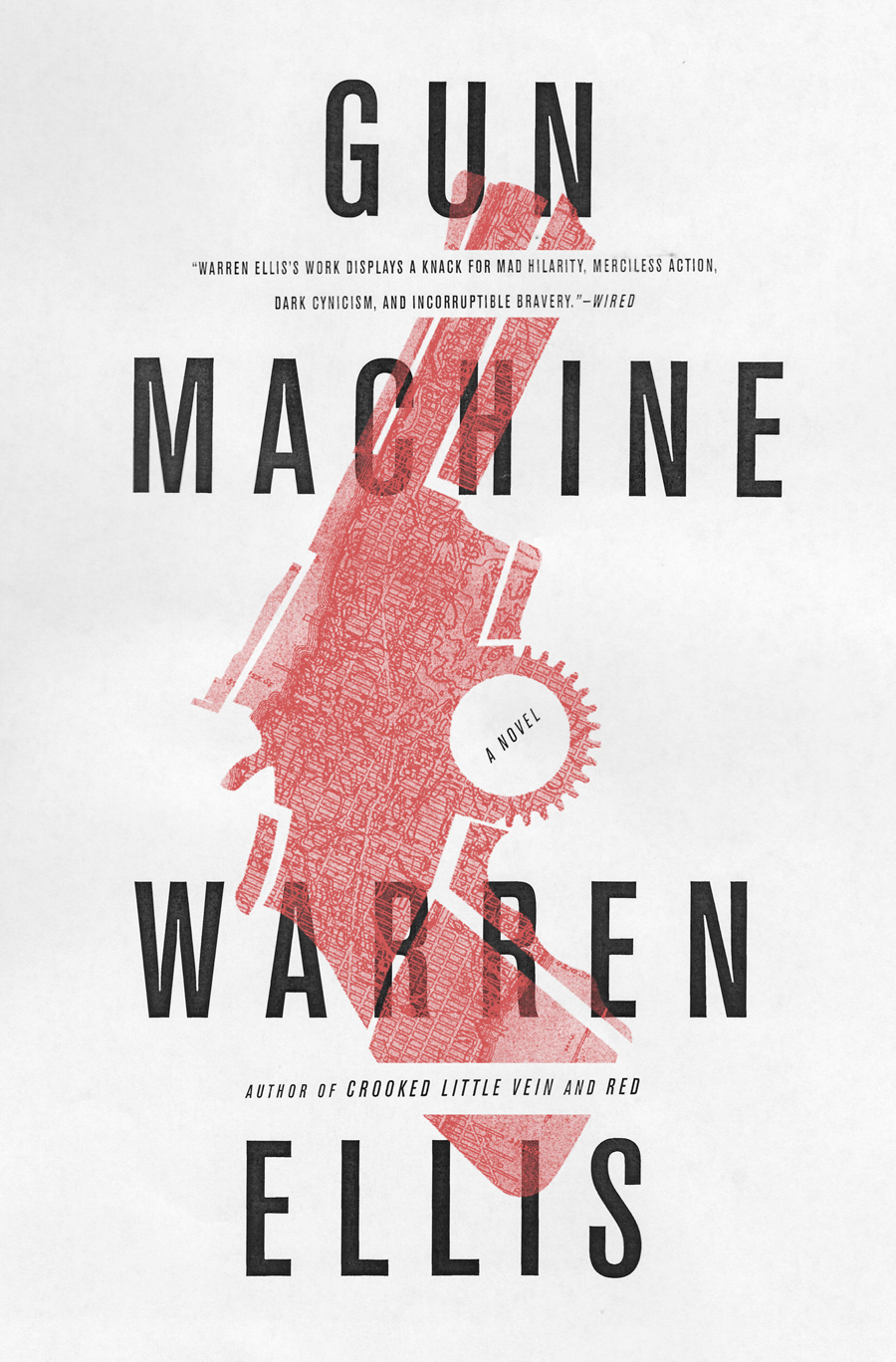
Ellis’ ‘Gun Machine’ a good cop thriller

gun machine warren ellis

Warren Ellis is best known for comic books like “Red” and “Planetary,” but his book “Gun Machine” is a good and offbeat New York police thriller.


The book follows NYPD detective John Tallow in the days following the on-the-job killing of his partner. The two had been responding to a call about a man in a run-down apartment building with a gun when the unhinged man shot and killed the partner. Tallow looks through a hole blown in an apartment wall and finds the place is full of guns – and not ones that belonged to the unhinged man who took out Tallow’s partner. The elaborate display of guns from over a couple hundred years is fetishistic, almost a temple dedicated to the firearms within. But who could their owner be?


In a city plagued by too much violence and too many cases to clear, Tallow’s fellow cops and CSIs greet this discovery with scorn and hostility, all of it directed at Tallow. That’s because every one of the discovered guns tested in police labs turns out to be a gun used in a separate, unsolved murder case. Tallow has stumbled across a horrific secret: The lair of a particularly prolific and bent hit man.


Working with CSIs Scarly and Bat, Tallow pulls at threads and tests limitations, including those of himself and his superiors. That’s because when some of the guns turn out to have been used in historic crimes, it becomes obvious that someone hasn’t just been hoarding random guns. Someone has been funneling guns – including the revolver used by Son of Sam – to the killer.


Although the plot is grim and involves not only high-level corruption between the police department and some high-level NYC corporations, there’s a lot of humor here. Most of that comes from Bat and Scarly, Tallow’s initially reluctant but increasingly enthusiastic partners. Bat is something of a geek cliche but one that’s well done. Scarly is a lipstick lesbian in a deeply committed but deeply odd relationship with a formidable partner.


I’ve read that there’s some thought to making “Gun Machine” into a TV series and I suppose that’s fine. But I wouldn’t want the book to be turned into TV’s typical police procedural with quirky characters. There’s a lot of potential for more stories about Tallow, Bat and Scarly if they do them right.


Classic ‘Buffy’ – ‘The Wish’

buffy the vampire slayer the wish

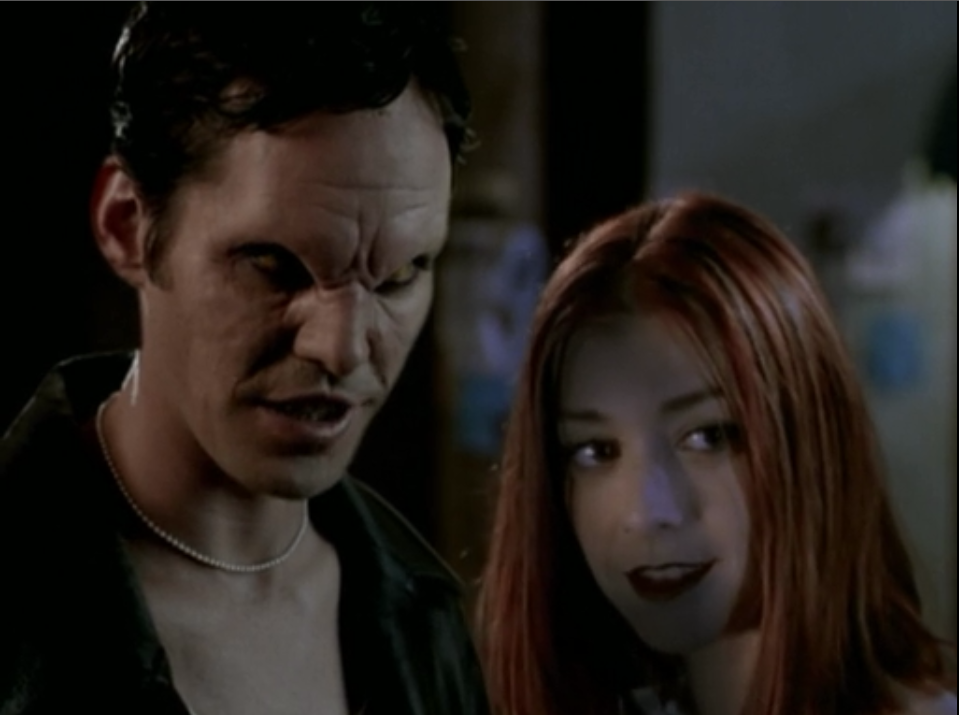
“Buffy the Vampire Slayer” had already long established itself as a groundbreaking TV classic before “The Wish” aired as the ninth episode of the third season, debuting in December 1998.

But “The Wish” was among the episodes of the series that helped distinguish “Buffy” as more than that show with an unlikely name.

During the first season, viewers of Joss Whedon’s series about a teenage girl who reluctantly becomes the foe of vampires, demons and other monsters were treated to imaginative and funny but somewhat conventional “monster of the week” episodes. “Prophecy Girl,” the final episode of the first season, elevated the show as Buffy put an end to the Master with the help of her friends.

In “The Wish,” written by Marti Noxon, “Buffy” returns to elements from that first season but gives them an alternate reality twist.

The unlikely couple of Cordelia (Charisma Carpenter) and Xander (Nicholas Brendon) has just ended when Willow (Alyson Hannigan) and Xander kissed in a moment of crisis. Cordelia, who often transcended her petty attitudes with heroism, gives into those baser instincts here and unknowingly falls in with new student Anya (Emma Caulfield), a vengeance demon who entices her into making a wish. That wish happens to be that Buffy had never come to Sunnydale.

The result? Sunnydale is controlled by vampires. Giles (Anthony Stewart Head) and a small group of non-super-powered demon fighters try to take on the vampires, but they’re outgunned by the Master and his minions, including vampiric versions of Xander and Willow.

The plot is nicely twisty – we think Cordelia will be key to reversing the alternate reality but, surprise, she gets killed – and full of foreshadowing, intentional or otherwise, of what’s to come: Vampire Willow returns in a later episode, of course, and Willow herself makes some momentous moves of her own as the series continues.

Random observations:

The Master (Mark Metcalf of “Animal House” fame) is lip-smackingly fun here.

It’s fun to spot the connections between “Buffy” and the cheerleading movie “Bring it On.” Here, Nicole Bilderback, one of the snooty cheerleaders in the movie, is a Cordelia/Harmony hanger-on.

Larry Bagby III, who’s made appearances as classmate Larry, gets to be one of the good guys in GIles’ Buffy-less Scooby Gang.

Caulfield returns as Anya, of course, later in the series. And we loved her.

Pop culture classic: ‘Galaxy Quest’

galaxy-quest-movie-poster-

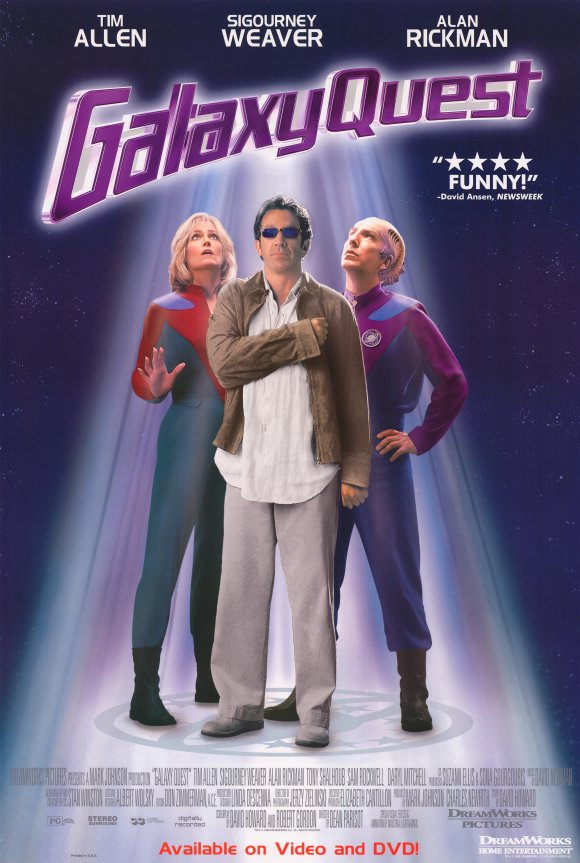
I’ve heard the argument made, online, that “Galaxy Quest” is the best big-screen “Star Trek” movie. “Star Trek” reboot director J.J. Abrams apparently said as much. While I think the claim is made somewhat facetiously, there’s a lot to be said for the light-hearted 1999 sci-fi comedy.

Beyond the trappings of the movie, which looks at a group of has-been actors living off the fame of their cult TV show 20 years later, there are a lot of subtle and not-so-subtle nods to “Star Trek” the show, its cast and fandom.

The movie, directed by Dean Parisot, shows us the cast of the former “Galaxy Quest” series in the only setting in which they can thrive: Fan conventions. While the show’s captain, played by Tim Allen, basks in the glory of his adoring fans, the rest of the crew – Sigourney Weaver as the ship’s eye candy, Alan Rickman as the Spock stereotype, Daryl Mitchell as the kid actor grown up, Tony Shalhoub as the perpetually befuddled and hungry engineer and Sam Rockwell as a glorified extra who comes along for the ride – seethe with jealousy.

From convention appearances to openings of electronic stores – where Rickman, so dry and sarcastic, has to trot out a modified version of his catchphrase: “By Grabthar’s Hammer … what a savings!” – the actors bicker and scramble for jobs.

When an oddball group of fans – led by Enrico Colantoni of “Veronica Mars” and including Rainn Wilson of “The Office” in a small role – asks for their help, they think they’re appearing in some elaborate fan-made performance. Soon enough they learn that the “fans” are aliens, come to Earth to find the heroes of the “historical documents” they’ve been watching in space. They’re seeking help in fighting off an evil alien conqueror.

“Star Trek” fans will find a lot that’s amusingly and comfortingly familiar here, from the perils of guiding the huge ship out of space dock to the ridiculous design of the craft itself.

Not to mention the ghettoized duties and personalities of the crew – Weaver’s character gets to repeat the computer’s pronouncements -and the backbiting behavior of the actors, all of who are resentful and jealous of Allen’s very Shatner-esque commander.

It’s easy to overlook Allen’s laid-back performance, but he really captures the bravado of a once-hot actor who still expects to be treated like a star.

Rickman is so good as the irritated Alexander, whose resemblance to Leonard Nimoy and his frustration at always being identified as Spock is dead on. Tony Shalhoub has some of the movie’s biggest laughs as the bemused engineer and Rockwell is wonderful as a bit player who would have given anything to have what even the cast of this cult TV show has.

“Galaxy Quest” might not be the best “Star Trek” movie ever made, but it sure is the best movie about “Star Trek” ever made.