Monthly Archives: December 2013

‘Guardians of the Galaxy’ new photo

guardians galaxy new photo

I’m excited about and worried about this movie at the same time. That has to be a good thing, right?

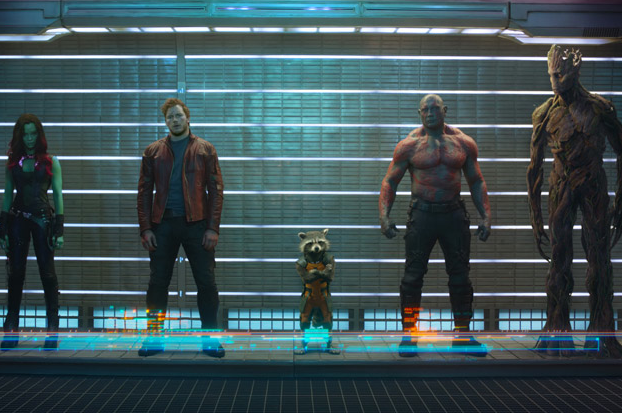
Marvel today released a new photo from “Guardians of the Galaxy,” next August’s big-screen release featuring the comic company’s kinda obscure but cultish space-faring superhero group.

The photo above captures a moment from that trailer that played at Comic-Con, with the main Guardians members in a line-up.

From left, they are Gamora (Zoe Saldana), Peter Quill (Chris Pratt), Rocket Racoon (voice of Bradley Cooper), Drax the Destroyer (Dave Bautista) and Groot (voice of Vin Diesel).

Here’s the official Marvel statement today:

An action-packed, epic space adventure, Marvel’s “Guardians of the Galaxy” expands the Marvel Cinematic Universe into the cosmos, where brash adventurer Peter Quill finds himself the object of an unrelenting bounty hunt after stealing a mysterious orb coveted by Ronan, a powerful villain with ambitions that threaten the entire universe. To evade the ever-persistent Ronan, Quill is forced into an uneasy truce with a quartet of disparate misfits — Rocket, a gun-toting raccoon, Groot, a tree-like humanoid, the deadly and enigmatic Gamora and the revenge-driven Drax the Destroyer. But when Peter discovers the true power of the orb and the menace it poses to the cosmos, he must do his best to rally his ragtag rivals for a last, desperate stand — with the galaxy’s fate in the balance.

As I’ve said before, I think the Guardians are after another of the cosmic Infinity Stones mentioned at the end of “Thor: The Dark World.” (The Cosmic Cube, or Tesseract, from “Captain America” and “The Avengers” is another one.)

The Infinity Stones are sought by Thanos, the bad guy revealed in the end credits of “The Avengers.” It’s all building to a huge showdown in the third “Avengers” movie, perhaps set for 2018.

Meanwhile, “Guardians of the Galaxy” opens Aug. 1, 2014.

‘Angel’ season five – ‘Shells’ and “Underneath’

angel shells illyria

I didn’t expect to be rewatching – no less reviewing here – the last handful of episodes of “Angel,” the “Buffy the Vampire Slayer” spinoff that was, in some seasons, superior to “Buffy.”

But after watching “Smile Time” and the devastating “A Hole in the World,” we decided to rewatch a couple more episodes.

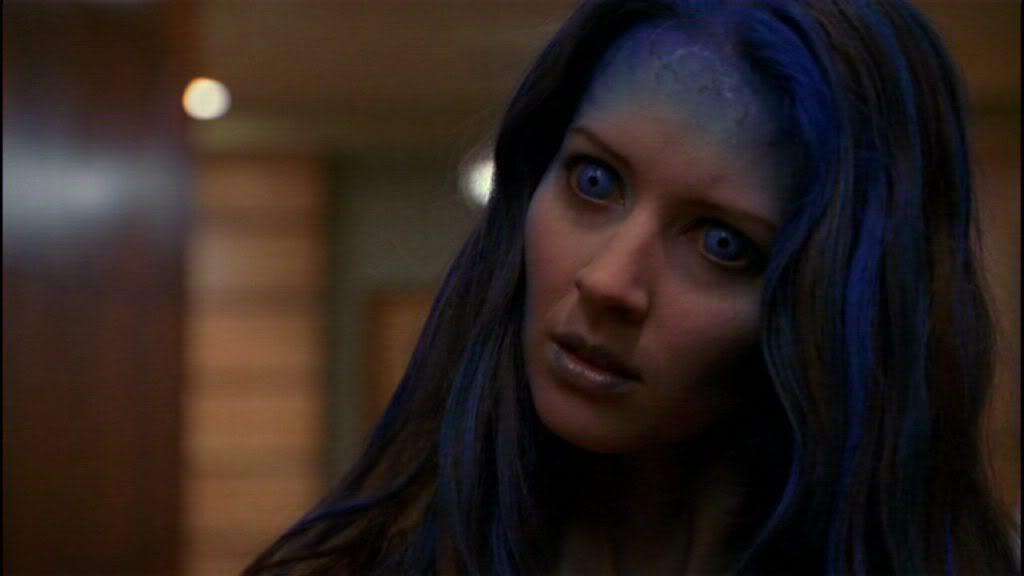
“Shells” is a continuation of “A Whole in the World,” in which lovable Fred (Amy Acker) is possessed by Illyria, an Ancient One looking to re-enter our world and rebuild its former kingdom.

angel illyria

While Angel, Spike, Gunn and Lorne continue to look for a way to reach an apparently impossible goal – re-infusing Fred’s soul into her body, now a blue, ambulatory but holy-moly-she-looks-good-in-blue-skin home for Illyria.

Illyria, meanwhile, plans to call forth her demon minions … but is in for an unpleasant surprise. With no undead army to command, she turns to Wesley, still morose over Fred’s death, to give her a reason for continuing to exist on this plain.

angel underneath

In “Underneath,” the plot points that will drive the rest of the season – and the series – are introduced. Duplicitous Eve, the former liaison to Wolfram & Harts’ senior partners, tells our heroes where they can find Lindsay, whose help they’ll need to defeat the apocalyptic plans of the senior partners.

Introduced was Adam Baldwin – so great as Jayne on “Firefly” a few years later – as Marcus Hamilton, the new liaison to the senior partners who will, ultimately be the surrogate Big Bad later in the season.

There’s no huge revelation or plot turning point in “Shells” and “Underneath.” They feel like mopping-up and setting-up episodes, in a way, continuing the origin of Illyria and setting up the final conflict. But damned if they aren’t strong hour-long fantasy dramas, deepening the characters we already know, returning favorites like Lindsay and making us love Amy Acker even more than we thought we could before.

The five episodes to come give us the return of Connor – a much more liable character than he was previously – and even Buffy, in a way.

“Angel” was overshadowed, in some ways, by “Buffy” during much of its run. But with the final season of “Buffy” over before season five of “Angel” began, it felt like all the stars aligned just at the right moment, giving us our only contact with the Buffyverse and great, beloved characters at their moments of truth.

Classic TV: ‘Angel’ – ‘A Hole in the World’

angel a hole in the world

Was there ever a stronger season of series TV than the fifth and final season of “Angel?”

Okay, maybe you can make arguments for peak seasons of “Lost” or “Breaking Bad,” or going way back, the first season of “Star Trek.”

But the fifth season of “Angel” – in which the stalwart heroes of Angel Investigations are put in charge of Wolfram and Hart, the Los Angeles law firm that represents evil on Earth – has to rank right up there.

The first season or two of “Angel” – which debuted in October 2003 as a spin-off of “Buffy the Vampire Slayer” – were uneven, with real highs and lows as vampire-with-a-soul Angel moved from Sunnydale to LA and began fighting crime. The best episodes gave off a real Batman vibe, with Angel fighting evil by night, jumping from rooftops and traveling through tunnels under the city. The worst episodes made it seem like “Buffy” mastermind Joss Whedon didn’t quite know what to do with star David Boreanaz and his supporting heroes like Wesley (Alexis Denisof) and Cordelia (Charisma Carpenter).

But despite a few mis-steps, “Angel” gradually built to a stronger series that was not only about the supernatural forces at work on Earth but also the flawed heroes who stood between us and the demon world.

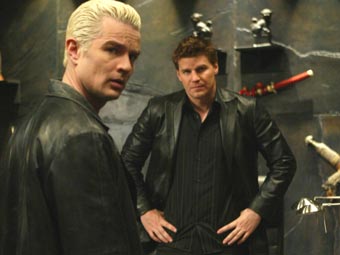
By the fifth season, “Buffy” co-star James Marsters had joined “Angel” as Spike, the charismatic “bad boy” vampire and antagonist to Angel. Everything clicked. Boreanaz and Marsters were almost co-leads and Denisof, J. August Richards and the lovely Amy Acker – joined later by Andy Hallett as showbiz demon Lorne – were as solid a cast as any show on TV in the 2003-2004 season.

angel smile time

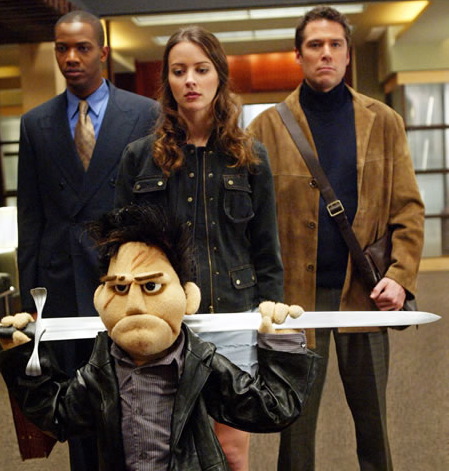
By the episode “Smile Time,” in which the Angel gang took on demonic puppets – and Angel found himself turned into a puppet – the show had hit a perfect mix of drama, soap opera and character comedy.

Then Whedon – more recently writer/director of “The Avengers” – hit us hard in the heart with “A Hole in the World.”

For several seasons, Acker had been the series’ secret weapon. An adorable genius, Fred had been the object of affection of half the cast, including both Wesley and Gunn (Richards). By this episode, she had picked up another admirer, nerdy Wolfram scientist Knox.

Although the romance between Fred and Gunn had been dramatically interesting, Wesley and Fred were destined to be together. They finally realized their full romantic potential in “A Hole in the World,” and – true to the Joss Whedon School of Romance in Drama – were soon to be split asunder. It’s the old “fall in love, get hit by a bus” theorem that I’ve referred to before.

Fred is infected by spores from an ancient sarcophagus in the Wolfram lab. Very quickly, it’s determined – in a whipsmart scene in which Lorne, who reads people’s thoughts and future by hearing them sing, hears Fred singing a few notes – that Fred is dying inside as Illyria, an ancient demon, hellbent on returning to Earth, reshapes her as its vessel.

Wesley comforts Fred, Gunn over-compensates for his inadvertent role in Fred’s condition and Angel and Spike head for Great Britain to find the Deeper Well, a literal “hole in the world” from which Illyria sprang.

There’s a tremendous “band of brothers” feel to the group that works feverishly to save Fred’s life and Whedon not only writes a devastating finale to Fred’s story but elevates an already great season.

Because there’s a price to be paid for the hubris and ambition of the players in this story and Fred pays it.

What’s extraordinary about the story is that, even while it brings Fred’s existence to an end, it continues her story as Illyria and gives Acker a totally different acting challenge.

The fifth season of “Angel” continued to one of the best series finales ever, one that was perfect and satisfying and yet made you want more at the same time.

But the season peaked with “A Hole in the World,” leaving a hole in viewers hearts.

Classic TV: “Dragnet: The Christmas Story’

dragnet the christmas story tree

Every TV series – well. most of them, anyway – does a Christmas episode. Sometimes they’re “very special” episodes. It’s too much for TV writers and producers to resist, really: Do a heartwarming episode for the holiday, usually adapting Dickens’ “A Christmas Carol.” As they said, in reference to another subject, on “Buffy the Vampire Slayer,” It is an opportunity to “hug and cry and learn and grow.”

But not Jack Webb, no ma’am. When the creator of “Dragnet” does a Christmas story, he does one that’s to the point and – even though it has some sentimental moments – full of sharp edges.

I just rewatched “The Christmas Story” episode of “Dragnet,” which also proved that when Webb had a story he liked, he stuck with it. Webb wrote the script originally for his “Dragnet” radio series and the version of TV’s “Dragnet” that aired in the 1950s.

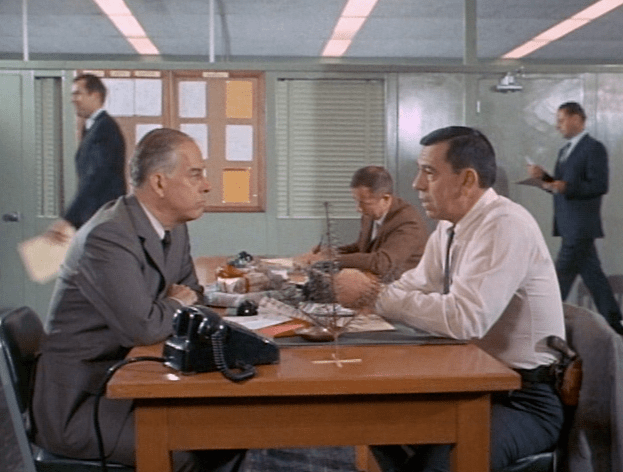
I watched the version – called “The Big Little Jesus” originally but retitled “The Christmas Story” by this time –  that aired on NBC in December 1967. This was the color version of “Dragnet” and the one that co-starred Harry Morgan as Bill Gannon, the partner to Webb’s LAPD Detective Joe Friday.

“Dragnet” reveled in the everyday police cases that Webb believed made the Los Angeles Police Department the best law enforcement agency in the world. “The Christmas Story” was a perfect example of that.

A San Fernando Valley church reports  on Christmas Eve that its Baby Jesus statute is missing from its Nativity display. Friday and Gannon question the priest about who might have been able to get into the church to steal it. Friday seems surprised when the priest says the church is open 24 hours a day. “So any thief could get in?” Friday asks the priest, who replies that the church especially wanted thieves to make their way to the altar.

Friday and Gannon promise the priest they will try to have the Baby Jesus statue back before 6 a.m. Mass on Christmas morning.

The detectives pursue a couple of leads, including a visit to an offbeat seller and, apparently, re-buyer, of religious statues. They also talk to a couple of altar boys, including Barry Williams, who would within two years be playing Greg Brady on “The Brady Bunch.”

Ultimately the cops are pointed toward a down-on-his-luck parishioner who, it’s assumed, stole the statue. But it’s obvious he did not, and Webb makes Friday’s frustration at the dead end briefly palpable.

The mystery, such as it was, is solved without any participation, other than as observers, by the cops. As Friday and Gannon go back to the church to tell the priest they failed, a little boy comes in, pulling a red wagon. In it, of course, is the Baby Jesus statue. The boy, whose family attends the church, had told the infant that if he got a red wagon for Christmas he would give it the first ride. The boy got the wagon from local firemen, who fix up broken toys for poor children in the neighborhood, which explains why he had the wagon early enough to pinch Baby Jesus from the manger.

“The Christmas Story” was, after all, a very special episode of “Dragnet.”

Random observations:

The conversation between Friday and Gannon that opens the episode acknowledges, for the first time I remember really, that Friday has a girlfriend. I’m sure this was touched on at other times in the series, and it’s well-established that Gannon is married, But it’s a nice touch, and the ensuing conversation about proper presents for a wife or girlfriend adds a bit of personality to the characters.

I also love that the Christmas tree that Gannon brings to the office and plops down on the work table he shares with Friday looks like an even more pathetic version of Charlie Brown’s tree, as seen in the animated special two years earlier.

It’s a nice bit of business for Friday and Gannon to get more time to work on the theft by asking their captain – who had wanted them on another case – to call the priest himself and tell him they wouldn’t be returning the stolen Baby Jesus in time for Christmas.

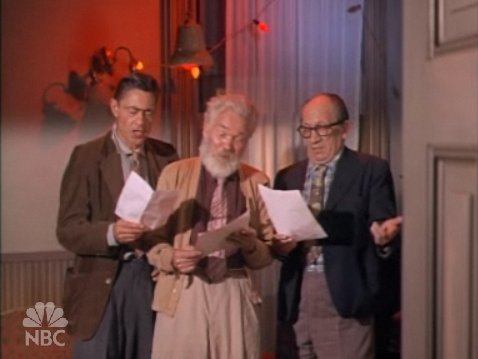
And this, the choir from the hotel for down-on-their-luck men:
dragnet the christmas story choir

‘Carnival of Souls’ still creepy

carnival-of-souls screaming

“Carnival of Souls” represented, until just recently, another of the few holes in my movie-watching experience.

Between late-night and weekend afternoon TV airings in my youth (hello, “Francis the Talking Mule”) and rampant cable and home video watching in the 1980s and 90s, I had caught up on many movies that came out before my time, movies that played in theaters in the 20s, 30s, 40s, 50s and 60s.

But I hadn’t seen “Carnival of Souls” until just the other day, when I watched it on one of those multi-movie, public domain collections of horror films.

And I thought it was pretty good. It’s effective and creepy and fairly innovative for its time.

The movie, which is in the public domain and thus shows up on many home video collections of horror films, was released in 1962 and reportedly made by director Herk Harvey for $33,000.

The movie shows its bigger-than-it-has-any-right-to-be budget in its first scene. Two carloads of teenagers (?) drag race and one goes over the side of a bridge … and you actually see the car go off the bridge and into the water, not just impressions of movement and shocked expressions on faces.

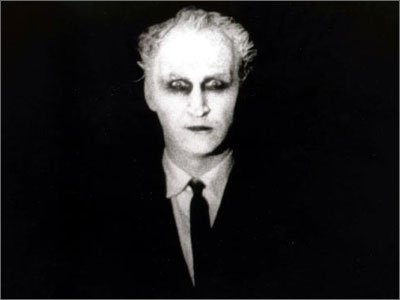
Church organist Mary Henry (Candace Hilligoss) is the only survivor of the car that went into the river. Understandably rattled, Henry begins seeing a white-faced man peering at her through windows and in darkened corners.

When she’s introduced to an abandoned amusement park, she is drawn to the haunted place, a gathering place for ghosts.

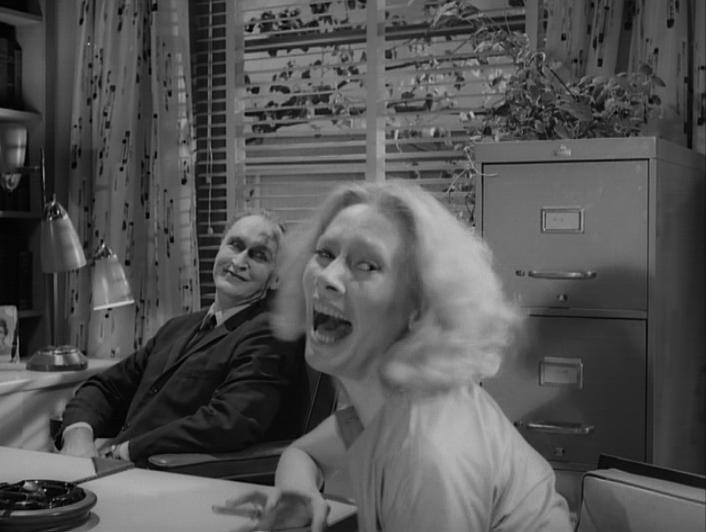
The movie plays out like an episode of “The Twilight Zone,” but that’s okay. As plots go – no spoilers here, even after a half-century – the story for “Carnival of Souls” is spooky and effective.

carnival of souls candace hilligoss

Hilligoss, who made only one other film – “The Curse of the Living Corpse,” in 1964 – is pretty good in the movie. She’s sharp-edged and not particularly likable yet still manages to evoke our feelings of sympathy and curiosity. And she’s striking.

Speaking of striking: The movie’s visually quite stark and eye-catching. The black and white cinematography helps, but Harvey found great locations and let them well.

Random observations::

Raza Badiyi is listed as assistant director. He is really Reza Badiyi, who worked for another 40 years or so and directed the “Out of Mind, Out of Sight” episode of “Buffy the Vampire Slayer” in 1997, featuring an invisible girl. According to his IMDB page, he also shot the famous curling wave for the credits of “Hawaii Five-O.”

herk harvey carnival of souls

There’s lasting scare value to the scenes in which Hilligoss suddenly sees a white-faced figure looming toward her. The ghostly apparition is played by director Herk Harvey.

Department of unhelpful information, from the dialogue: “Hysteria won’t solve anything. Now control yourself!”

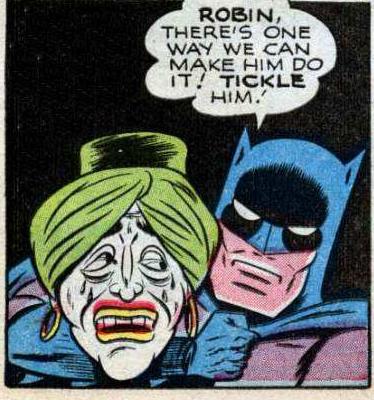
Comic book odd: Batman tickles Joker

tickle joker

This one doesn’t require much explanation.

Or maybe it does.

This installment of our occasional series of odd and inappropriate comic book panels comes from Batman Volume 1 Number 49, released by DC in October 1948.

The story is “Batman’s Arabian Nights,” and the action finds the Caped Crusaders up against the Joker. Kinda.

Bruce and Dick find a 1,000-year-old rug with the Joker’s face on it. To investigate, they go back in time (!) through hypnotism to ancient Baghdad and find a duplicate for the Joker …  only this one sobs all the time.

Before long, Batman tickles him to make him laugh and … I kind of lost the thread of the story there.

But it’s a good panel.

RIP Tom Laughlin

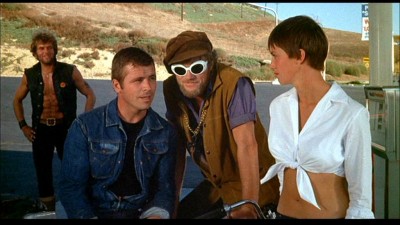
billy jack born losers

Tom Laughlin is not as well known as Peter O’Toole, certainly, but Laughlin made his own mark on the movie business. He died today at 82.

Laughlin was probably best known for creating the character of Billy Jack, a pacifist who unleashed his deadly martial arts moves when he was pushed … too … far.

Laughlin played Billy Jack in four movies: “The Born Losers” in 1967, “Billy Jack” in 1971, “The Trial of Billy Jack” in 1974 and “Billy Jack Goes to Washington” in 1977. He was ultra-recognizable with his close-cropped hair and blue jean jacket. He was also the guy usually laying waste to a bunch of heavies.

Although the movies were pretty straightforward vigilante fantasies, Laughlin, who also directed, was credited with pioneering modern-day marketing techniques and releasing some of his films himself when big studios spurned them.

Laughlin ran for president – yes, president – in 1992, 2004 and 2008.

Last year I wrote about going to see “The Born Losers” at the drive-in. Here’s that entry.

RIP Peter O’Toole

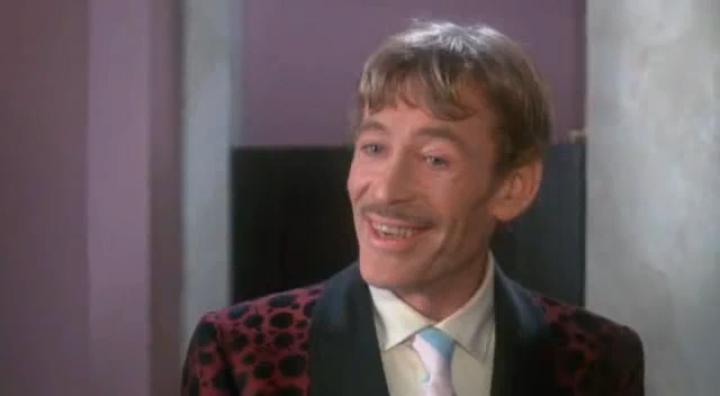
Peter O'Toole in My Favorite Year

One of our favorite actors has died. Peter O’Toole has died at age 81, according to early online reports.

O’Toole was best known, of course, for essaying the title role in David Lean’s 1962 epic “Lawrence of Arabia.”

O’Toole was famously a carouser and hellraiser. Here’s a quote from an obituary by The Guardian:

“We heralded the ’60s,” he once said. “Me, [Richard] Burton, Richard Harris; we did in public what everyone else did in private then, and does for show now. We drank in public, we knew about pot.”

Although he’s justifiably famous for “Lawrence of Arabia,” I think most fondly of O’Toole in “My Favorite Year.” the 1982 comedy classic about the early days of American live TV sketch shows and the chaos that arose when a great Brit actor – by that time better known for his drinking and womanizing – appears as a guest star.

I’m startled to realize now that O’Toole was younger at the time he was playing a nearly washed-up actor for “My Favorite Year” than I am now.

We’ll miss him.

‘Three Ghosts’ elevates ‘Arrow’ even more

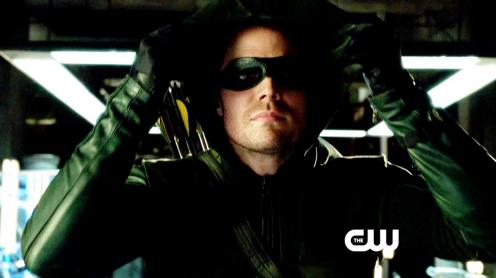
arrow three ghosts mask

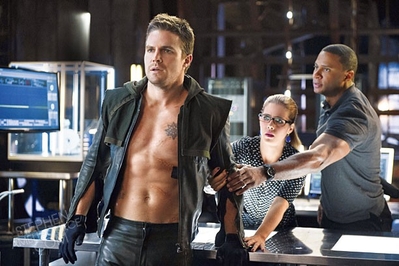
Just a few days ago, I was arguing here that “Arrow,” the current CW show about the early days of the DC Comics hero Green Arrow, might be the best superhero TV show of all time.

Last night’s “mid-season finale” episode of “Arrow” really backed up my argument.

(A word about mid-season finales or winter finales or whatever the networks are calling them: Shows like “Mad Men” and “The Walking Dead” take very deliberate breaks in the middle of their 14 or 16-episode seasons – mostly to avoid periods when networks think no one is watching, like the holidays, even though they’re wrong – and build to a strong climax for the final episode before that break. Although it would sound a little overblown on a sitcom, for example, mid-season finale seems appropriate for hour-long serialized shows that have built to a dramatic temporary stopping point. Like “Arrow.”)

“Three Ghosts,” last night’s “Arrow,” has as many dramatic elements as some season finales. And if you missed the significance of the title, it’s a reference to Dickens’ “A Christmas Carol.” During the course of the episode, Oliver is haunted by three figures from his past. Thankfully, the Dickensian undertones were decidedly undertones.

Arrow_Three_Ghosts three

“Three Ghosts” had a lot on its plate:

Although the flashbacks to five years earlier on the island aren’t likely to be done, last night’s episode went a long way toward tying those events into the Arrow’s present-day Starling City action.

We learned the fate of a couple of characters. Maybe.

We saw the origins, I’m thinking, of at least two more. Cyrus Gold, one of Brother Blood’s “super soldiers,” might have bigger (and deader) things ahead for him. As the poem that Diggle discovered goes, “Solomon Grundy, born on a Monday …”

The Scientist

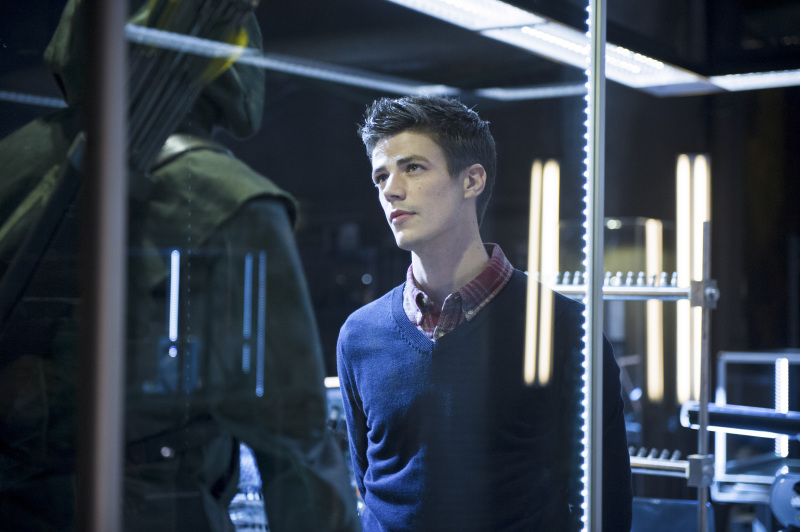
Although it was a surprise, we saw the origin of the Flash, the DC hero who’s getting his own CW series (most likely) next fall. Grant Gustin has been guest-starring the past couple of episodes as Barry Allen, a CSI from Central City. The network had said Allen would appear in only these two episodes before moving on to his own series pilot. I didn’t expect to see the accident – true to the comics – that turns Allen into the Scarlet Speedster at the end of this episode, but I was glad they did it.

I guess you could argue that we saw the origin of Green Arrow, too, since Allen’s parting gift to Oliver Queen was a green mask that he could wear in place of camo makeup. As the episode closed, Ollie donned the mask. Is he still Arrow? Or is he Green Arrow? He’s sure not “the Hood” or “the Vigilante” anymore.

The episode had something for every cast member to do and emphasized, with one exception, what a strong ensemble this show is built around.

By the end of the episode, the series has set up a much more compelling “Big Bad” than Brother Blood. I won’t spoil it here if you haven’t watched it yet, but it’s not surprising to anyone with some comics history under their utility belt.

Here’s looking forward to the back half of the season.


Cult classic: ‘D.E.B.S.’

debs

The first time I was channel-surfing and went past “D.E.B.S.” I thought it must be some TV show I hadn’t heard of.

Maybe it was some syndicated or cable TV show – which might explain why I’d never heard of it – featuring Michael Clarke Duncan, the actor from “Daredevil,” as the supervisor of a bunch of young female spies, living in a dormitory – and hey, are those two young women flirting and kissing?

It was only later, after a cursory Internet search, that I determined I had stumbled upon a cult movie.

“DEBS” – as I’m going to call it from here forward, omitting the periods just like I do with “Agents of SHIELD” – isn’t a TV show, although it would be a natural fit on a progressive cable channel like Bravo or Logo. It’s a 2004 film written and directed by Angela Robinson.

It’s a lightweight and silly movie that’s become something of a cult classic within the lesbian community for three reasons:

It presents a light-hearted flirtation and romance between two young women without a lot of the heartache and tragedy of earlier movies like “Desert Hearts” and “Personal Best.”

debs jordana brewster

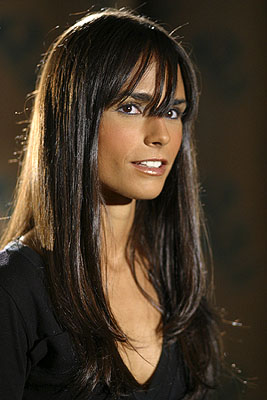
There are some “oh my god I can’t believe you’re kissing another girl” moments, but mostly because the romantic leads are young women at the opposite end of the crime and punishment spectrum: Amy (Sara Foster) is one of the DEBS, a government spy recruited right out of school and Lucy Diamond (Jordana Brewster, more recently Elena of the “Dallas” reboot) is a criminal, prone to robbing banks and threatening the world with high-tech weapons. Lucy is kind of like Dr. Evil if he was a woman, weighed 100 pounds, had great cheekbones and to-die-for hair. And Lucy has better taste in assistants: Scud (Jimmi Simpson) is funnier and more understanding than Mini Me.

And thirdly, Amy and Lucy get – spoiler – a happy ending.

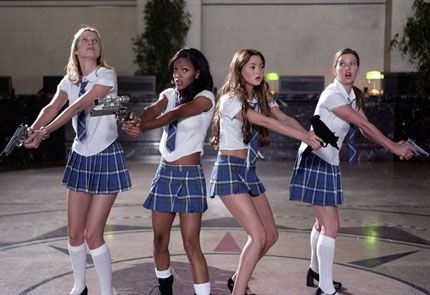
There’s no doubt there’s some intent to appeal to horny guys here. After all, the movie features the DEBS agents running around in school girl outfits and high heels.

But the movie doesn’t treat Amy and Lucy like pieces of eye candy – at least not solely for men in the audience. Judging by the online outpourings of love for “DEBS,” the movie has a cult following among the lesbian community. There are not only fan sites but fan fiction out there. That’s a sure sign of a cult movie.

An added bonus if you watch “DEBS” is Duncan and Holland Taylor in supporting roles and Brewster and Simpson (who more recently appeared in movies like “White House Down”) in early roles.

If you want to know more about “DEBS,” check out the fan site debsmovie.com.