Monthly Archives: February 2014

Retro superhero: ‘The Phantom’

the phantom billy zane

Richard Donner’s “Superman” movies and Tim Burton’s “Batman” movies – and their sometimes regrettable sequels – came before, of course, but Bryan Singer’s “X-Men” really kicked off the big-screen superhero genre in 2000, and the trend was solidified a couple of years later by Sam Raimi’s “Spider-Man.”

But during the “lost in the wilderness” years of the the 1990s, the studios tried not once, not twice, but three times to capture the spirit of the superhero genre as typified by the great pulp magazine-style heroes, the forefathers to comics.

“The Rocketeer” came first in 1991 and was probably the most successful. “The Shadow” came in 1994 and did a pretty good job of hitting all the key elements of the most popular radio and pulp hero of them all.

Then there was “The Phantom.”

The 1996 Simon Wincer movie, starring Kristy Swanson, Catherine Zeta-Jones, Treat Williams and Billy Zane as the Ghost Who Walks, was certainly faithful to Lee Falk’s original comic-strip hero.

Maybe too faithful.
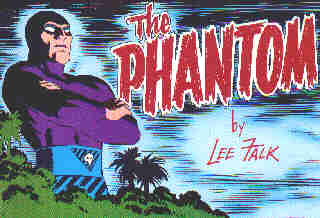
the phantom by lee falk

If you’re not familiar with the Phantom himself, the character was born in newspaper comic strips in 1936 and continues to this day. The Phantom is Kit Walker, the 21st in a series of fathers and sons who – following the 14th-century murder of a father, prompting a son to vow vengeance and the upholding of law and order – has kept the peace around the world and battled evil accompanied by his wolf companion, Devil, and his horse, Hero.

The Phantom is notable for some cool characteristics, including his twin handguns, the skull ring – whose imprint is left on bad guys’ jaws – and the legend that has been cultivated around him: He’s known as the Ghost Who Walks because criminals – a superstitious and cowardly lot, as Batman could tell you – believe he’s immortal rather than just the latest in a long family of crimefighters.

Falk created “The Phantom” after his newspaper syndicate asked for a follow-up to his “Mandrake the Magician.” In creating the Phantom, Falk invented a couple of superhero conventions, including the skin-tight costume and pupil-less eyes behind the hero’s mask.

“The Phantom” movie had the courage of its convictions, certainly. Its tale – the Phantom tries to protect a set of magical skull carvings and keep them out of the hands of a wealthy villain (Williams) – goes through the correct motions. Switching back and forth from the remote island home of the Phantom to New York City, the hero is aided by a spunky newspaper reporter (Swanson) and everything is complicated by the femme fatale played by Zeta-Jones. And what a revelation she was here. I really wanted her to play Wonder Woman after seeing her here and in another, better superhero 1990s movie, “The Mask of Zorro.”

There are pirates and submarines and seaplanes and immense sets and some action set-pieces, some better than others.

Zane leaves a lot of people cold – including me – but he’s really pretty good here as the Phantom. He nicely underplays the role, tossing off jokes and filling out the purple outfit about as well as anyone can. I was as frustrated as anyone by the black leather “X-Men” outfits, but maybe the world just wasn’t ready for purple spandex. And striped shorts.

As much as Zane underplays his part, Williams seems to have been told to overplay every line. I guess he’s being a good sport and the “Power Rangers” villain delivery would at least come across as non–threatening to kids in the audience. While the character is amusing, a villain who’s never truly threatening is not a great villain.

I’m not sure there’s ever been a big-screen movie that so desperately wanted to be “Raiders of the Lost Ark.” (I’m not counting the low-budget knock-offs here.) From the 1930s setting to the rickety bridge crossing that ends with the heroes swinging to safety to the ancient relics that magically illuminate a spot on a map to the villains that go “boom” at the end, “The Phantom” tries to strike so many “Raiders” grace notes it’s almost bizarre. Maybe that’s not a a surprise: Screenwriter Jeffrey Boam wrote “Indiana Jones and the Last Crusade,” a far better film.

“The Phantom” is worth seeing if you never have or if, like me, you haven’t in 18 years. It’ll seem like something of an awkward artifact because of the string of superheroes that followed it into theaters beginning just four years later, though.

Purple tights or no.

‘Dallas’ – Five things we want to see

dallas season 3

The third-season premiere of TNT’s continuation of “Dallas” aired last night and I was missing Larry Hagman.

Although Hagman’s illness reduced his presence on the first two seasons of the new take on the classic nighttime soap, I have to say I wish that, before his death, producer Cynthia Cidre had shot several hours of Hagman talking on the phone, riding in the back of a limo and just walking across the room that she could generously salt through upcoming seasons.

But I guess that wouldn’t be right.

Anyway, in this, its first season without the venerable J.R. Ewing, “Dallas” will have to make its way on its own soapy power. I think it can do this … if it gives us a few things we want to see.

Plenty of the young’uns. I’m really growing to like the new generation of Ewings. Josh Henderson (John Ross) and Jesse Metcalfe (Christopher) are getting to be pretty good antagonists and I’ve already fallen for Julie Gonzalo as Pamela and Jordana Brewster as Elena.

But plenty of the original Ewings too. Patrick Duffy is stalwart as Bobby and Linda Gray is plainly filling the Hagman role in some scenes with their son John Ross this season. I’m enjoying both. And even though I’m wincing at the thought they’re going to have Sue Ellen fall off the wagon and begin drinking again, it would give Gray, a wonderful soap opera actress, a juicy season.

Faces from the original “Dallas.” We’re seeing plenty of Ken Kercheval (who is 78!) as Cliff Barnes, but I want to see more of Gary Ewing and Lucy Ewing and Val Ewing and Ray Krebbs. I’d really enjoy seeing Ted Shackelford in several episodes, clashing with nephew John Ross over the fate of Southfork.

More of Judith Light. Last season, the “Who’s the Boss” star made a big impression as the mother of Mitch Pileggi’s character … despite the fact that Light is, at 65, just four years older than her on-screen son. I didn’t like Light much when she first appeared, but she’s just the right kind of looney character the show could use.

The drama. The drama. Not just drama from the Ewing Global boardroom, but from Southfork, where it looks like most of the characters will be in residence this season. We need more dinner scenes with all the Ewings staring daggers at each other from their spots around the bar.

Here’s to another good season.

‘Fiddlehead’ wraps up steampunk series with a bang

cherie_priest

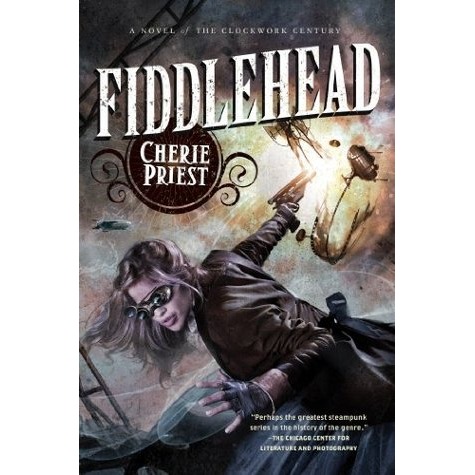
Cherie Priest has been the best working purveyor of steampunk – the genre that mixes sci-fi, alternate history and 19th-century technology with a twist – for several years now with her “Clockwork Century” novels.

The series – and if you haven’t tried it, you should – is set around 1880 and presents an America that is pretty radically different from the history books we know: The Civil War still rages on, with battlefield skirmishes and Union and Confederate spies crossing borders in clandestine missions. Often the action plays out in a series of skirmishes not only on the ground, in horrifying lethal “dreadnaught” locomotives, and in the air in high-flying dirigibles.

As the war rages on, another menace proves to be a great threat. In the first book, “Boneshaker,” a digging machine opens up a fissure in the earth in Seattle that releases a yellow gas. The gas turns humans into flesh-eating creatures and, even more fiendishly, is used as the basis of a highly-addictive drug that soldiers and other combatants on both sides of the Mason-Dixon Line willingly ingest, creating even more zombies.

fiddlehead cherie priest

By the time of “Fiddlehead,” Priest has brought these storylines together in an explosive climax. Gideon Bardsley, an ex-slave and scientist, has created the Fiddlehead, a steampunk computer that predicts that neither the Union nor the Confederacy will win the war. Both sides, weakened by nearly two decades of fighting, will be lost in a tide of zombies that will not only destroy the United States but the entire North American continent.

It’s up to Bardsley and Pinkerton Detective Agency operative Belle Boyd and their associates to stay alive long enough to get word out about Fiddlehead’s forecast – and stop the machinations of a war profiteer who hopes to use the zombie gas to not only make money but deal a devastating blow.

“Fiddlehead” is a fun thriller that not only brings back many of the characters from Priest’s earlier books – one of the author’s techniques is to mix up her sprawling cast, making some the leading players in some books and the supporting players in the next – but a couple of important figures who have been just outside the parameters of the page in the earlier books: Abraham Lincoln and U.S. Grant.

In Priest’s storyline, Lincoln wasn’t killed that April night in Ford’s Theatre, but he was seriously injured and had to leave the presidency. By the time “Fiddlehead” takes place, Lincoln and wife Mary are patrons of scientist Bardsley and thus leading the campaign to spread the word about the horrors of the zombie gas.

And Grant, wearing down in his fourth term in the White House and fighting his own demons, joins with Lincoln in turning back the murderous challenge from the war profiteers and behind-the-scenes manipulators who want to keep the war going.

Priest has created an engaging set of fictional characters but, to me, really shines in her treatment of fictionalized versions of real-life characters like Lincoln and Grant. Maybe it’s no surprise that readers would find themselves rooting for Lincoln, a beloved historical figure. But the Lincoln that Priest presents here is scarred and tough and scrappy as you would hope for.

Priest’s books are fun and clever and fast-moving fun-house-mirror looks at American history. With zombies. What more could we ask?


Essential geek library: The works of Les Daniels

marvel_five_decades les daniels

I come to praise Les Daniels, not to bury him. But it turns out one of my favorite authors of comic book histories died and I didn’t even hear the sad news.

Daniels – who died in November 2011 at age 68 – is one of those authors to whose work I have returned again and again.

And no wonder. While he wrote fiction, his non-fiction work lines a shelf near by bedside.

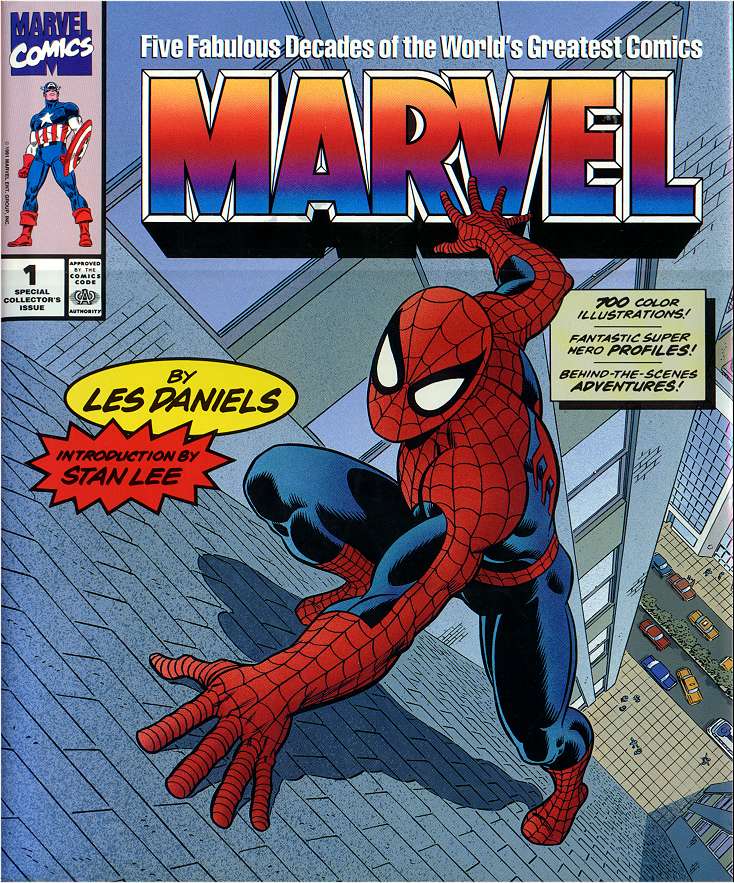
In 1971, he wrote one of the early serious histories of comic books, “Comix: A History of the Comic Book in America.”  He followed this up with some of the most readable “official” histories of comic book publishers and characters in print, including “Marvel: Five Fabulous Decades of the World’s Greatest Comics” in 1991, “DC Comics: Sixty Years of the World’s Favorite Comic Book Heroes” in 1995, and what I consider his best modern-day work, a three-volume history of DC Comics’ Trinity, Batman, Superman and Wonder Woman.

These  three”Complete History” volumes were published in the late 1990s and early 2000s and, in addition to his clear and concise writing, feature some of the best design in comic book histories to that day. These volumes include covers by Chip Kidd, a star of the book design world.

Daniels was also an author of historical fiction and historical fiction with a supernatural bent.

There’s so much online – and so much crap online – about comic books these days, Daniels’ work seems – and is -authoritative and comprehensive and first-rate by comparison.

RIP Mr. Daniels.

Big spoilers for ‘Captain America: The Winter Soldier?’

redford cap winter soldier

Warning: This is the kind of spoiler that, once seen, cannot be unseen.

I’ll give you another warning before unleashing the spoiler.

I’m torn when it comes to spoilers. I like knowing things that other people don’t know and, through this blog, sharing them with readers.

This is a lifelong condition for me. Back in the spring of 1980, I sat down at the curb outside a bookstore and scanned through the paperback novelization of “The Empire Strikes Back,” which had come out a few weeks before the movie. I remember being startled by the revelations in the print version. I couldn’t blog about it, of course. Pity.

Just like novelizations of movies can vary, to greater or lesser extent, so can merchandising tie-ins.

That brings us to the spoilers for “Captain America: The Winter Soldier.”

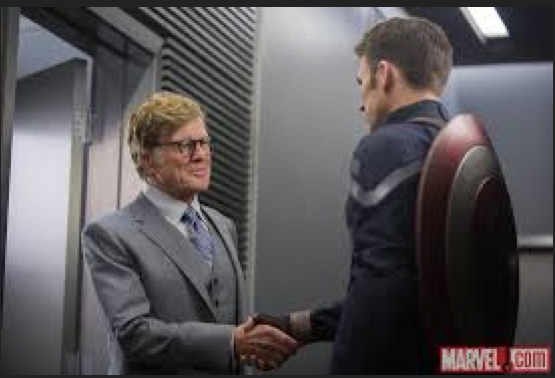
As you know, the movie – which comes out in April – pits Cap, now an integral part of spy organization SHIELD, against the title character, a Russian assassin with a bionic arm. This struggle plays out against the bigger backdrop of Cap’s disillusionment with SHIELD, particularly as represented by D.C. insider Alexander Pierce, played by Robert Redford.

Still not in ultimate spoiler territory, so hang in there.

If you’re familiar with the Winter Soldier concept from the comics, you know the character is really Bucky Barnes, Cap’s World War II partner, who seemingly fell to his death in the comics (and the first Cap movie).

And if you’ve seen trailers for the movie, you’ve gotten a pretty good idea that the movie makes Cap and other characters, including Black Widow and Falcon, rebels within the SHIELD organization.

Okay. So here’s where we get into spoilers, maybe. Keep in mind I haven’t seen the movie and don’t have any inside knowledge. I’m reading conjecture online and putting two and two together.

Okay. Spoilers in 

5

4

3

4

1

Ready? 

If the movie follows the storyline of the Marvel Comics “Winter Soldier” book, the Red Skull – Cap’s nemesis from the comics – will play a role in the modern-day.

As played by Hugo Weaving, the Skull seemed to disappear – whooshed away to another dimension or another of the Nine Realms – at the end of the movie. It sure looked that way to me.

And if you’re a comic reader, you know that the Skull has popped up, in person and in various disguises, for much of the past half-century. So it’s safe to say that the Skull could return without too much surprise.

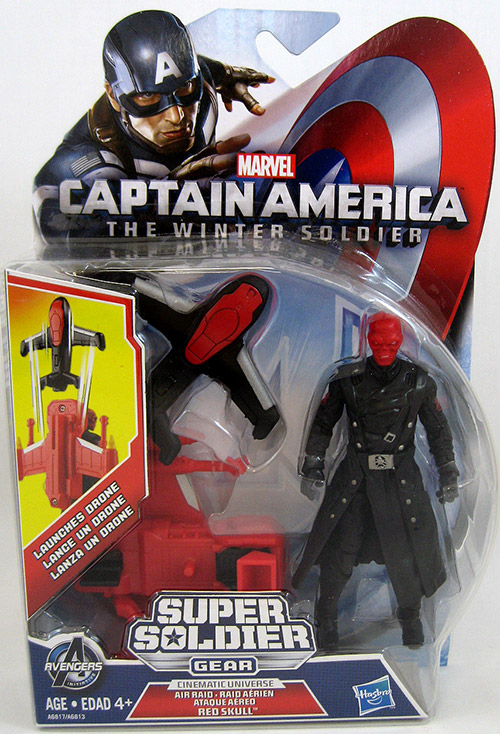
Which makes the Red Skull action figure, released to tie into the movie, make sense.

winter soldier red skull action figure 

Again, he might not be in the movie. He might just be part of the action figure merchandising from the movie.

Then we remember this quote, from early 2013, in which Redford – who could have played Cap in a 1960s or 1970s big-screen version – talked about why he wanted to appear in the movie.

“I think a career requires a certain amount of reinvention. If you get caught in one track I think that can be dangerous. Success has a dark side to it. you want to be careful if you’ve had success at something, that you not try and follow it by just duplicating it. That’s why I’m doing this Captain America thing. I like the idea of playing a villain…I did that just because it’s a different thing for me to do.”

So is Redford playing the Red Skull in disguise?

What better to re-introduce the character and interject a huge note of suspicion and distrust in how Cap and other heroes feel about SHIELD.

Remember, if you will, that Cap and Tony Stark discovered in “The Avengers” that SHIELD was making new Hydra weapons. The Red Skull channeled the power of the Tesseract, or Cosmic Cube, for those weapons.

Who’s to say the Skull, under the guise of the leader of SHIELD, hasn’t been using SHIELD’s resources to re-arm Hydra?

Speculation online and in interviews with Marvel officials has centered on how thoroughly the Marvel cinematic universe will change based on “Captain America: The Winter Soldier.” The movie is supposed to be something of a game-changer in the year leading up to when “Avengers: The Age of Ultron” comes out in 2015.

What better way to change the game than by taking the organization that’s been a part of every Marvel movie since Nick Fury stepped out of the shadows of Tony Stark’s living room in “Iron Man” in 2008 … and deconstructing it.

And what better way to do that than by revealing that the man ultimately in charge of SHIELD, Nick Fury’s own boss, has been the Marvel universe’s most enduring villain, maybe for decades?

We’ll see in April if any of this is even remotely correct.

Get off my lawn: Geekery is wasted on the young

wkrp cast

Here’s the latest irregular installment of my view from the perspective of a longtime fan. So if you don’t want to hear it, you’re welcome to come back for the next entry. No hard feelings.

Back in my day (and ohmygod yes I did just write that, but mostly for the ironic effect) young fans or geeks or indoor kids or whatever we wanted to call ourselves appreciated classic books, movies and TV.

I mean, what choice did we have? We could slip back into the past with classic Universal monster movies or we could thrill to “Island at the Top of the World.” We could delight in “The Twilight Zone’s” dated pleasures or stay rooted in the present-day of “Manimal.”

I loved the TV and movies of my time, like “Star Trek” and “Star Wars,” but also loved the classics, like the aforementioned Universal movies featuring Frankenstein or the Wolf Man as well as the films of W.C. Fields, the Marx Brothers and Abbott and Costello.

I like to think of myself as living in the present day. I love the online world, from my ability to blog here to Twitter (two accounts). I can enjoy the treasure trove of information and entertainment available now thanks to the Internet that I couldn’t have imagined when I was young.

But …

Really, there’s no excuse for being ignorant of what’s come before.

Two things I’ve read recently bring this to mind.

robocop original poster

With the release of the “Robocop” remake, a writer on io9 “discovered” the original 1987 movie and wrote, in pretty funny terms, about how awesome the movie is. It was pretty amusing and I didn’t really mind it, but I was thinking, “Really? You can watch any movie or TV show you want now, on several devices, and you seem shocked by your initial exposure to a very high-profile satirical science fiction movie from less than 30 years ago?”

Far more egregious was a recent AV Club roundtable about the 1970s series “WKRP in Cincinnati.” The series, about a radio station, was an MTM production and ran for several years. It’s not like nobody remembers it.

But one writer for the AV Club, who almost certainly wasn’t born when the series originally aired, was very dismissive of the show. She said the look and feel of the show and the characters were so dated she couldn’t get into the story.

Again I’m wondering how this person had never seen a bit of, or even heard of, the series before … and how that qualified her to take part in a roundtable discussion of the series.

Yes, I know. It’s a different world now. The young shall inherit the earth and all that.

But can’t they educate themselves on their way to the throne?

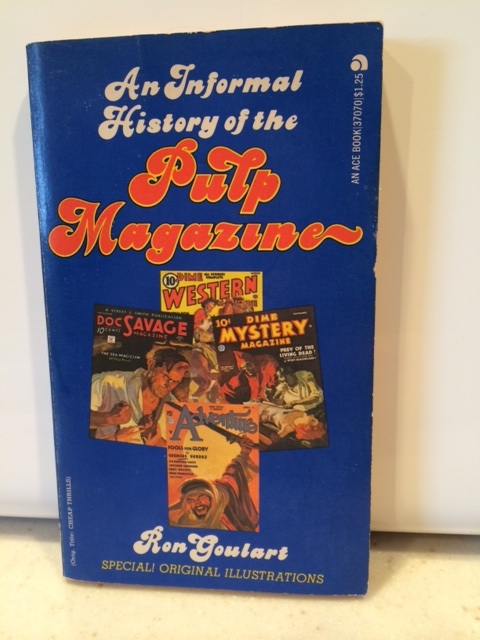
Essential geek library: ‘An Informal History of the Pulp Magazine’

history pulp magazines

By the time Ron Goulart’s “An Informal History of the Pulp Magazine” was published in 1972, the pulp magazine – the art form and industry that gave millions of readers cheap thrills on cheap pulp paper and gave us all such heroes as “The Shadow” and “Doc Savage” – was already more than two decades dead. In the 40 (!) years since the prolific Goulart’s book was published, “Pulp Fiction” has come to mean little more than a Quentin Tarantino film.

But in 1972, when Goulart’s book came out, it was a bible to me, a look back into a colorful world of avenging heroes and penny-per-word writers that had been eclipsed by comic books.

Here in Muncie, a bookstore – long gone now – had shelves and shelves of old pulp magazines, which were so named because of the rough-edged, cheap paper they were printed on. I never bought any, although I wanted to. But I couldn’t even begin to start.

By the 1970s, I was enjoying the paperback reprints of pulp magazine stalwart Doc Savage, with those great James Bama covers, and that helped me appreciate the pulps in general and Goulart’s book.

In a relatively slim volume, Goulart gives an overview of pulps but concentrates on the best and brightest, the pulps featuring Doc Savage – precursor to Superman – and the Shadow, one of Batman’s contemporaries and inspirations.

Goulart gives us Tarzan and cowboys and detectives and jingoistic Yellow Peril villains and, best of all, a glimpse of the (mostly) men who created all those characters, working anonymously under pen names and turning out literally hundreds of novel-length yarns that were eagerly consumed by adventure-seeking readers.

Goulart interviewed many of the surviving writers and artists and even devotes the last chapter to their unfiltered memories.

Goulart’s topic has no doubt been covered by others since then, but even 40 years later, his book remains my favorite look back to that time and the pulpy art of storytelling.

An odd note: An inside page notes that the original title of Goulart’s book was “Cheap Thrills.” Although the cover doesn’t include that title, folios throughout the book refer to it as such. Did publisher Ace take the cheap way out, slapping a new cover on the interior text of Goulart’s book?

Considering the on-a-shoestring nature of pulp magazines, it would be appropriate if they did.

Visual guide to Marvel character movie rights

visual guide to marvel character movie rights

Well this is awesome.

Based on various reports, the Geek Twins have put together a graphic showing which movie studios own which Marvel Comics characters.

Not every character is here, of course. That would be impossible. But it’s a pretty good guide.

Here’s their post.

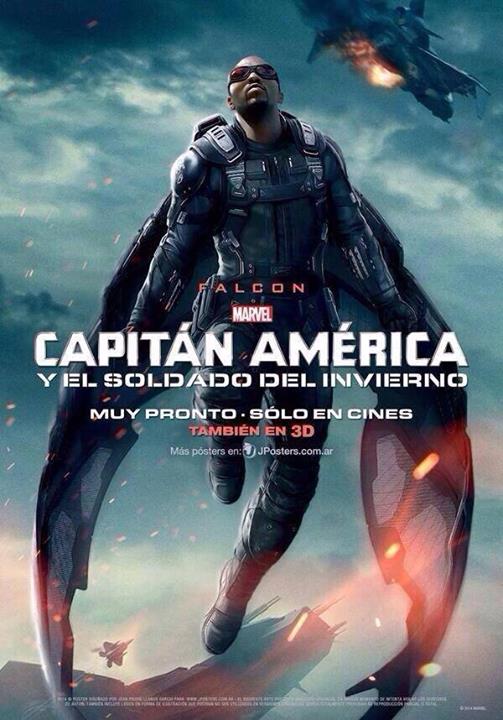
Falcon gets his own poster. Kinda.

falcon-movie-poster

Okay, Marvel, good for you, a little.

Marvel’s releasing character posters (Cap, Black Widow, Nick Fury) from “Captain America: The Winter Soldier.”

So here’s this cool character poster featuring Anthony Mackie as Sam Wilson, AKA the Falcon, Cap’s partner.

But it’s only in Spanish-speaking territories so far, apparently.

Come on, Marvel. Let this one loose on U.S. soil.

I want kids to be able to see a poster featuring the first African-American superhero in comics. (Black Panther was African.)