
This.
ABC ‘Muppets’ promo gets it
Leave a reply
This.

It’s hard being a weather obsessive these days.
Oh sure, there are more ways than ever to check the current weather and the forecast. There’s more radar, both past, present and future. There are more ways to see it all, from TVs to computers to phones.
So why is this weather obsessive so dissatisfied?
It’s because the pure heart of weather – current conditions and forecast – are buried beneath a top of distractions and other reductive irrelevancies.
The Weather Channel iPhone app is still okay, but the Weather Channel itself I wrote off long ago when it stopped doing forecasts and updates “on the eights” every 10 minutes. First it relegated those updates to a small portion of the screen. Then it bumped them altogether for hours each day for inane shows about prospectors and outdoor adventurers. Weather Channel, you lost me when you tried to be something other than the place where I could find the forecast every few minutes.
The last straw might have occurred in recent weeks when I noticed that the Weather Channel page that I had bookmarked on my computer had omitted radar. Really, what’s the point of looking up current conditions or the forecast if you can’t see the radar?

Of course, I turned to the Weather Channel in the first place because local TV weather reports were so inadequate, and they remain so. After spending several minutes on some silly story and what’s “trending” online right now – useless info to anyone who actually goes online and sees what’s trending on Twitter or Facebook – the weather people rush through a forecast that spends as much time on current conditions as it does on what we can expect next. Seriously, I don’t need to know what the temperature is right now someplace else.
So we weather obsessives are forced to mix and match our weather checking to get a true picture of what’s happening and what’s to come. I’ll look at radar on my phone. I’ll check out the radar channel on TV to see the live radar but I’m wary of the forecast on those channels, which is hours old. I’ll watch a TV weather person occasionally when I want a forecast that might, just might, take into account changes in the past few hours.
That’s assuming the weather people will acknowledge changes in their “storyline” intended to keep people tuned in.
It’s not easy being a weather obsessive.
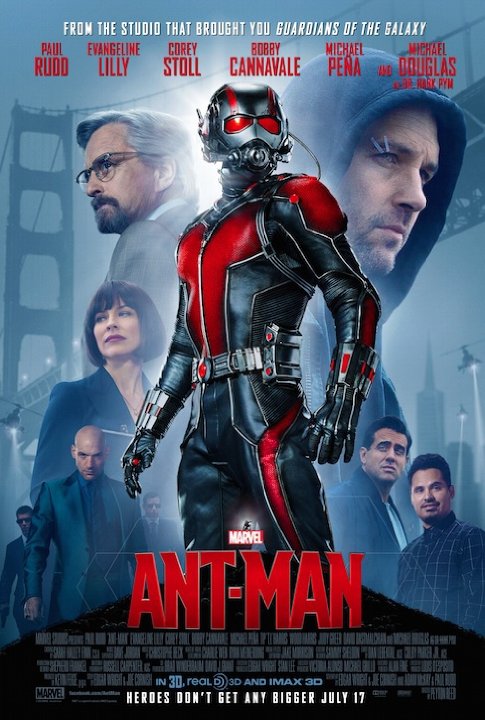
“Ant-Man?” “Ant-Man?” Ludicrous. Silly. Comic-booky.
Exactly.
Go see it.
It’s late and I’m tired, but some first impressions upon seeing the movie tonight:
Spoilers ahead, more likely than not.
It seems like every new Marvel movie has naysayers convinced – at least in advance – that this will be the one that destroys the studio. We heard that with “Guardians of the Galaxy” last year. We heard it with “Ant-Man” this year.
Nope. Hasn’t happened. Sure won’t happen with “Ant-Man,” which is smaller in scale than some of the Marvel movies but still has high personal stakes for the characters, as well as fun action and character scenes.
Credit scenes, because this is what you want to know: As these things go, the scenes have some heft. The first – in the mid-credits – at least promises a new, female hero. The second sets up the entry of the Ant-Man character into the larger Marvel Cinematic Universe and next spring’s “Captain America: Civil War.”
The final credits scene, however, is foreshadowed somewhat by the extended cameo played by Anthony Mackie’s Falcon character, however. After Falcon intercepts and fights with Paul Rudd’s Scott Lang at the new Avengers facility and Falcon turns up again at the end of the movie, looking for Ant-Man, there’s little surprise to the post-credits scene. Still, it’s pretty cool.
The movie has Easter eggs – more than I could catch – and plot threads for the overall MCU. But the best of those by far is the opening scene, set in 1989, with an uncanny, younger CGI version of Michael Douglas’ character, Hank Pym, the original Ant-Man. Loved this scene and loved how it filled in some blanks in the Marvel Cinematic Universe as we know it so far.
There’s a surprising amount of comedy in the movie, maybe not really surprisingly. The whimsy makes for some of the best moments in “Ant-Man,” however.
I’ll come back to the movie at a later date, maybe after I see it a second time.
And by the way, here’s my earlier post on why Ant-Man matters to the MCU.
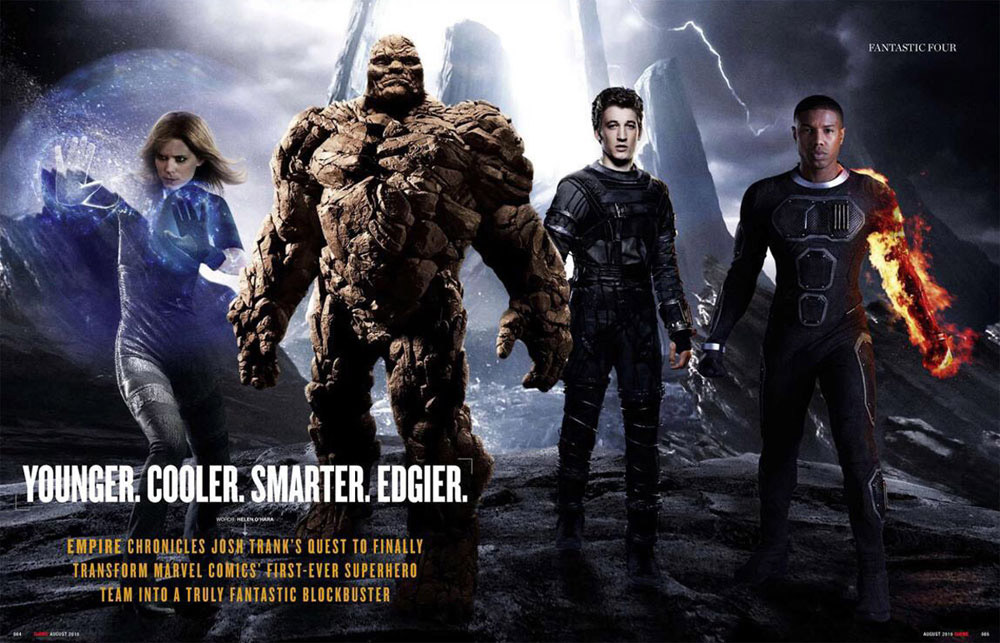
And also, apparently, nakeder. And less penis-ier.
You know, Ben Grimm is a tragic character and all, but … damn, man.
In the “Fantastic Four” comics and movies, there’s usually been an attempt to give the characters a consistent look in their costumes. This was done even for Ben Grimm, who turned into the rocky Thing. Benjamin Grimm usually had trunks on – blue to match the costumes of the other members of the FF – and or sometimes had on a whole jumpsuit-type-thing.
In the new movie, which comes out in August, the Thing apparently doesn’t wear any kind of costume.
And he apparently doesn’t … have … a penis.
I was already pretty uncertain about what I thought about the movie.
Now this.
Other people have noted this online, but does the Thing in the movie not eat or drink? Does he have any means at all of eliminating waste?
Is Ben Grimm’s longtime girlfriend, Alicia Masters, in the movie?
Are they going to address all this in the storyline?
Okay, now I’m just depressed.
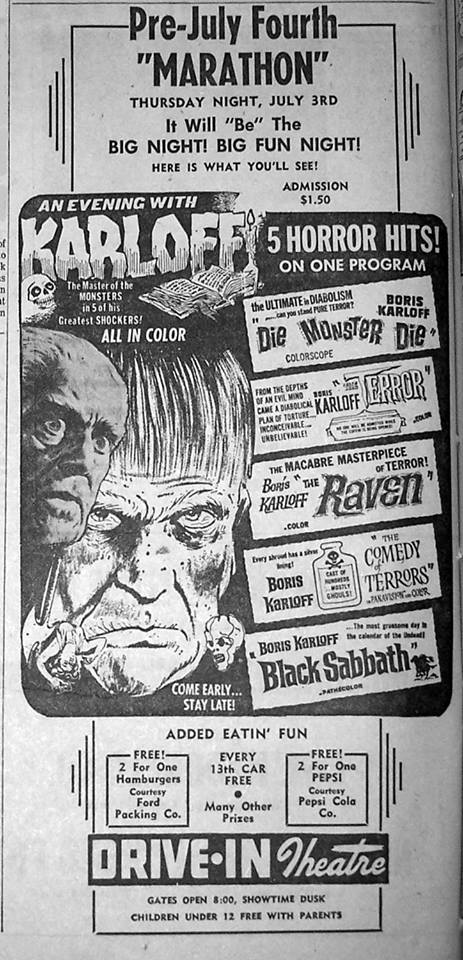
You don’t necessarily think about Boris Karloff, king of the Universal monsters, on the Fourth of July.
You do think about drive-in movies on the Fourth, and here’s a Karloff-centric drive-in quintuple feature ad.
It’s likely this drive-in Karloff marathon took place in 1965. The top-billed picture, “Die, Monster, Die,” was released that year. All the others were older.
Karloff had been well-known as a horror film actor for decades by that point, since 1931’s “Frankenstein,” and continued to appear in movies and TV up until his death in 1969. Beyond his death, actually. Although his health had declined over the years and he was often confined to a wheelchair, Karloff worked on movies late in life and some of those were released as late as 1971, two years after his death.
In 1965, when this quintuple feature was released, he was considered a horror movie elder statesman at age 77.
Karloff wasn’t known to a new generation of fans, by the way, until he narrated “How the Grinch Stole Christmas” in 1966.
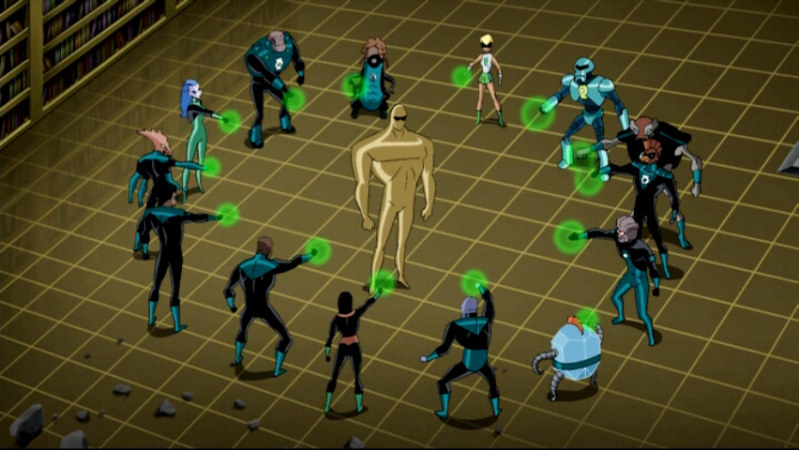
I’ve had so many favorite TV series over the years, from “Buffy the Vampire Slayer” to “Star Trek” to “Justified.” But as surprising as it may sound, it just might be “Justice League Unlimited” – right up there with another animated series, “Jonny Quest” – that ranks at the top of the list.
“JLU,” as I’m going to refer to it here, ran for 39 episodes over two or three seasons – who could tell, really, the way “Cartoon Network” abused the show with its scheduling? – from 2004 to 2006. The animated series, featuring the work of true artists like Bruce Timm and Dwayne McDuffie, was a continuation of the two-season “Justice League” series, which ran from 2001 to 2004, which itself was a continuation of “Batman” and “Superman” animated series that dated back as far as 1992.
“Justice League” was a fun series, giving us our first “real” look at characters beloved for decades, in personas and performances that defined them for a generation. When I see DC/Warners trying to bring those characters to the screen now in the inadequate “Man of Steel” and unpromising “Batman vs Superman: Dawn of Justice,” I just wish they had given the reins to the people – including voice director Andrea Romano – who brought the characters to life in animation.
I’m rewatching “Justice League Unlimited” now and I might share some thoughts on other episodes with you here. But after watching it today, I have to talk about “The Return.”
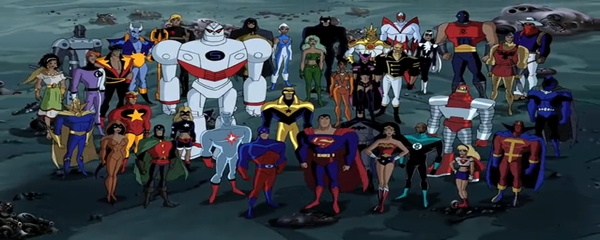
If you’ve seen the series – or even if you haven’t – you don’t need me to go into the plot in great detail. But a little context: In “JLU,” Superman, Batman, Wonder Woman and the other core members of the Justice League decide to expand the roster of the league as seen in the first two seasons. They do so for practical reasons – Superman explains a greater number of heroes can put out more fires, literally and figuratively – but for storytelling purposes, this opens up a wealth of possibilities.
Even though “Justice League” episodes had brought in characters like Dr. Fate and Aquaman, “JLU” not only brought DC A-listers into the fold but B, C and D-listers. Ever want to see Bwana Beast in action? The Creeper? Maybe best of all, The Question? Here’s your first, and probably only, chance. I can’t imagine The Elongated Man is going to show up in one of the big-screen movies.
The first few episodes of “JLU” were intent on showcasing characters other than the core, founding members of the League. The opener, which included Batman and Superman, focused on an emergency response team consisting of Green Lantern, Supergirl, Captain Atom and a reluctant Green Arrow responding to a rampage of a nuclear monster in an Asian country that is less than welcoming to the heroes. Other early episodes featured Wonder Woman teamed with Hawk and Dove, for example.
But it wasn’t until “The Return, an episode that aired in September 2004, that “JLU” hit its stride.
Amazo, an advanced robot that had figured into a “Justice League” episode, is returning to Earth, ostensibly on a mission to kill Lex Luthor, who had betrayed the robot and his creator, Professor Ivo.
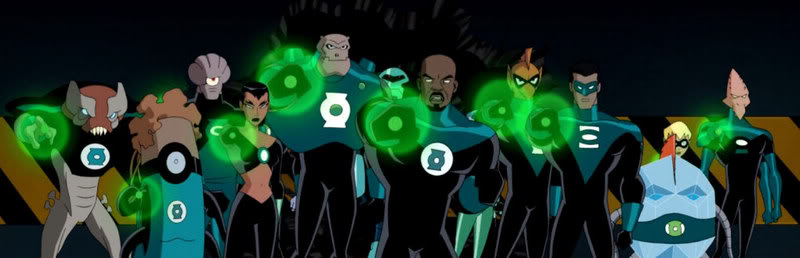
This meant the League has to protect Luthor from the unstoppable creature, which decimates first the Green Lantern Corps at their home planet Oa, then blasts through a defensive line in space that includes Superman and Green Lantern, then wipes out an airborne troupe that includes Supergirl and Red Tornado – who meets a startling fate – and finally trounces a ground-level line of defenders that include Wonder Woman and Flash.
Finally, it’s down to the Atom – voiced in great fashion by John McGinley – who is locked in an underground lab with Luthor – to come up with a solution.
And he fails.
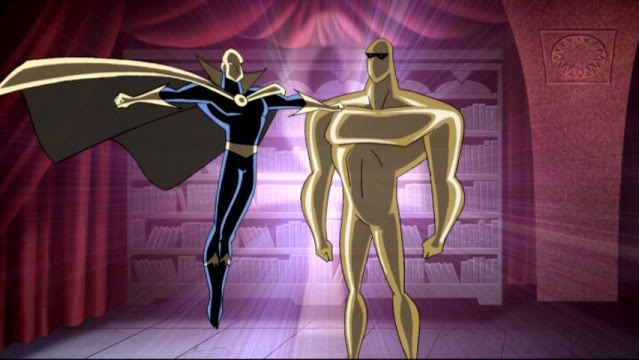
But just as the regrouped Green Lantern Corps arrives to blast Amazo … Dr. Fate shows up with a better solution.
It’s an ending as satisfying as it is unexpected and shows the depth of this series. A little-known DC hero could show up for a cameo, a funny in-joke – or a feat that saves the world.
“Justice League Unlimited” had many great episodes and I might touch on some of those here as I rewatch. But “The Return” showed what the series was capable of.
 keithroysdon