

I’m kind of heartbroken right now.
Earlier today I saw a random tweet about the passing of Jeff Rice.
If you ask, “Who is Jeff Rice?” you’ll either not give a damn about his death or – hopefully – you will care after I lay a little information on you.
Jeff Rice, who died in Las Vegas on July 1 at age 71, was a talented writer who peaked way before he should have and struggled – and failed – to reach the same height of success again.
You see, Jeff Rice created Carl Kolchak and “The Night Stalker.”
If that rings a bell, and it should, you might remember that “The Night Stalker,” a TV movie from “Dark Shadows” creator Dan Curtis and starring Darren McGavin as Kolchak, aired on ABC on Jan. 11, 1972.
The movie – what might now be called a procedural, as Las Vegas newspaper reporter Kolchak tracks a serial killer in Vegas and ruffles the feathers of cops, politicians and his boss at the paper – was one of the most successful TV movies of all time, with 54 percent of TVs in use and 33 percent of all TV homes tuned in the night it aired.
That’s in part due to the funny, action-filled script by “I Am Legend” and “Twilight Zone” screenwriter Richard Matheson and Kolchak’s way of staying one step ahead of everyone else – and rubbing their noses in it. (I’m betting he influenced almost as many would-be newspaper reporters, like me, as did Woodward and Bernstein.)
But “The Night Stalker” also did as well as it did, I believe, because Vegas serial killer Janos Skorzeny was a vampire.
I’ve written in this space before about my love for the movie – and my great fondness for the follow-up movie “The Night Strangler” and the “Kolchak: The Night Stalker” TV series that aired from September 1974 to March 1975.
As writer Mark Dawidziak noted in his book “The Night Stalker Companion” and his online obituary for Rice, the author’s work and the adaptations of it were enormously influential.
Not just on “The X-Files,” which captured the spirit of the movies and TV series and even paid tribute to Kolchak, but also a host of series that, like Rice’s work, brought “creatures of the night” out of the Victorian era and shook off their gothic trappings to introduce them to the modern world, like “Buffy the Vampire Slayer” and pretty much every recent movie or series that used “The Night Stalker”‘s mix of horror, humor, sarcasm, pessimism and, ultimately, bravery.
There had been little like “The Night Stalker” before but there was plenty to come.
As Dawidziak notes, however, Rice’s story was in many ways as dark as his story “The Kolchak Papers,” which eventually saw paperback publication as “The Night Stalker” in December 1973.
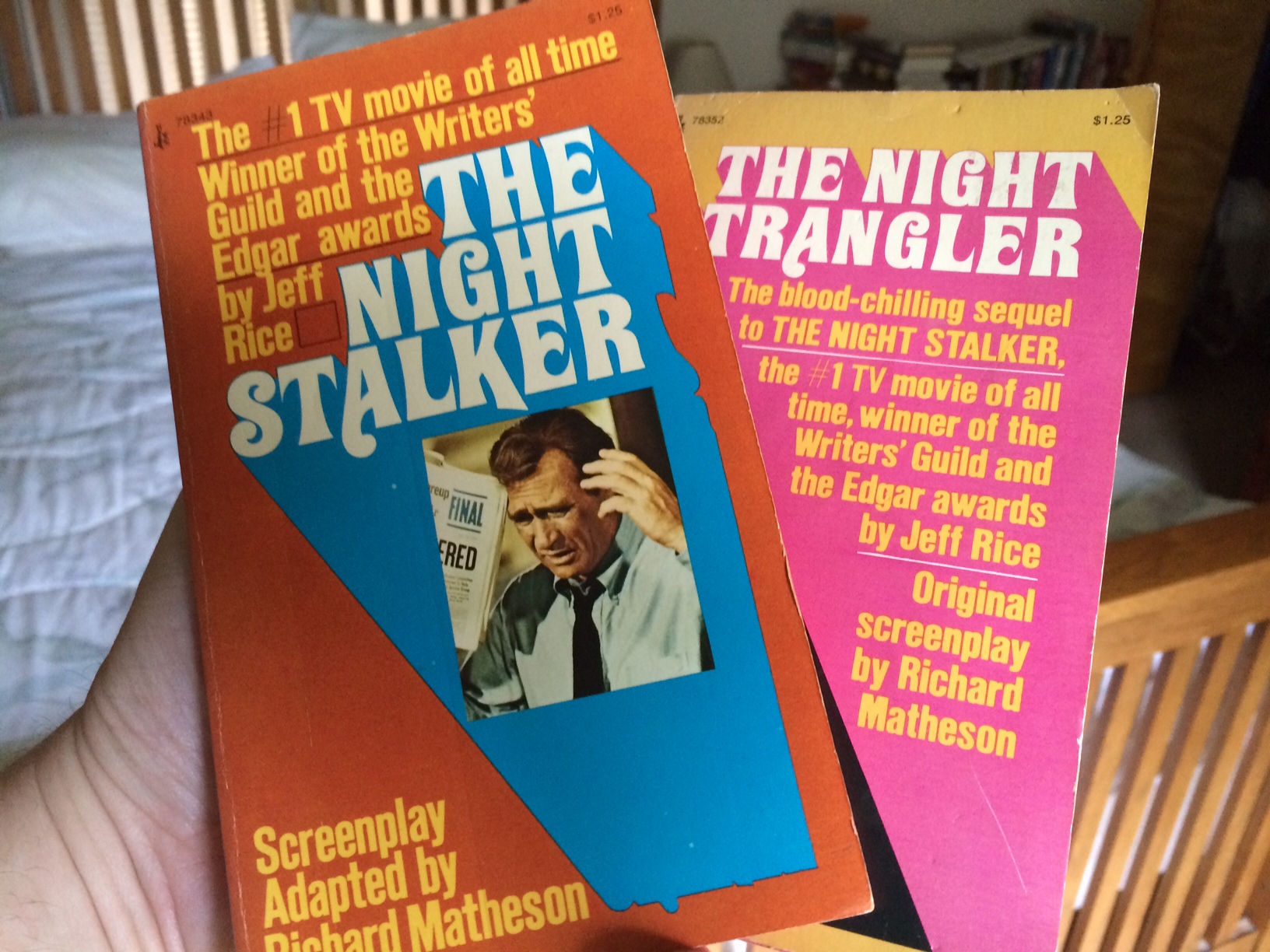
(The book cover photos that accompany this post I took today of my copies of Rice’s books. I’ve had them since they were published. They’re terrific.)
Dawidziak notes that Rice – himself a Las Vegas Sun reporter in the 1960s, and nobody’s pushover – based his fantastic yarn on his own experiences in Vegas, running up against corrupt politicians and criminals. Rice didn’t encounter any vampires, as far as we know, but anyone who remembers the movie knows that the most dangerous antagonists in the movie aren’t the age-old vampire but the forces of politics and the law, who lower the boom on Kolchak just as he triumphs.
As Dawidziak tells it, Rice’s downfall came after the “Kolchak” series was approved. It seems like somebody neglected to get the rights to the characters from Rice. The author asked for a piece of the action and, when the studio thumbed its nose at him, threatened to sue.
Rice was barred from the the production of the series and felt like his career was greatly diminished.
Rice never caught the huge break that his talent deserved.
And as Las Vegas Review-Journal writer John L. Smith reported, Rice lived out a “troubled” life until his death a little more than month ago.
I’ve seen “The Night Stalker” countless times and I’ve read Rice’s books several times. From the first page, Rice grips the reader with his portrait of Cheryl Ann Hughes, a casino worker in one of Las Vegas’ darker sidewalks on the wrong night.
A series of bullet points – a style best appreciated by those of us in the newspaper business – sums up Hughes in less than a page. Then this:
“Cheryl Ann Hughes: a girl with less than fifteen minutes to live.”
If you seek out and read Rice’s book – and you should – you’ll realize how much the TV movie owes to Rice not just because of characters and plot but also tone and voice. You can hear McGavin’s voice as you read Rice’s story.
I was 12 and a horror film fanatic when I first saw “The Night Stalker.” I greedily sought out more of this world, snapping up Rice’s novels when I found them and watching the sequel movie and series.
After hearing the news about Jeff Rice today, I’ll be stepping back into Kolchak’s world again soon.

 keithroysdon