Category Archives: classic TV

101 best-written TV series of all time?

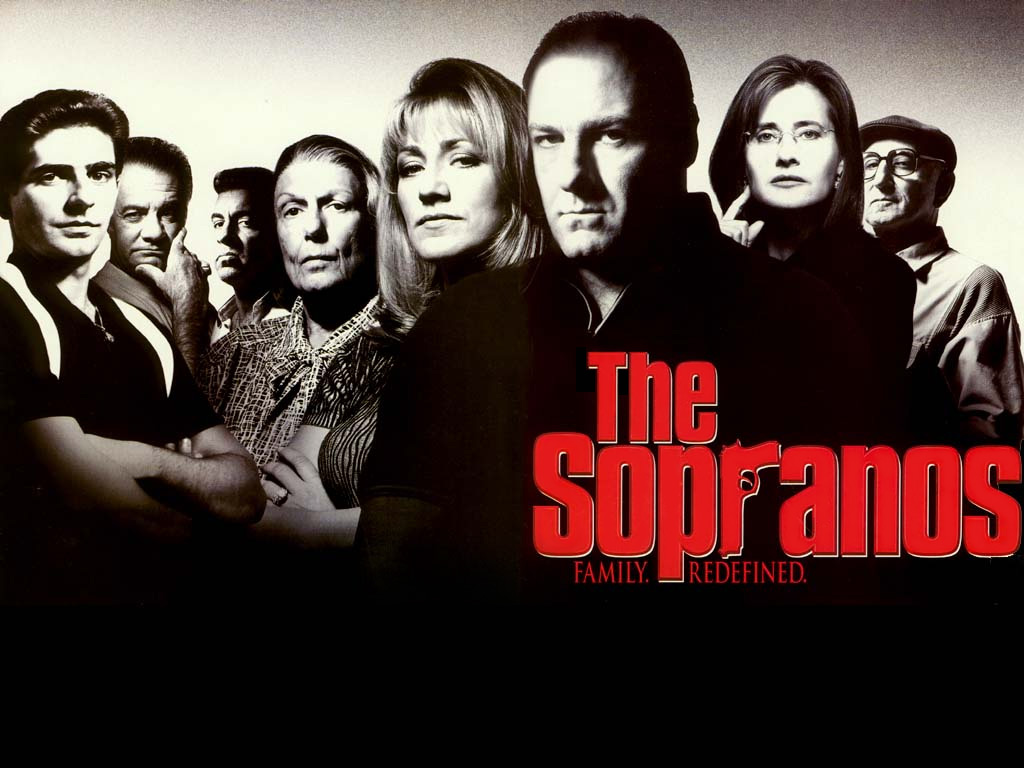
the-sopranos

The Writers Guild of America released its list of the 101 best-written TV series of all time today, and the list is guaranteed to generate some discussion.

I mean, it’s a cool idea and all, and everybody likes lists. But is anybody qualified to say “The Sopranos” is better than “Seinfeld?” I mean, how can you even compare those two?

(Cue funky “Seinfeld” music as Tony Soprano and family sit down in a diner in the final scene of the series.)

I think I’d rank “Buffy the Vampire Slayer” a hellmouth of a lot higher on my list. I can guarantee you that “Sex and the City” and “thirtysomething” don’t belong higher on the list than “Buffy” or “The Rockford Files” or “Freaks and Geeks.”

What do you think of the list?

1.             THE SOPRANOS

2.             SEINFELD

3.             THE TWILIGHT ZONE

4.             ALL IN THE FAMILY

5.             M*A*S*H

6.             THE MARY TYLER MOORE SHOW

7.             MAD MEN

8.             CHEERS

9.             THE WIRE

10.            THE WEST WING

11.            THE SIMPSONS

12.            I LOVE LUCY

13.            BREAKING BAD

14.            THE DICK VAN DYKE SHOW

15.            HILL STREET BLUES

16.            ARRESTED DEVELOPMENT

17.            THE DAILY SHOW WITH JON STEWART

18.            SIX FEET UNDER

19.            TAXI

20.            THE LARRY SANDERS SHOW

21.            30 ROCK

22.            FRIDAY NIGHT LIGHTS

23.            FRASIER

24.            FRIENDS

25.            SATURDAY NIGHT LIVE

26.            THE X-FILES

27.            LOST

28.            ER

29.            THE COSBY SHOW

30.            CURB YOUR ENTHUSIASM

31.            THE HONEYMOONERS*

32.            DEADWOOD

33.            STAR TREK

34.            MODERN FAMILY

35.            TWIN PEAKS

36.            NYPD BLUE

37.            THE CAROL BURNETT SHOW

38.            BATTLESTAR GALACTICA (2005)

39.            SEX AND THE CITY

40.            GAME OF THRONES

41.            THE BOB NEWHART SHOW – TIE

                YOUR SHOW OF SHOWS* – TIE

43.            DOWNTON ABBEY* – TIE

                LAW & ORDER – TIE

                THIRTYSOMETHING – TIE

46.            HOMICIDE: LIFE ON THE STREET – TIE

                ST. ELSEWHERE – TIE

48.            HOMELAND

49.            BUFFY THE VAMPIRE SLAYER

50.            THE COLBERT REPORT – TIE

                THE GOOD WIFE – TIE

                THE OFFICE (UK)* – TIE

53.            NORTHERN EXPOSURE

54.            THE WONDER YEARS

55.            L.A. LAW

56.            SESAME STREET

57.            COLUMBO

58.            FAWLTY TOWERS* – TIE

                THE ROCKFORD FILES – TIE

60.            FREAKS AND GEEKS – TIE

                MOONLIGHTING – TIE

62.            ROOTS

63.            EVERYBODY LOVES RAYMOND – TIE

                SOUTH PARK* – TIE

65.            PLAYHOUSE 90

66.            DEXTER – TIE

                THE OFFICE (U.S.) – TIE

68.            MY SO-CALLED LIFE

69.            THE GOLDEN GIRLS

70.            THE ANDY GRIFFITH SHOW

71.            24 – TIE

                ROSEANNE – TIE

                THE SHIELD – TIE

74.            HOUSE – TIE

                MURPHY BROWN – TIE

76.            BARNEY MILLER – TIE

                I, CLAUDIUS* – TIE

78.            THE ODD COUPLE

79.            ALFRED HITCHCOCK PRESENTS – TIE

                MONTY PYTHON’S FLYING CIRCUS* – TIE

                STAR TREK: THE NEXT GENERATION – TIE

                UPSTAIRS, DOWNSTAIRS* – TIE

83.            GET SMART

84.            THE DEFENDERS – TIE

                GUNSMOKE – TIE

86.            JUSTIFIED – TIE

                SGT. BILKO (THE PHIL SILVERS SHOW) – TIE

88.            BAND OF BROTHERS

89.            ROWAN & MARTIN’S LAUGH-IN

90.            THE PRISONER*

91.            ABSOLUTELY FABULOUS (U.K.)* – TIE

                THE MUPPET SHOW – TIE

93.            BOARDWALK EMPIRE

94.            WILL & GRACE

95.            FAMILY TIES

96.            LONESOME DOVE – TIE

                SOAP – TIE

98.            THE FUGITIVE – TIE

                LATE NIGHT WITH DAVID LETTERMAN – TIE

                LOUIE – TIE

101.            OZ
 

Unsung actors: Eddie Paskey of ‘Star Trek’

star trek eddie paskey

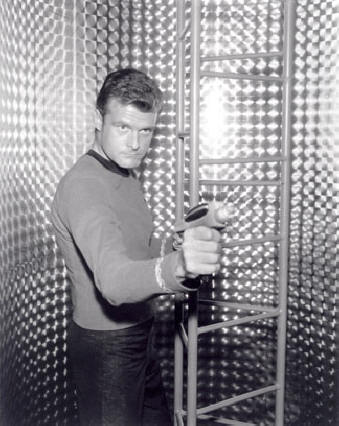
Besides the featured cast of the original “Star Trek” series, even beyond such recurring performers as Grace Lee Whitney as Janice Rand, there’s a familiar face in the background of most episodes of the series.

If you’ve watched many episodes, you’ve noticed actor Eddie Paskey, usually in a red shirt, a bad sign for “Star Trek” crew members.

star trek paskey w doohan

Yet Paskey appeared in 57 episodes of the original “Star Trek” series. He often played crewman and security officer Mr. Leslie, and the “Star Trek” wiki Memory Alpha says he appeared more often than Sulu or Chekov.

Paskey even died in one episode – true to his “red shirt” status – although he was alive and well in the next.

Paskey, now 73, left the series in its third season due to bad headaches from a medical condition complicated by the bright lights of the set. He operated his family’s auto-detailing shop and makes occasional “Star Trek”-related convention appearances.

Although Paskey is a familiar face from his many background appearances on the show, I didn’t know until I looked him up online that he had another pivotal role in the series: He was the driver of the truck that struck and killed Edith Keeler (Joan Collins) in the series’ greatest episode, “City on the Edge of Forever.”

And he was the hand double on the show for James (Scotty) Doohan, who was missing a finger.

If that’s not enough to guarantee a lifetime of appearances on “Star Trek” convention stages, I don’t know what would be.

‘Dragnet’ – Joe Friday on the job

dragnet the badge racket

I love “Dragnet.” Really.

The classic Jack Webb series – which ran in the 1950s and in the 1960s, although I’m really only familiar with the latter show – has long since become a touchstone for parody with Webb’s “just the facts, ma’am” writing, direction, casting and performances. But the show has a lot of virtues.

I’ve written about it as a LA travelogue before, for example.

Each half-hour episode quickly and concisely tells a story of crime and punishment in Los Angeles. Sure the show is ripe with silly hippie portrayals and overreaches in it’s messages. But Webb was master of the 30-minute (minus commercials) drama like no one since Rod Serling – and maybe no one since.

Still, it can be more than a little unintentionally funny.

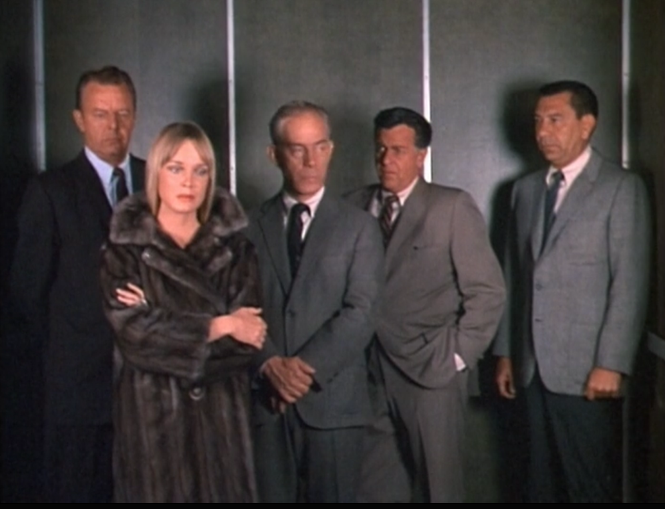
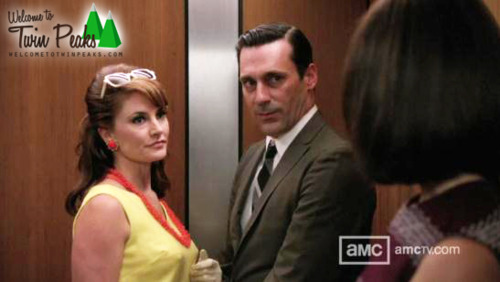
I was watching an episode today – “The Badge Racket,” from September 1967 – in which Gannon (Harry Morgan) goes undercover at an LA hotel to catch a threesome blackmailing out-of-town businessmen. A bimbo barges into the businessman’s hotel room and then two guys, posing as cops, shake him down for money in lieu of telling the folks back home in Nebraska or Iowa or wherever.

As Gannon leaves the hotel with the crooks, Friday follows in a “loose” tail.

When they get to police headquarters – it’s all part of the crooks’ plan, so just go with it – Friday tightens that “loose” tail and is seen riding the elevator with them in a “don’t mind me, folks” moment.

dragnet the badge racket

The scene very nearly made me fall out of my chair laughing. I looked around online and was able to find a screen cap on the wonderful site dragnetstyle.blogspot.com.

Love it.

RIP actor Steve Forrest

steve forrest dallas

Longtime TV  fans remember actor Steve Forrest as Hondo in the 1975 series “SWAT.” But I fondly remember Forrest from a later role in “Dallas.”

The 1986 season of “Dallas” was one of the oddest during the show’s original run on CBS. In the previous season, Bobby Ewing (Patrick Duffy) was written out of the show … only to return in a season-ending cliffhanger. Bobby’s disappearance was explained as “only a dream” of Pamela.

In the season that followed, Forrest joined the cast as Southfork Ranch foreman Wes Parmalee, a grizzled good ole boy who took a liking to Miss Ellie.

In time, Ellie came to believe that Wes was actually her husband, Jock, a character written out of the show when actor Jim Davis died.

Eventually, the Ewing boys proved that Parmalee was not Jock and Parmalee confessed and wandered into the sunset.

It was a fun storyline, however, and Forrest was good in it.

Forrest died in the Los Angeles area at age 87.

‘Star Trek Into Darkness’ easter eggs

Kirk_surrounded_by_Tribbles

If you’ve seen “Star Trek Into Darkness,” you know that a lot of the plot revolves around events told, in a different manner, in an earlier “Star Trek” movie, “Wrath of Khan.”

I won’t go into that here – I touch on it in my review – but there’s more in the way of easter eggs than just those remake references.

william marshall richard daystrom

Daystrom. The meeting of Starfleet captains and admirals that’s interrupted by the attack by villain John Harrison (Benedict Cumberbatch) is to be held, Chris Pike tells Jim Kirk, at “Daystrom,” possibly a reference to the often-referenced Daystrom Institute. Richard Daystrom, as played by William Marshall, appeared in the original series episode “The Ultimate Computer” as the inventor of the title character, which (briefly) displaces Kirk in command of the Enterprise.

harry mudd

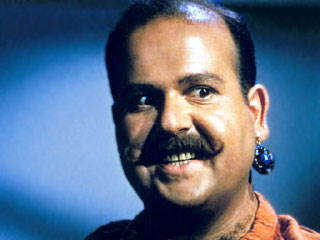
Mudd. There’s a throw-away reference to “the Mudd Incident,” undoubtedly a reference to Harry Mudd, the galactic con artist played by Roger C. Carmel who appears in two episodes of the original series.

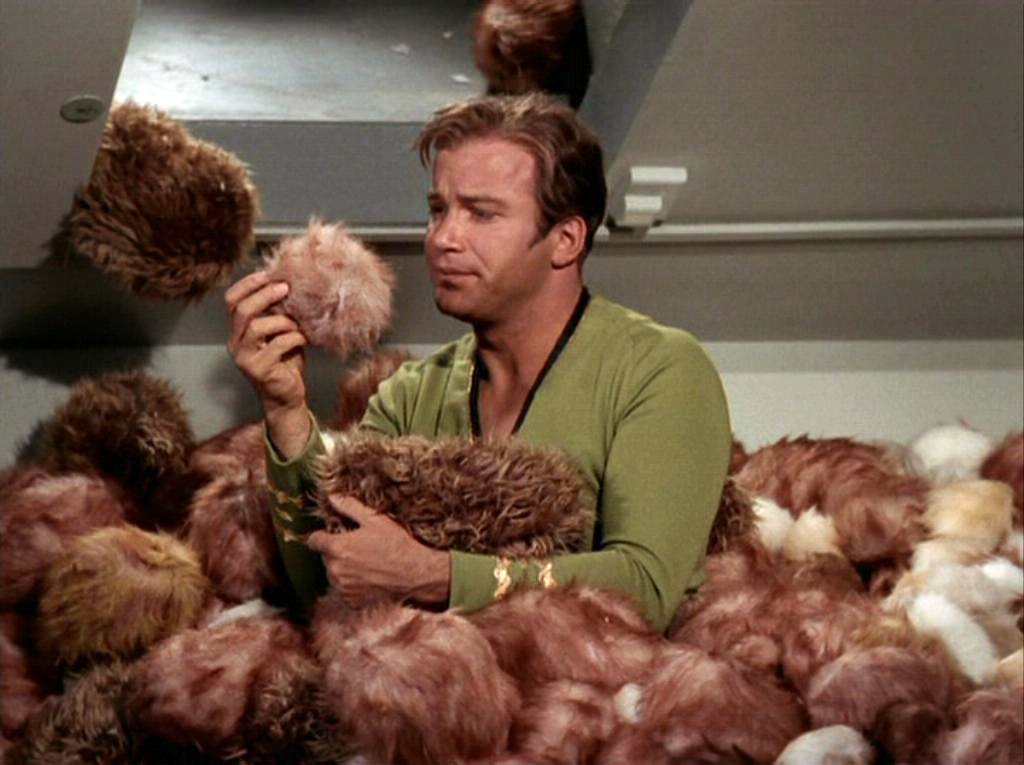
Tribbles. There’s a tribble – the furry, prolific fan favorite creatures from the original series – that plays an important role in the movie. They’re from the original series episode “The Trouble with Tribbles.” Although the one in the movie looked even more sluggish than you might expect an ill tribble to look.

Christine Chapel. Carol, the blonde Starfleet officer played by Alice Eve, tells Kirk he’s gained a reputation with women and cites Christine Chapel, a nurse she knew. It’s obvious Kirk bedded her and doesn’t remember her. In the original series and movies, of course, Chapel is Dr. McCoy’s nurse and is played by Majel Barrett Roddenberry, wife of “Star Trek” creator Gene Roddenberry.

Section 31. In the later TV series, Section 31 is a top-secret division of Starfleet that handles investigations and special missions. It is name-dropped in “Into Darkness.”

There’s probably more that didn’t have to do with the new movie’s basis in “Wrath of Khan.” Spot any that I missed?

Into Darkness: ‘Star Trek’ past and present

star trek into darkness brig

All weekend, I’ve been trying to find a way to express my feelings about “Star Trek Into Darkness,” the new J.J. Abrams follow-up to his 2009 reboot of the classic TV and movie series.

I really liked the 2009 movie and liked what Abrams did with it:  By rebooting the stories but putting his own stamp on them by playing havoc with the timeline, he made it all seem fresh. True, the movie lacked a compelling villain and took a while to get started, but it was a top-notch effort.

Almost the opposite is true of “Star Trek Into Darkness.”

I should say that I actually liked the  movie pretty well. This being the second film, no long set-up to establish the setting and characters was necessary. The cast has settled into their roles with ease. I could watch Zachary Quinto and Chris Pine play Spock and Kirk until they are as old as Leonard Nimoy and William Shatner.

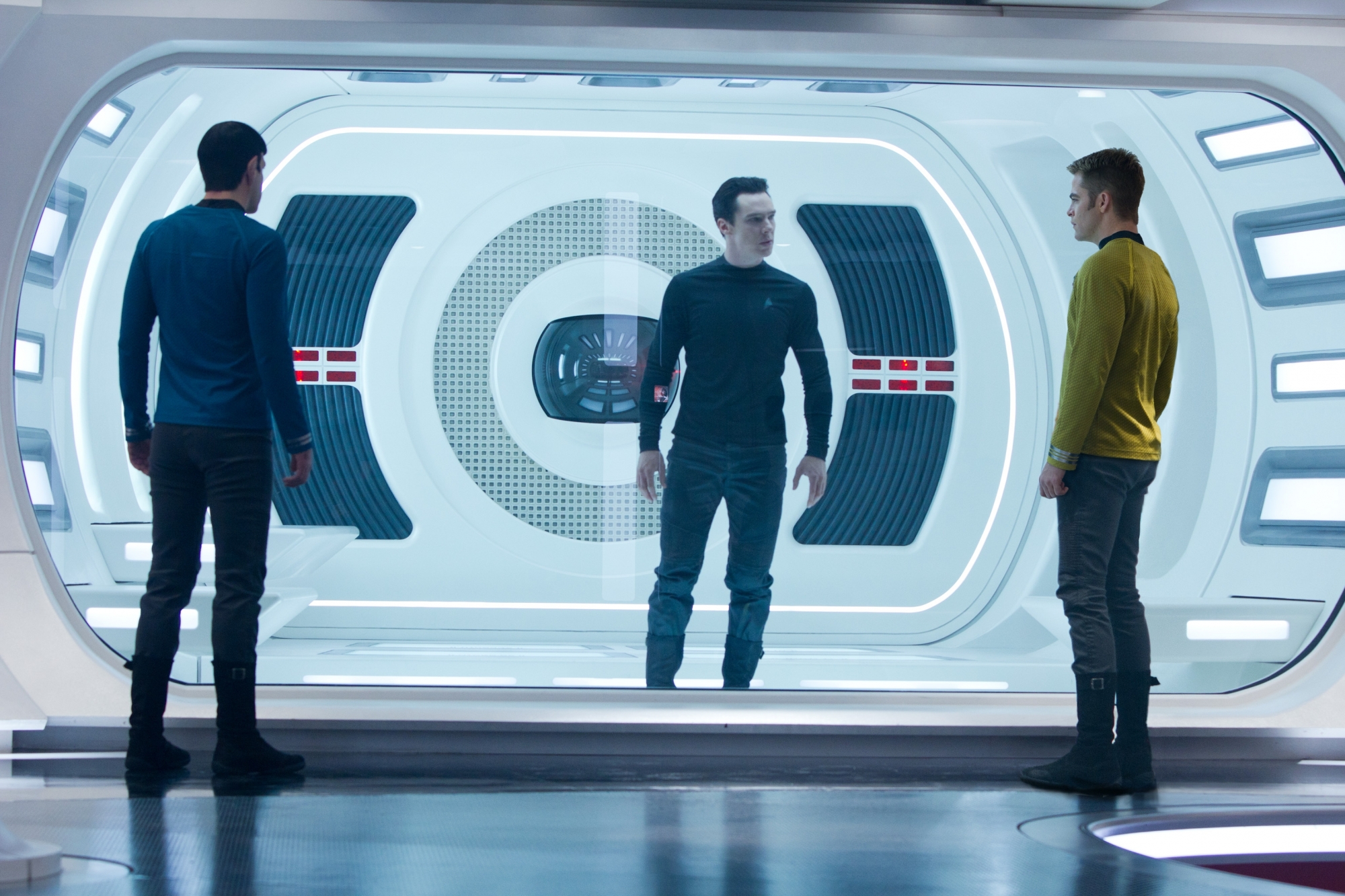
And what a villain. I’m going to be venturing into spoiler territory here, so be warned. Okay? As “John Harrison,” Benedict Cumberbatch is one of the best “Star Trek” bad guys ever. Half-way through the film, when a captive Harrison announces that he is, indeed, Khan, it seemed perfect and gratuitous at the same time. Cumberbatch matched Ricardo Montalban for arrogant menace. But to what end? While I likewise could watch Cumberbatch play this dangerous but fascinating superhuman in a new movie every few months, there was nothing about the way the character was written that added meaning to the fact that he was Khan. He could have been your garden variety genetically superior bad guy.

In fact, Abrams’ and his screenwriters’ best creation is also, in some ways, their most pointless. The weight of history made the Khan character important in “Star Trek II: The Wrath of Khan.” This was a superheroic but tragic figure who had a reason to hate Kirk from – in the movie’s timeline – the captain having abandoned him 15 years before. In “Into Darkness,” Khan has a grudge against Peter Weller’s Starfleet admiral. And you know what? Weller’s Admiral Marcus was an asshole. In those scenes in which Khan was working with Kirk and Scotty to take Marcus down – and as much as I appreciated Kirk’s “I think we’re helping him” – I was actively rooting for Khan.

So much about “Into Darkness” seems overstuffed. My son observed after the movie, “It seemed like they were trying too hard.” He had just seen most of “Wrath of Khan” the night before and, while he’s not overly impressed with “Star Trek” in general, took note when “Harrison” introduced himself as Khan. But ultimately the shared plot and characters didn’t have much of an impact, on him or me.

“Into Darkness,” as fun and exciting as it is – and it is – seemed to be too laden with references and plot points and call backs to characters. We get the Prime Directive. Tribbles. All those cryogenic supermen (and not another single one gets thawed out). Carol Marcus, future mother (at least in the old movies/timeline) of Kirk’s son. And the whole sacrifice that doesn’t turn out to be a sacrifice at the end.

star trek II wrath of khan

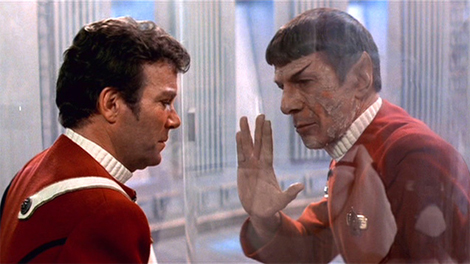
I still remember going with a group of friends to see “Wrath of Khan” in 1982. We had been delighted to see “Star Trek: The Motion Picture” three years earlier but its leisurely pace (jeez, just dock the shuttle already) and uncharacteristic relationship between Kirk and Spock and McCoy – because of Spock’s efforts to purge his human traits – were disappointing. “Wrath of Khan” was like a rebirth.

And the suspense. Even in those pre-internet days, somehow we all knew the rumors that Spock might be killed off at the end of the movie. Director Nicholas Meyer even teased us when, early on, he has Kirk ask Spock, “Aren’t you dead?” after the training exercise.

By the time the end of the movie rolled around, and we saw Spock’s fate play out in front of us, we were deeply moved.

As affecting as the climax of “Into Darkness” was – and it was – it felt like just another plot twist. Yes, we knew that “E.T.” was going to come back from the dead when Elliott’s flower revived. Same with the tribble here.

I can’t say I didn’t like “Star Trek Into Darkness.” I did. I felt it hit all the right notes – albeit maybe a few too many – and was a great showcase for terrific actors – especially Cumberbatch and Quinto – and rousing action scenes.

But the movie didn’t improve on the original in the ways that really mattered.

Random observations:

As great as Quinto is as Spock, Pine equals him as Kirk. It was cool to see him, by the end of the movie, in the place where Shatner’s Kirk was when the series started.

I miss Bruce Greenwood’s Chris Pike already.

Does Zoe Saldana rock that ponytail or what?

Karl Urban is so good as Bones, I wish he had more to do in these movies. There’s just one scene where the Kirk/Spock/McCoy character triangle plays out as it did in the TV show and movies. I could have used more.

I was pleased there were so many space scenes in the movie, particularly since the trailers and commercials made it look like the plot revolved around urban (not Karl) action in London and San Francisco.

It was good to see Leonard Nimoy although his scene was perhaps the most gratuitous moment in the film if you don’t count Alice Eve showing off Carol Marcus’ “holy moley” figure. I didn’t mind either, but Nimoy’s scene in particular seemed pointless.

khan!!!!!!

Still no Shatner. I’ve come to accept that William Shatner will probably never appear in these movies. Apparently there was a nice Classic Kirk scene – mostly voice over, a holographic recording from beyond the grave – considered for the end of the first movie. I mourn that didn’t happen.

Classic TV: ‘Electra Woman and Dyna Girl’

electra woman and dyna girl point

Airing in 1976 on the Saturday morning “Krofft Supershow,” “Electra Woman and Dyna Girl” was, frankly, a little after my time. I was a high-schooler by that point and not watching a lot of Saturday morning cartoons or live-action shows like this one.

But there must be a reason why there’s an “Electra Woman and Dyna Girl” magnet on my refrigerator.

electra-woman-and-dyna-girl

Well, two reasons: Stars Deidre Hall and Judy Strangis.

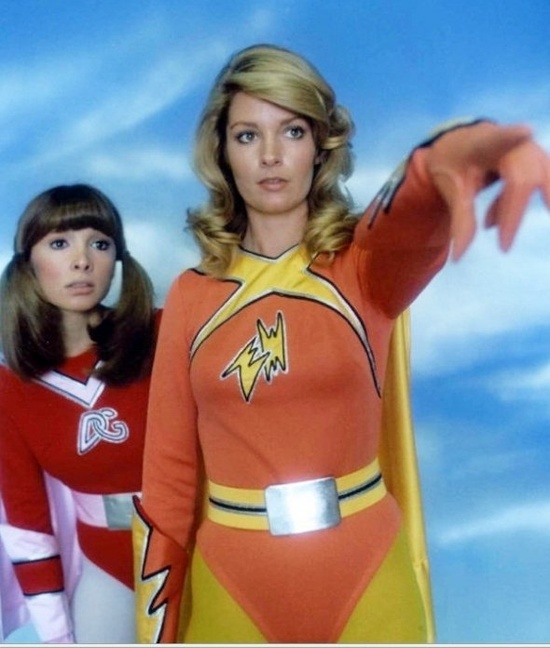
The show – just 16 episodes of about 15 minutes each – was a campy and dreadfully cheap female knock-off of the 1960s “Batman” series. Hall – later to win fame in “Days of Our Lives” – and Strangis – who had starred in the school sitcom “Room 222” – played the title roles as do-gooders who, with help from colorful spandex costumes, their inventive assistant Frank (Norman Alden) and oodles of spirit, fought dire super villains like Ali Baba (Malachi Throne, with a henchman played by the wonderful Sid Haig) and Glitter Rock.

The shows were cheaply made – shot on video, with shoestring special effects – and filled with exclamations like “Electra wow!” from Dyna Girl.

Yet Hall and Strangis made an indelible impression on kids, especially boys, and teens (ahem) who saw the show. There’s a reason clips fill You Tube to overflowing and website after website is devoted to the duo.

judy strangis dyna girl

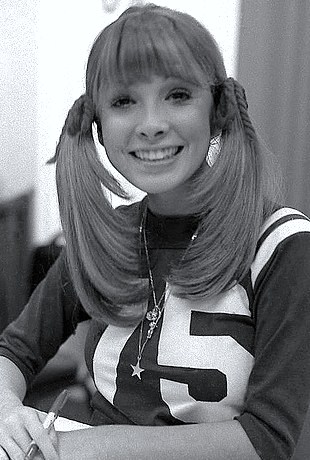
Hall, with an amazing pile of blonde hair, was gorgeous. But Strangis, fresh-faced and pigtail-wearing, was a girl that all of us could fall in love with.

The ‘Star Trek’ / ‘To Kill a Mockingbird’ connection

brock peters star trek

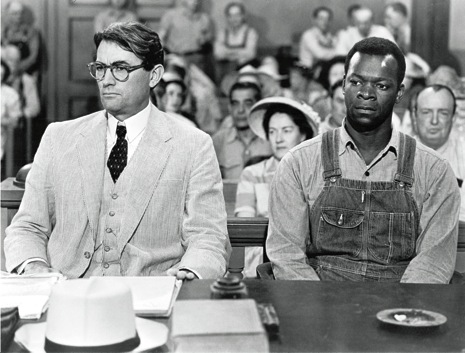
I’m not sure when I first noticed that some of the cast of that classic 1962 drama “To Kill a Mockingbird” had later turned up in “Star Trek” TV episodes and movies, but I was watching the Gregory Peck film – an adaptation by Horton Foote of Harper Lee’s novel of tolerance – recently and was struck when I realized that not one, not two, but three members of its cast had memorable roles in “Star Trek” within a few years.

brock peters to kill a mockinbird

It’s likely the easiest-to-spot connection is actor Brock Peters, who played criminal defendant Tom Robinson in the movie.

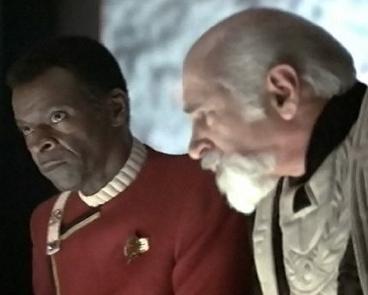
Peters is memorable for two “Star Trek” roles. He played Joseph Sisko, father of Avery Brooks’ Benjamin Sisko, in the 1990s series “Star Trek: Deep Space Nine.” And he played Starfleet Admiral Cartwright in “Star Trek IV: The Voyage Home” and “Star Trek VI: The Undiscovered Country,” two of the best in that series. (How can you tell? They’re both even-numbered “Trek” movies.)

william windom to kill mockinbird

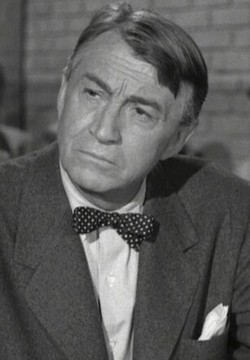
Also easy to spot is William Windom as the prosecutor, Gilmer, in “To Kill a Mockingbird.”

william windom star trek doomsday machine

Windom had one of the showiest guest-starring roles in all of the original “Star Trek” series, as Commodore Decker, the doomed starship commander who squares off against “The Doomsday Machine” in the memorable 1967 “Star Trek” of the same name.

paul fix judge to kill mockingbird

The hardest-to-spot actor who crossed over from the movie to the “Trek” universe might be Paul Fix, who played Judge Taylor in the movie.

paul fix star trek mark piper

If things had gone differently, Fix might be as familiar a Hollywood figure as any of the “Star Trek” regulars. Fix was cast as Mark Piper, the ship’s surgeon of the Enterprise, in “Where No Man Has Gone Before,” the second pilot for “Star Trek.” Yes, Piper was the early version of Leonard “Bones” McCoy, The ship’s doctor was McCoy by the time the series began airing, but Fix is there throughout “Where No Man Has Gone Before” as Kirk’s doctor and confidant.

While the series was still trying to find a spot on NBC’s schedule, the network rejected Gene Roddenberry’s original pilot, which featured Jeffrey Hunter as Captain Christopher Pike. “Where No Man Has Gone Before” was the second pilot, and made several alterations to the make-up of the crew, including the addition of William Shatner as Kirk.

Although Fix – who died in 1983 – was a solid character actor, the mix of great writing and DeForrest Kelley’s portrayal of Bones McCoy made that character a classic. It’s impossible to imagine Mark Piper saying, “He’s dead, Jim!” with as much feeling as Kelley.


Don’s new fling: Linda Cardellini in ‘Mad Men’

Linda-Cardellini

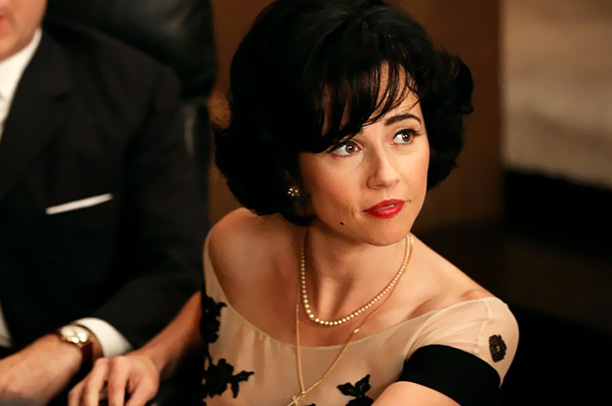
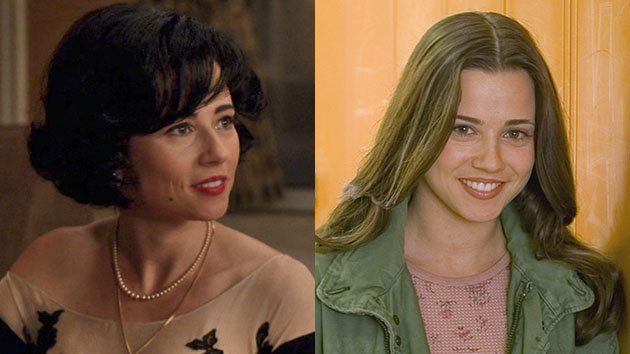
Every few scenes in last night’s season premiere of “Mad Men,” I was wondering: Who’s the actress playing the wife of Don and Megan’s neighbor, heart surgeon Dr. Rosen?

After the final scene, I was wondering: Who’s the actress playing the wife of Don and Megan’s new neighbor, heart surgeon Dr. Rosen, whom Don is boinking? (The wife, that is. Good god, people. He’s not Don’s type.)

madchen amick mad men

She looked so familiar, but I couldn’t figure it out. Was this another actress from the 1990s, like Madchen Amick as Don’s flirtation last season?

The credits went by way too fast to catch a name, so I turned to online sources and was shocked to discover the character was played by Linda Cardellini.

Lindsay from the classic TV show “Freaks and Geeks!”

linda cardellini mad men

Mind. Blown.


Classic TV: ‘Duel’

duel

Four years before Steven Spielberg became one of the few Hollywood directors to be a household name – thanks to “Jaws” in 1975 – he made one of the most-watched TV movies of all time. It even won a Golden Globe.

“Duel” featured Dennis Weaver – TV’s “McCloud” – as a salesman traveling the backroads of Southern California, pressured to make it to an appointment on time, when he runs afoul of the driver of a tanker truck. The two take turns passing each other on a winding two-lane road and it quickly becomes obvious that the trucker has more than just an attitude. Weaver comes to believe that the man intends to kill him.

When Spielberg made “Jaws” just a few years later, a lot of people drew comparisons to “Duel.” Both do feature a large unstoppable force finally brought down by a lone man. Spielberg has said the movies share the theme of “leviathans targeting an everyman.”

The movie was written by Richard Matheson, one of the great fantasy writers of all time. Matheson’s stories have been adapted into movies ranging from “The Incredible Shrinking Man” to “I Am Legend.”

There’s not a lot of character development – heck, there’s not a lot of characters – in “Duel.” I guess we’re supposed to think that Weaver starts off kind of wimpy – he doesn’t say anything when a neighbor makes advances on his wife – and ends up saving his own life and taking a menace off the road.

Watching this movie again recently made me think it played like a prequel to Pixar’s “Cars.” And not just because the truck in question looks like rusty, lovable ol’ Mater on steroids. The story plays out on a dusty two-lane western road that seems like the one that leads to and from Radiator Springs. No wonder people quit going to that town: the charming little road was filled with psychotic truckers!

“Duel” was Spielberg’s second TV movie, after an episode of “The Name of the Game.” Although it lags in spots – Weaver’s sojourn in a cafe seems to go on forever – it’s tense and gritty when Weaver is on the road, being pushed and bullied by the trucker.

It’s an interesting choice by Spielberg to keep the trucker anonymous. Other than a pair of boots and an arm, we never see him, even at the end.

“Duel” was released in theaters, particularly overseas, and its short running time required that some scenes be added. Weaver’s call home to his wife was one of those, as was a scene with the truck driver idling ominously while Weaver tries to help a stranded school bus. Also added was a great railroad crossing scene.

“Duel” was the state of the art for TV movies more than 40 years ago and is still quite suspenseful and effective.