Category Archives: comic books

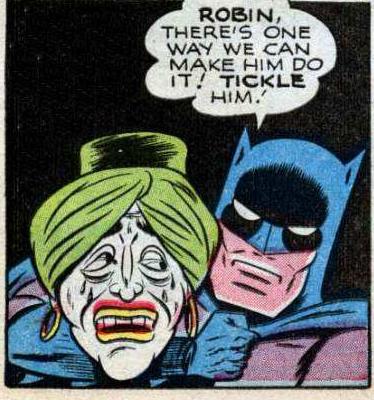
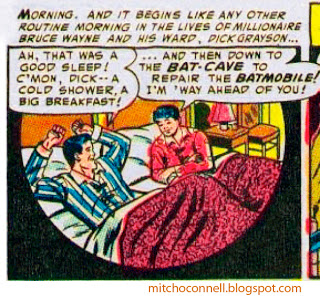
Comic book odd: Batman tickles Joker

tickle joker

This one doesn’t require much explanation.

Or maybe it does.

This installment of our occasional series of odd and inappropriate comic book panels comes from Batman Volume 1 Number 49, released by DC in October 1948.

The story is “Batman’s Arabian Nights,” and the action finds the Caped Crusaders up against the Joker. Kinda.

Bruce and Dick find a 1,000-year-old rug with the Joker’s face on it. To investigate, they go back in time (!) through hypnotism to ancient Baghdad and find a duplicate for the Joker …  only this one sobs all the time.

Before long, Batman tickles him to make him laugh and … I kind of lost the thread of the story there.

But it’s a good panel.

‘Three Ghosts’ elevates ‘Arrow’ even more

arrow three ghosts mask

Just a few days ago, I was arguing here that “Arrow,” the current CW show about the early days of the DC Comics hero Green Arrow, might be the best superhero TV show of all time.

Last night’s “mid-season finale” episode of “Arrow” really backed up my argument.

(A word about mid-season finales or winter finales or whatever the networks are calling them: Shows like “Mad Men” and “The Walking Dead” take very deliberate breaks in the middle of their 14 or 16-episode seasons – mostly to avoid periods when networks think no one is watching, like the holidays, even though they’re wrong – and build to a strong climax for the final episode before that break. Although it would sound a little overblown on a sitcom, for example, mid-season finale seems appropriate for hour-long serialized shows that have built to a dramatic temporary stopping point. Like “Arrow.”)

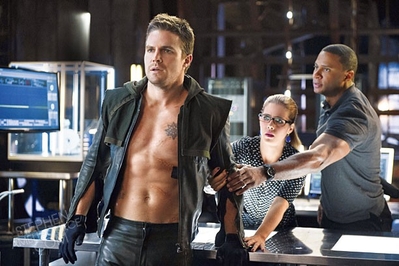
“Three Ghosts,” last night’s “Arrow,” has as many dramatic elements as some season finales. And if you missed the significance of the title, it’s a reference to Dickens’ “A Christmas Carol.” During the course of the episode, Oliver is haunted by three figures from his past. Thankfully, the Dickensian undertones were decidedly undertones.

Arrow_Three_Ghosts three

“Three Ghosts” had a lot on its plate:

Although the flashbacks to five years earlier on the island aren’t likely to be done, last night’s episode went a long way toward tying those events into the Arrow’s present-day Starling City action.

We learned the fate of a couple of characters. Maybe.

We saw the origins, I’m thinking, of at least two more. Cyrus Gold, one of Brother Blood’s “super soldiers,” might have bigger (and deader) things ahead for him. As the poem that Diggle discovered goes, “Solomon Grundy, born on a Monday …”

The Scientist

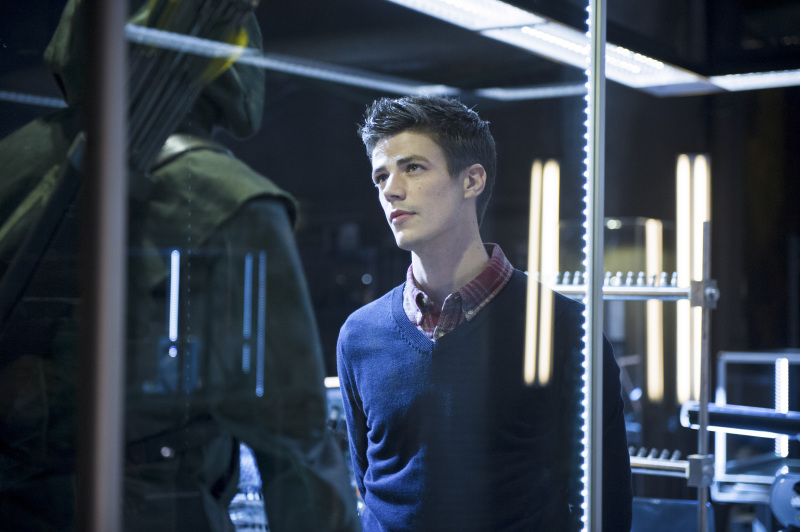
Although it was a surprise, we saw the origin of the Flash, the DC hero who’s getting his own CW series (most likely) next fall. Grant Gustin has been guest-starring the past couple of episodes as Barry Allen, a CSI from Central City. The network had said Allen would appear in only these two episodes before moving on to his own series pilot. I didn’t expect to see the accident – true to the comics – that turns Allen into the Scarlet Speedster at the end of this episode, but I was glad they did it.

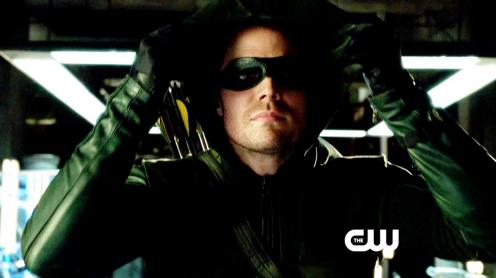
I guess you could argue that we saw the origin of Green Arrow, too, since Allen’s parting gift to Oliver Queen was a green mask that he could wear in place of camo makeup. As the episode closed, Ollie donned the mask. Is he still Arrow? Or is he Green Arrow? He’s sure not “the Hood” or “the Vigilante” anymore.

The episode had something for every cast member to do and emphasized, with one exception, what a strong ensemble this show is built around.

By the end of the episode, the series has set up a much more compelling “Big Bad” than Brother Blood. I won’t spoil it here if you haven’t watched it yet, but it’s not surprising to anyone with some comics history under their utility belt.

Here’s looking forward to the back half of the season.


‘Arrow’ – Best superhero TV of all time?

Three GhostsHow can you – well, I, really – proclaim anything the best of its kind of all time when it’s still relatively new and hasn’t withstood the test of time?

Beats the heck out of me. But I’m inclined to call “Arrow” the best live-action superhero series of all time. And yes, we’re not quite half-way through the CW network show’s second season.

But the gritty and stylish Greg Berlanti-developed series, featuring Stephen Arnell as millionaire crimefighter and adventurer Oliver Queen, who uses gimmicky arrows and amazing trick shots to fight crime, is tops.

Believe me, I didn’t expect to go into this fall season liking “Arrow,” the DC Comics-based show about a Batman-style vigilante in its second season, better than “Agents of SHIELD,” the TV beachhead for the Marvel movie universe.

And yet …

Crowning “Arrow” might sound like heresy for people who loved the simple pleasures of the 1950s “Adventures of Superman” series or the camp 1960s classic “Batman” or even more recent ventures like “Lois and Clark” or “The Flash” or “Birds of Prey,” all of which have their strong points.

But no, “Arrow” is better than all of them, a truly satisfying experience for comic book fans.

I was a little worried about “Arrow” when it was announced by the CW a couple of years ago. The Green Arrow character had been a nice addition to the network’s “Smallville,” the 10-season show about the growing years of Superman and, for me, marked when the series finally got interesting. The Clark and Lex theme of the show was always good but the writers were just too coy for too long. And I have to say I was kind of ticked off when they never actually showed Clark in the suit, even in the final episode. It all reeked of superhero shame.

But despite some coyness of its own – “Arrow” instead of “Green Arrow” as a title – “Arrow” has the courage of its convictions. The series put millionaire Oliver Queen into a green hood right from the word go and put him on the path to avenging criminal activity. He’s surrounded by an engaging supporting cast.
barry allen on arrow

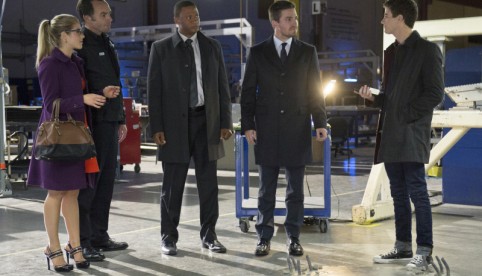
And the series has aggressively set about building its own universe, adding characters like Black Canary, Slade Wilson, Huntress and, this week, Barry Allen, a young police scientist who’s not yet the Flash. The character, as played by Grant Gustin, is apparently destined for his own CW show. If it’s handled like “Arrow,” we’ll have another classic on our screens.

“Arrow” has some problems, certainly. But it feels like they recognized most of them early.

Chief among them is Katie Cassidy, cast as Oliver’s ex-girlfriend Dinah Laurel Lance, who comic fans know is destined to become Black Canary, a tough-as-nails hero and companion to Green Arrow.

But it’s almost as if the producers decided early on that the character and actress combination was just too … I don’t know, awkward? Cassidy seems like she would never for a moment be believable as a street-fighting gal. The show has introduced a new Black Canary, Dinah’s sister, played by Caity Lotz, and she’s more believable.

The cast is pretty uniformly good, from thinking man’s hunk Arnell to David Ramsey as Dig, Oliver’s cohort, to Emily Bett Richards as Felicity, Oliver’s Gal Friday and tech guru who deserves all the online worship she gets.

The show flips back and forth from Arrow’s exploits fighting crime in present-day Starling City (an inexplicable change from Star City in the comics) to five years earlier, when Oliver was shipwrecked on a not-even-remotely-deserted island and learned his survival skills.

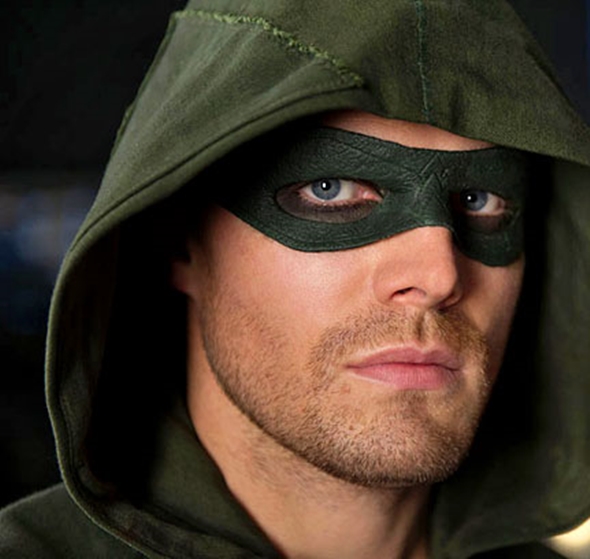
The first season gave us an Oliver on a mission to clean up his city and willing to casually kill bad guys. The second season has Oliver pursuing a less murderous campaign. Heck, he’s apparently even about to start wearing the mask seen in the photo at top here.

All the while, “Arrow” is adding characters and mythology and feeling stronger and stronger.
‘The Avenger’ is coming – the one you haven’t heard of

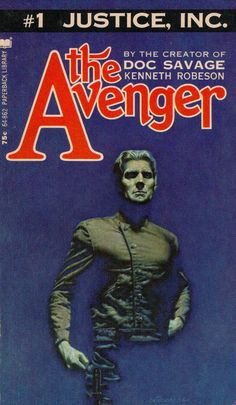
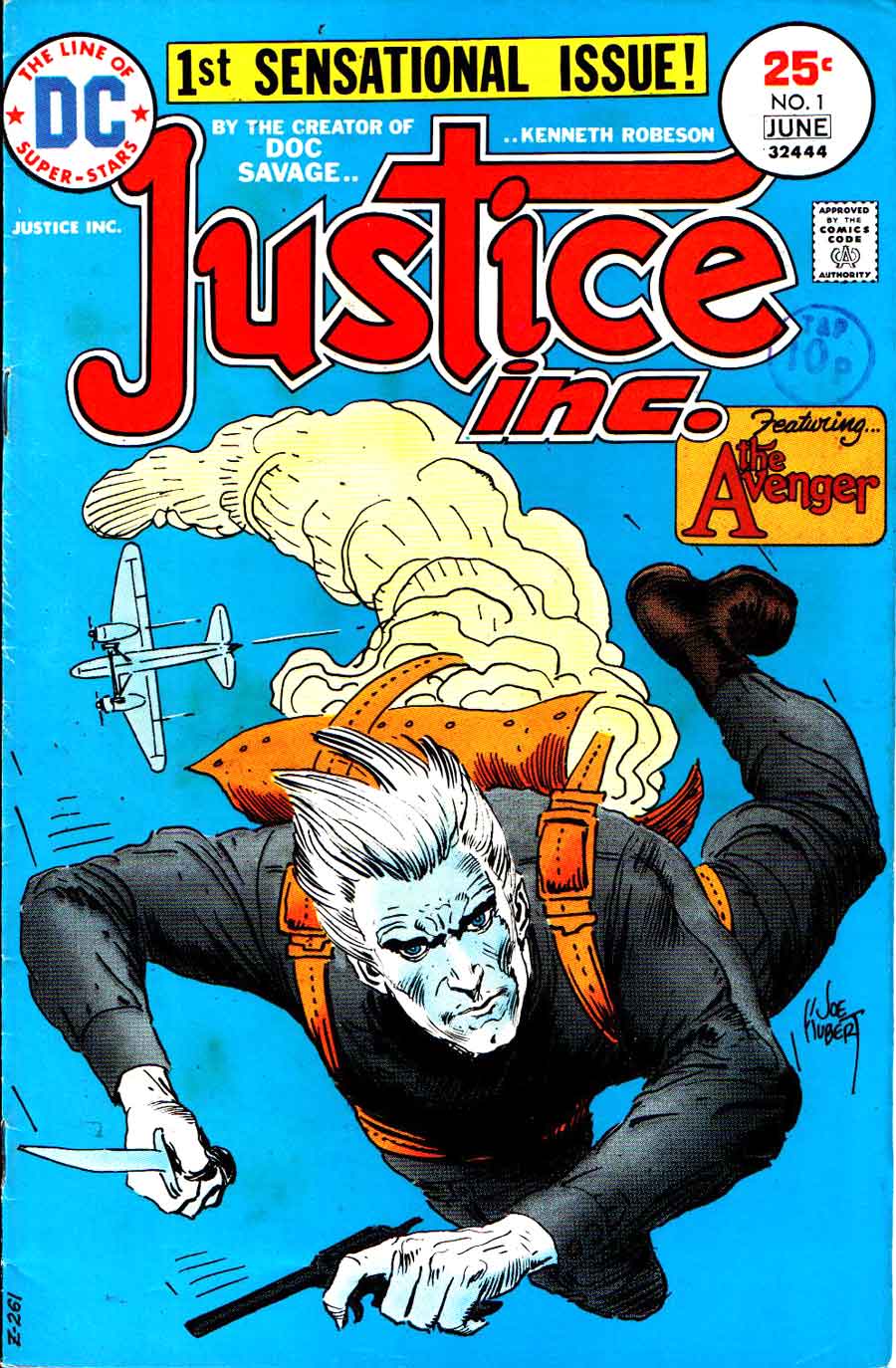
the avenger 1 justice inc

When the adventures of the 1930s pulp magazine hero The Avenger were reprinted in paperback in the early 1970s, they were right up my alley. I had already become a fan of the Doc Savage paperback reprints and the Avenger books were labeled as being by Kenneth Robeson, creator of Doc Savage.

I later found out that the stories – which originally appeared in Street and Smith pulp magazines from 1939 to 1942 – had actually been written, all those decades earlier, by Paul Ernst. Robeson was a Street and Smith “house name” that several action hero writers used. The Doc Savage books had been written by Lester Dent, to a great extent.

But the stories of The Avenger were so cool and so dire that it didn’t matter.

Like Doc Savage, the Avenger – originally a normal guy (if you call a wealthy world-traveler and adventurer normal) named Richard Henry Benson – fought crime with the help of a band of comrades and a healthy bank account.

But Benson/The Avenger drew his crime-fighting inspiration from the same dark well as Batman. Benson’s wife and daughter were brutally killed by gangsters.

Benson didn’t just take up the mantle of crimefighter. The shock of his family’s slaying was literally a shock to Benson’s system. His hair turned white. His eyes – somehow – turned pale. And Benson’s face froze. No longer could he voluntarily change his expression. His bleached face was described as like something out of a graveyard.

But Benson could suddenly mold his face, moving his jaw and nose and cheekbones and brow to resemble other people. With the help of makeup, colored contact lenses and wigs, Benson could now go undercover, infiltrating crime rings and mobs.

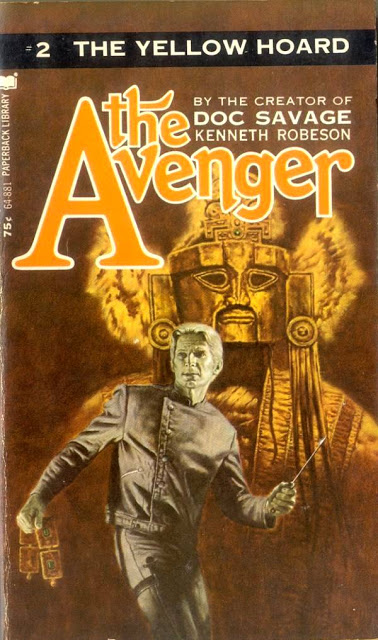
the avenger 2 the yellow hoard

Armed with his ghoulish visage and high-tech weapons – including a streamlined gun and knife set he called “Mike and Ike” – Benson brought criminals to justice.

I was fascinated by all this. By the time i was reading the Avenger stories in the early 70s I was familiar with Batman’s tragic backstory, of course. Richard Henry Benson’s was perhaps even stranger and more tragic in that it also left him disfigured … but he turned the handicap into a crimefighting tool.

justice inc comic

The Avenger had a couple of changes at revival after the paperback stories were published. DC Comics – which in the early 1970s had revived another great pulp hero, The Shadow – published an Avenger comic book in 1975. No doubt because DC competitor Marvel had been publishing “The Avengers” for more than a decade, DC called its Avenger book “Justice Inc. featuring The Avenger.”

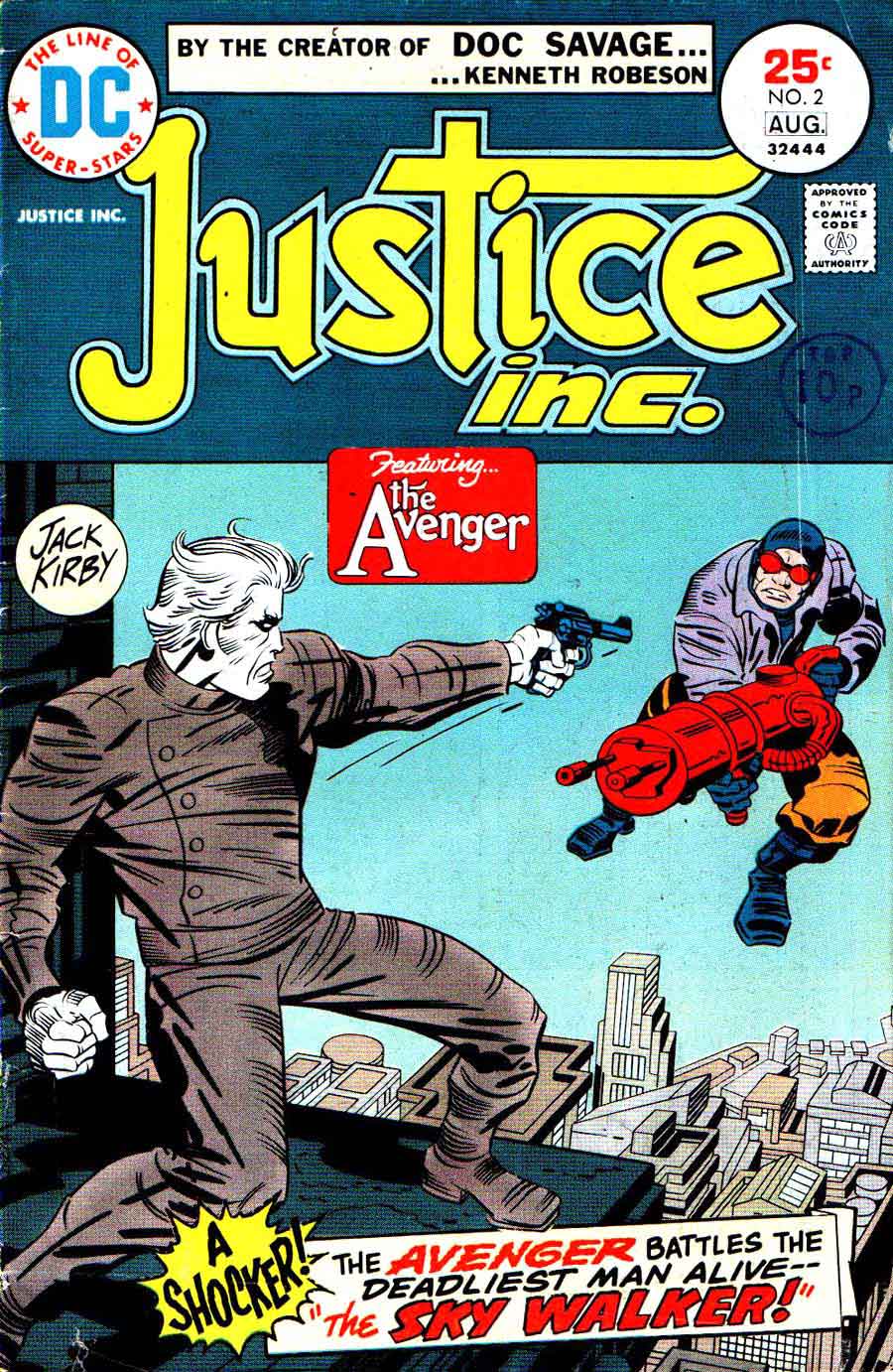
justice inc kirby cover

Jack Kirby even did some work on the comic.

Besides the nostalgia factor, I’m noting all this now because of the recent news that producers are developing, for The CW network, a new TV series version of The Avenger, with several changes, of course. Instead of Richard Henry Benson, the heroine is Alice Benson. The new Avenger has the same malleable features and the same undercover missions as she investigates the deaths of her parents (rather than spouse and child).

I’m guessing in light of Marvel’s big-screen “The Avengers” movie, the TV series will be called something else.

It’ll be interesting to see if the new series can capture the same feeling of an adventurer – an avenger – with nothing left to lose in a hell-bent pursuit of evildoers.

RIP comic book great Al Plastino

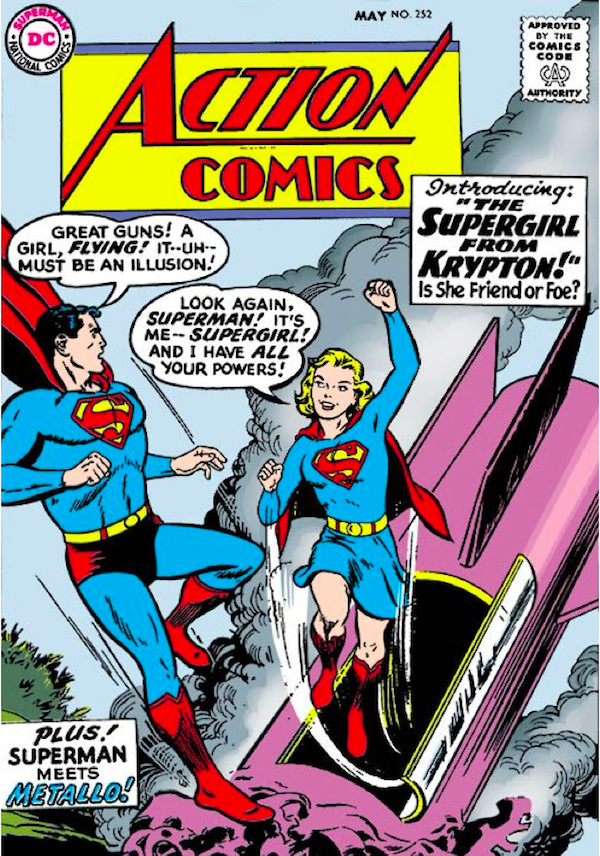
al plastino supergirl action 252

The comic book Golden Age was a simpler time and – as befits the name – a truly golden period of straightforward storytelling, plots and art.

Al Plastino, who passed away Nov. 25 at age 91, was responsible for some of the most golden Golden Age art, particularly in DC Comics and particularly with the Superman family of books and characters.

In 1959, in Action Comics 252, Plastino co-created with Otto Binder the character of Supergirl, Superman’s cousin who also survived the destruction of Krypton.

The debut of Kara, the Supergirl from Krypton, was on the charming cover above.

Comic book odd: Um, you sure about that, Cap?

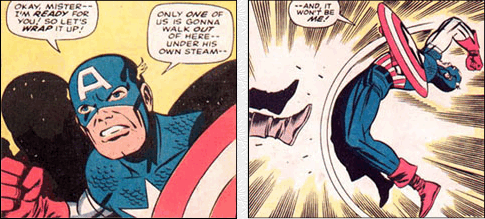
captain america blooper

Anybody’s who’s read this blog knows I love Captain America.

So this is one of my favorite comic book bloopers. I first saw it in a Marvel Comics “No Prize” collection a long time ago.

From “Tales of Suspense” 92, cover dated August 1967. Also in this issue, Iron Man returns to Vietnam.

‘Nuff said.

By Selvig’s Chalkboard! More ‘Thor’ sequel Easter eggs

selvig chalkboard thor the dark world

Right before “Thor: The Dark World” opened, I pointed out some of the hidden secrets from the latest Marvel movie and how its first end credit scene – featuring the Collector, a character from next year’s “Guardians of the Galaxy” movie – set up a narrative thread that could carry Marvel movies through “Avengers 3” in 2018.

Turns out there were other Easter eggs also that I’ve been learning about this week thanks to online postings.

The “Cabin in the Woods” whiteboard was a treasure trove of geeky fun for fans of that movie, and the chalkboard Erik Selvig uses to explain the events of the first “Thor” movie are pretty fun too.

Sharp-eyed fans have pointed out the reference on the chalkboard to the “616 Universe,” the name for the Marvel universe all the comic book characters inhabit. Looks like crazy old Selvig knows it exists.

The board also references – in a portion of the board right behind Selvig – “The Fault,” a “tear in the universe” plot point used in comic book stories featuring The Inhumans, the secretive super-powered race that Marvel is said to be interested in bringing to the big screen.

There’s also reference to “The Crossroads,” taken from a past adventure featuring the Hulk and … Dr. Strange, another Marvel character apparently destined for the big screen.

Here’s one I’m actually kinda more excited about, even if it is a longshot:

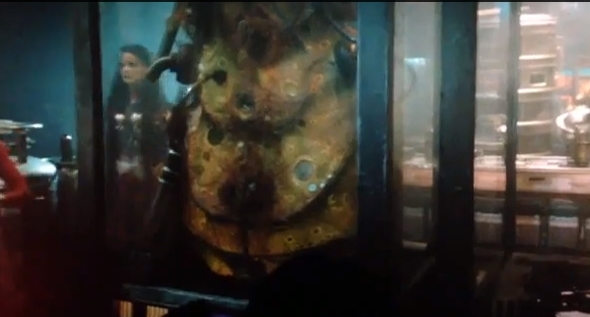
warlock cocoon thor the dark world

That cocoon-type thing is from the first scene in the end credits of “Thor: The Dark World” and is something that’s apparently been collected by … well, the Collector.

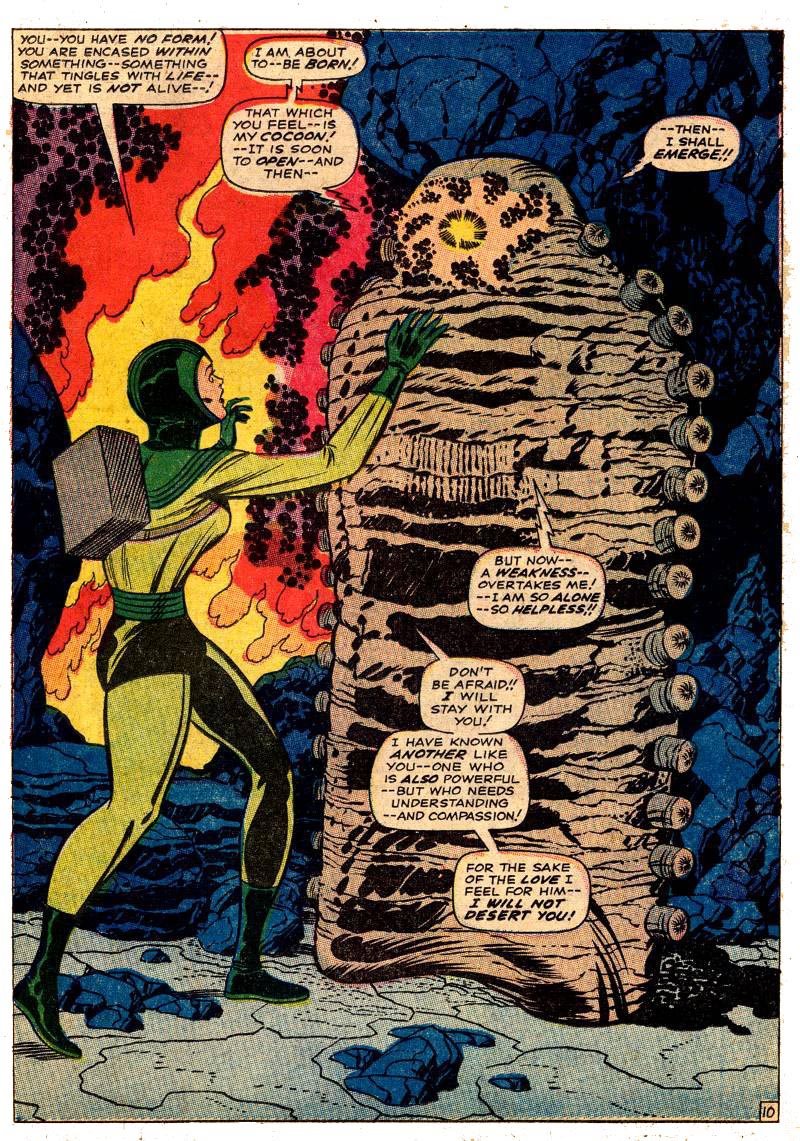
It looks suspiciously like this object:

warlock cocoon-fantastic_four_167_1

That’s from Fantastic Four 67, and that panel shows FF friend Alicia Masters finding the cocoon of Him, the cosmic being later known as Adam Warlock.

Warlock was a favorite of mine from the comics. He was a foe of Thanos, the smiley bad guy from the end credits of “The Avengers,” the guy who’s apparently destined to play antagonist in future Marvel movies, including “Avengers 3.”

Cool, huh? I’m kind of convinced that nothing happens in these Marvel movies by accident. Maybe they’re just in-jokes to entertain fans. Maybe they’re pointing the way toward future adventures. Either way, it’s fun stuff.