Category Archives: End of the world

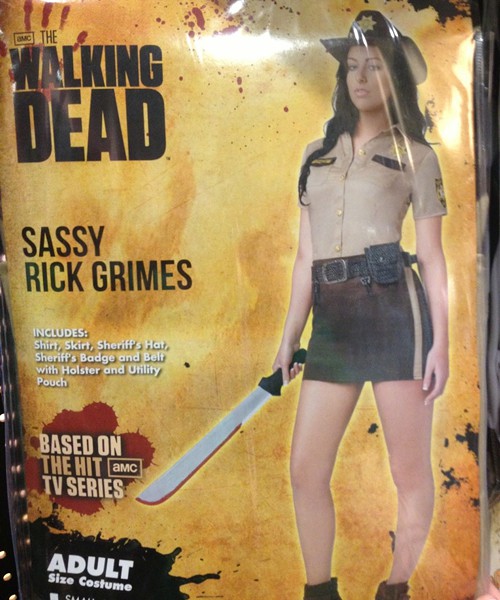
Today in Halloween: ‘Sassy’ Rick Grimes costume

sexy rick grimes walking dead halloween costume

Fan of “The Walking Dead?”

Fan of Andrew Lincoln’s portrayal of Rick Grimes, the show’s lead?

Want to go dressed up for Halloween as Rick Grimes?

Have the secondary sexual characteristics of the female of the species?

No problem!

hallow sassy female rick grimes

Yes, folks, here’s the “sassy” Rick Grimes Halloween costume, in honor of tonight’s season premiere of the show.

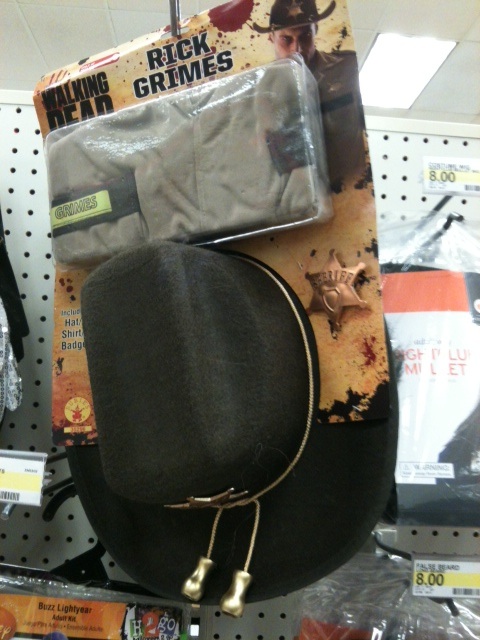
hallow rick costume

If you don’t want to show off your legs, here’s components of the male version.

Yes, these are the end times.

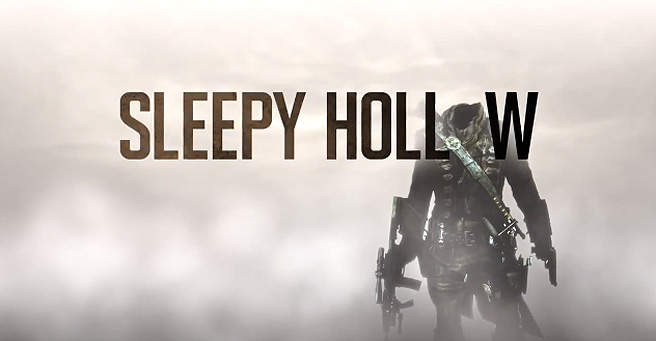
‘Sleepy Hollow’ mixes fantasy, cop show

sleepy-hollow-banner

One of the more unusual new shows of the fall is “Sleepy Hollow,” which turns Washington Irving’s “Legend of Sleepy Hollow” into a modern-day fantasy adventure mixed with a investigatory procedural.

The Fox pilot opens with Ichabod Crane, a Revolutionary War soldier, fighting the British on a gray battlefield. In short order, a British soldier wielding an ax rides up. Wearing a mask and coming across like Jason Vorhees, the warrior seems impervious to bullets but dies – or does he? – when Crane beheads him.

Cut to today and Crane, who had seemingly succumbed to battle wounds, wakes up in a grave, struggles his way above ground and is nearly run over by a truck when he stumbles upon a nearby road. The road happens to lead to the bustling modern-day village of Sleepy Hollow.

Meanwhile, the battlefield destroyer faced by Crane is now a Headless Horseman marauding through the area around Sleepy Hollow, killing and beheading people, including – dammit – the grizzled sheriff played by Clancy Brown.

Although he is initially considered a lunatic because he maintains he was personally selected by Gen. George Washington to find and kill a mercenary who just might be one of the Four Horsemen of the Apocalypse, Crane (played by Tom Mison) works with deputy Abbie Mills (Nicole Beharie) to uncover the intentions of the modern-day occultists who brought the Headless Horseman back from the dead.

It turns out there are two competing covens of witches – one good, one eeeevil – who to this day are using magic and murder to put the Horseman into play in the game leading up to the end of the world. The McGuffin? The Horseman’s skull, which he’s seriously seeking.

“Sleepy Hollow” was created by Alex Kurtzman and Bob Orci, a couple of the writers behind the recent “Star Trek” movies as well as the cult favorite “Fringe.” John Cho, who plays Sulu in the new “Trek” films, is even around, at least briefly, as Abbie’s confidant.

Mison has a nicely wry and humorous take on Crane, who is written as sarcastic as well as a fish out of water. Beharie is feisty and Orlando Jones is on hand, and dependable, as a police captain.

“Sleepy Hollow” – at least the pilot – was fun, if not overwhelming. There’s no moment where my “must watch this every week” response kicked in.

But … the climactic battle with the Horseman in a cemetery, a glimpse of their ultimate demonic foe – the series Big Bad – and a preview of a parade of demons in the episodes to come have me very nearly convinced that I’ll be checking out “Sleepy Hollow” each week.

Random observations:

Clancy Brown! But he has little more than a single scene, dammit.

The show has a nice ersatz Danny Elfman score. More reserved but still full of playful strings.

The skull in the glass jar made me think of “Futurama.”

The Headless Horseman is nicely done, with good effects and, smartly, no preference for old-timey weapons. Seeing a walking headless guy stalking our heroes with semi-automatic weapons was a pleasant surprise.


Extra creepy: Post-apocalyptic ‘Simpsons’

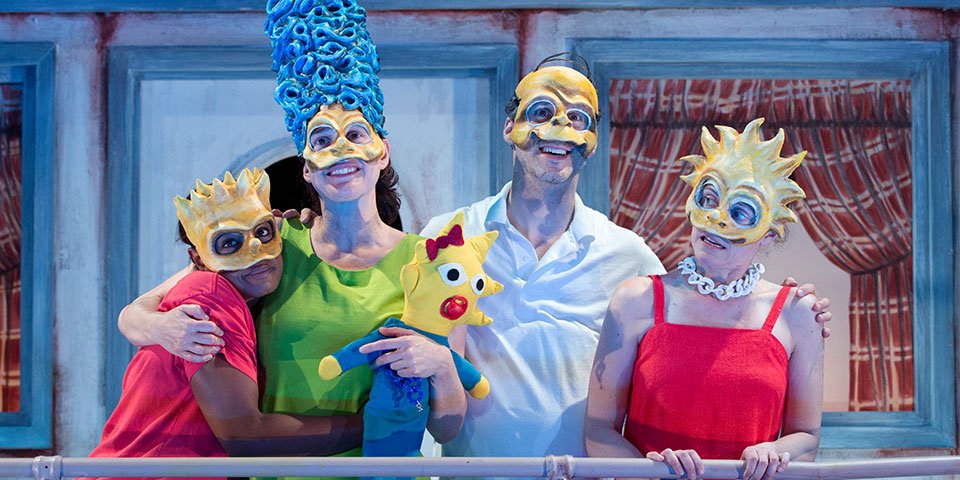
mr burns a post electric play

Here’s a real “ay carumba!” moment.

Above is the cast – in costume – of “Mr. Burns: A Post-Electric Play,” Anne Washburn’s musical being staged in NYC.

The premise of the show: After the apocalypse and the end of the world, a group of survivors entertain themselves – and survive – by re-enacting old episodes of “The Simpsons.”

The group starts out by trying to remember lines, particularly from the classic “Cape Feare” episode featuring Bart and his family menaced by Sideshow Bob.

Eventually the effort turns into actual stage productions featuring those masks.

The same masks I’m afraid I’m going to be seeing in my nightmares tonight.

Yikes.

Thanks to Cartoon Brew for calling our attention to the production.

Classic SF on TV: ‘Outer Limits: Soldier’

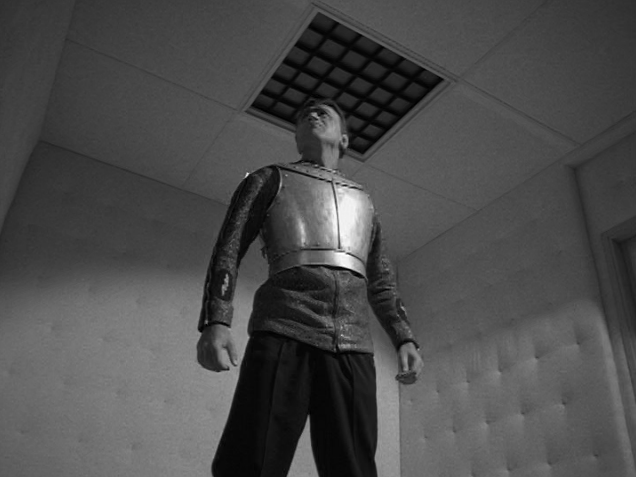
outer limits soldier

When “The Outer Limits,” an ABC TV anthology series, began airing, Rod Serling’s “The Twilight Zone” had been on the air for four years and was making its mark with literate science fiction and fantasy stories by great writers like Richard Matheson.

“The Outer Limits,” which has always had less recognition than “The Twilight Zone,” nevertheless presented smart and ahead-of-their-time SF and fantasy tales, including the first episode of the second season, “Soldier.”

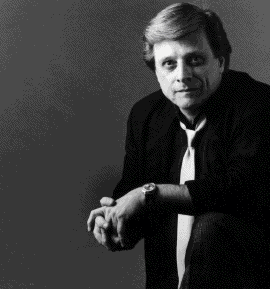
Written by established author Harlan Ellison, “Soldier” (1964) was the first of two episodes of “The Outer Limits” written by Ellison. In “Soldier” and “Demon with a Glass Hand,” Ellison explored somewhat different takes on the same kind of story: A soldier from the future comes back in time to our present day (well, 1964 in the case of “Soldier”). He’s pursued by a relentless killer who’s also from the future. The soldier ends up protecting modern-day humans before he meets his fate.

If the story sounds familiar … well, Ellison thought a movie that came out 20 years later took too many liberties with his basic idea. More on that in a minute.

In “Soldier,” Michael Ansara (who died just recently) plays Qarlo, a soldier from 1800 years in the future who materializes, in full battle gear, in a big-city alley after a battle in the future with his enemy. Qarlo quickly attracts the attention of the police, who arrest him after he melts their patrol car.

Once Qarlo, who struggles like a caged animal, is in the hands of the FBI, an agent (Tim O’Connor) calls in Kagan, a language expert (Lloyd Nolan), to try to figure out what language Qarlo is speaking. It’s English, Kagan says, and he quickly (probably too quickly, but hey, it’s an hour-long show) theorizes that Qarlo is a soldier from the future, in a time when men like Qarlo are bred to be soldiers, fighting machines with no knowledge of love and family and no master but the state.

Kagan, trying to introduce Qarlo to the modern-day world because they have no way of sending him  back to his own time, even takes him home to meet his family.

There’s that other soldier from the future to be considered, however, and a showdown in the Kagan family living room that feels kind of anti-climactic.

There are more than a few leaps in logic in “Soldier,” but most of them can be forgiven. A couple of head-scratchers – Qarlo’s lines-and-circles drawing of his – our – solar system is taken to a scientist who can tell, from the rudimentary sketch, that the Earth’s position around the Sun indicates Qarlo came from 1,800 years in the future – stand out.

But a lot about the episode is still effective, including Ansara’s performance as the bred-and-born soldier and Nolan’s intuitive expert. I also loved O’Connor, a character actor who is great in so many TV shows in the 1960s, 1970s and 1980s, as the snappy FBI agent.

harlan ellison

You’ve probably figured out that a lot of people – notably Ellison – have drawn comparisons between “Soldier” and “Demon with a Glass Hand” and “The Terminator,” director James Cameron’s 1984 SF adventure about two soldiers – one an android – who time-travel back from the future to the present day (well, the 80s), one to kill a woman who’s crucial to the future of mankind and one to protect her.

Ellison heard about the similarities before the movie came out and investigated. His attempts to see the movie before it premiered were stymied by Cameron and his studio. Cameron had apparently joked to a reporter that he had “ripped off” a couple of Ellison “Outer Limits” ideas. Eventually Ellison saw the movie and recognized enough of his plot to threaten to sue.

Ellison ended up with – according to a video interview with him that I saw – $65,000 to $75,000 and an acknowledgement, in the end credits of video releases of “The Terminator,” to his work.

“The Terminator” might have been made even without the inspiration of “Soldier” and it might not. But there’s no doubt that “Soldier” got there first and gave us a sci-fi story that still holds up.

Revisiting ‘World War Z’

world war z book cover

It had been a couple of years since I read “World War Z,” Max Brooks’ “Oral History of the Zombie War,” but in light of seeing the Brad Pitt-starring movie version this summer, I decided to revisit the book.

Reading it recently emphasized two thing to me:

Although I liked the movie fairly well, the book is much, much better.

The book was probably unfilmable as a two-hour movie.

The latter observation isn’t a new one or even new to me, of course. Brooks’ 2006 story is deliberately episodic. Every chapter has a different narrator and is set in a different location around the globe and a different time. True, there is an overarching framework – a United Nations researcher collects first-hand accounts 10 years after the zombie apocalypse – but there’s no place for a starring character – or actor, like Pitt – in the book. A few characters show up again but for the most part only as codas to their earlier tales.

The book’s strength lies in its episodic nature. No narrator, even an omnipotent, all-seeing one, could be as effective as the first-person accounts of the doctors, soldiers, government leaders, opportunists and even International Space Station astronauts as the zombie plague grows from initial outbreak into world-changing calamity.

Despite the premise – the walking dead, to coin a phrase – Brooks’ story is for the most part starkly realistic. There are few superheroics here. Civilians and soldiers fight to survive the onslaught of an enemy that is unlike any army on any battlefield.

Random observations:

I look forward, a few years hence, when somebody gets the idea of turning “World War Z” into a cable TV series. But I hope they’re faithful to Brooks’ story this time. And I hope they don’t decide, for the sake of an ongoing series, to turn Brooks’ book into a multi-year story like the producers of Stephen King’s “Under the Dome” apparently have done.

There’s a nice inside joke, late in the book, referencing Brooks’ father, renowned director and writer Mel Brooks. It’s a sly reference to “Free to Be You and Me,” the early 1970s Marlo Thomas production and one sketch in particular, in which Brooks and Thomas play newborn babies.

The end of the world as we know it: ‘The World’s End’

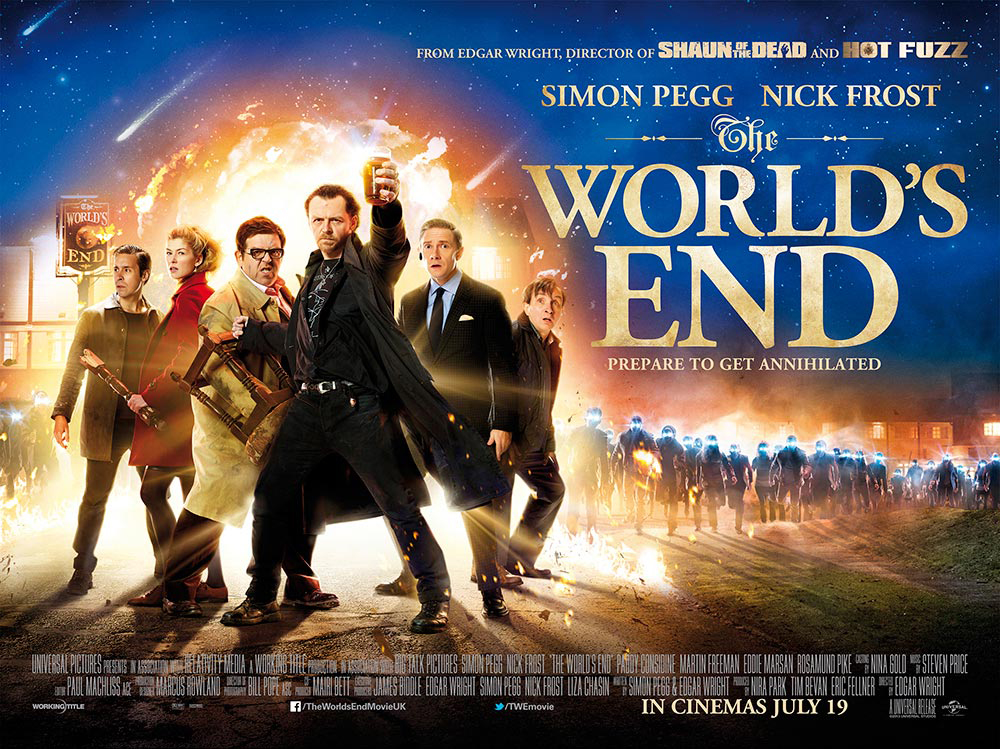
The-Worlds-End-poster

Edgar Wright, who might someday be known as the director of “Ant-Man,” has over the past decade given movie fans often-funny, often-touching glimpses into the lives of a few misfits and outcasts in the UK, from the dead-end zombie fighters of “Shaun of the Dead” to the small-town coppers of “Hot Fuzz.”

Now comes Wright’s “The World’s End,” which seems to cap this summer’s moviegoing (and end of the world-depicting) experience.

What Wright jokingly refers to as the third film in his “Cornetto” trilogy – named after a popular ice cream treat that shows up in all three movies, yes that’s how offbeat Wright’s humor is – is actually two movies in one: A “growing up is hard to do” reunion of old chums movie and an end-of-the-world comic thriller.

Needless to say, spoilers ahead if you haven’t seen the movie, which opened wide yesterday.

Two of Wright’s regular collaborators, Simon Pegg (Shaun as well as Scotty from “Star Trek”) and Nick Frost are among a group of friends who get together more than two decades after one of the most awesome but frustratingly incomplete nights of their lives: In 1990, before they went their separate ways and left their hometown of Newton Haven, they attempted an epic pub crawl that entailed drinking a pint at each of 12 pubs.

In fact, Pegg’s character, Gary King, only gets his four friends to join him by lying to them that the others have already agreed to meet to try to complete their challenge. That’s not enough for some, notably Andy (Frost’s character), who not only stopped drinking but holds Gary in contempt for his actions (only gradually revealed) that night. Andy comes along only after Gary tells him he needs the flashback to recover from the recent death of his mother.

Nevertheless, Pegg and cohorts played by Frost, Martin Freeman, Eddie Marsan and Paddy Considine return to Newton Haven and attempt the feat. Along the way, they run into Rosamund Pike as Freeman’s sister, who hooked up with Gary that night long ago.

The quest begins with a couple of disappointments for the hilariously self-centered Gary – played with gusto by Pegg – in that Andy no longer drinks and no one in their old town seems to remember them.

Those anomalies are resolved, however, when at one stop King impetuously confronts one of the townspeople and the fivesome is shocked to discover many of the residents of Newton Haven have been replaced by robots.

The rest of the movie plays out in a comic rush as the group of friends tries to get away without being absorbed and assimilated by the robots and their alien overlords – even while Gary, increasingly drunk, determined and frustrated, tries to complete the pub crawl.

Parts of “The World’s End” are laugh-out-loud funny and parts are poignant. There are some bizarre shock value special effects and a funny final encounter with the invaders who’ve turned Newton Haven into a bland lab experiment.

Driven by Pegg’s bravura performance and the propulsive “must get to the next pub” plot, “The World’s End” is a fun capper to Wright’s Brit-rich series of comedies.

Random observations:

Wright likes casting former James Bond actors in his movies. Timothy Dalton was in “Hot Fuzz,” while Pierce Brosnan is on hand here. I’m looking forward to Connery, Moore or Lazenby in “Ant-Man.”

The director gives us “call backs” to favorite moments in the earlier films, but none more obvious and beloved – it’s even in the commercials – than Pegg attempting to jump a fence.

It’s been a big summer for the end of the world, from “World War Z” to “This is the End” to this. It’s odd that the two more humor-inclined movies seemed to work best.

End of the world or not, “The World’s End” owes as much to “Invasion of the Body Snatchers” as to any other story.

Here’s a big spoiler alert, for discussion of the ending:

I was startled by it. When the little village of Newton Haven melts down thanks to the alien invaders and an electromagnetic pulse shoots out, the lights go out everywhere. I mean, around the globe. The final montage of scenes, narrated by Frost’s character, depicts the disparate members of the group living out their lives in the post-apocalypse. Most appropriately, Pegg’s Gary King is a wayfaring adventurer, moving across the wasteland as the now-teetotalling leader of a group of robotic duplicates of his friends’ younger selves. It feels like a climax that teases a sequel or spin-off film, but it’s really all we need to see to enjoy that premise.

‘Pacific Rim’ is ‘Top Gun’ meets Godzilla

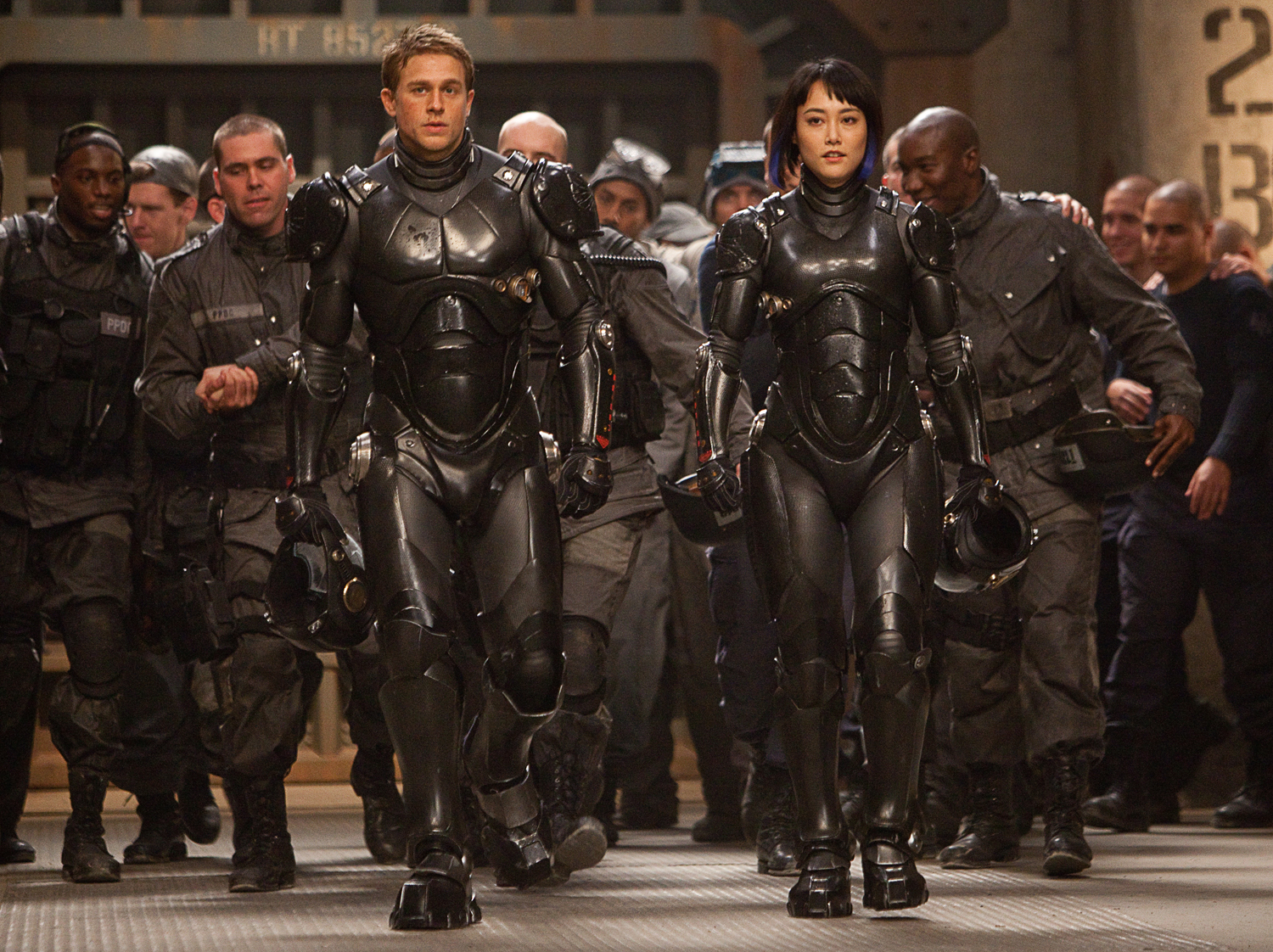
PACIFIC RIM

I was never the biggest fan in the world of Toho’s “Godzilla” series and their ilk. There’s lots to like in certain elements of the movies, particularly the first, black-and-white “Godzilla” film, which was a nightmarish funhouse mirror reflection of the atomic bombing of Japan that closed World War II.

Most of the later “Godzilla” movies, including those that introduced Gamera and Ghidora and Mothra and a variety of kaiju – Japanese for strange creatures – had some cool miniatures and pleasantly amusing “man in suit” special effects and they are watchable for their silliness. But terrifying? Awe-inspiring? No.

I think what was missing was the human element. Not just the scientists and military men on the ground, watching giant-sized mayhem unfold and trying to come up with a solution.

What was missing, it turns out, was “Top Gun.”

Director Guillermo Del Toro recognized not only the need to give the kaiju worthy human enemies but also the idea of introducing the soap opera-ish lives and traumatic pasts of the pilots of the fighter jets – here Jaegers, building-sized robots that battle the kaiju.

As everybody knows by now, “Pacific Rim” is the story of mankind’s response to a plague of kaiju – giant, destructive monsters, some with brute strength, some with acid spray, some with fiery breath – who arise from the sea through a rift in the bottom of the ocean and attack the mainland. San Francisco is the first to be hit, but eventually almost every city along the Pacific Rim finds itself fighting off monsters.

The nations of the world create the giant Jaegers, which are driven by two pilots, joined at the brain and working in tandem, to right the kaiju.

Del Toro makes this a fairly rich world, with war efforts like the Jaeger program as well as a wall-building effort that is doomed to failure. He also gives us the men and women who occupy this world.

“Pacific Rim” gives us some “Top Gun”-level conflict among the pilots and some personal stakes, including Raleigh’s (Charlie Hunnam) efforts to get back into the game after his brother’s death by kaiju years before, and Mako Mori (Rinko Kikuchi), who wants to be a Jaeger jockey to get revenge.

Charlie Day and Ron Perlman have a ball as a Jaeger program scientist and kaiju black market mobster, respectively, and Idris Elba is mesmerizing as the leader of the effort.

“Pacific Rim,” with its giant monster and robots, is like every little geek sci-fi fan’s dream come true on the big screen. It’s a good summertime movie that goes down easier than “Man of Steel.”

Some stray observations:

Pretty sure I heard a snatch of Godzilla cry from one of those kaiju.

I was startled to see that the SyFy channel cheapie “Sharknado” beat “Pacific Rim” to the punch on its “cut yourself out from the inside” joke. It might have even outdone it.

I’m guessing special effects limitations meant that so many battle scenes had to be in rain-swept darkness. I enjoyed the clarity we got in the few daytime scenes.

‘Sharknado’ blows us away

sharknado

“Sharknado” owned us all last night.

Social media like Twitter were ablaze Thursday night with jokes and jibes about the latest SyFy movie, featuring TV “stars” like Tara Reid and Ian Ziering fighting to survive a series of tornados and waterspouts raining … er, sharks … down on Los Angeles.

The sight of sharks falling from the sky and maliciously trying to snap up everything in sight was hilarious.

But even better was the accompanying Twitter onslaught, with almost everyone I follow, well-known and unknown, commenting on the show.

SyFy, the network behind “Mansquito” and “MegaShark” and other cheap and cheesy movies, blew up the Internet.

A big win for all of us. Especially the sharks. And Tara Reid.

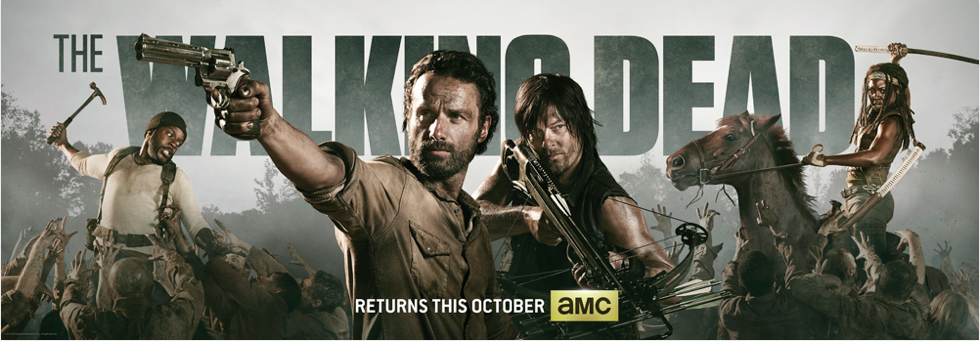
Coolness: ‘Walking Dead’ season 4 banner

walking dead season 4 bannerOh man.

AMC today released a banner for season four of “The Walking Dead,” which returns this fall.

The essential elements of the show – well, there’s no sign of Carl, but other than that – are here. You got Rick, you got Daryl.

Tyreese wielding a hammer!

Michonne wielding her katana – from the back of a horse!

The banner was released to promote “The Walking Dead” panel at San Diego Comic Con later this month.

But I like to think of it as a present for us.

Enjoy.


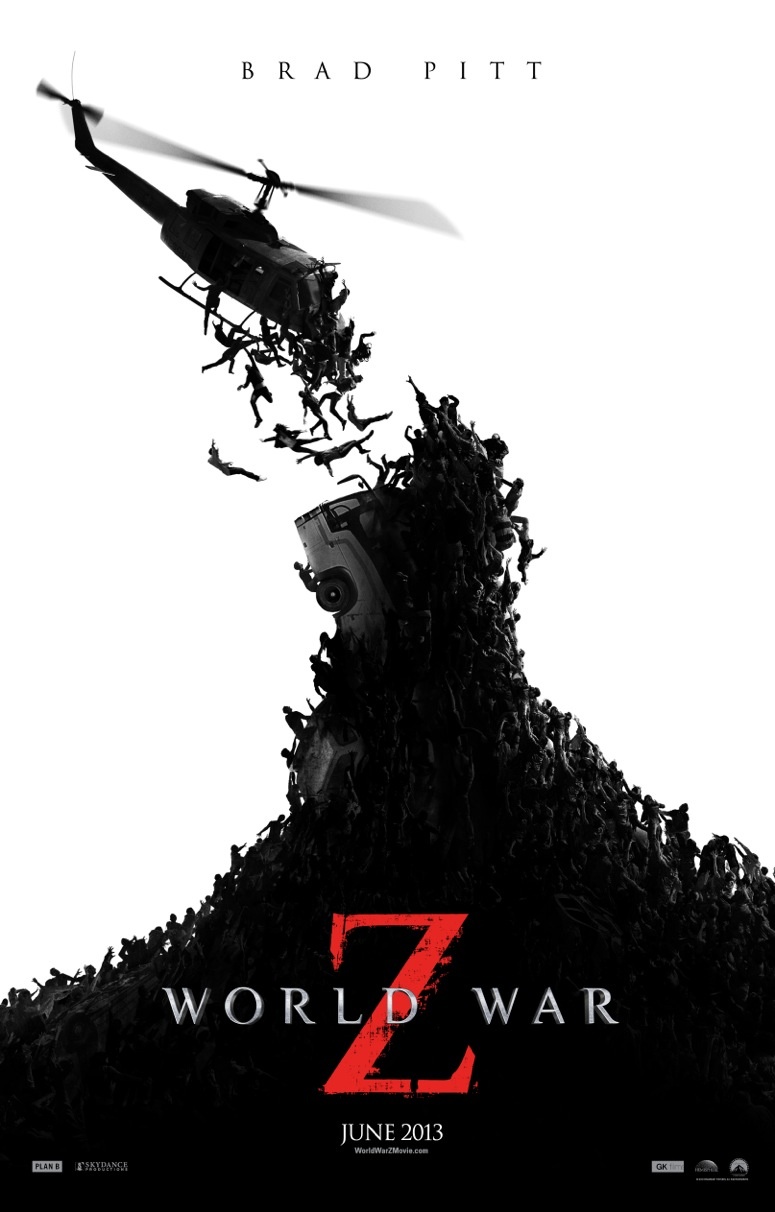
It’s the end of the world as we know it, part 2: ‘World War Z’

World_War_Z_Poster

I’ve been pretty vocal here about my concerns that Marc Forster’s “World War Z” would vary so much from Max Brooks’ terrific 2006 novel that it wouldn’t possibly capture the essence of the book. And to be sure, adapting Brooks’ book faithfully would be nearly impossible.

Brooks’ book is episodic in the extreme in its record of the zombie apocalypse, moving from China to India to New York to Denver to the Great Plains. Although a narrator – writing an oral history of the zombie war from the perspective of 10 years later – is present throughout the book, nearly every chapter features new characters and a new setting. A couple of years after I read the book, some scenes stand out in my mind: A downed flier is guided through the wilderness by a mysterious voice on a radio. Astronauts watch the end of the world from the International Space Station. The military is humbled in the Battle of Yonkers.

So when the makers of “World War Z” the movie said Brad Pitt would play a U.N. troubleshooter jetting around the globe to find a means of turning back the zombie virus, I thought: Well, that might be fun, but that’s not the plot of the book.

Upon seeing “World War Z” today, I thought two things:

I want to read the book again soon.

Forster and Pitt made a pretty good end-of-the-world movie. There’s little resemblance to Brooks’ book, but it’s a pretty fun suspense thriller along the lines of “The Andromeda Strain” and “Outbreak” and “Contagion.” Maybe even like the first book in “The Strain” series.

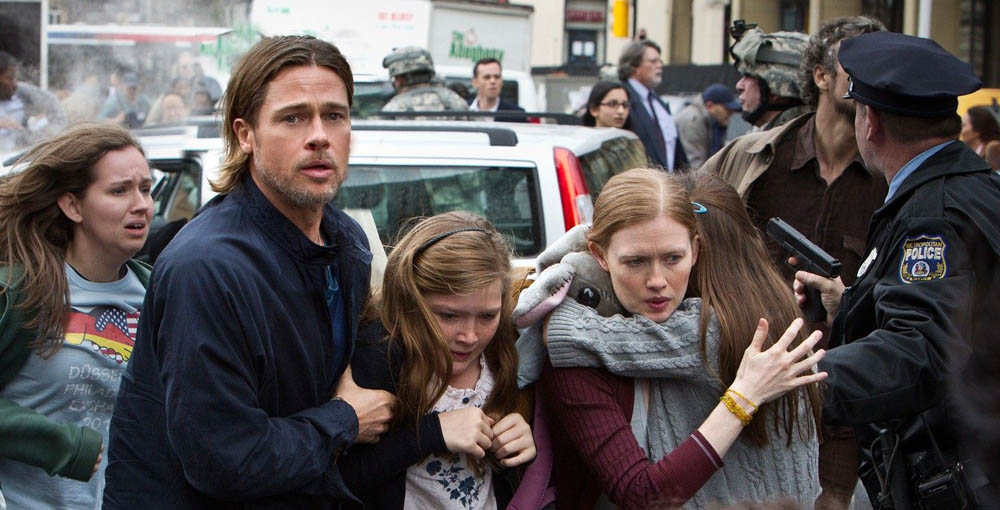
world-war-z family

Pitt is called out of retirement in Philly with his wife (Mirielle Enos) and daughters when the outbreak begins. At first, it’s uncertain what’s happening. Zombies? That can’t possibly be real, can it?

But the U.N, gets with the program fairly quickly and sends Pitt jetting around the world, looking for Patient Zero and clues to how to stop the epidemic. He goes from South Korea to Israel to, eventually, Wales. The last section of the movie is a pleasant change from the “Brad flies in and all hell breaks lose” feel of the first two-thirds of the movie. It’s a nail-biting “how do we get from point A to point B and avoid being bitten?” story and it’s very good.

Pitt is fine here, although the part could have been played by anyone from Will Smith to Clive Owen (two actors with plenty of apocalyptic experience).

The real highlights of the film are the suspenseful scenes leading up to a zombie outbreak and/or attack. Forster builds tension quite well and interjects some good scares.

The zombies here are not the slow walkers of George Romero’s “Living Dead” films or TV’s “The Walking Dead.” They’re not precisely like the sprinting zombies of “28 Days Later” or the “Dawn of the Dead” remake. They’re fast but they’re more like lemmings or ants, throwing themselves against barriers and off the roofs of buildings, piling up in a grinding mass in their efforts to reach their prey.

“World War Z” is a disappointment to anyone hoping for a faithful telling of Brooks’ book. But it’s a good, suspenseful action take on the end of the world.