Category Archives: favorite books

Today in Halloween: ‘The Halloween Tree’

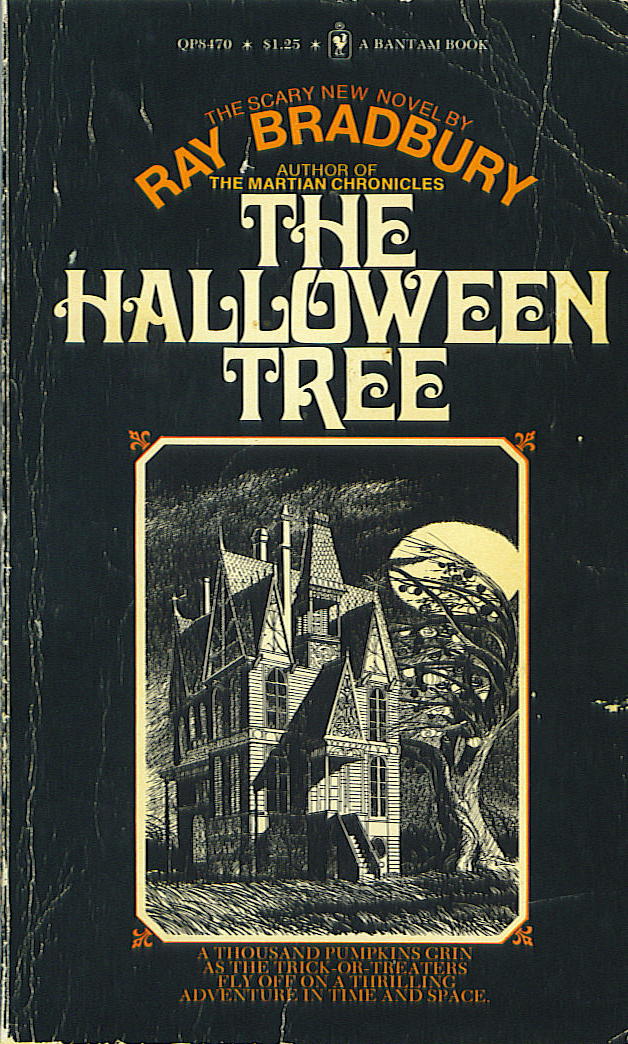
halloween tree bradbury cover

As a kid and young teen in the early 1970s, I counted among my favorite authors Ray Bradbury.

I loved Harlan Ellison and Robert Heinlein and Isaac Asimov, mind you, but Bradbury had a poetry to his prose that appealed to the young romantic in me. Heinlein was a funky libertarian and Asimov a mind-reeling intellectual and Ellison – Ellison! – was a cranky, spit-in-your-face rebel.

But Bradbury wrote small-town fantasy like no one ever had, and as a small-town kid with a mind and a heart for fantasy, I loved him.

It had been a while, though, since I’d read “The Halloween Tree,” and I was afraid I’d have the same experience I’ve had in going back to other works that I loved when I was young. Let’s just say I still haven’t managed to struggle my way back through “A Wrinkle in Time.”

I knew I had to re-read “The Halloween Tree” this October, though. And I’m relieved to say I still enjoyed its oddball, old-fashioned homage to Halloween.

I will say, though, that the book is incredibly dated. Considering it was published in 1972 – the year that I participated in an anti-Nixon mini-protest outside a school-adjacent polling place on election day – I’m kind of amazed it wasn’t too hokey and cheesy for me even back in the day.

I can’t imagine my son, reading it now, putting up with the earnest “Pipkin is the greatest boy who ever lived” stuff.

For better or worse, kids are more sophisticated today than we were. The boisterous love among 13-year-olds for their buddies, the “oh gosh” dialogue, the thought of boys disappearing into the Halloween darkness with a mysterious man … well, let’s just say all but the most poetic and artistic kid today would roll his eyes and think about all those parental warnings of “stranger danger.”

Which is too bad, in a way. But I think we’re safer in a savvier world.

But in Bradbury’s world, in a small Illinois town, a pack of eight 13-year-old boys costumed as archetypes like skeletons and witches and mummies goes out to trick-or-treat on Halloween night, worried about the whereabouts of their friend, Pipkin, and whether he will join them for trick-or-treating.

Before long, they discover the house with the Halloween tree – a towering growth with hundreds or even thousands of carved and lit jack-o-lanterns hanging on its branches – and the occupant of the house, Mr. Moundshroud, who takes them on a time-traveling adventure to not only find Pipkin but the origin of Halloween. It’s a journey that takes them from ancient Egypt to Europe to home in time for the midnight (!) finish to trick-or-treating.

I remember loving “The Halloween Tree” when I was a kid and still have my original copy, in much better condition than the one at the top of this entry. It was not my favorite Bradbury, however, which might just be “Something Wicked This Way Comes.”
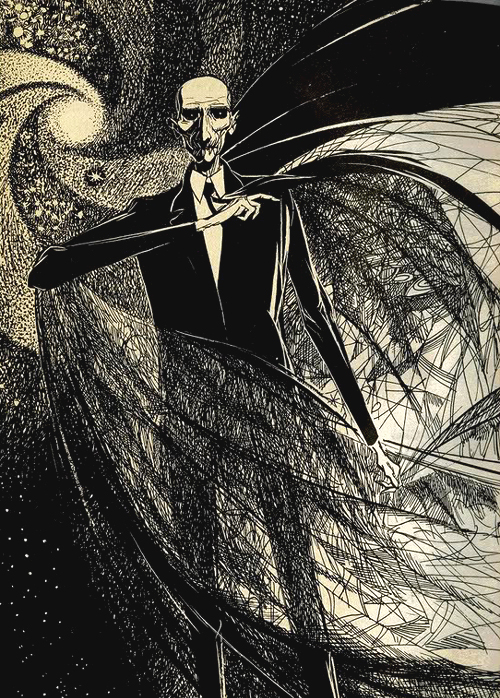
halloween tree bradbury mugnaini

If you’ve never read “The Halloween Tree,” you should, even if your tolerance for brave and poetic boys is low. Bradbury’s imagery is beautiful, and there’s another kind of great imagery, too: The drawings of artist Joe Mugnaini.

halloween tree house mugnaini

I used to love to draw, pencil or pen-and-ink drawings, and I can’t image the artistic talent and work that went into Mugnaini’s work. It’s simply beautiful.

mugnaini halloween tree

And a great accompaniment to Bradbury’s story.

Revisiting ‘World War Z’

world war z book cover

It had been a couple of years since I read “World War Z,” Max Brooks’ “Oral History of the Zombie War,” but in light of seeing the Brad Pitt-starring movie version this summer, I decided to revisit the book.

Reading it recently emphasized two thing to me:

Although I liked the movie fairly well, the book is much, much better.

The book was probably unfilmable as a two-hour movie.

The latter observation isn’t a new one or even new to me, of course. Brooks’ 2006 story is deliberately episodic. Every chapter has a different narrator and is set in a different location around the globe and a different time. True, there is an overarching framework – a United Nations researcher collects first-hand accounts 10 years after the zombie apocalypse – but there’s no place for a starring character – or actor, like Pitt – in the book. A few characters show up again but for the most part only as codas to their earlier tales.

The book’s strength lies in its episodic nature. No narrator, even an omnipotent, all-seeing one, could be as effective as the first-person accounts of the doctors, soldiers, government leaders, opportunists and even International Space Station astronauts as the zombie plague grows from initial outbreak into world-changing calamity.

Despite the premise – the walking dead, to coin a phrase – Brooks’ story is for the most part starkly realistic. There are few superheroics here. Civilians and soldiers fight to survive the onslaught of an enemy that is unlike any army on any battlefield.

Random observations:

I look forward, a few years hence, when somebody gets the idea of turning “World War Z” into a cable TV series. But I hope they’re faithful to Brooks’ story this time. And I hope they don’t decide, for the sake of an ongoing series, to turn Brooks’ book into a multi-year story like the producers of Stephen King’s “Under the Dome” apparently have done.

There’s a nice inside joke, late in the book, referencing Brooks’ father, renowned director and writer Mel Brooks. It’s a sly reference to “Free to Be You and Me,” the early 1970s Marlo Thomas production and one sketch in particular, in which Brooks and Thomas play newborn babies.

Words of wisdom from Elmore Leonard

elmore leonard frowning

The great crime novel and western writer Elmore Leonard passed away recently and a lot of sites are recalling his 2001 piece for The New York Times with tips for writers.

Here’s Leonard’s wisdom:

These are rules I’ve picked up along the way to help me remain invisible when I’m writing a book, to help me show rather than tell what’s taking place in the story. If you have a facility for language and imagery and the sound of your voice pleases you, invisibility is not what you are after, and you can skip the rules. Still, you might look them over.

1. Never open a book with weather.

If it’s only to create atmosphere, and not a character’s reaction to the weather, you don’t want to go on too long. The reader is apt to leaf ahead looking for people. There are exceptions. If you happen to be Barry Lopez, who has more ways to describe ice and snow than an Eskimo, you can do all the weather reporting you want.

2. Avoid prologues.

They can be annoying, especially a prologue following an introduction that comes after a foreword. But these are ordinarily found in nonfiction. A prologue in a novel is backstory, and you can drop it in anywhere you want. There is a prologue in John Steinbeck’s ”Sweet Thursday,” but it’s O.K. because a character in the book makes the point of what my rules are all about. He says: ”I like a lot of talk in a book and I don’t like to have nobody tell me what the guy that’s talking looks like. I want to figure out what he looks like from the way he talks. . . . figure out what the guy’s thinking from what he says. I like some description but not too much of that. . . . Sometimes I want a book to break loose with a bunch of hooptedoodle. . . . Spin up some pretty words maybe or sing a little song with language. That’s nice. But I wish it was set aside so I don’t have to read it. I don’t want hooptedoodle to get mixed up with the story.”

3. Never use a verb other than ”said” to carry dialogue.

The line of dialogue belongs to the character; the verb is the writer sticking his nose in. But said is far less intrusive than grumbled, gasped, cautioned, lied. I once noticed Mary McCarthy ending a line of dialogue with ”she asseverated,” and had to stop reading to get the dictionary.

4. Never use an adverb to modify the verb ”said” . . .

. . . he admonished gravely. To use an adverb this way (or almost any way) is a mortal sin. The writer is now exposing himself in earnest, using a word that distracts and can interrupt the rhythm of the exchange. I have a character in one of my books tell how she used to write historical romances ”full of rape and adverbs.”

5. Keep your exclamation points under control.

You are allowed no more than two or three per 100,000 words of prose. If you have the knack of playing with exclaimers the way Tom Wolfe does, you can throw them in by the handful.

6. Never use the words ”suddenly” or ”all hell broke loose.”

This rule doesn’t require an explanation. I have noticed that writers who use ”suddenly” tend to exercise less control in the application of exclamation points.

7. Use regional dialect, patois, sparingly.

Once you start spelling words in dialogue phonetically and loading the page with apostrophes, you won’t be able to stop. Notice the way Annie Proulx captures the flavor of Wyoming voices in her book of short stories ”Close Range.”

8. Avoid detailed descriptions of characters.

Which Steinbeck covered. In Ernest Hemingway’s ”Hills Like White Elephants” what do the ”American and the girl with him” look like? ”She had taken off her hat and put it on the table.” That’s the only reference to a physical description in the story, and yet we see the couple and know them by their tones of voice, with not one adverb in sight.

9. Don’t go into great detail describing places and things.

Unless you’re Margaret Atwood and can paint scenes with language or write landscapes in the style of Jim Harrison. But even if you’re good at it, you don’t want descriptions that bring the action, the flow of the story, to a standstill.

And finally:

10. Try to leave out the part that readers tend to skip.

A rule that came to mind in 1983. Think of what you skip reading a novel: thick paragraphs of prose you can see have too many words in them. What the writer is doing, he’s writing, perpetrating hooptedoodle, perhaps taking another shot at the weather, or has gone into the character’s head, and the reader either knows what the guy’s thinking or doesn’t care. I’ll bet you don’t skip dialogue.

My most important rule is one that sums up the 10.

If it sounds like writing, I rewrite it.

Or, if proper usage gets in the way, it may have to go. I can’t allow what we learned in English composition to disrupt the sound and rhythm of the narrative. It’s my attempt to remain invisible, not distract the reader from the story with obvious writing. (Joseph Conrad said something about words getting in the way of what you want to say.)

RIP Elmore Leonard, king of hardboiled crime

Elmore Leonard

Sad news today: Elmore Leonard, author of such crime novels as “Get Shorty” and “Glitz,” has passed away at 87 after recently suffering a stroke.

I won’t pretend to be an expert on Leonard. I’ve read a few of his books – I reviewed his final book published before his death, “Raylan,” in February 2012 – and I appreciated his knack for making his bad guys as interesting as, or more interesting than, his good guys.

I also appreciated Leonard’s nurturing of “Justified,” the FX series based on his short story “Fire in the Hole,” about Raylan Givens, a deputy U.S. marshal working in Kentucky.

As he finds himself up against meth dealers and murderers, Raylan was cool and compelling, especially when dealing with lifelong antagonist Boyd Crowder.

Leonard didn’t have  a lot of love for movie and TV versions of his work, but he liked Graham Yost’s “Justified” and had some kind of synergy going with it, contributing story ideas and writing an episodic novel (the aforementioned “Raylan”) drawn from the same setting.

We’ll miss you, Mr. Leonard.

‘Longmire” hews closer to Johnson’s books

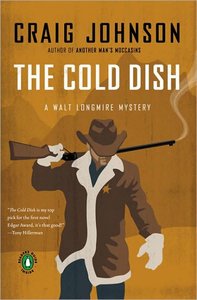
craig johnson longmire the cold dish

When I wrote about the first season of A&E’s “Longmire” in June 2012, my natural inclination was to compare the books and TV series. I’d been enjoying the books for a couple of years and hoped for the best for the series. The best I could say – I mean that sincerely – was that the show captured the characters and flavor but not the plot integrity of author Craig Johnson’s mysteries, set in a rural Wyoming county.

I noted some differences between the series and the books. The series omitted a few characters – Sheriff Walt Longmire’s predecessor in office,  crusty old retired sheriff Lucian, notably – and added a few, including Lucian’s nephew, ambitious deputy Branch Connally, who wants to unseat Walt in an election.

Missing was the forged-in-Vietnam bond between Walt and pal Henry Standing Bear, leaving the Bear’s motivations sometimes in doubt.

Also absent were a Philadelphia connection – deputy Vic is from there, and it is home to Walt’s daughter Cady’s law practice – and the sense of the mystical and spiritual, as Henry nudges Walt toward a deeper connection with the Native American spirits of the Wyoming countryside. Also absent, to some extent, were the Crow and Cheyenne supporting characters that filled the books.

Maybe the most egregious variation from the books is how the series has dealt with the death of Walt’s wife. In the books, she died before the first story began after a battle with cancer. Martha Longmire likewise died before the TV series began, but it’s implied she died at the hands of a drug dealer in Colorado and Walt (and perhaps Henry) then killed her killer.

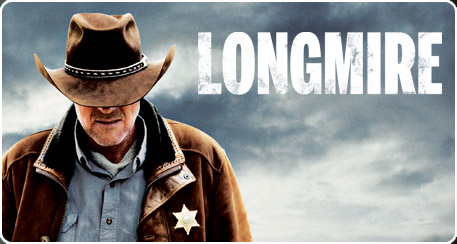
longmire logo

I’m glad to say, most of the way into the second season of “Longmire,” that the series has greatly improved.

Sure, star Robert Taylor and supporting cast like Katee Sackhoff were always good. But the second season – perhaps with input from Johnson himself, perhaps from a realization on the part of show creators Hunt Baldwin and John Coveny that Johnson gave them excellent material to work with and they should take advantage of it – has seen the show capture the spirit – and sometimes the letter – of the books.

The first episode of the second season, “Unquiet Mind,” echoed the “prisoners on the loose in mountainous countryside” plot of the seventh book, 2011’s “Hell is Empty.”

The third episode of this season, “Death Came in Like Thunder,” explored the Wyoming Basque community that’s a big part of the books. One of the characters omitted from the TV series is Basque deputy Santiago.

And the second season even returned to two major plotlines of the books: Cady Longmire’s serious injury at the hands of an attacker – although in the books it happens in Philly, where’s she’s practicing law – and deputy Vic’s history on the Philly PD.

The Native American spiritualism that seemed so missing from the first season was greatly felt in the second, climaxing in a scene where Walt – to atone for the killing of his wife’s killer – hooks his chest in “Man Called Horse” style and suffers in the blazing sun.

And although I haven’t seen it yet, I’m told an episode even features the TV series version of Lucian.

I can’t think of a recent TV series that improved so markedly from the first season to the second. I think if you’re a fan of the books, you’ll find more to like than just the character portrayals and tone this season. If you’re not a reader of the books, you’ll find an enjoyable crime drama unfolding on a weekly basis.

‘Fool Me Twice’ carries on Parker tradition

fool me twice robert parker brandman

With 70 books to his credit, masterful crime writer Robert B. Parker passed away in 2010. It might have seemed, for a few moments anyway, that classic detective characters like Boston PI Spencer, tough investigator Sunny Randall and New England small town police chief Jesse Stone might have died with him, along with the leads of other Parker series.

Then the Parker estate picked crime writer Ace Atkins to continue the Spencer series and Michael Brandman, a writer and producer who worked with Parker on adapting the Jesse Stone stories into a successful series of appropriately somber TV movies, was tapped to continue Stone’s adventures.

Brandman’s second Stone book – titled, somewhat unwieldingly, “Robert B. Parker’s Fool Me Twice,” takes us back to the small town of Paradise and not one, not two, but three storylines for Stone to unravel.

Stone, a recovering alcoholic and former LA cop, has settled into his job as small-town police chief but isn’t any less anti-authoritarian. Stone clashes with town council members as well as other law enforcement officials on a couple of the matters he faces here. Paradise is host to a movie production company and its troubled lead actress, Marisol, who is being menaced by her estranged husband; there are also complaints by town residents that their water bills are mysteriously high; and Stone butts heads with a rich family and their privileged teenage daughter.

Brandman is a writer gifted at telling his tale in Parker’s voice, and he does so quite well here. One of the plotlines feels kind of abrupt and another – Stone’s response to the troubled teen – is familiar to fans of Spencer, who showed the value of tough love to a couple of errant young people in that series.

As with all of Parker’s creations, the heroes are more than capable – so much so that there’s very little credible threat to their safety or their plans.

But Brandman, like Atkins, knows what Parker fans want: A strong but soft-spoken hero who can handle any number of tough guys and guys who think they’re tough.

In Brandman’s hands, I’m hoping Jesse Stone will be around for years to come.

Stars set for ‘Gone Girl?’

Rosamund-Pike-

I really liked Gillian Flynn’s twisty 2012 thriller “Gone Girl,” a terrific mystery novel about what happens when a wife goes missing and suspicion falls on her husband.

For the movie version, a number of stars have been considered for the roles of the husband and wife,  but the latest news makes it sound like Ben Affleck (whose “Argo” demonstrated his directing skills but who hasn’t been thought of as just a leading man for a while) and Rosamund Pike (most recently seen as the female lead in “Jack Reacher”) were likely to be cast.

ben affleck

Affleck seems like the perfect choice for the male lead. He can easily play a husband who would seem ideal and loving at first glance but could be quite unsympathetic when needed.

pike

And Pike could be good, I think, as the female lead, who is … well, I can’t even say. To describe the character would be to give away the plot, which has too many great turns to spoil.

David Fincher is directing.


RIP great writer Richard Matheson

Richard_Matheson

It’s impossible to neatly summarize how important author Richard Matheson was to the word of writing, fantasy and science fiction and movies and TV.

Matheson, who has passed away at age 87, left so many great works behind.

Here are just a few.

“I Am Legend,” which inspired movie treatments starring Vincent Price, Charlton Heston (“The Omega Man”) and Will Smith.

“The Shrinking Man,” adapted as “The Incredible Shrinking Man.”

Other works that were made as movies, some of them written for the screen by Matheson: “What Dreams May Come.” “A Stir of Echoes.”

Original movies and TV shows he wrote: “House of Usher.” “The Raven.” “Comedy of Terrors.”

Several of the best-remembered “Twilight Zone” episodes, including “Nightmare at 20,000 Feet.” The “Star Trek” episode “The Enemy Within.”

“Duel.”

“The Night Stalker” and its sequel, “The Night Strangler.”

“The Legend of Hell House.” “Trilogy of Terror.” “Somewhere in Time.” “Twilight Zone: The Movie.”

“Jaws 3-D.”

“Profile in Silver,” the great JFK assassination time travel story for the 1980s remake of “The Twilight Zone.”

“Steel,” the story that was the basis for the Hugh Jackman fighting robot movie “Real Steel.”

Matheson might have been the most versatile and most accomplished writer to ever move between books, short stories, TV and movies.

He will be missed, but his legacy lives on.


Reading is fun: The ‘President’s Vampire’ series

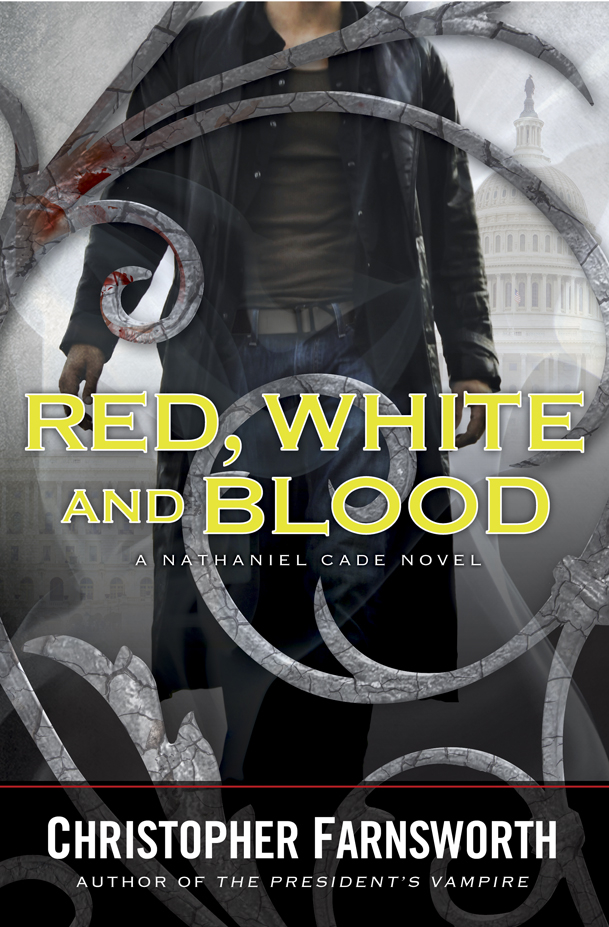
red white and blood

Christopher Farnsworth had done what might seem impossible: He’s merged the political thriller and the horror novel with his “President’s Vampire” series.

Beginning with “Blood Oath” and continuing through “The President’s Vampire” and “Red, White and Blood,” Farnsworth recounts the adventures of Nathaniel Cade, a 150-plus-year-old vampire, and Zach Barrows, a young political operative, who are thrown together when Barrows becomes Cade’s handler.

Since shortly after his creation as a vampire, Cade has been – thanks to a spell conjured by by voodoo mistress Marie Laveau and evoked by President Andrew Johnson – an undead servant of the occupant of the White House.

The books, although mostly set in the present-day, trace Cade’s history in the service of presidents ranging from Ulysses Grant to Sam Curtis, the Obama-surrogate in the Oval Office during most of the series so far.

Thanks to the spell, the otherworldly strong and fast Cade is bound to obey the orders of the president and his trusted operatives. In the books, this pits Cade against plotters of the political and supernatural variety – the two are often connected here – and his own set of enemies.

The latest book, “Red, White and Blood,” pits Cade against the Boogeyman, an ages-old monster that, we’re told, is the basis for all kinds of urban legends and spooky stories that range from New Orleans’ legendary Axe Man to the guy with the hook on his hand who stalks Lovers Lane.

Farnsworth’s plots are clever and thrilling as Cade and Zach maneuver their way through threats both supernatural and political, including the real-life Dr. Frankenstein and renegade CIA agents.

The author accents the stories with smart and funny references to monsters both real – Son of Sam gets name-dropped a lot in the third book – and fictional, including not only the Jason surrogates but also creatures that are sly references to movies and books.

Farnsworth’s books are a fun read for fans of Washington-based thrillers as well as the adventures of other types of monsters.

Chelsea Cain’s fun, twisted mysteries

chelsea_cain

If you haven’t checked out author Chelsea Cain’s series of crime novels centering on Archie Sheridan and Gretchen Lowell, you’re missing one of the most interesting and offbeat partnerships in crime fiction.

But if you think Archie and Gretchen are a crime-solving duo like Patrick and Angie in Dennis Lehane’s series, you’re wrong.

Archie is a Portland cop and Gretchen is the infamous Beauty Killer, a stone-cold beautiful female serial killer.

Gretchen, in years pre-dating most of the books, killed dozens – maybe even hundreds – of people. And in the most gruesome ways imaginable. We’re talking neckties made of intestines here.

She also very nearly killed Archie, who as the series began was recuperating from the double-whammy laid on him by Gretchen. Archie and other cops consulted with Gretchen on a series of slayings and Archie cheated on his wife with the blonde bombshell. Only afterward did he find out that Gretchen was the killer. And he found out when Gretchen drugged and kidnapped him.

Gretchen tortured Archie for days, keeping him barely alive and getting him hooked on powerful pain killers. During their time together, Gretchen left Archie with permanent scars, including one heart-shaped one carved into his chest. It’s a Beauty Killer trademark.

Although Gretchen is eventually captured and put in prison, Archie’s dealings with her don’t end. That’s because she prolongs their meetings by parceling out information about other killings. It’s an opportunity for Archie to close cases and give some relief to still-grieving families.

But it’s also Archie’s opportunity to be near Gretchen. Archie has a very real fatal attraction to the Beauty Killer. It’s an attraction that threatens to ruin any chance of reconciliation with his wife, wreck a budding relationship with Susan, an endearing if oddball young newspaper reporter, and harm his relationship with his stalwart and supportive partner, Henry.

Cain writes with a level of gore and kink that will drive some readers away and appeal to many others. Her characters are totally sympathetic – well, not Gretchen. Not much anyway – and compelling.

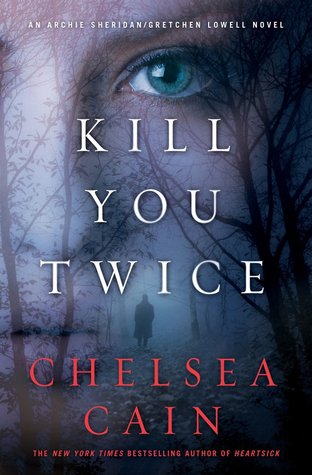
kill you twice

Cain has a new book in the series due out this summer, but I just finished the most recent, “Kill You Twice,” and there’s a Hannibal Lecter element to the book that most of the entries in the series don’t have. (And don’t need.) It’s a great yarn about another serial killer on the loose and that murderer’s ties to Gretchen.

If you have a taste for some twisted mystery, check out Cain’s books. I recommend reading them in order, though, starting with 2007’s “Heartsick.” There are five so far, and you might find yourself racing hungrily through them.