Category Archives: geek culture

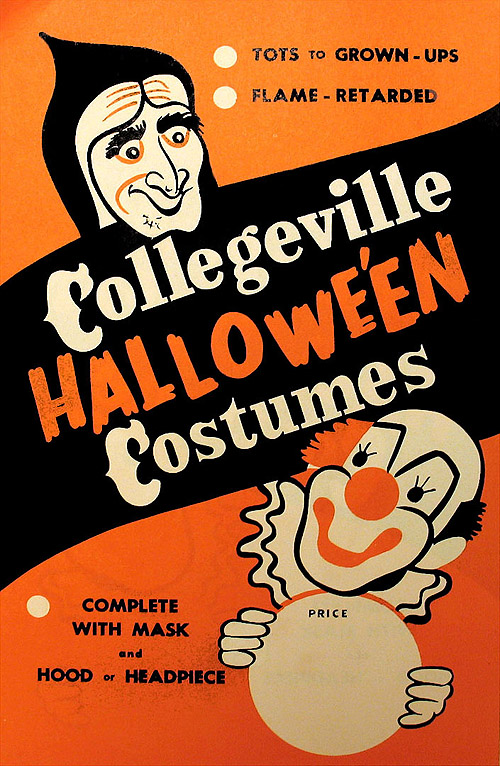
Today in Halloween: Collegeville costumes sign

CollegevilleHalloweenCostumeSign

During the month of October, you’ll find a few references to Collegeville and Ben Cooper Halloween costumes in this blog and many other spots on the Internet.

As much as I enjoy the wide array of Halloween costumes and decorations and makeup and … well, stuff in general that’s available today, none of it has the charm and nostalgia that most of us of a certain age feel for the two top Halloween costume makers for a half-century, Ben Cooper and Collegeville.

Here’s a sign, not unlike you’d find in a Woolworth or W.T. Grant or some other store, advertising Collegeville Halloween costumes.

Collegeville, operating out of Collegeville, PA, was maybe the lower-rent of the two companies. Ben Cooper costumes were officially licensed and featured characters from “Star Wars” and comics and TV shows.

Collegeville costumes were a little cheaper – still the standard rubber mask with a string, but a little more generic – but just as dear to our hearts.

Halloween wouldn’t have been the same without finding this sign at your neighborhood store, letting you know that the promise of finding the perfect costume for trick-or-treating was just down the aisle.

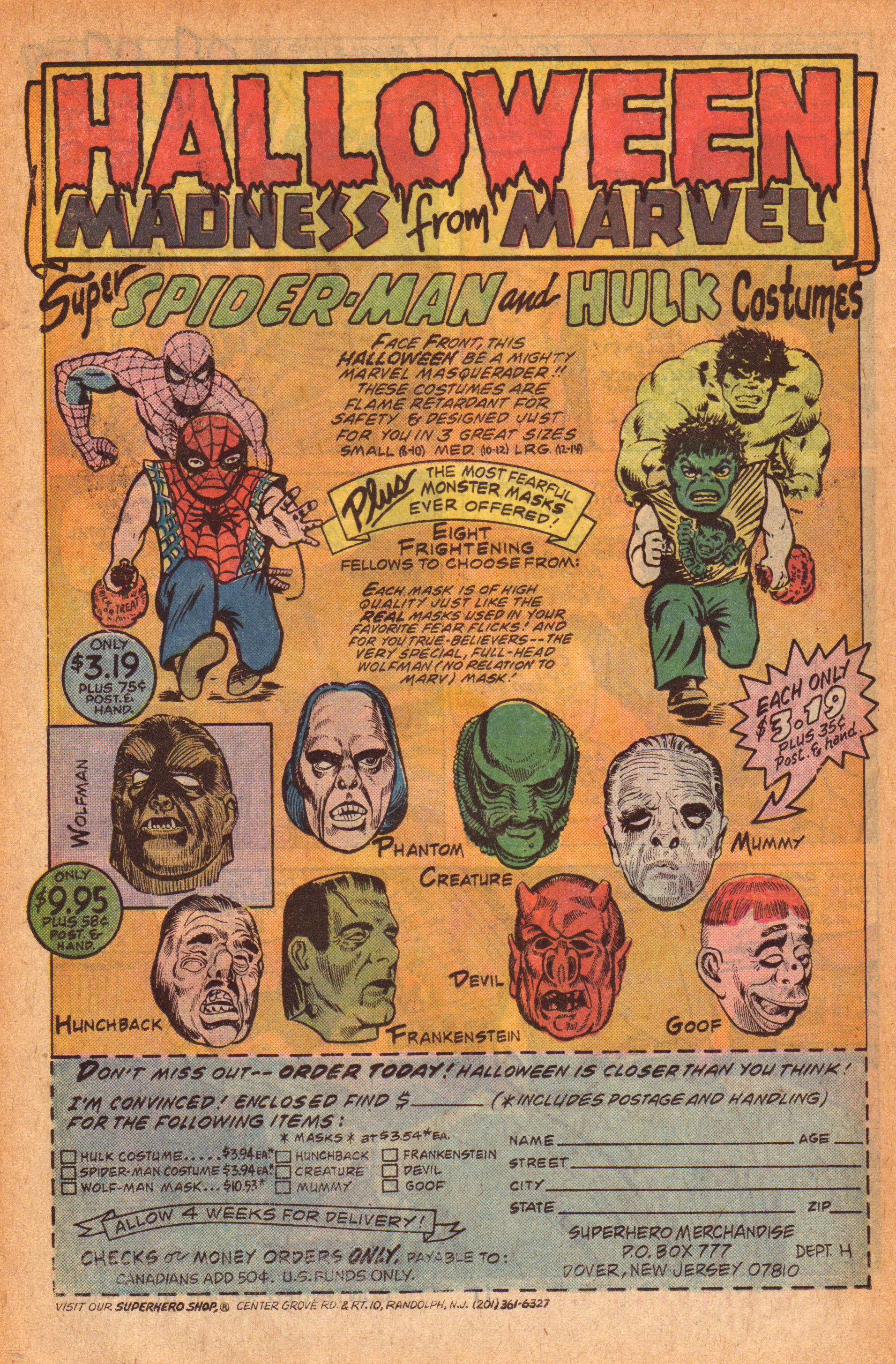
Today in Halloween: Marvel Madness

hallow marvel costumes ad

I intended to wait until Oct. 1 to begin this year’s crop of Today in Halloween posts, but I jumped the gun a little when I came across this vintage Marvel comics ad for Halloween costumes at the great Blog of Monster Masks.

I’m guessing this was sometime in the 1970s considering the prices – $3.19 for Spider-Man and Hulk costumes! – and the reference to Marvel writer/editor Marv Wolfman in a joke we could totally see coming.

As someone who perused every page of my favorite comics, this kind of exclamatory ad is so familiar from Marvel back in the day.

And bonus: The costumes are flame retardant for safety!

I hope to post something Halloween-related here every day. And you can check out the past couple of years’ worth of posts by clicking on the Halloween tag.

Comic book odd: The Joker’s boners

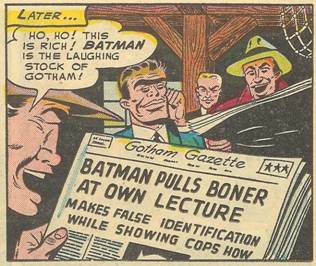
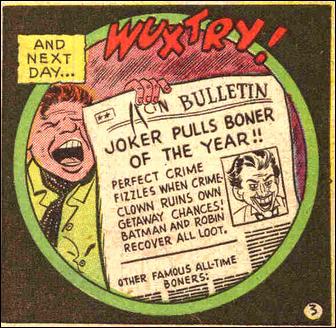
batman pulls boner

Ah, the Golden Age of comics.

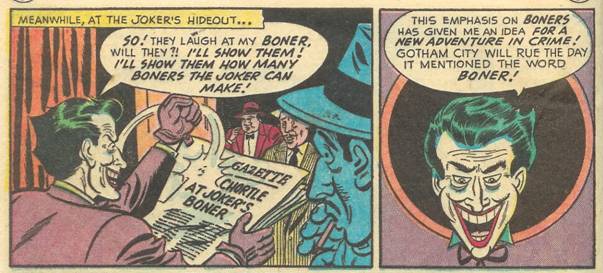
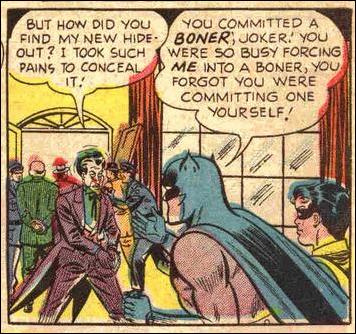
jokers boners two panel

Such an innocent time. A time when Batman’s arch nemesis the Joker could talk about boners and nobody would snicker.

joker boner of the year

Fast forward a few decades. Let the snickering begin.

batman boner conceal

These panels from old “Batman” books from DC  prove that the English language is a living, ever-changing thing.

Now where’s that Bat-boner-repellant when we need it?

Comic book odd: Lois gets a Super Spanking

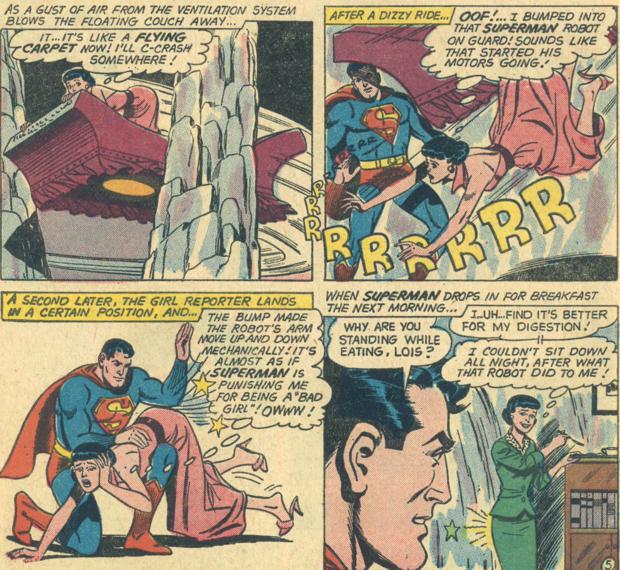
superman robot spanking lois

You know, I could do a whole website with odd moments from the Silver Age of comic books.

Actually, the good folks at Superman is a Dick do a wonderful job of highlighting strange covers and panels from the entire history of comics.

And the Comics Should Be Good section of Comic Book Resources does a good job with offbeat and funny moments.

That’s where I saw the panels above, from Lois Lane 14 from 1960.

“It’s almost as if Superman is punishing me for being a bad girl!” Lois says.

There’s so much to love about those panels. So many unintentionally funny lines. So … Silver Age.

Really, somebody should do a book with psychoanalysis of the writers of Silver Age comics. Or a “Mad Men”-style TV series.


Pop culture classic: ‘Galaxy Quest’

galaxy-quest-movie-poster-

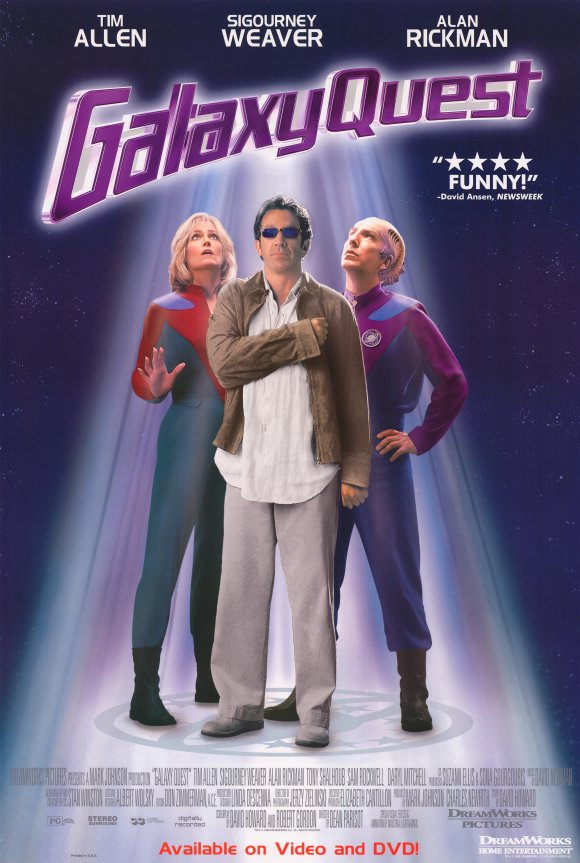
I’ve heard the argument made, online, that “Galaxy Quest” is the best big-screen “Star Trek” movie. “Star Trek” reboot director J.J. Abrams apparently said as much. While I think the claim is made somewhat facetiously, there’s a lot to be said for the light-hearted 1999 sci-fi comedy.

Beyond the trappings of the movie, which looks at a group of has-been actors living off the fame of their cult TV show 20 years later, there are a lot of subtle and not-so-subtle nods to “Star Trek” the show, its cast and fandom.

The movie, directed by Dean Parisot, shows us the cast of the former “Galaxy Quest” series in the only setting in which they can thrive: Fan conventions. While the show’s captain, played by Tim Allen, basks in the glory of his adoring fans, the rest of the crew – Sigourney Weaver as the ship’s eye candy, Alan Rickman as the Spock stereotype, Daryl Mitchell as the kid actor grown up, Tony Shalhoub as the perpetually befuddled and hungry engineer and Sam Rockwell as a glorified extra who comes along for the ride – seethe with jealousy.

From convention appearances to openings of electronic stores – where Rickman, so dry and sarcastic, has to trot out a modified version of his catchphrase: “By Grabthar’s Hammer … what a savings!” – the actors bicker and scramble for jobs.

When an oddball group of fans – led by Enrico Colantoni of “Veronica Mars” and including Rainn Wilson of “The Office” in a small role – asks for their help, they think they’re appearing in some elaborate fan-made performance. Soon enough they learn that the “fans” are aliens, come to Earth to find the heroes of the “historical documents” they’ve been watching in space. They’re seeking help in fighting off an evil alien conqueror.

“Star Trek” fans will find a lot that’s amusingly and comfortingly familiar here, from the perils of guiding the huge ship out of space dock to the ridiculous design of the craft itself.

Not to mention the ghettoized duties and personalities of the crew – Weaver’s character gets to repeat the computer’s pronouncements -and the backbiting behavior of the actors, all of who are resentful and jealous of Allen’s very Shatner-esque commander.

It’s easy to overlook Allen’s laid-back performance, but he really captures the bravado of a once-hot actor who still expects to be treated like a star.

Rickman is so good as the irritated Alexander, whose resemblance to Leonard Nimoy and his frustration at always being identified as Spock is dead on. Tony Shalhoub has some of the movie’s biggest laughs as the bemused engineer and Rockwell is wonderful as a bit player who would have given anything to have what even the cast of this cult TV show has.

“Galaxy Quest” might not be the best “Star Trek” movie ever made, but it sure is the best movie about “Star Trek” ever made.

Peter Capaldi is the new Doctor

peter-capaldi-doctor-who

A woman would have been nice, as would a non-white actor.

But there’s almost universal acclaim online since the announcement, a little more than a half hour ago, that British character actor Peter Capaldi would play the Doctor, the traveling time lord in the 50-year-old British TV series “Doctor Who.”

Capaldi – who played a WHO (World Health Organization) doctor in “World War Z – is best known as another kind of doctor – a spin doctor – in the BBC series “The Thick of It.”

We’d heard a lot of possible new Doctors – the 12th in the run in the series, including a one-shot TV movie starring Paul McGann but not counting the version played on the big screen by Peter Cushing – to replace Matt Smith. Capaldi had apparently become a favorite in recent days.

Since the modern “Doctor Who” era began in 2005 when the show was revived with Christopher Eccleston in the title role, I’ve caught the series a few times on SyFy or BBC America.

My real background with “Doctor Who” goes back to the 1970s and early 1980s, though, and the heyday of Tom Baker as the Fourth Doctor.

This was before the age of home video, so the only way to catch the show was when it aired, usually on some obscure cable channel.

I remember watching “Doctor Who” with friends up near the Region (for those of you who don’t know, that’s Northern Indiana) and enjoying Baker’s scarf-wearing escapades.

The modern-day Doctors have been younger romantic lead-types. The 55-year-old Capaldi brings a slightly older, more distinguished feel to the role.

One additional thought: It’s funny that Twitter was alive this afternoon with anticipation and reaction to the announcement of the new Doctor. The changing of the series’ lead actor has drawn some attention in recent years, but for much of the show’s early history, the change didn’t get a lot of notice around the world and especially here in the states.

It’s further proof that the geeks have inherited the Earth.

‘Pacific Rim’ is ‘Top Gun’ meets Godzilla

PACIFIC RIM

I was never the biggest fan in the world of Toho’s “Godzilla” series and their ilk. There’s lots to like in certain elements of the movies, particularly the first, black-and-white “Godzilla” film, which was a nightmarish funhouse mirror reflection of the atomic bombing of Japan that closed World War II.

Most of the later “Godzilla” movies, including those that introduced Gamera and Ghidora and Mothra and a variety of kaiju – Japanese for strange creatures – had some cool miniatures and pleasantly amusing “man in suit” special effects and they are watchable for their silliness. But terrifying? Awe-inspiring? No.

I think what was missing was the human element. Not just the scientists and military men on the ground, watching giant-sized mayhem unfold and trying to come up with a solution.

What was missing, it turns out, was “Top Gun.”

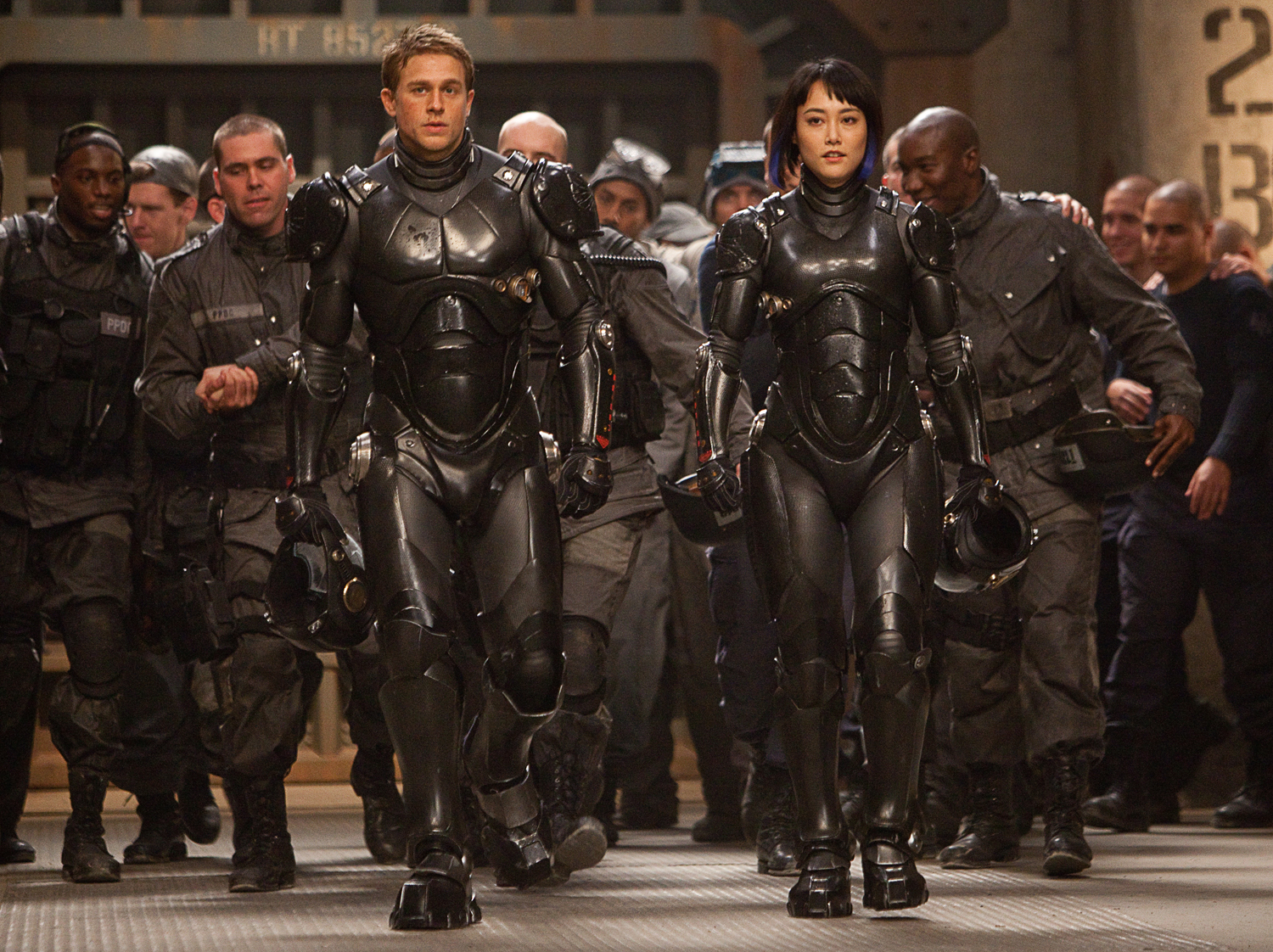
Director Guillermo Del Toro recognized not only the need to give the kaiju worthy human enemies but also the idea of introducing the soap opera-ish lives and traumatic pasts of the pilots of the fighter jets – here Jaegers, building-sized robots that battle the kaiju.

As everybody knows by now, “Pacific Rim” is the story of mankind’s response to a plague of kaiju – giant, destructive monsters, some with brute strength, some with acid spray, some with fiery breath – who arise from the sea through a rift in the bottom of the ocean and attack the mainland. San Francisco is the first to be hit, but eventually almost every city along the Pacific Rim finds itself fighting off monsters.

The nations of the world create the giant Jaegers, which are driven by two pilots, joined at the brain and working in tandem, to right the kaiju.

Del Toro makes this a fairly rich world, with war efforts like the Jaeger program as well as a wall-building effort that is doomed to failure. He also gives us the men and women who occupy this world.

“Pacific Rim” gives us some “Top Gun”-level conflict among the pilots and some personal stakes, including Raleigh’s (Charlie Hunnam) efforts to get back into the game after his brother’s death by kaiju years before, and Mako Mori (Rinko Kikuchi), who wants to be a Jaeger jockey to get revenge.

Charlie Day and Ron Perlman have a ball as a Jaeger program scientist and kaiju black market mobster, respectively, and Idris Elba is mesmerizing as the leader of the effort.

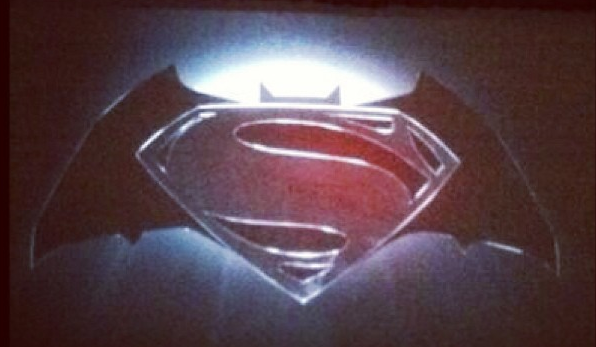
“Pacific Rim,” with its giant monster and robots, is like every little geek sci-fi fan’s dream come true on the big screen. It’s a good summertime movie that goes down easier than “Man of Steel.”

Some stray observations:

Pretty sure I heard a snatch of Godzilla cry from one of those kaiju.

I was startled to see that the SyFy channel cheapie “Sharknado” beat “Pacific Rim” to the punch on its “cut yourself out from the inside” joke. It might have even outdone it.

I’m guessing special effects limitations meant that so many battle scenes had to be in rain-swept darkness. I enjoyed the clarity we got in the few daytime scenes.

RIP Sammy Terry: We’ll miss our favorite ghoul

sammy terry b&w

I come to praise Sammy Terry, not to bury him.

With the passing Sunday, at age 83, of longtime Indianapolis music store owner Bob Carter, a chapter of television history closes.

That’s because, of course, Carter was the real-life, not-totally-secret identity of Sammy Terry, horror movie host on WTTV Channel 4 from 1962 to 1989.

I’ve written about Sammy before, but his passing prompts me to recount the Sammy Terry legend at greater length.

Carter was a TV pitchman who claimed to have invented the Kentucky Fried Chicken catchphrase “It’s finger-lickin’ good!” during a live commercial spot. He always seemed like a gentle soul and, on the rare occasions I called him for an interview, answered the phone in a toned-down version of the sepulchural voice he used to play Sammy.
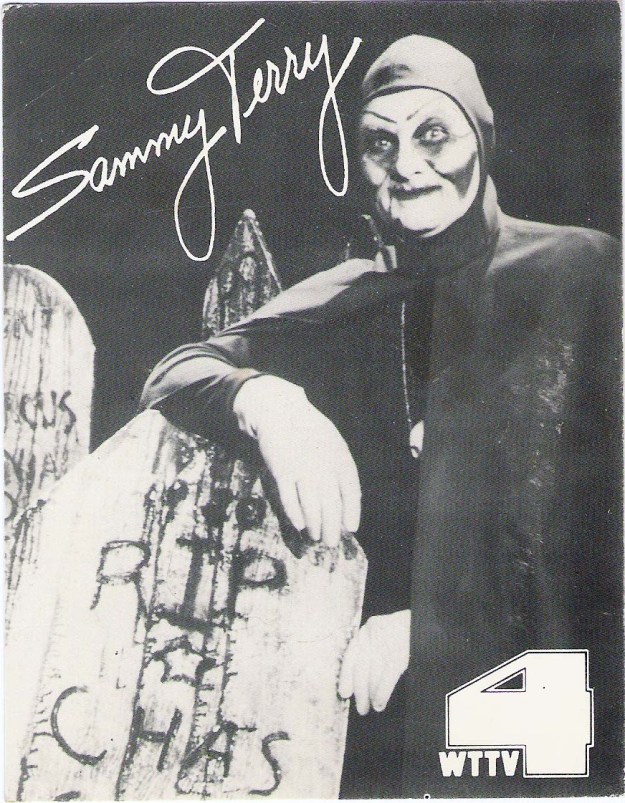
sammy terry autographed

He seemed to take his celebrity in stride. For a couple of generations – at least – of Indiana kids, he was a cultural icon before we knew what that phrase meant. But probably because you couldn’t make barrels full of money taping a once-a-week horror movie show on Indianapolis TV – and no doubt because he loved providing music education to legions of school children – he kept that day job.

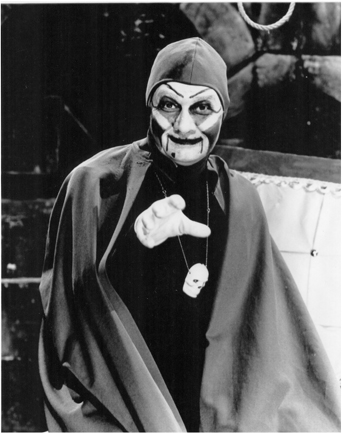
But 11 p.m. Friday rolled around and Carter – in yellow rubber gloves with veins drawn on, pasty pancake makeup, a dark purple cowl and cape and plastic skull around his neck – became friend and nemesis to us kids all at the same time.

He was a friend in my household. Because she knew it was important to me, my mom helped me stay up late on Fridays, talking to me and prodding me and even occasionally offering me a McDonald’s hamburger left over from our special Friday night dinner.

For other kids, including some of my cousins, Sammy, his creaking coffin, his spider friend George and his spooky movies were just a bit too much. Sammy’s entrance was a cue for the sleepover to move into deep sleeping bag mode.

And what movies he showed. Channel 4, like stations all over the country, had bought the Shock Theater package of films. The 50-plus films, including many classic black-and-white Universal Studios horror movies like “Frankenstein” and “The Wolf Man,” had been re-released to theaters for much of the 1930s and 1940s and even the 1950s. But in 1957, the package was released to television and many stations built a weekly horror movie show around it. Thus were born the TV horror hosts, men (and a few women) who dressed up in spooky outfits and presented the classic films, often seasoning their introductions and cut-away bits with campy humor.

Carter – whose stage name was a play on “cemetery” – told me on a couple of occasions how much he enjoyed the gig. He recalled with great fondness how the cardboard dungeon set was created and how the most realistic thing about the show – the coffin from which he arose every Friday at 11 p.m. – had been provided by a funeral home that insisted he never tell its origin for fear it would upset customers.

Carter made appearances here in Muncie over the years, and before one such appearance, in the early 1980s, I had done an interview and asked if I could meet him “backstage” at Muncie Mall as he got into makeup and costume. He graciously agreed and, along with a couple of friends, I was ushered into the room where he was getting ready.

Like three starstruck kids, Jim, Derek and I watched as he got ready and made small talk. When he was finished, I took a picture of the other two with him. That picture hung on Derek’s wall for many years.

Sammy’s time as a horror movie host passed more than a couple of decades ago, a victim of changing tastes and TV economics. He continued to make personal appearances, to the delight of the grown-up kids who remembered him and wanted their kids to know Sammy. In the past couple of years, Carter’s son has been making personal appearances in the character and might continue to do so. It’s a continuation I heartily approve of. Sammy would be pleased to know that he, the ultimate Hoosier TV ghoul, had a life after death.

We’ll miss you, Mr. Carter. And you too, Sammy.
Dead in Hollywood: Avco Embassy Pictures

avcoembassy

If you saw “This is Spinal Tap” or “Escape from New York” or “The Graduate” or “Phantasm” or “The Fog” or “Scanners” or “The Howling” in theaters – and if you didn’t get there late – you saw the Avco Embassy pictures logo at one time or another.

Blue and green geometric shapes swirling into place and into focus, the logo was a familiar one for devoted movie fans, particularly those with a taste for the low-budget and offbeat.

I still remember the anticipation I felt during the Avco Embassy logo at the beginning of John Carpenter’s “The Fog.” “Halloween” had become one of my favorite horror films of all time and I was looking forward to “The Fog.” I wasn’t disappointed, and I can still see that Avco Embassy logo in my head and will forever associate it with that movie.

Founded in 1942 by producer Joseph E. Levine as Embassy Pictures, the releasing company was more highbrow in its early years. The low-rent and fondly remembered period comes after 1967, when Levine sold the company to Avco and the stuff of low-budget dreams was born.

Under president Robert Rehme, the company released movies like “Scanners” and “Time Bandits” and “Phantasm.” Surely this was its heyday.

Norman Lear, creator of “All in the Family,” bought the company in 1982 and, for the most part, concentrated on television production.

Luckily for us, the studio’s best films live on. And so does that logo.