Category Archives: movies

We’re still friends, ‘Veronica Mars’

Veronica_Mars camera

As sure as “Buffy the Vampire Slayer” was a drama about high school filtered through horror movie trappings like vampires and demons, “Veronica Mars” was a drama about real-life horror show elements – murder, rape, STDs and, most of all, betrayal – filtered through the high-school experience.

“Buffy” and “Veronica Mars” were sisters of the same mother – as a throw-away line in the “Veronica Mars” movie that debuted just this weekend testifies – and are, ultimately, stories about surviving not just people with murderous intentions but the people who love you and the people you love. Betrayal hurts a hell of a lot worse than a stake to the heart or the zap of a Taser.
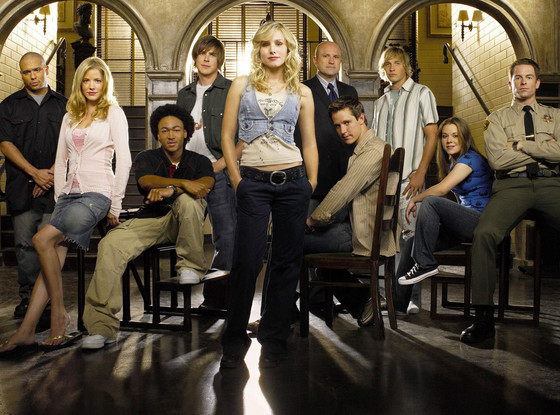
veronica mars cast

As TV shows, “Buffy” and “Veronica Mars” ended before their time. Sure, it can be argued that “Buffy” had more weak moments than strong ones in its last couple of seasons, but the most bitter pill for fans is that the show ended before pop culture’s full-on fixation with vampire stories began, with far lesser tales like “Twilight” hogging the spotlight that should have gone to the show that started it all.

And while “Veronica Mars” had the benefit of an online Kickstarter campaign that brought it back as the big-screen incarnation that debuted this weekend, its three seasons – again, admittedly, with some uneven stories late in its run – just missed out on the shared online community of Facebook, Twitter and name-your-social-media that generates – or at least proves to the world – the dedication of fans.

So we come to the new “Veronica Mars,” a big-screen movie that follows up, seven years later, on the heroine who gave the series and movie their names.

Director Rob Thomas, creator of the series, duplicates the success of the series in creating an unlikely protagonist in Veronica: A female protagonist who acts and talks like the tough-guy hero of a hard-boiled detective story but is still, realistically, a young woman trying to navigate the caste system of a small California town.

Neptune – “It really was built on a Hellmouth,” as one character says in the movie, in a nod to “Buffy” – is still a town full of haves and have nots. Thanks to the corruption that rules the town, the haves – politicians and software makers and movie actors and the police who do their bidding – push the have-nots down and keep them down.

Veronica – the former high-school outcast-turned private investigator, still played with toughness and vulnerability by Kristen Bell – returns to Neptune when former antagonist, former boyfriend Logan (charming, as always, Jason Dohring) is accused of killing his girlfriend, a former classmate who’s become a pop celebrity.
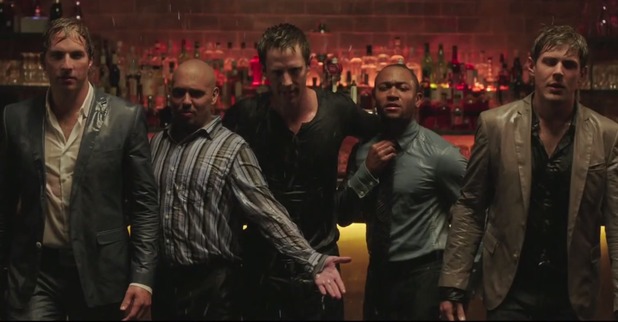
the guys fight veronica mars

The trip means leaving boyfriend Piz (Chris Lowell) and a promising job at a law firm behind in New York. And it means a reunion with friends like Wallace (Percy Daggs III), Mac (Tina Majorino) and Weevil (Francis Capra). There’s also that most dreaded function of “all these years later” plots – an actual high school reunion.
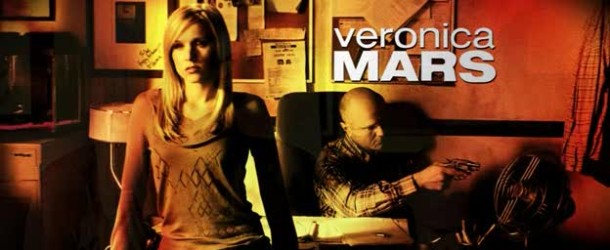
veronica and keith mars

Much more welcome is the reunion between Veronica and her dad, private investigator Keith Mars (Enrico Colantoni). It’s the relationship between Veronica and Keith – heartfelt and quippy, with the warmest and sometimes thorniest parent-child dynamic on TV – that made the show more than a rehash of Nancy and Carson Drew.

Well, that and the more-than-a-little caustic look at a town that seems more relevant today, frankly, than it did in the comparative boom days of the early 2000s. Neptune feels like a jaundiced and corrupt town from the best noir, full of biker gangs, seedy motels and people with either too much to lose or nothing at all.

The heart of the movie is Logan’s dilemma and Veronica’s puzzling out a solution, but there are a lot of nice moments with most of the cast. And there are some nice surprise appearances for fans of the show – mostly along the lines of glimpses of favorite supporting characters, with the notable exception of one who was written out of the story when it was on TV – and a fun and unexpected cameo or two.

The surprises emphasize, in a way, just how focused the movie is on fans – including those tens of thousands who helped fund it through Kickstarter  but also those who fondly remembered the series, its plucky and wry heroine and its jaded look at relationships and a town’s caste system.

The movie’s clubby anti-club slant probably limits its appeal to people who never watched the series. The point of rebooting an old TV show or movie is to bring in new fans, but like the “Serenity” follow-up to Joss Whedon’s “Firefly” series, “Veronica Mars” isn’t likely to engage new followers.

But for the faithful, the fans of the young sleuth and her world, “Veronica Mars” is a welcome reunion.
Method to their madness: Marvel movie credits scenes

Thanos-in-The-Avengers-

In all the verbiage that’s been dedicated to end-credits scenes in Marvel movies, gone unaddressed is the question of why some movies have one end-credits scene and why a few have two.

Early Marvel movies had only one end-credits “stinger,” or “button,” scene. The first, of course, was Samuel L. Jackson as Nick Fury showing up at the end of “Iron Man” in 2008.

“The Avengers” set a precedent for two credits scenes that was continued in “Thor: The Dark World” and, we’re hearing, “Captain America: The Winter Soldier.”

Spoilers ahead, obviously, although some are for movies you’ve probably seen by now. And if you haven’t, why not?

What we’re hearing so far about the end credits scenes from the “Captain America” sequel indicate the movie continues the mini-trend of two end credits scenes but also the trend of making one a direct promo for a future movie and one a character piece.

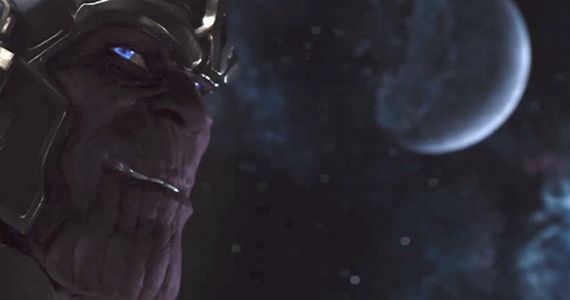
We saw that in “The Avengers,” which – in its first credits scene – teased Thanos as the bad guy behind the scenes of the movie. Then, in the end credits scene, the tired Avengers sit down for a meal in a nearly-demolished NYC restaurant. It’s a scene that emphasized the humor of director Joss Whedon.

Two end-credits scenes in “Thor: The Dark World” followed that pattern. In the first, the story is advanced toward this August’s “Guardians of the Galaxy” by introducing not only the character the Collector but the concept of the Infinity Stones before the very final scene showed Thor returning to Earth and reuniting with Jane Foster.

Now we’re hearing that two end credits scenes in “Captain America: The Winter Soldier” will follow the same approach. One will advance the larger Marvel movie storyline while the other will further the development of one character.

Is it purely a marketing strategy on the part of Marvel? At the end of the original “Captain America,” the most marketing-oriented extra so far included a montage of shots from “The Avengers.”

Is it artistic vision from the director? We know that’s not always the case. “Thor: The Dark World” director Alan Taylor grumbled about the inclusion of footage promoting “Guardians of the Galaxy” at the end of his movie. He didn’t direct it. Likewise, “Avengers” series director and Marvel’s big-screen consultant Whedon directed an “Avengers”-leaning promo at the end of the original “Thor” and, it was announced this week, directed one of the two scenes at the end of “Winter Soldier.”

So we’re guessing it’s more of a savvy, catch-em-while-they’re-in-the-theater-and-create-buzz move by Marvel.

And it’s one that usually adds to the enjoyment of the movies for fans.

Movie essentials: ‘The Dead Zone’

the dead zone walken tunnel

In the 1970s, I was reading everything that Stephen King wrote as fast as I could get my hands on it. I always thought “The Dead Zone,” his 1979 novel of a man with psychic powers trying to live a normal life and, failing that, trying to stop an apocalypse, ranked right up there with his work of the time, including “Salem’s Lot” and “The Stand.”

And I thought director David Cronenberg’s 1983 adaptation of King’s book was among the best movie versions of the author’s work. Much better than Kubrick’s “The Shining,” for example.

Watching “The Dead Zone” again recently, I think it’s held up remarkably well. The story is a pretty timeless one of love and loss and its small-town setting keeps everything from looking too dated.

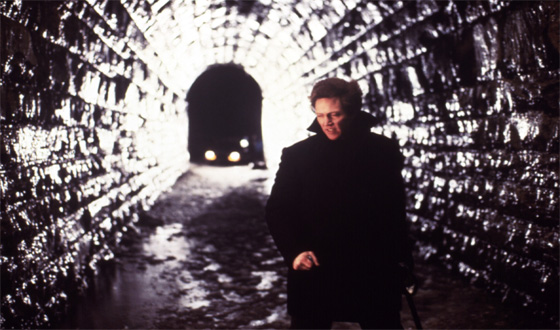
Christopher Walken – who has, in the 30-plus years since “The Dead Zone” was released, become an icon and has verged on self-parody – plays John Smith, a Maine school teacher looking forward to marrying his girlfriend, Sarah (Brooke Adams).

But Smith has an accident and is in a coma for five years. Although his parents are still around, Sarah has married someone else and had a young child.

Before he even gets out of bed, Johnny discovers another change: His coma has apparently awakened within him a psychic ability. If he touches someone, he can read their mind and see visions of their future. He is even able to tell his doctor, played by Herbert Lom, that his mother, separated from him in Europe in World War II, is still alive.

Not surprisingly, this unexpected talent doesn’t bring Johnny any peace of mind or comfort. Particularly when he touches the hand of a huckstering politician, Greg Stillson (Martin Sheen) and sees that he’s destined to one day be elected president and bring about the end of the world.

King’s book has more layers, but Cronenberg’s movie does a pretty good job of capturing the details and somber mood of King’s story.

Johnny is a haunted man, a man who can see everyone else’s future but has no future of his own, and the character is perfectly played by the Christopher Walken of 1983. The actor hadn’t yet become so familiar to us, through offbeat characters in movies like “Pulp Fiction” and through TV appearances on “Saturday Night Live” (“I pranked him in my basement”). We had a bad feeling about Johnny Smith just by looking at Walken’s pale and pained face.

Cronenberg’s movie feels as fresh as if it was made just a few years ago, thanks in part to its lack of trendy-at-the-time touches and the chilly blue-gray “look.”

Random observations:

It’s startling seeing Sheen as a maniacal, murderous president. That’s President Bartlet, man!

“The Dead Zone” makes me wonder why Brooke Adams, so good in this and the “Invasion of the Body Snatchers” remake, didn’t have a longer movie career.

Lom, who played “The Phantom of the Opera” way back in the 1960s and the nemesis of Clouseau in the “Pink Panther” movies in the 1970s, is a nice, steadying presence here.

Anthony Zerbe, one of my favorite character actors of the 1970s, is likewise welcome here as a potential campaign donor who sees through Stillson’s shtick.

Essential geek library: ‘The Best from Famous Monsters of Filmland’

best from famous monsters

I’ve noted it here before – as have many elsewhere – but it’s hard to overstate the importance of Famous Monsters of Filmland magazine to a generation of movie fans and, in particular, horror movie fans.

When FM appeared on newsstands in 1958 – before I was born, no less reading it – the Shock Theater package of old Universal horror films was playing on TV stations around the country, often hosted by an over-the-top character like Sammy Terry here in Indiana.

FM, published by Warren Publishing and edited by Forrest J Ackerman, greatly appealed to the audience of horror movie fans – including me, when I discovered it a few years later.

My relationship with my collection of FMs was a complicated one. I never had a complete run of the magazine, although I had most of them, between buying them new each month on the newsstand and buying back issues.

Then, possessed of the insane writer/designer spirit that led to my actual career, I cut up many of my issues, rearranging photos and articles in scrapbooks in my own fashion.

I bought many of the old issues again, years later, before selling off most of my collection a couple of decades ago.

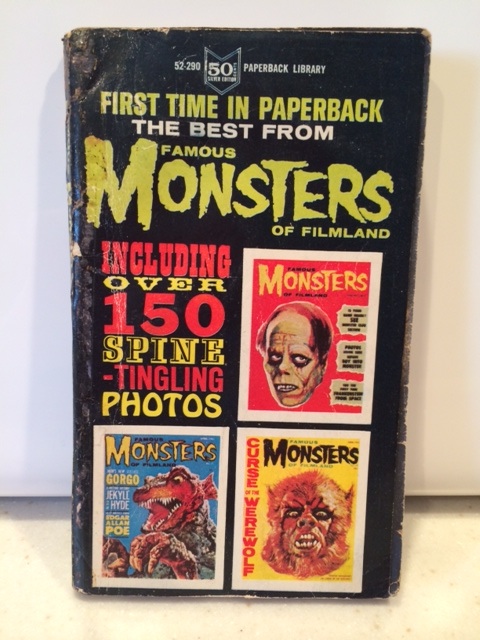
I kept my copy of “The Best from Famous Monsters of Filmland,” however, and wanted to mention it here in this edition of the Essential Geek Library.

Published in June 1964 by Paperback Library with a cover price of 50 cents, the book was a paperback-sized, 162 page reprint, basically, of some Famous Monsters articles from 1958 through 1960.

Individual articles bore such titles as “Monsters are Good for You,” “Alice in Monsterland,” “The Frankenstein Story” and “Girls Will Be Ghouls.”

Littered with Ackerman’s trademark puns – “Kong-fidentially Yours” – the book offered not only an enthusiastic defense of monster movies but inside information, including the number of models and armatures that were used in making “King Kong,” (27, Ackerman says. In a visit to his house in the Los Angeles area in the 1980s, I got to see one of those armatures, which was nothing but a metal skeleton with bits of material clinging to it by that point.)

I’m not sure when I picked up my copy of “The Best of …” but I’m guessing it was years after publication. It’s in pretty good shape but battered by years of reading, over and over again, by me and the previous owners.

Online sources indicate Warren and Forry published at least three paperback reprint collections of FM articles, following “The Best From …” with “Son of …” and “Famous Monsters of Filmland Strike Back.”

They were just what all of us monster kids wanted and we loved ’em.

Ranking the Marvel movies

Avengers assemble

Here’s a pointless exercise but maybe a fun one.

I decided to rank, in order of how much I enjoyed them/how good I thought they were, the big-screen Marvel movies.

It’s not too hard to tell that I prefer the official Marvel Cinematic Universe movies over the random Fox and Sony movies, I know.

A few provisos:

I’m not dipping back into pre-history far enough to drag “Howard the Duck” into this. And I haven’t seen it in a couple decades.

And I’m not including the 1994 “Fantastic Four” movie because it wasn’t released – I’ve only seen it on a bootleg DVD bought at a convention – and it doesn’t belong on this list any more than the awful “Captain America” TV movies do. Same for the “Blade” movies, which had their moments but seem as remote as the 1944 “Captain America” serial now.

Be aware, I’ve only glimpsed moments of the “Ghost Rider” movies on TV. And I’ve never seen the “Punisher” movies at all.

Two lists: First, just the “official” Marvel movies, then the list with the non-Marvel-overseen movies mixed in.

The Avengers

Captain America: The First Avenger

Iron Man

Thor

Thor: The Dark World

The Incredible Hulk

Iron Man 3

Iron Man 2

If you add the other post-2000 Marvel movies that aren’t part  of the official Marvel Cinematic Universe into the mix, it’s still weighted pretty heavy toward the official Marvel canon.

The Avengers

Captain America: The First Avenger

Iron Man

Thor

Thor: The Dark World

X-Men 2

Spider-Man 2

X-Men

X-Men: First Class

The Incredible Hulk

Spider-Man

Iron Man 3

The Wolverine

The Amazing Spider-Man

Daredevil

Iron Man 2

X-Men 3

Fantastic Four

Fantastic Four: Rise of the Silver Surfer

Spider-Man 3

X-Men Origins: Wolverine

Hulk

Elektra

Looking at that list, it seems like “Iron Man 3” is way too far down. But maybe not. I need to see it again.

Something tells me my list will see a big shake-up next month, when “Captain America: The Winter Soldier” opens.

Oscars: I’ll catch up tomorrow

oscars statue

I doubt I’ll be watching much, if any, of the Oscars tonight.

It’s not a protest of anything, or a statement about anything, including Ellen, the host.

I just feel more disconnect with the Academy Awards than I ever have.

For one thing, I haven’t seen a single one of the nine Best Picture nominees. I want to see at least three or four of them, but my schedule doesn’t encourage a lot of movie-going. And when it does, frankly, I really like escapist fare. Not that I didn’t see, and enjoy, movies like last year’s “Silver Linings Playbook.” But – and if you’re a reader of this blog, I don’t have to tell you this – I’m more likely to see the latest big-screen comic book adventure or action movie or comedy.

So other than tuning in to see what could be some funny stuff from Ellen at the opening, I’ll probably do other things until “The Walking Dead” comes on and then I’ll be watching it.

One reason I’m startled by my disconnect with the Oscars and movies in general is that I was a movie reviewer from 1978 to 1990. I saw two or three movies every week – during a period that was pretty good for movies of a certain type – and wrote about them. I loved Oscar night. I did my own predictions and sometimes the winners even coincided with my picks.

But tonight I’ll check out Ellen and undoubtedly enjoy Twitter comments by people who are watching. I’ll be amused, as always, by people who complain that the Oscar telecast runs long, like it doesn’t every year.

And if the show seems too long to you, why are you watching? There’s room alongside me on the couch for someone with an actual excuse as to why they’re not watching.

But I’ll catch up tomorrow.

Retro superhero: ‘The Phantom’

the phantom billy zane

Richard Donner’s “Superman” movies and Tim Burton’s “Batman” movies – and their sometimes regrettable sequels – came before, of course, but Bryan Singer’s “X-Men” really kicked off the big-screen superhero genre in 2000, and the trend was solidified a couple of years later by Sam Raimi’s “Spider-Man.”

But during the “lost in the wilderness” years of the the 1990s, the studios tried not once, not twice, but three times to capture the spirit of the superhero genre as typified by the great pulp magazine-style heroes, the forefathers to comics.

“The Rocketeer” came first in 1991 and was probably the most successful. “The Shadow” came in 1994 and did a pretty good job of hitting all the key elements of the most popular radio and pulp hero of them all.

Then there was “The Phantom.”

The 1996 Simon Wincer movie, starring Kristy Swanson, Catherine Zeta-Jones, Treat Williams and Billy Zane as the Ghost Who Walks, was certainly faithful to Lee Falk’s original comic-strip hero.

Maybe too faithful.

the phantom by lee falk

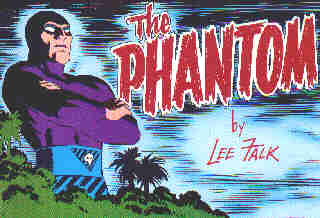
If you’re not familiar with the Phantom himself, the character was born in newspaper comic strips in 1936 and continues to this day. The Phantom is Kit Walker, the 21st in a series of fathers and sons who – following the 14th-century murder of a father, prompting a son to vow vengeance and the upholding of law and order – has kept the peace around the world and battled evil accompanied by his wolf companion, Devil, and his horse, Hero.

The Phantom is notable for some cool characteristics, including his twin handguns, the skull ring – whose imprint is left on bad guys’ jaws – and the legend that has been cultivated around him: He’s known as the Ghost Who Walks because criminals – a superstitious and cowardly lot, as Batman could tell you – believe he’s immortal rather than just the latest in a long family of crimefighters.

Falk created “The Phantom” after his newspaper syndicate asked for a follow-up to his “Mandrake the Magician.” In creating the Phantom, Falk invented a couple of superhero conventions, including the skin-tight costume and pupil-less eyes behind the hero’s mask.

“The Phantom” movie had the courage of its convictions, certainly. Its tale – the Phantom tries to protect a set of magical skull carvings and keep them out of the hands of a wealthy villain (Williams) – goes through the correct motions. Switching back and forth from the remote island home of the Phantom to New York City, the hero is aided by a spunky newspaper reporter (Swanson) and everything is complicated by the femme fatale played by Zeta-Jones. And what a revelation she was here. I really wanted her to play Wonder Woman after seeing her here and in another, better superhero 1990s movie, “The Mask of Zorro.”

There are pirates and submarines and seaplanes and immense sets and some action set-pieces, some better than others.

Zane leaves a lot of people cold – including me – but he’s really pretty good here as the Phantom. He nicely underplays the role, tossing off jokes and filling out the purple outfit about as well as anyone can. I was as frustrated as anyone by the black leather “X-Men” outfits, but maybe the world just wasn’t ready for purple spandex. And striped shorts.

As much as Zane underplays his part, Williams seems to have been told to overplay every line. I guess he’s being a good sport and the “Power Rangers” villain delivery would at least come across as non–threatening to kids in the audience. While the character is amusing, a villain who’s never truly threatening is not a great villain.

I’m not sure there’s ever been a big-screen movie that so desperately wanted to be “Raiders of the Lost Ark.” (I’m not counting the low-budget knock-offs here.) From the 1930s setting to the rickety bridge crossing that ends with the heroes swinging to safety to the ancient relics that magically illuminate a spot on a map to the villains that go “boom” at the end, “The Phantom” tries to strike so many “Raiders” grace notes it’s almost bizarre. Maybe that’s not a a surprise: Screenwriter Jeffrey Boam wrote “Indiana Jones and the Last Crusade,” a far better film.

“The Phantom” is worth seeing if you never have or if, like me, you haven’t in 18 years. It’ll seem like something of an awkward artifact because of the string of superheroes that followed it into theaters beginning just four years later, though.

Purple tights or no.

Big spoilers for ‘Captain America: The Winter Soldier?’

redford cap winter soldier

Warning: This is the kind of spoiler that, once seen, cannot be unseen.

I’ll give you another warning before unleashing the spoiler.

I’m torn when it comes to spoilers. I like knowing things that other people don’t know and, through this blog, sharing them with readers.

This is a lifelong condition for me. Back in the spring of 1980, I sat down at the curb outside a bookstore and scanned through the paperback novelization of “The Empire Strikes Back,” which had come out a few weeks before the movie. I remember being startled by the revelations in the print version. I couldn’t blog about it, of course. Pity.

Just like novelizations of movies can vary, to greater or lesser extent, so can merchandising tie-ins.

That brings us to the spoilers for “Captain America: The Winter Soldier.”

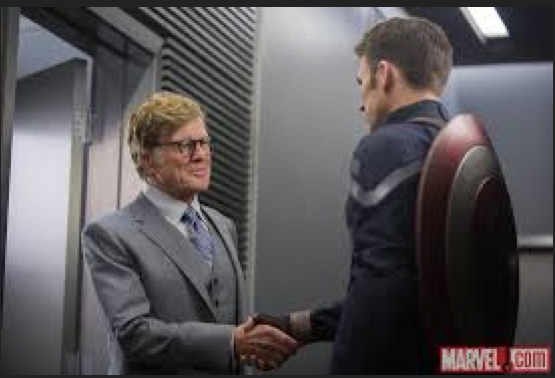
As you know, the movie – which comes out in April – pits Cap, now an integral part of spy organization SHIELD, against the title character, a Russian assassin with a bionic arm. This struggle plays out against the bigger backdrop of Cap’s disillusionment with SHIELD, particularly as represented by D.C. insider Alexander Pierce, played by Robert Redford.

Still not in ultimate spoiler territory, so hang in there.

If you’re familiar with the Winter Soldier concept from the comics, you know the character is really Bucky Barnes, Cap’s World War II partner, who seemingly fell to his death in the comics (and the first Cap movie).

And if you’ve seen trailers for the movie, you’ve gotten a pretty good idea that the movie makes Cap and other characters, including Black Widow and Falcon, rebels within the SHIELD organization.

Okay. So here’s where we get into spoilers, maybe. Keep in mind I haven’t seen the movie and don’t have any inside knowledge. I’m reading conjecture online and putting two and two together.

Okay. Spoilers in 

5

4

3

4

1

Ready? 

If the movie follows the storyline of the Marvel Comics “Winter Soldier” book, the Red Skull – Cap’s nemesis from the comics – will play a role in the modern-day.

As played by Hugo Weaving, the Skull seemed to disappear – whooshed away to another dimension or another of the Nine Realms – at the end of the movie. It sure looked that way to me.

And if you’re a comic reader, you know that the Skull has popped up, in person and in various disguises, for much of the past half-century. So it’s safe to say that the Skull could return without too much surprise.

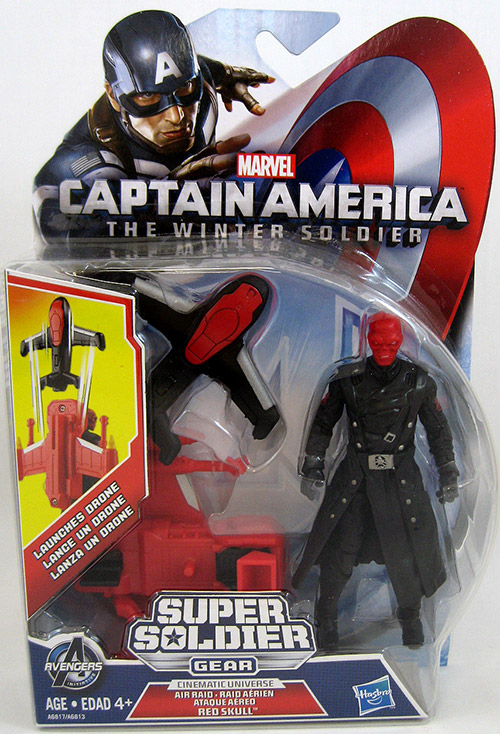
Which makes the Red Skull action figure, released to tie into the movie, make sense.

winter soldier red skull action figure 

Again, he might not be in the movie. He might just be part of the action figure merchandising from the movie.

Then we remember this quote, from early 2013, in which Redford – who could have played Cap in a 1960s or 1970s big-screen version – talked about why he wanted to appear in the movie.

“I think a career requires a certain amount of reinvention. If you get caught in one track I think that can be dangerous. Success has a dark side to it. you want to be careful if you’ve had success at something, that you not try and follow it by just duplicating it. That’s why I’m doing this Captain America thing. I like the idea of playing a villain…I did that just because it’s a different thing for me to do.”

So is Redford playing the Red Skull in disguise?

What better to re-introduce the character and interject a huge note of suspicion and distrust in how Cap and other heroes feel about SHIELD.

Remember, if you will, that Cap and Tony Stark discovered in “The Avengers” that SHIELD was making new Hydra weapons. The Red Skull channeled the power of the Tesseract, or Cosmic Cube, for those weapons.

Who’s to say the Skull, under the guise of the leader of SHIELD, hasn’t been using SHIELD’s resources to re-arm Hydra?

Speculation online and in interviews with Marvel officials has centered on how thoroughly the Marvel cinematic universe will change based on “Captain America: The Winter Soldier.” The movie is supposed to be something of a game-changer in the year leading up to when “Avengers: The Age of Ultron” comes out in 2015.

What better way to change the game than by taking the organization that’s been a part of every Marvel movie since Nick Fury stepped out of the shadows of Tony Stark’s living room in “Iron Man” in 2008 … and deconstructing it.

And what better way to do that than by revealing that the man ultimately in charge of SHIELD, Nick Fury’s own boss, has been the Marvel universe’s most enduring villain, maybe for decades?

We’ll see in April if any of this is even remotely correct.

Get off my lawn: Geekery is wasted on the young

wkrp cast

Here’s the latest irregular installment of my view from the perspective of a longtime fan. So if you don’t want to hear it, you’re welcome to come back for the next entry. No hard feelings.

Back in my day (and ohmygod yes I did just write that, but mostly for the ironic effect) young fans or geeks or indoor kids or whatever we wanted to call ourselves appreciated classic books, movies and TV.

I mean, what choice did we have? We could slip back into the past with classic Universal monster movies or we could thrill to “Island at the Top of the World.” We could delight in “The Twilight Zone’s” dated pleasures or stay rooted in the present-day of “Manimal.”

I loved the TV and movies of my time, like “Star Trek” and “Star Wars,” but also loved the classics, like the aforementioned Universal movies featuring Frankenstein or the Wolf Man as well as the films of W.C. Fields, the Marx Brothers and Abbott and Costello.

I like to think of myself as living in the present day. I love the online world, from my ability to blog here to Twitter (two accounts). I can enjoy the treasure trove of information and entertainment available now thanks to the Internet that I couldn’t have imagined when I was young.

But …

Really, there’s no excuse for being ignorant of what’s come before.

Two things I’ve read recently bring this to mind.

robocop original poster

With the release of the “Robocop” remake, a writer on io9 “discovered” the original 1987 movie and wrote, in pretty funny terms, about how awesome the movie is. It was pretty amusing and I didn’t really mind it, but I was thinking, “Really? You can watch any movie or TV show you want now, on several devices, and you seem shocked by your initial exposure to a very high-profile satirical science fiction movie from less than 30 years ago?”

Far more egregious was a recent AV Club roundtable about the 1970s series “WKRP in Cincinnati.” The series, about a radio station, was an MTM production and ran for several years. It’s not like nobody remembers it.

But one writer for the AV Club, who almost certainly wasn’t born when the series originally aired, was very dismissive of the show. She said the look and feel of the show and the characters were so dated she couldn’t get into the story.

Again I’m wondering how this person had never seen a bit of, or even heard of, the series before … and how that qualified her to take part in a roundtable discussion of the series.

Yes, I know. It’s a different world now. The young shall inherit the earth and all that.

But can’t they educate themselves on their way to the throne?