Category Archives: TV

‘Mad Men’ hits the desperate season with ‘Christmas Waltz’

When I noticed the name of last night’s new “Mad Men” episode, “Christmas Waltz,” I had a moment of confusion. Surely this can’t be a Christmas episode. How far along into the season are we?

Then I remembered that last week’s episode featured Weight Watchers member Betty struggling with Thanksgiving dinner preparations. (And then eating the most pathetic meal ever. Seriously, one Brussels sprout?)

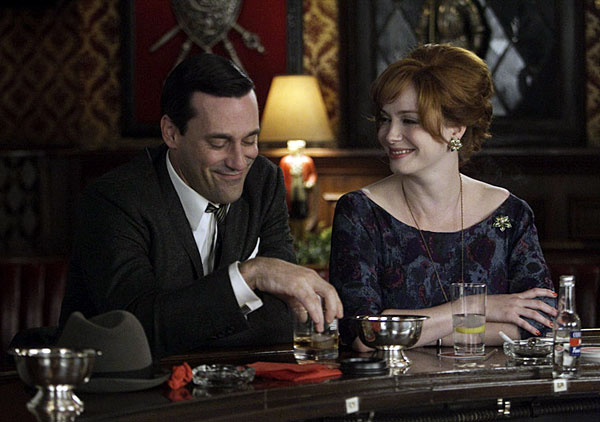
So tonight’s episode, crowned by a lengthy scene of Don and Joan drinking in a Manhattan bar festooned with Christmas lights, seems a bit jarring in May — and also seems like a fast-forward to some distant point in the “Mad Men” season so far.

But the episode was knit together out of the kind of desperation that seems right around every corner during the holidays:

Joan, served divorce papers by her soldier husband, momentarily wigs out.

Harry gets contacted by former colleague Paul, who’s now become a Hare Krishna. Harry goes to a gathering and meets Lakshmi, Paul’s pseudo-girlfriend. Lakshmi later asks Harry for a favor and offers him the only thing she has: Herself.

Lane’s increasingly erratic behavior this season appears to be caused by a bad debt. To come up with the money, Lane secretly borrows $50,000 and convinces the other partners the firm is flush enough to award Christmas bonuses. The Brit finds himself sweating, however, when the firm’s Mohawk Airlines account is sidelined and revenue stops coming in. It’s only a matter of time before Lane’s situation blows up in his face.

Pete is still a pompous little ass.

Other thoughts:

Feeling of doom: I swear, almost every episode this season has seemed to foreshadow death and destruction — not personal self-destruction, although there’s plenty of that going on — and usually for Don. A couple of episodes ago, Don stood peering into an empty elevator shaft. In this weeks’ episode Don, half in the bag from drinking with Joan, drove a borrowed Jaguar home, speeding and shifting like crazy. I was almost afraid to look until the scene ended.

Pop culture watch: Recently Megan was helping an actress friend rehearse for an audition for the “Dark Shadows” TV show. This week, Harry’s Hare Krishna convert friend Paul desperately wanted to get a script into the hands of the producers of “Star Trek” — maybe even the show’s creator, Gene Roddenberry. And how perfect was it that the script Paul wrote was a thinly — very thinly — race relations allegory?

Time’s running out: As AMC reminded us at the end of this episode, only three installments remain in this season.

‘Sherlock’ takes a leap with ‘The Reichenbach Fall’

Anyone who has read the Canon — as Arthur Conan Doyle’s Sherlock Holmes stories are known — knows the significance of Reichenbach Falls.

It was there, at the famous Swiss waterfall, that Conan Doyle’s famous consulting detective met his end. In the 1893 story “The Final Problem,” Conan Doyle — sick to death of the notoriety and fame and, yes, stereotyping and literary ghetto-izing that the Holmes stories had placed on his shoulders — decided to kill off Holmes once and for all. (Reader demand led Conan Doyle to reverse the decision a few years later.)

Holmes pursued Moriarty, the criminal genius, the spider at the center of the web of crime for all of England and a good portion of the globe, to the falls. Holmes’ friend and biographer, John Watson, becomes separated from the detective and later finds a note from Holmes. He is about to grapple with Moriarty atop the falls.

Two sets of footprints ascend to the top. No footprints are seen coming back down. Even an amateur detective like Watson can see that.

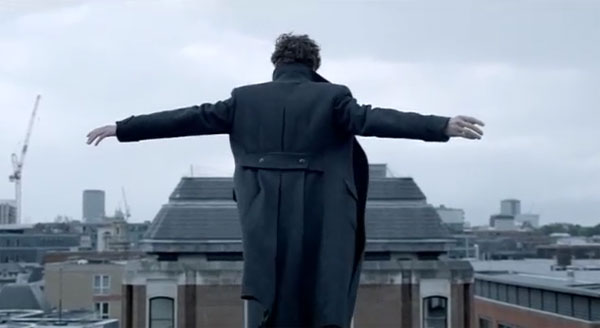
Tonight’s episode of “Sherlock,” “The Reichenbach Fall,” plays on that theme. After a cat-and-mouse game in previous episodes of the first and second seasons of the BBC series — airing on Masterpiece Mystery stateside — Moriarty begins an all-out assault on Holmes in this story.

Moriarty pulls off three seemingly impossible crimes: He opens the vault of the Bank of England, unlocks the gates of an impenetrable prison and seizes the Crown Jewels from the Tower of London.

But instead of making off with the priceless baubles, Moriarty sits on the throne, be-crowned-and-sceptered, waiting for Lestrade and the other London coppers to arrive.

Holmes testifies at Moriarty’s trial and — being Holmes — irritates the members of the jury so much that they exonerate the criminal. Or is some other game afoot?

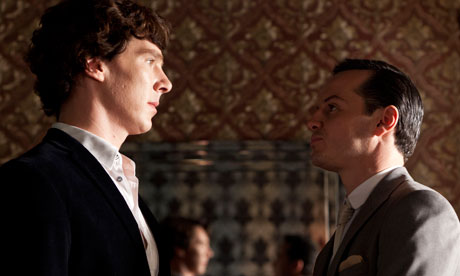
After the trial, Moriarty shows up at 221B Baker Street and begins “playing” with Holmes. It is a game that sees Holmes trying to find a computer code of Moriarty’s design that can unlock virtually any door, any secret, a code that makes Holmes a target of an international set of assassins.

Meanwhile, Moriarty begins chipping away at Holmes’ reputation until only Watson is still in his corner. And even Watson’s faith is a little shaken.

Although there are only three “Sherlock” episodes per season — maybe because there are only three — the series is uniformly high in quality and clever beyond compare. I’m guessing they’ll do more episodes this year and we’ll get to see them in 2013. I sure hope so.

Other thoughts about tonight’s episode:

I love the way the series plays with how Sherlock and Watson are perceived. Tonight Watson is irritated to see himself described in the press as a “confirmed bachelor” and constant companion to Holmes.

As a member of the press, I’m a little chagrinned about how it was portrayed tonight. But it is the British press, after all.

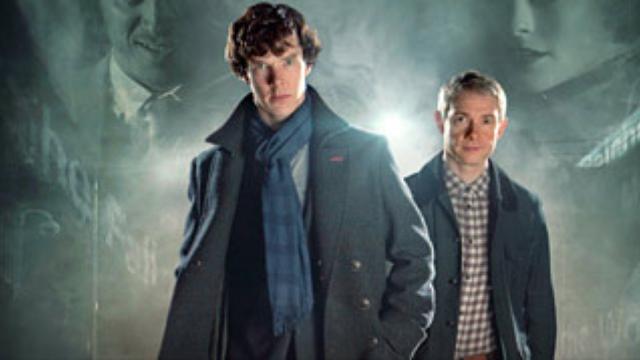
Benedict Cumberbatch and Martin Freeman continue to be among my favorite Holmes and Watsons of all time. Cumberbatch in particular isn’t afraid to play Holmes as unlikable for most of an episode.

Andrew Scott played Moriarty with just enough crazy. A little bit more would have been too much. If tonight’s episode, in the style of “The Final Problem,” proves to be his swan song, it was a good one.

Most of this show is attention-grabbing and attention-keeping. There’s some effort involved, of course, in keeping up with the quick-paced, accent-tinged dialogue delivery. But the riveting stories and scenes are another reason to keep watching the screen. The two main dialogue scenes between Holmes and Moriarty in tonight’s episode could not have been more mesmerizing.


‘Sherlock’ runs with the pack in ‘The Hounds of Baskerville’


Since it was published in serialized form in 1901 and 1902, Arthur Conan Doyle’s “The Hound of the Baskervilles” has become one of those touchstone Sherlock Holmes stories. As much as everybody knows (often wrongly) that Holmes was a “difficult” genius and that John Watson was always a step behind him, everyone knew that Holmes took on a huge, mysterious hound in this Conan Doyle novel.

So the makers of “Sherlock,” the BBC production airing on PBS’ “Masterpiece Mystery” series, had to do an adaptation and had to do something different.

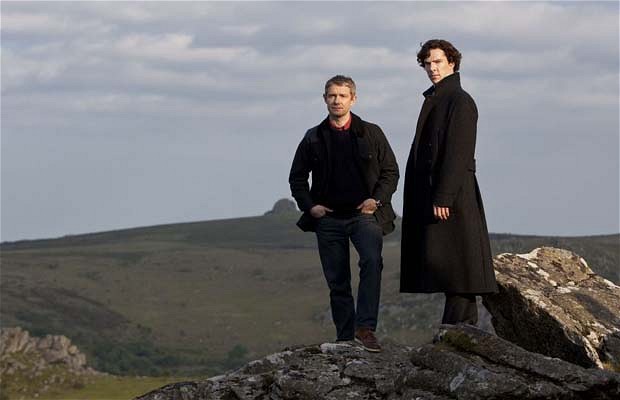
In “The Hounds of Baskerville,” the second of three “Sherlock” episodes in this season, Holmes (Benedict Cumberbatch) and Watson (Martin Freeman) take on the case of Henry Knight, who remains traumatized by seeing his father killed by a huge hound 20 years before. The two venture into the English countryside, specifically to the Baskerville military research base, to find out if giant glowing dogs with red eyes really do exist.

In the process, they have brushes with Sherlock’s brother Mycroft (the top-level British intelligence agent) and even James Moriarty, the warped genius who has become Sherlock’s nemesis. The ending of tonight’s episode forecasts the return of Moriarty next week.

Of course, Holmes and Watson also have the misfortune of running into that hound — as well as a couple of levels of conspiracy.

A few thoughts about the episode:

I loved that Holmes at one point notes that the CIA has a top-secret facility in Liberty, Indiana. That’s just down the road from me and I can assure you that if the Company has set up shop there, it’s pretty well hidden. Made me wish, for a moment, that they had chosen Muncie like everyone from “Tom Slick” to “The Simpsons” to “Hudsucker Proxy” to “Angel” has.

Not that there’s anything wrong with that: Not for the first time in the run of the series, someone mistakes Holmes and Watson for a couple. Cute.

Watson mockingly refers to Holmes as “Spock” after a scene in which Holmes is shaken by his failure to keep his emotions in check. Comparisons between the two have always been made and “Star Trek” episodes have obliquely referred to Spock’s ancestor Holmes (possible, as Trek fans know, because Spock’s mother is human). But for a joke that trumps all, Cumberbatch plays the bad guy in the now-in-production “Star Trek” movie sequel.

This Sherlock turns to cigarettes when he’s bored and anxious between cases, and not a seven percent solution.

Tonight’s episode had the misfortune of airing in the US following a couple of successful movies that had similar elements. The Baskerville hound looked a bit too much like the “mutts” in “Hunger Games,” while the idea of mind-altering gas released into outdoor settings echoed “Cabin in the Woods.”


‘Sherlock’ returns with ‘Scandal in Belgravia’

One of the unexpected pleasures of TV in the past couple of years — along with “The Walking Dead” and a handful of other shows — has been “Sherlock,” Steven Moffat’s modern-day updating of Arthur Conan Doyle’s Victorian-age detective Sherlock Holmes.

There have been so many — hundreds — of stage, film and TV adaptations of the Conan Doyle books and short stories in the past century years that it’s hard to imagine crowning one as the best, particularly one that takes such liberties with the content of the canon. But “Sherlock,” a BBC production airing on PBS’ “Masterpiece” series (with two more installments to come May 13 and 20) is certainly near the top of the list.

In the series, set in the present day, Holmes (Benedict Cumberbatch) and Watson (Martin Freeman) forge the offbeat relationship familiar to readers of the original stories. Holmes is a brilliant consulting detective, Watson a physician and soldier. Each man is troubled in some respects. Watson is recovering from physical and spiritual wounds suffered in Afghanistan while Holmes is, for all his British intellect and wit, a stranger in a strange land.

The updated series uses original Conan Doyles stories (and titles; tonight’s episode is a take-off on “A Scandal in Bohemia”) as jumping off points, mixing in high-tech touches along with Holmes’ old-school detective work. In other words, for every scene in which Holmes deduces someone’s life story by observing stay hairs on their pants or scuffs on their shoes, there’s another scene in which Holmes or one of the players is texting on their smartphone. Just as Conan Doyle’s original writing had Watson publishing stories about his exploits with Homes — much to Holmes’ bemusement — in the new series, Watson writes a popular blog about the detective.

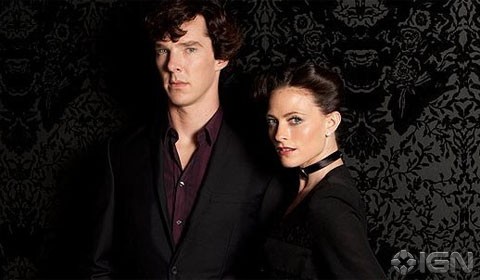
Tonight’s episode, like the 1891 original, introduced Irene Adler, a woman who is Holmes’ equal in sheer, cool intellect. In “Sherlock,” Adler is a high-society dominatrix who, as the  episode opens, is being sought for the compromising photos of a member of the royal family on her cell phone.

Adler is, as fans know, “The Woman,” the female who greatly intrigued Holmes, who was very likely his perfect match … if not for her habit of lawbreaking.

In “Belgravia,” we get some choice “Sherlock” scenes, as Holmes stays one step ahead of the police and the bad guys even as he struggles to keep up with Adler.

All the key ingredients to the “Sherlock” series are here: Holmes and Watson’s fond verbal jousting; landlady Mrs. Hudson; even Holmes’ nemesis James Moriarty. The opening of the episode resolves the standoff between Holmes and Moriarty from the end of the first season.

“Sherlock” revels in its modern-day ingenuity — the use of technology and London’s cool blue exteriors give the series a properly detached feel — as much as it encourages us to focus on Holmes’ never-out-of-style intensity.

Cumberbatch and Freeman are among the best portrayers of Holmes and Watson ever. Cumberbatch gets a showy role but Freeman — soon to star in “The Hobbit” with Cumberbatch providing the voice of the dragon Smaug — is an understated delight.

“John Hamish Watson. Just in case you’re looking for baby names,” Watson mutters at some point when Holmes and Adler are striking sparks.

And what an Alder Lara Pulver is. I love Rachel McAdams, who plays Adler in the current Robert Downey Jr. Holmes movies. But Pulver makes McAdams look like the high schooler she played in “Mean Girls.” Pulver, who matches Cumberbatch in cheekbones and ivory skin, is gorgeous and dangerous. She’s utterly believable as “the woman” in Holmes’ life.

Next week, “Sherlock” takes on “The Hound of the Baskervilles.” I’ll be watching.

‘Man Men’ gets naughty ‘At the Codfish Ball’

Tonight’s episode of “Mad Men” was called “At the Codfish Ball,” but it might as well have been called “The In-laws.”

Peggy, disappointed that her boyfriend, Abe, suggested they live together rather than get married, asks her mother over for a special dinner to announce their new living arrangements.

Instead of staying for dessert, Peggy’s mom gets up and leaves at the news. Heck, she even takes back the dessert she brought with her.

For all the change the series has been demonstrating as it marches through the 1960s, it was a pointed reminder that social mores had yet to change substantially and young women were expected to get married, or — as Peggy’s mom noted — get a cat. Then another cat. Then another cat. “Then you’re done.”

There was a similarly unpleasant undertone to the visit by Megan’s parents to the Draper household. Sure there were a few moments of lighthearted family fun, particularly when Sally and Megan and her mother went shopping and came home so Don could play Dagwood to Megan’s Blondie.

But most of the time the in-laws were visiting was filled with hate-filled French tirades between Megan’s parents.

Megan’s mother — played by Julia Ormond, who is, needless to say, too young to be playing Jessica Pare’s mother — livened thing up considerably at the ball that the family and Roger Sterling attended late in the episode.

After striking sparks with Roger, Megan’s mom accompanies him into a room down the hall from the ballroom. It is there they are spotted by Don’s young daughter, Sally (Kiernan Shipka) in a thoroughly compromising position. It’s another disillusioning moment for Sally and a shocking moment in the episode.

Random observations:

Roger’s one liners continue to be a highlight of the series. “Maybe Jesus was just pursuing the loaves and fishes account,” he notes during a discussion of motivations for good acts. John Slattery is at his most charming in this episode, partnering with Sally for the business gathering and jokingly calling her a “mean drunk” before giving her a Shirley Temple. And, needless to say, before giving her an eyeful by his antics with her sort-of-grandmother.

Joan (Christina Hendricks) gets the prize for best recovery of the episode. After observing that Peggy (Elizabeth Moss) isn’t wearing an engagement ring, Joan hears about Abe’s proposal and blurts out, “Shacking up?” before she recovers and convinces Peggy it’s really a romantic idea.

For the second time this season, “Mad Men” mines the “Twin Peaks” cast for guest stars. A few weeks ago it was Madchen Amick as Andrea, Don’s old fling.

Tonight Ray Wise, the actor who played Leland Palmer, murder victim Laura Palmer’s father on “Twin Peaks,” guest starred as a business executive who breaks some bad news to Don regarding the repercussions of his infamous ad about tobacco and smoking in The New York Times.

Which “Twin Peaks” vet will guest next? I’m holding out for Peggy Lipton.

‘Mad Men’ tunes in and turns on with ‘Far Away Places’

This season of AMC’s “Mad Men” is one of the most enjoyable — if hard to predict — because you never know what’s going to happen next. In any given episode, Don Draper might be choking an old fling — at least in the depths of a fever dream — or Lane Pryce might be handing young Pete a beat down.

In tonight’s episode, “Far Away Places,” the plot was appropriately odd and disjointed, especially considering all the sex, drugs and rock and roll.

The show continues its headlong plunge into the heart of the most turbulent part of the 1960s as Peggy (Elizabeth Moss, who is always wonderful) gets fed up with the Heinz beans people and insults them, much to everybody’s shock. So Peggy, who earlier had an argument with her boyfriend, decides to take in a matinee.

Peggy gets offered a joint by a guy (in very loud striped pants) in the theater and doesn’t react with dismay when he makes a pass. As a matter of fact, Peggy administers an “Animal House”-style handjob — minus the Greg Marmalard plastic gloves — right there in the theater.

Meanwhile, Roger (the likewise always wonderful John Slattery) and wife Jane (Peyton List) go to a party and partake of LSD. The middle part of the episode finds Roger and Jane tripping out. When they come around, Roger tells Jane he’s moving out, a decision based on her acid-inspired comments.

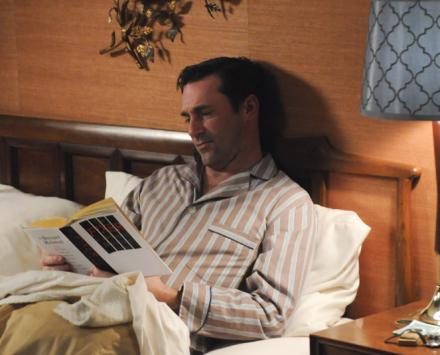
Also meanwhile, Don (Jon Hamm) and Megan (Jessica Pare’) go out of town on a trip to a Howard Johnson’s. It’s ostensibly to check out a client, but Don plans the same uncomfortable mixture of business and pleasure that he’s been practicing with Megan all season. When they get into a fight and Megan disappears, Don’s anxiety skyrockets.

To top it all off, Bert Cooper (Robert Morse) — who’s spent how many seasons wandering in the wilderness of the conference room? — administers a brisk slap across the face to Don. Bert calls him out on how little work he’s done lately. Holy crap!

Other highlights:

I’m enjoying the little glimpses of Ginsberg and his father (“I’m the original,” the elder Ginsburg tells Peggy) but I’m curious where the characters are going.

Has “Mad Men” been employing flashbacks? Tonight we get a glimpse of the past in Don and Megan’s Disney vacation with Sally and the little Draper boy, whatever his name is.

In the preview for next week, Roger says he’s had a life-changing experience. Does he mean the acid trip? At the end of tonight’s episode, he was pretty damn cheerful.

“Mad Men” continues to keep us guessing.

‘Itchy and Scratchy and Poochie:’ Totally in your face

Leave it to “The Simpsons” to have the final word on adding unwanted — and hated — characters to a TV show.

I’m talking about Poochie, the “proactive” and “totally in your face” canine added to the show-within-a-show, “Itchy and Scratchy,” in the eighth season of “The Simpsons,” way back in 1997 (!).

It was far from the “worst episode ever.”

As the show opens, Krusty the Clown and Rogers Meyers Jr., the creator of “Itchy and Scratchy,” are trying to re-invigorate the ratings for the show. A network type has the idea of adding a character because we’ve seen how well that works (Cousin Oliver on “The Brady Bunch,” any character Ted McGinley played on various sitcoms).

After a frustrating round of focus groups with kids who don’t know what they want, Meyers and company add Poochie, a dog. But not just any dog. He’s a “surfer dude,” complete with board, sunglasses and attitude.

Inevitably, Homer auditions for the role of Poochie’s voice and debuts in an episode in which Itchy and Scratchy pick Poochie up along the road on their way to a fireworks factory.

As Poochie raps and poses and dunks basketballs to heavy metal guitar riffs, the audience gathered in the Simpsons’ living room grows restless.

“When are they going to get to the fireworks factory?” a frustrated Milhouse whines.

The introduction of Poochie is a disaster, with even Kent Brockman weighing in, noting that kids won’t be sad when the canine is “put to sleep.”

Meyers decides to kill Poochie off on the cartoon, but Homer insists on recording a heartfelt bit of dialogue first.

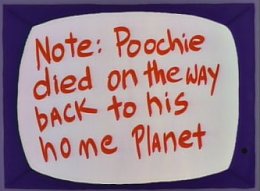
Meyers and the crew appear to be touched. But when the episode airs, instead of Homer’s moving words, Poochie simply announces he must return to his planet. The animation cel bearing his likeness is crudely pulled upwards and out of view.

Then a slide appears:

Ah, Poochie. We hardly knew ye.

Other highlights:

This was the episode that introduced the catchphrase “Worst. Episode. Ever,” intoned by Comic Book Guy. The show’s writers have some fun by having the geeky character declare he will be hurrying to the Internet to air his complaints.

Homer and the voice actress who performs Itchy and Scratchy make a personal appearance at the Android’s Dungeon. In a riff on the “Saturday Night Live” sketch in which William Shatner is asked insane questions about “Star Trek” episodes, a nerd in the audience asks about a mistake in an “Itchy and Scratchy” cartoon.

The show features a fun in-joke as the Simpsons also get a new character, Roy, who moves in with the family. By the end of the episode, Roy is out the door.

Troy McClure makes another appearance. The ham actor, voiced by the sadly missed Phil Hartman, also auditions for the voice of Poochie. “I’m Troy McClure. You may know me from such cartoons as ‘Christmas Ape’ and ‘Christmas Ape Goes to Summer Camp.'”


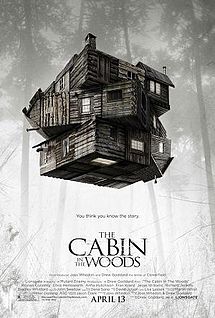
‘Cabin in the Woods’ a fun thrill ride

A lot of people are comparing “The Cabin in the Woods,” the new thriller, to other movies that simultaneously exploited, explored and expanded on horror film themes, notably “Scream.”

But besides being better than “Scream,” “Cabin” reminds me more of a grown-up and bloody “Monsters Inc.,” the Pixar animated movie about a company that specializes in giving kids nightmares with monsters under their bed and in their closet.

Since I didn’t see “Cabin” until a week after it opened, I’m going to assume anyone reading this has either seen the movie or heard the basic story by now. So there might be some spoilers ahead. I won’t spoil the ending, though.

“Cabin” was written by “Avengers” director and “Buffy the Vampire Slayer” creator Joss Whedon and directed and co-written by Drew Goddard. On the surface, it plays like a “Friday the 13th” throwback: A group of college students — a jock, a stoner, a brain, a shy girl and a slut — go to a remote cabin to party.
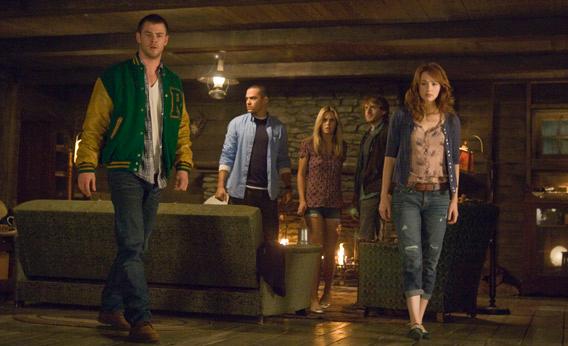
From the very start, though, the audience knows something else is going on. The group is being monitored by office monkeys/scientists in a war room-style bunker. Not only are the watchers seeing everything that happens as the five get to the cabin; they’re manipulating the players and events. Gas is pumped through vents that prompts the partiers to behave in particular ways. A mild electric shock runs through the handle of a knife to make the person holding it drop it.

A few spooky things happen in the cabin — not the least of which is the uncharacteristic behavior of the five — but the movie shifts into high gear when they venture into the cabin’s basement and find hundreds of old and obscure items, including a necklace, reels of film, a studded metal ball (more than a little reminiscent of the mechanical nightmare box from the “Hellraiser” movies) and a diary of the former occupants of the cabin.

The partiers choose — and seal — their fate when they become engrossed in the diary, even reading aloud a passage in Latin. It is here when the movie seems most like “Scream,” as the stoner warns against reading the words aloud. He’s seen enough movies to know what might happen.

Before long, the long-dead cabin occupants have crawled out of their graves and begun stalking the teens.

Of course, it is the lab scenes that set “Cabin” apart from the “Evil Dead” films. We quickly find out that the lab workers are monitoring the goings-on at the cabin — as well as other sites around the world — and causing terror and mayhem. The reason? They’re servants of the ancient, Lovecraftian gods, the old ones, that once dominated the earth. And they know that bad things will happen if those gods aren’t appeased by their sacrifice.

The lab workers are also the source of much of the film’s humor, which is as crass and mean-spirited as it is funny. The scientists, led by Bradley Whitford and Richard Jenkins, are cold-hearted (mostly) and unfeeling as they must be. Their jobs are to stage modern-day human sacrifices. There’s no room for bleeding hearts here — except for the ones being ripped out on the lab’s monitors.

It’s hard to imagine, given the ending, how a sequel to “Cabin” could happen, but I guess a prequel is possible. What’s more likely is the Internet will fill up with speculation/fan fiction set in the world in which “Cabin” takes place that will fill in the backstory of the lab and its workers, how their system was set up and maintained and how it otherwise interacted with the outside world. Do the lab workers commute? Is the lab government-sponsored?

The lab workers, who also include Amy Acker and Tom Lenk from Whedon’s “Buffy” and “Angel,” are perfectly cast and always believable.

The archetype young people offered up for sacrifice are likewise terrific. The movie was made a couple of years ago and sat on the shelf not because of its quality but because its original studio, MGM, was having money problems. Since then, Chris Hemsworth (who plays the jock) has become a star as the Marvel comics character “Thor.” He’s got a big summer between this and “The Avengers.” Hemsworth is good and he and his four co-stars — Kristin Connolly, Anna Hutchison, Jesse Williams and Fran Kranz — are well-cast and play their parts perfectly. Kranz, who was in Whedon’s “Dollhouse” TV series, is very Shaggy-reminiscent as the stoner.

Random thoughts:

The sterile, underground labs and monster holding cells of “Cabin” reminded me of the Initiative, the secret military experiment from the fourth season of Whedon’s “Buffy.” Only instead of stocking a compound full of monsters to kill teenagers, the Initiative captured monsters to experiment on them.

Another “Buffy” echo: “Cabin” builds on the idea of thousands of years of human sacrifice to appease evil. Of course in “Buffy,” the Slayers and Watchers were created, thousands of years ago, to fight evil.

I hope someone’s working on a detailed analysis of the whiteboard in the war room that contained all the monsters and scenarios. I tried to read as much of it as I could and caught some of the other threats like “Kevin” — a Jason stand-in, possibly? — but I would love to see everything that was up there.

Do you think the monsters in the movie were supposed to be real in their world? Or were they created, “inspired” by old horror tales and movies? Or does — as one clever person I know suggested — “Cabin” take place in the same world as all those old horror movies, finally taking us behind the scenes of Jason, Michael Myers, Freddy and all the rest?

“Cabin” is, for those with strong hearts and stomachs, cool, geeky fun. Maybe best of all, it made me want to re-watch “Buffy” episodes and some favorite recent horror movies.
Saying goodbye to Jonathan Frid

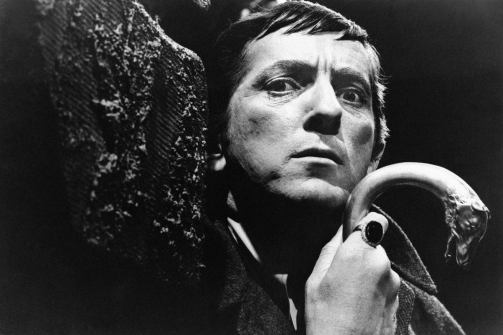
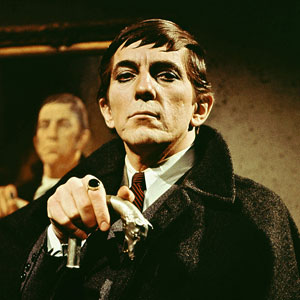
One of the pop culture icons of my childhood is gone. It was announced today that Jonathan Frid died April 13 in his home in Canada. He was 87.

Frid was, of course, Barnabas Collins on the classic supernatural daytime drama “Dark Shadows.”

His death came just a few weeks before the May 11 release of the Tim Burton, Johnny Depp big-screen version of the venerable soap. Frid, along with other regulars from the TV series, appears in the movie, which is pitched as a much more light-hearted take on the gothic drama.

“Dark Shadows” aired late afternoon weekdays from 1966 to 1971. Frid didn’t join the cast until several months in, however, when groundskeeper Willie Loomis (John Karlen) accidentally released him by opening his coffin.

I’ve noted before that the show was a special one for me. I came home from elementary school every day, sat down at the coffee table in my living room and watched the show while I did my homework.

My deepest appreciation for the series, however, came when it aired in syndication years later. Then I recognized all the tricks and treats the series contained: Wild storylines that involved not only vampires like Barnabas but witches, werewolves and ghosts and even time travel.

“Dark Shadows,” like many soaps at the time, was videotaped with little room for error or fixing of same. Actors would sometimes forget their lines or bump into furniture or doors while making a dramatic exit from a scene. I loved the show anyway.

I still remember with bitter disappointment watching the last episode. This was 1971, of course, before the Internet and news of show business — particularly a geeky daytime drama — was hard to come by.

The final episode reflected an effort to tie up loose ends. The last storyline for the show had all the actors playing their ancestors in the past. Near the end of the episode, bite-type neck wounds are inflicted on someone. Is a vampire loose at Collinwood?

But the voice-over narration contradicted that ominous development and predicted a happy ending for Bramwell Collins, played in this storyline by Frid:

There was no vampire loose on the great estate. For the first time at Collinwood the marks on the neck were indeed those of an animal. Melanie soon recovered and went to live in Boston with her beloved Kendrick. There, they prospered and had three children. Bramwell and Catherine were soon married and, at Flora’s insistence, stayed on at Collinwood where Bramwell assumed control of the Collins business interests. Their love became a living legend. And, for as long as they lived, the dark shadows at Collinwood were but a memory of the distant past.

The words had an element of finality to them and I suspected the worst. The following Monday I tuned in and, sure enough, the show was not on.

My disappointment was massive. I even wrote a letter to the Indianapolis TV station that aired the show, asking if it would return. I don’t recall getting an answer.

“Dark Shadows” — all 1,200-plus episodes — is now available on DVD for the enjoyment of fans.

I’m leery of what Burton and Depp have done with the remake, but I’ll probably see it.

And if he does indeed appear in the movie, Frid will be a welcome sight.

So I’ll mourn his passing and enjoy my memories of my afternoons with Barnabas and family and all the enjoyment Jonathan Frid gave me over the years.

‘Mad Men’ goes for shock value with ‘Signal 30’

Just when you thought this season’s “Mad Men” couldn’t get any more … out there than last week’s choke-tacular “Mystery Date,” comes tonight’s episode, “Signal 30.”

The title refers to the blood-and-guts-filled, 1960s-era drivers education movie that pompous little ad man Pete sees in preparation for getting his drivers license in time for life in the ‘burbs. But tonight’s episode had mayhem all the way through.

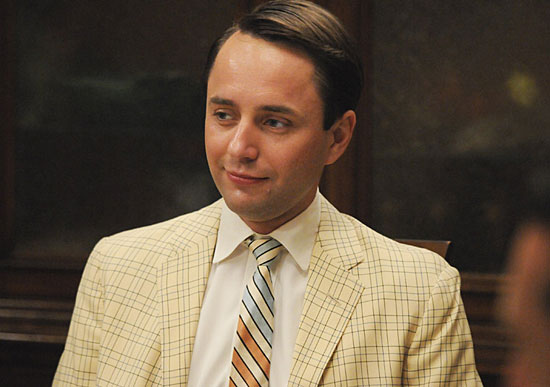
Let’s start with Pete (Vincent Kartheiser), who can be an awfully hard character to take. I take that back. Pete is almost impossible to like, with his grasping, career-climbing ways and pissy attitude. So it was kind of fun to see him squirming and taking his licks — literally — tonight.

First there was Pete’s attempts to seduce the high school girl in his class, only to be outdone by … a high school boy, who ends up feeling up the object of Pete’s jailbait leanings. All the while, Pete watches, frustrated, from one row back in the classroom.

Then there’s Roger and Pete’s partaking of hookers at a high-class whorehouse. That unlikely twosome and Don take Lane’s client, a Jaguar executive, to a brothel. Don — still living the honeymoon life with “zoobie zoobie” Megan — sits at the bar and behaves himself while Pete, Roger and the Jag guy plunge into the beds of what would appear to be high-class 1960s Manhattan call girls.

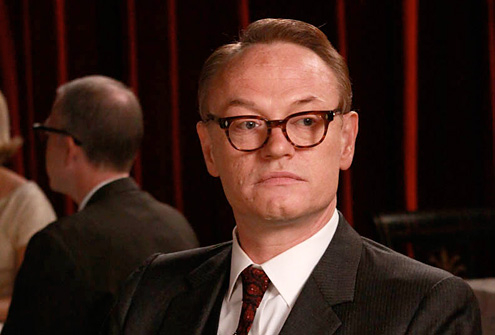
Then there’s Pete’s comeuppance at the hands of Brit Lane Pryce (Jared Harris, who is just wonderful). When the Jaguar exec’s infidelity is discovered by his wife the account goes up in smoke and Lane throws down on Pete.

The resulting fight, right in the Sterling Cooper Draper Pryce offices, shows Lane delivering unto Pete a sound thrashing and is bookended by great quips from Roger: “I suppose cooler heads should prevail, but I want to watch this” and “I had Lane.”

Other highlights:

Pete showing off his wall-length cabinet record player to visitors to his home.

This season’s daring “Mad Men” fashion experience continues as Don becomes the latest wearer of a crazy plaid sportscoat.

This season’s desperation level is high. Roger’s a mess, Pete’s trying to pick up schoolgirls, Lane’s fixation on the wallet a few episodes ago and, tonight, Lane’s passionate move on Joan.

Ad man Ken’s second career as a science fiction writer. Ken’s proud wife brags about it, prompting Roger to tell him to knock it off, saying that a career in advertising is satisfying enough when things are going well.

“I remember that,” Roger says before stalking out.