Tag Archives: Academy Awards

Oscars: I’ll catch up tomorrow

oscars statue

I doubt I’ll be watching much, if any, of the Oscars tonight.

It’s not a protest of anything, or a statement about anything, including Ellen, the host.

I just feel more disconnect with the Academy Awards than I ever have.

For one thing, I haven’t seen a single one of the nine Best Picture nominees. I want to see at least three or four of them, but my schedule doesn’t encourage a lot of movie-going. And when it does, frankly, I really like escapist fare. Not that I didn’t see, and enjoy, movies like last year’s “Silver Linings Playbook.” But – and if you’re a reader of this blog, I don’t have to tell you this – I’m more likely to see the latest big-screen comic book adventure or action movie or comedy.

So other than tuning in to see what could be some funny stuff from Ellen at the opening, I’ll probably do other things until “The Walking Dead” comes on and then I’ll be watching it.

One reason I’m startled by my disconnect with the Oscars and movies in general is that I was a movie reviewer from 1978 to 1990. I saw two or three movies every week – during a period that was pretty good for movies of a certain type – and wrote about them. I loved Oscar night. I did my own predictions and sometimes the winners even coincided with my picks.

But tonight I’ll check out Ellen and undoubtedly enjoy Twitter comments by people who are watching. I’ll be amused, as always, by people who complain that the Oscar telecast runs long, like it doesn’t every year.

And if the show seems too long to you, why are you watching? There’s room alongside me on the couch for someone with an actual excuse as to why they’re not watching.

But I’ll catch up tomorrow.

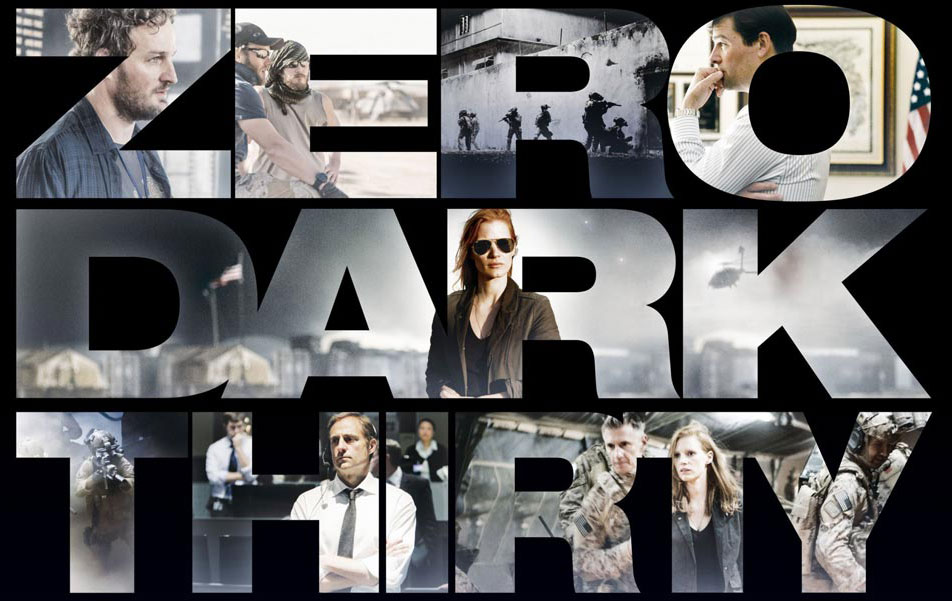
Oscar catch-up: ‘Zero Dark Thirty’

zero-dark-thirty

In which I try to see a few Oscar nominated movies before the Oscars roll around.

Director Kathryn Bigelow’s “Zero Dark Thirty” has picked up a lot of political baggage, much of it centered around the film’s early scenes of CIA operatives using waterboarding and other means of torture to try to extract knowledge of the whereabouts of Osama bin Laden from low-to-mid-level al Qaeda operatives.

The scenes are pretty harrowing and few moviegoers will go away without an opinion of the use of torture. Suffice it to say the scenes also set the tone for the movie even as they serve to introduce Maya (Jessica Chastain), a CIA analyst who goes from standing by and watching colleague Dan (Jason Clarke) administer torture to ordering punishment herself.

Maya’s quarry is bin Laden and, over the course of the next two hours, she pursues not sightings of the al Qaeda leader – there aren’t any legitimate ones – but the identity and whereabouts of people who might have contact with him.

Over the course of several years, Maya and fellow operatives like Jessica (Jennifer Ehle) interrogate those with knowledge of bin Laden and those protecting him, cultivate sources and begin to focus – obsessively, at times, for Maya – on a courier who is reportedly bin Laden’s connection to the outside world.

As most of the world knows, the CIA finally finds the courier and tracks him to a Pakistani town and fortress-like compound where bin Laden has been hiding … well, not in plain sight, but in a far more likely location than a remote cave for the leader of an international terror organization.

Bigelow and screenwriter Mark Boal let the story unfold at a deliberate pace but pepper it with suspenseful scenes, including Jessica’s meeting at an Afghan base with a potential informant as well as the tracking of the courier.

It surprised me, somewhat, to see “Zero Dark Thirty” described online as a spy thriller. It is, certainly, but aside from the raid on bin Laden’s compound the movie came across most like a political thriller as Maya pushes her way through CIA bureaucracy, the doubts of her superiors and what seems like a more urgent mission for many in government than finding bin Laden: preventing future terror attacks.

Chastain is quite good as the smart and dedicated Maya, a character based on the woman who led the decade-long pursuit of bin Laden.

The movie features a cast of familiar faces, from Mark Strong (“Green Lantern”) and Harold Parrineau (“Lost”) to Chris Pratt (“Parks and Recreation”) and Joel Edgerton (the “Star Wars” prequels). Luckily, they don’t pull the audience out of the story.

“Zero Dark Thirty” is a first-rate political and historical thriller.

Oscar catch-up: ‘Lincoln’ deserves the praise

Daniel-Day-Lewis-as-Abraham-Lincoln-634x445

The other day I noted I hadn’t seen a single one of the major Academy Award contenders and hoped to do so before Oscar night.

Last night I finally had a chance to see “Lincoln,” Steven Spielberg’s big-screen treatment of events surrounding the passage of the 13th Amendment to the constitution and the wind-down of the Civil War.

Considering the praise that’s been heaped on the film – and the 12 Oscar nominations, including Best Picture – it’s no real surprise that the film is so good. But what’s best about the movie is that it doesn’t sanctify Abraham Lincoln. Yes, Spielberg emphasizes the 16th president’s determination to do what’s right in all things, as well as his kind soul.

But the best things about “Lincoln” are the ways it humanizes Lincoln, a man given to folksy stories and metaphors, so much so that he quips at one point that it’s good to be comprehended.

Daniel Day-Lewis’s Lincoln – and Day-Lewis disappears into the role; I rarely thought of the actor himself at any point during the movie – is a mix of grim humor and pathos, a towering man bowed by tragedy.

As the movie opens, in early 1965, it’s assumed that the war is coming to an end after four bloody years and more than 600,000 casualties. But Lincoln is determined to push the 13th Amendment, outlawing slavery and involuntary servitude, through Congress. Democrats in the House oppose the move and Lincoln’s own Republicans are torn between strident abolitionists like Thaddeus Stevens (Tommy Lee Jones) and moderates who want to end the war as quickly as possible. If that means maintaining slavery, then so be it, they reason.

The movie – written by Tony Kushner and based in part on Doris Kearns Goodwin’s “Team of Rivals” – shows Lincoln trying to accomplish the balancing act of trying to get the amendment passed but maintaining the urgency of the war as a motivator for Washington’s politicians.

The idea that Lincoln is prolonging the war, even by a few days, weighs heavily on him and the film. The president visits a battlefield strewn with bodies as well as a Union hospital to talk to young soldiers who lost limbs. There’s a horrible moment when Lincoln’s oldest son, Robert (Joseph Gordon-Levitt) watches as hospital orderlies dump arms and legs into a pit. Robert desperately wants to enlist. His mother, Mary (Sally Field), plagued by memories of the death of another son as well as depression and headaches, threatens to hold her husband personally responsible if Robert dies.

Don’t assume that “Lincoln” is somber throughout, however. Lincoln is himself a wry and funny presence and a major subplot – in which three Republican operatives (James Spader, Tim Blake Nelson and John Hawkes) go around soliciting the votes of outgoing Democrat representatives to support the amendment – is consistently amusing.

I have very few quibbles with “Lincoln,” although a major one is an unnecessary scene near the end. The war over and the slaves freed, Lincoln continues to meet with his cabinet to plan his second term. He’s reminded that he’s to go out with his wife for the evening. He dons his coat and hat and leaves the White House. The iconic shots of Lincoln walking away would have sufficed to emphasize the man’s passing into history.

I didn’t even mind a scene that followed, with young Tad Lincoln (Gulliver McGrath) watching a play, only to be heartbroken when an announcement is made that his father had been shot.

I just wish that Spielberg had omitted a bed scene, with Lincoln being pronounced dead from his wounds. It is the least subtle moment of the movie, complete with the phrase, “Now he belongs to the ages.” The movie was more than strong enough to do without it.

“Lincoln” is a smart, heart-breaking and sometimes wryly humorous look at a pivotal moment in our nation’s history and the man at the center of it.
And the Oscar won’t go to …

Back when I was a movie reviewer and entertainment writer, I followed the Oscar announcements as if the head of the motion picture academy was releasing puffs of either gray or white smoke. They were that important to me. Movies were my religion.

This year’s nominees were announced this morning but I’ve yet to really study the full list. I do have a few thoughts, however.

I’m not going to suggest that “X-Men First Class” or “Captain America” or “Bridesmaids” or any of several movies I saw in 2011 should have been nominated.

But each year when Hollywood is buzzing about the best movies of the year, my mind goes back to 1982. I wrote an article listing my picks for best pics of the year.

But I was too caught up in what I should choose as the best movie of the year rather than what I really thought.

Considering 1982 was a milestone year for movies, guess which of the following I picked as the best of the year:

“E.T.”

“Tootsie”

“Star Trek II: The Wrath of Khan”

“The Verdict”

“Gandhi”

“Sophie’s Choice”

“Blade Runner”

“My Favorite Year”

“Richard Pryor Live on Sunset Strip”

“The Year of Living Dangerously”

Yep, that’s right. I picked “Gandhi.”

Undoubtedly a good movie, and an Oscar winner, but one that I’ve never watched a second time.

Since then, I’ve learned to be true to my own tastes.

Between now and the Academy Awards ceremony in February, I’ll no doubt see some more of the nominees. So far, of the nine movies in contention for Best Picture, I’ve seen “Midnight in Paris” and “The Help.” I don’t know that either picture is one for the ages but they were pretty good.

I’m looking forward to “War Horse” and “The Artist” and some of the other nominees.

And I don’t really think I’ll see the makers of “Captain America” leaping up on stage next month.

But I might be wishing they would.