Tag Archives: Cherie Priest

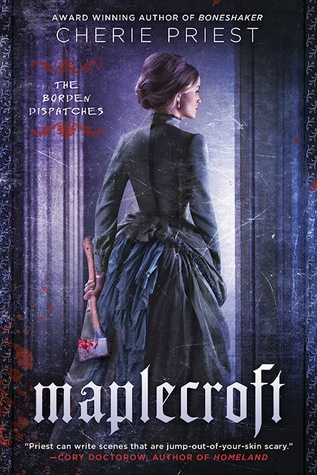
‘Maplecroft’ brings the creeping horror

maplecroft cherie priest

Regular readers of this blog know I’m a fan of writer Cherie Priest, who became queen of steampunk fiction with her “Clockwork Century” series – kicked off by “Boneshaker” – about an 1800s America where the Civil War drags on for decades and a plague of zombies threatens the very existence of the country. Any series that combines spunky Seattle adventurers, Texas rogues and Abraham Lincoln is ambitious as can be.

I also really enjoyed Priest’s stories about Raylene Pendle, an “urban fantasy” heroine. I’m kind of disappointed there’s only been two books so far.

As fond of the “Clockwork Century” stories as I am, I think her latest, “Maplecroft,” is Priest’s strongest work yet.

For those of us who know little about the real-life Lizzie Borden – beyond the “40 whacks” childhood rhyme – Priest gives us a Victorian-era heroine who’ll remind you a bit of Buffy Summers. Borden is strong yet vulnerable and wields a mean axe in her battle with shambling, skittering death.

It seems that Borden killed her father and his wife for a good reason: They were possessed by the spirit of a sea creature not unlike Cthulhu, HP Lovecraft’s immortal demon-god.

In Borden’s little New England town, the sea is calling to people – and not in a romantic way. Infected by ancient stones and specimens of unidentifiable sea creatures, people are slowing turning into monsters with shark-like teeth and soggy, water-soaked bodies.

No one knows this, of course, but Borden and her sister, Emma, who live in the family’s mansion, two years after Borden has been acquitted of killing her father and his wife. The Borden sisters – and eventually a small and uneasy group of allies – fight off this watery invasion in what’s promised as the first in a series of novels.

There’s some fun action, a lot of nameless, faceless horror and some terrific characters in “Maplecroft,” which is totally not surprising to anyone who’s read Priest’s work. She has a knack for creating characters who, even when their fears and insecurities are laid bare, retain a lot of mystery.

“Maplecroft” is a horror/adventure novel for people who think they know the genre and think nothing new can be done. By going back to the beginnings of the horror genre, Priest brings her readers something that feels new and fresh and full of dread.

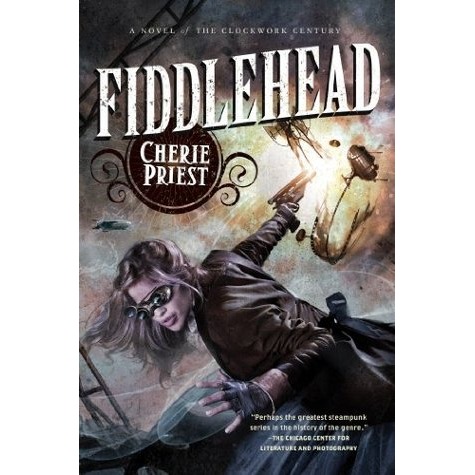
‘Fiddlehead’ wraps up steampunk series with a bang

cherie_priest

Cherie Priest has been the best working purveyor of steampunk – the genre that mixes sci-fi, alternate history and 19th-century technology with a twist – for several years now with her “Clockwork Century” novels.

The series – and if you haven’t tried it, you should – is set around 1880 and presents an America that is pretty radically different from the history books we know: The Civil War still rages on, with battlefield skirmishes and Union and Confederate spies crossing borders in clandestine missions. Often the action plays out in a series of skirmishes not only on the ground, in horrifying lethal “dreadnaught” locomotives, and in the air in high-flying dirigibles.

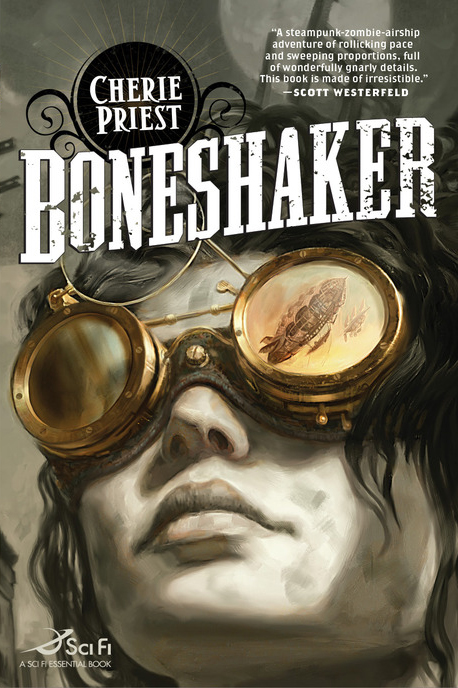
As the war rages on, another menace proves to be a great threat. In the first book, “Boneshaker,” a digging machine opens up a fissure in the earth in Seattle that releases a yellow gas. The gas turns humans into flesh-eating creatures and, even more fiendishly, is used as the basis of a highly-addictive drug that soldiers and other combatants on both sides of the Mason-Dixon Line willingly ingest, creating even more zombies.

fiddlehead cherie priest

By the time of “Fiddlehead,” Priest has brought these storylines together in an explosive climax. Gideon Bardsley, an ex-slave and scientist, has created the Fiddlehead, a steampunk computer that predicts that neither the Union nor the Confederacy will win the war. Both sides, weakened by nearly two decades of fighting, will be lost in a tide of zombies that will not only destroy the United States but the entire North American continent.

It’s up to Bardsley and Pinkerton Detective Agency operative Belle Boyd and their associates to stay alive long enough to get word out about Fiddlehead’s forecast – and stop the machinations of a war profiteer who hopes to use the zombie gas to not only make money but deal a devastating blow.

“Fiddlehead” is a fun thriller that not only brings back many of the characters from Priest’s earlier books – one of the author’s techniques is to mix up her sprawling cast, making some the leading players in some books and the supporting players in the next – but a couple of important figures who have been just outside the parameters of the page in the earlier books: Abraham Lincoln and U.S. Grant.

In Priest’s storyline, Lincoln wasn’t killed that April night in Ford’s Theatre, but he was seriously injured and had to leave the presidency. By the time “Fiddlehead” takes place, Lincoln and wife Mary are patrons of scientist Bardsley and thus leading the campaign to spread the word about the horrors of the zombie gas.

And Grant, wearing down in his fourth term in the White House and fighting his own demons, joins with Lincoln in turning back the murderous challenge from the war profiteers and behind-the-scenes manipulators who want to keep the war going.

Priest has created an engaging set of fictional characters but, to me, really shines in her treatment of fictionalized versions of real-life characters like Lincoln and Grant. Maybe it’s no surprise that readers would find themselves rooting for Lincoln, a beloved historical figure. But the Lincoln that Priest presents here is scarred and tough and scrappy as you would hope for.

Priest’s books are fun and clever and fast-moving fun-house-mirror looks at American history. With zombies. What more could we ask?


Cherie Priest says get ‘Hellbent’

I have to admit the “urban fantasy” genre was new to me. Or maybe it wasn’t, but I just never heard it called that. I gather it’s a genre of fiction that involves vampires and werewolves and things of that nature (emphasis on the “things” part) but instead of hanging out in Transylvania they’re duking it out in the streets of NYC or San Francisco.

I became a Cherie Priest fan through her “Clockwork Century” steampunk books like “Boneshaker,” which is being made into a movie.

But I decided to try Priest’s urban fantasy book “Bloodshot” and was impressed. Priest is a master at finding the right tone for the period of her stories. The steampunk books are set in the late 1800s and “Bloodshot” and its sequel, “Hellbent,” are modern-day urban fantasies (there’s that phrase again) featuring a vampire named Raylene Pendle.

Pendle wears a lot of hats (not literally, although we do find out a lot about her wardrobe) here. She’s a vampire, a master thief, a kick-ass fighter and someone who acknowledges her own “issues,” including a healthy dose of obsessive compulsive disorder.

I don’t mean the “check the stove, check the door, check the stove” type of OCD (all too familiar to me). Raylene is self-proclaimed OCD in her worries over planning her missions. She acknowledges she takes too much stuff when she’s about to knock over a stronghold and steal some artifact (for a price). But Raylene doesn’t get bogged down in details when a case heats up. She’s got the super strength and super speed of a supernatural being and not afraid to take risks.

In “Bloodshot,” Raylene found her solitary existence in a made-over warehouse in Seattle changed by a couple of young humans she protects as well as a blind vampire, Ian, and a Navy Seal/drag queen named Adrian. About Adrian: Strangely enough, the character works and is totally appealing. A lot of pop fiction characters have a sidekick and Adrian is like Spencer’s Hawk — only he knows how to apply makeup.

In “Hellbent,” Raylene takes on one task for pay — the retrieval of several artifacts that are offbeat, to say the least — and one (maybe two) tasks that are personal in nature — working to clear up Ian’s status with his old vampire “house” (read family) and looking for Adrian’s missing sister.

That’s a lot of plot strands already, but Priest introduces another to the mix: Her competitor for the artifacts is the ultimate version of a woman wronged: A middle-aged woman with her own mental illness who uses magic to get vengeance.

The storylines don’t jell as well as they should, but there’s an appealing quality to the unsettled nature of the plot. “Hellbent” feels like a book that’s building to something, but there’s a good resolution to the story at the end so readers won’t feel cheated.

Above all, Priest’s characters are winning. None are more so than Raylene herself, who is as likable as an undead killing machine can possible be. How likable is that? Pretty damn likable, as it turns out.

It’s impressive that Priest has created two book series that feel as different as her steampunk and urban fantasy books. They read as if they’re by different authors, although both have Priest’s knack for appealing characters.

And “Bloodshot” and “Hellbent” have something else: A funny, dangerous heroine who will, hopefully, grace the supernatural world with her presence again soon.

High Priest(ess) of steampunk

Steampunk is kind of heard to explain.

Remember the rivet-covered, steam-powered flying saucers and such in the old 1960s “Wild, Wild West” TV series? Or the giant mechanical spider in the awful big-screen adaptation of the series, starring Will Smith?

Wait, let’s back up. I’m not sure anybody wants to remember that widescreen nightmare.

Anyway, steampunk — and the genre of fiction that bears that name — is, for the most part, a fanciful recreation of the latter half of the 1800s and early 1900s. Cowboys ride horses and use six-shooters and people travel on trains, but dirigibles are commonplace, people with missing limbs brandish elaborate false appendages and coal-or-steam-or-pedal-powered engines of destruction are the latest weapons of war.

Enter Cherie Priest.

Priest is a blogger and author of several works of fantastic fiction that falls into the “urban fantasy” category, where vampires and werewolves clash with criminals in big-city settings. I’m going out on a limb somewhat there, because I’ve just started reading one of Priest’s urban fantasy books, “Bloodshot,” so I’m not exactly sure what her books in that genre are all about.

But I can speak authoritatively about her steampunk books.

Priest isn’t the only person writing steampunk right now, certainly, but she’s one of the top practitioners. And her “Clockwork Century” series is not to be missed.

Priest’s steampunk series is set in the American 1880s, but one that’s markedly different from what we find in history books.

For one thing, the Civil War is dragging on. The battle between the North and South has been prolonged by the meddling of other parties, most notably the Republic of Texas, whose oil wealth and martial might — symbolized by the Rangers — have mustered on the side of the Confederacy.

Motivated by war and the profits to be had, inventors and captains of industry have pushed the 19th century’s technology and perfected lighter-than-air ships, trains bristling with armament, submarines and, most impressively, walking suits of armor.

Priest’s characters — many of them strong women, including a widow searching for her son in a ravaged city landscape, a nurse trying to make her way across country to find her father and a New Orleans madam eager to help the North and shake loose the bonds of the Confederacy — move through her plots in a matter-of-fact manner, wielding a gun or feminine wiles with equal skill.

Oh, and did I mention the zombies?

Yes, Priest has complicated matters by creating a wave of the walking dead — or rotters, as they’re called in their place of origin, Seattle.

In “Boneshaker,” Priest explains how the zombies were created. A drilling machine released a toxic gas from the bowels of the earth under Seattle. Much of the city’s population fled. Others turned into rotters, shambling through the streets in search of human flesh. Others Seattle-ites fled to the underground beneath the city, where they live in tunnels safe from the toxic gas because of an intricate series of tubes and pumps.

If they go topside, they must wear gas masks to avoid turning into rotters. And they must be on guard not only from the zombies but the criminal element that thrives in the city.

In “Dreadnought,” we get our first glimpse of how the zombie plague is spreading. Drug makers and dealers are distilling the gas and turning it into “sap,” a highly addictive substance that eventually turns its users into the walking dead. The title refers to an especially deadly war train on which much of the story unfolds.

In “Ganymede,” the addiction has spread to New Orleans, which is a hotbed of Civil War intrigue thanks to a missing submarine and efforts to get it in the hands of the Union.

One of the most fun elements of Priest’s books is how she weaves characters through all her stories. The protagonist of “Boneshaker” is a supporting player in “Ganymede,” while the nurse and a Texas Ranger from “Dreadnought” show up in “Ganymede.”

Priest is a nimble writer. If you’re worried that her books would be written in a pseudo-Victorian-era style, don’t be. While her characters are not anachronisms, they have enough modern sensibilities to be completely relatable.

The books are fun, fast reads. (One of my few quibbles can be blamed on my aging eyes. The print in the paperback editions is sepia-toned. It might be appropriate to set the mood for the period in which the stories take place, but it makes it a bit hard to read.) Priest keeps the plot moving and throws in just enough twists and turns to surprise the reader.

Priest announced some big news right around the end of November. “Boneshaker” has been  acquired for adaptation as a movie. It’s probably not surprising, considering how hot zombies are right now, with “The Walking Dead” a hit on TV and in comics and “World War Z” coming out later this year.

Besides, who can resist the pitch — included in the announcement — that “Boneshaker” was like “Jules Verne meets ‘Resident Evil?'”

Movies are tricky things. Sometimes they completely miss the flavor of the books on which they’re based. Sometimes they get everything right.

Priest’s steampunk stories — and more of them are on the way — are as entertaining as any movie adaptation could be. Don’t wait for the big-screen version.