

Tag Archives: Daniel Craig

‘Skyfall” best Bond in years

In seeing the new James Bond adventure, “Skyfall,” today, I was struck by the thought that I don’t believe I’ve seen a movie that seemed so much like the first film in a series and so much like the last film in a series simultaneously.

I’ll tread lightly in the spoiler department here, have no fear, but let’s just say that director Sam Mendes debut in the Bond series – and Daniel Craig’s third outing as the durable British spy, marking his 50th year in movies – wraps up and reinvigorates the character at the same time.

The recent “Star Trek” remake left me with much of the same feeling. Although it featured a mostly new cast, the presence of so many familiar “Trek” elements – not to mention the presence of Leonard Nimoy as classic Spock – made the movie feel like a new beginning and a summation.

Much the same can be said of “Skyfall,” which opens with Bond and fellow agent Eve (her full name is withheld for obvious reasons by the end of the movie) in pursuit of an agent with the names of MI6 operatives working undercover in terrorist organizations.

After a chase through very familiar-to-moviegoers street markets, over rooftops and on top of  a moving train, Bond is lost and presumed dead.

M (Judi Dench) mourns but has other matters to think about. There’s not only the list of agents’ names but someone seems to be targeting her for death.
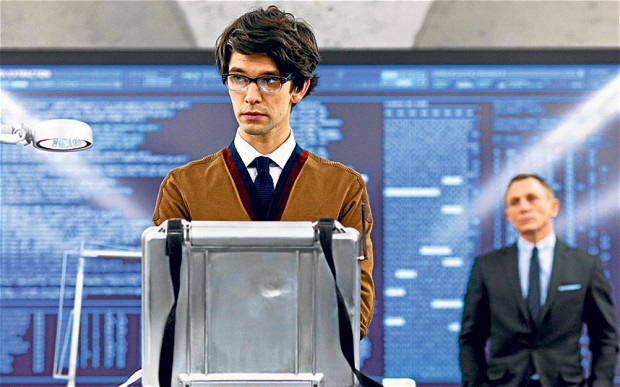
It is an attempt on M’s life that brings Bond back from an island hideaway. M sends him back to work, but not before he meets British intelligence official Mallory (Ralph Fiennes) and the new quartermaster, Q (Ben Whishaw), an impossibly young tech expert.

Before long, Bond finds that M’s tormentor is Silva (Javier Bardem), a former MI6 spy who feels he was abandoned in the field by M.

That’s one of the elements of “Skyfall” that seems most interesting. While Silva has some destructive plans and a bizarre lair on an abandoned city/island, he’s no Dr. Evil-style global extortionist. This is personal between Silva and M and it quickly becomes personal for Bond too.

As much of a feel as we get for M and her life and personality in “Skyfall,” we get the most personal look at Bond we’ve had since he fell in love and married in “On Her Majesty’s Secret Service.”

We learn the circumstances that propelled Bond into the spy game. We see his childhood home. And we see a transformation in Bond during the course of the movie.

I’m not sure if Craig is continuing in the role. It would be a shame if he and Mendes don’t come back for another entry. By the end of this movie, everything is in place for a truly stirring Bond follow-up.

Some random observations:

Rumors circulated that Mendes briefly considered asking Sean Connery to take a small but pivotal supporting role in the movie. He didn’t, and wisely so, thinking it would be too distracting to have a former Bond on hand. Albert Finney does a nice job with the part.

I really enjoyed the origin of the name Skyfall.

I don’t think I’ve seen a komodo dragon menace someone so effectively since “Jonny Quest.”

The movie’s action takes place in a couple of far-flung locales, as usual, but the best scenes are in steel-gray Britain and Scotland.

‘Dragon Tattoo’ does the research

Who knew research nerds were so sexy? Not to mention so dangerous?

Well, everybody who has read Stieg Larsson’s “The Girl with the Dragon Tattoo” trilogy, I suppose, or those who’ve seen the original Swedish film adaptations or the new movie version of the original novel in the trilogy.

I guess it’s easy enough to say that all detectives — from Sherlock Holmes to Batman — are characters who do a lot of research because, after all, that’s what investigating is all about.

But Larsson’s characters, Lisbeth Salander and Mikael Blomkvist, spend more time scanning old photographic contact sheets, reading corporate histories, perusing personal scrapbooks and, of course, tap-tap-tapping on the keyboards of their laptops than any of their written word or big-screen contemporaries.

The thought occurred to me today after seeing David Fincher’s big-screen, big-budget adaptation of Larsson’s first book, starring Daniel Craig as Blomkvist and Rooney Mara as Salander.

Anyone who’s read the books or seen the earlier movies knows there’s a reassuring and even kind of humorous pattern of activity in the stories, much of it centering on Salander, the emotionally and socially estranged but brilliant investigator who helps Blomkvist, a discredited journalist, probe the long-buried secrets of a rich family.

Salander spends much of Larsson’s books smoking, buying frozen pizzas from convenience stores and riding her motorcycle. Blomkvist drinks enough coffee to float all of Sweden.

But seeing the movie today emphasized how much time the two spend poring over everything from the Bible to old newspaper archives to Google search results.

I should note that I’m a fan of Larsson’s books at the same time I recognize their shortcomings. Completed before the author’s untimely death in 2004, the books have taken on a life of their own, selling 15 million copies in the U.S. alone.

There’s some clunky moments in the stories, to be sure, and maybe that’s from the editing or translation. But the compelling characters and ingenious plots more than make up for it.

Blomkvist is, as has been noted elsewhere, a somewhat passive character. I think some people don’t realize, though, that Larsson’s background as a journalist probably contributed to that. Blomkvist is a social crusader and risk-taker — not only in his amorous personal life, but in his professional life too — but, like good journalists, is more of an observer than an agitator. His role, even when people are shooting at him, is to probe rather than instigate. Can you imagine how unlikely a reporter he would be if he pushed and provoked like Robert B. Parker’s Spencer?

But Salander … man, what a character Larsson has created.

If you haven’t read the books or seen the original movies, the new movie won’t give you too many clues to her background. But suffice it to say, Salander survived an incredibly abusive upbringing and traumatic events — both of her own making and at the hands of authorities — than wouldn’t be survivable by many people.

She lives in self-exile in the midst of bustling Stockholm, relating to most people sideways, out of the corner of her eye. In fact, it’s remarkable when, late in the movie, Salander trusts and likes Blomkvist enough to look at him head-on.

That’s not to say that Salander is a pliable character. Because she likes to disappear into the background doesn’t mean that she’s a pushover. After being brutalized by her government guardian, she lashes back in a most satisfying manner. Throughout the stories, Salander takes things into her own hands, achieving revenge and righting wrongs. She has a fierce personal code and protective streak and has the tools to back it up. One of the pleasures of the trilogy is seeing Salander unleash her fury. A small woman, she launches herself into a fight, devastating her opponents. Larsson called it “Terminator mode,” and while it might be as cliche as it is unlikely, it’s thrilling.

The new movie — which, of course, is not for younger audiences, considering the sex and violence quotient — necessarily telescopes some of Larsson’s story. Blomkvist’s troubles are given a thumbnail treatment and there’s little of the admittedly yawn-inducing thumbsucking over the operations of his investigative magazine. I really didn’t need more discussions of which staffer would take over which role if Blomkvist left. If the second book, “The Girl Who Played with Fire,” gets made into a movie, some of that internal magazine stuff will be necessary since two staffers from the magazine figure into the plot.

There’s a moment with Craig’s Blomkvist makes a joke about losing track of the members of the divisive Vanger family. Who can blame him? They’re all old and either Nazis or worse — yes, that’s possible — and mercifully off-screen for most of the movie, and that’s a good thing.

The movie doesn’t shy away from the book’s sexual, violent and sexually violent overtones. Really. Don’t go if you’re squeamish.

Craig, normally so take-charge and headlong as James Bond, is good as the journalist who isn’t really an action hero. When he gets rescued by Mara’s Salander, it’s believable.

Mara — like Noomi Rapace, who played Salander in the Swedish film versions — is very good as the damaged Salander. She’s appropriately spiky but vulnerable.

There’s been speculation that the box-office returns for “The Girl with the Dragon Tattoo” haven’t been good enough to warrant a sequel. That’s too bad in a way, because I’d like to see what Fincher, Craig and Mara do with “The Girl Who Played with Fire,” because it’s my favorite of the three books. If they don’t make another movie, though, that’s okay. The book is still there, right on my shelf, ready to take me back to the cold and barren world of Salander and Blomkvist.