Tag Archives: Elmore Leonard

Words of wisdom from Elmore Leonard

elmore leonard frowning

The great crime novel and western writer Elmore Leonard passed away recently and a lot of sites are recalling his 2001 piece for The New York Times with tips for writers.

Here’s Leonard’s wisdom:

These are rules I’ve picked up along the way to help me remain invisible when I’m writing a book, to help me show rather than tell what’s taking place in the story. If you have a facility for language and imagery and the sound of your voice pleases you, invisibility is not what you are after, and you can skip the rules. Still, you might look them over.

1. Never open a book with weather.

If it’s only to create atmosphere, and not a character’s reaction to the weather, you don’t want to go on too long. The reader is apt to leaf ahead looking for people. There are exceptions. If you happen to be Barry Lopez, who has more ways to describe ice and snow than an Eskimo, you can do all the weather reporting you want.

2. Avoid prologues.

They can be annoying, especially a prologue following an introduction that comes after a foreword. But these are ordinarily found in nonfiction. A prologue in a novel is backstory, and you can drop it in anywhere you want. There is a prologue in John Steinbeck’s ”Sweet Thursday,” but it’s O.K. because a character in the book makes the point of what my rules are all about. He says: ”I like a lot of talk in a book and I don’t like to have nobody tell me what the guy that’s talking looks like. I want to figure out what he looks like from the way he talks. . . . figure out what the guy’s thinking from what he says. I like some description but not too much of that. . . . Sometimes I want a book to break loose with a bunch of hooptedoodle. . . . Spin up some pretty words maybe or sing a little song with language. That’s nice. But I wish it was set aside so I don’t have to read it. I don’t want hooptedoodle to get mixed up with the story.”

3. Never use a verb other than ”said” to carry dialogue.

The line of dialogue belongs to the character; the verb is the writer sticking his nose in. But said is far less intrusive than grumbled, gasped, cautioned, lied. I once noticed Mary McCarthy ending a line of dialogue with ”she asseverated,” and had to stop reading to get the dictionary.

4. Never use an adverb to modify the verb ”said” . . .

. . . he admonished gravely. To use an adverb this way (or almost any way) is a mortal sin. The writer is now exposing himself in earnest, using a word that distracts and can interrupt the rhythm of the exchange. I have a character in one of my books tell how she used to write historical romances ”full of rape and adverbs.”

5. Keep your exclamation points under control.

You are allowed no more than two or three per 100,000 words of prose. If you have the knack of playing with exclaimers the way Tom Wolfe does, you can throw them in by the handful.

6. Never use the words ”suddenly” or ”all hell broke loose.”

This rule doesn’t require an explanation. I have noticed that writers who use ”suddenly” tend to exercise less control in the application of exclamation points.

7. Use regional dialect, patois, sparingly.

Once you start spelling words in dialogue phonetically and loading the page with apostrophes, you won’t be able to stop. Notice the way Annie Proulx captures the flavor of Wyoming voices in her book of short stories ”Close Range.”

8. Avoid detailed descriptions of characters.

Which Steinbeck covered. In Ernest Hemingway’s ”Hills Like White Elephants” what do the ”American and the girl with him” look like? ”She had taken off her hat and put it on the table.” That’s the only reference to a physical description in the story, and yet we see the couple and know them by their tones of voice, with not one adverb in sight.

9. Don’t go into great detail describing places and things.

Unless you’re Margaret Atwood and can paint scenes with language or write landscapes in the style of Jim Harrison. But even if you’re good at it, you don’t want descriptions that bring the action, the flow of the story, to a standstill.

And finally:

10. Try to leave out the part that readers tend to skip.

A rule that came to mind in 1983. Think of what you skip reading a novel: thick paragraphs of prose you can see have too many words in them. What the writer is doing, he’s writing, perpetrating hooptedoodle, perhaps taking another shot at the weather, or has gone into the character’s head, and the reader either knows what the guy’s thinking or doesn’t care. I’ll bet you don’t skip dialogue.

My most important rule is one that sums up the 10.

If it sounds like writing, I rewrite it.

Or, if proper usage gets in the way, it may have to go. I can’t allow what we learned in English composition to disrupt the sound and rhythm of the narrative. It’s my attempt to remain invisible, not distract the reader from the story with obvious writing. (Joseph Conrad said something about words getting in the way of what you want to say.)

RIP Elmore Leonard, king of hardboiled crime

Elmore Leonard

Sad news today: Elmore Leonard, author of such crime novels as “Get Shorty” and “Glitz,” has passed away at 87 after recently suffering a stroke.

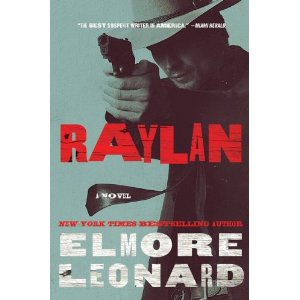
I won’t pretend to be an expert on Leonard. I’ve read a few of his books – I reviewed his final book published before his death, “Raylan,” in February 2012 – and I appreciated his knack for making his bad guys as interesting as, or more interesting than, his good guys.

I also appreciated Leonard’s nurturing of “Justified,” the FX series based on his short story “Fire in the Hole,” about Raylan Givens, a deputy U.S. marshal working in Kentucky.

As he finds himself up against meth dealers and murderers, Raylan was cool and compelling, especially when dealing with lifelong antagonist Boyd Crowder.

Leonard didn’t have  a lot of love for movie and TV versions of his work, but he liked Graham Yost’s “Justified” and had some kind of synergy going with it, contributing story ideas and writing an episodic novel (the aforementioned “Raylan”) drawn from the same setting.

We’ll miss you, Mr. Leonard.

‘Justified’ takes a page from Leonard’s book

A while back I reviewed Elmore Leonard’s latest book, “Raylan,” which featured Leonard’s U.S. marshal character Raylan Givens, played in the FX series “Justified” by Timothy Olyphant.

In “Raylan,” the marshal investigates and runs afoul of a nurse and criminal crew who are stealing kidneys in a manner familiar to students of urban legends: They tranquilize people, deposit them in motel bathtubs and remove their kidneys.

Tonight’s episode of “Justified,” “Thick as Mud,” explores that same story line. In this case, the victim is Dewey, one of Harlan’s least intelligent lowlifes. As the episode opens, Dewey wakes up in a motel bathtub with a couple of incisions and a timeline until his body starts shutting down.

Dewey (Damon Herriman) staggers through much of the episode looking for cash in order to buy back his kidneys. He leaves a trail of knocked-over stores and rifled cash registers. And, of course, Raylan is on the case.

It all comes down to a face-off between Raylan and the kidney thieves.

Also tonight, Raylan’s frenemy, Boyd Crowder (Walton Goggins) finally meets up with Quarles (Neal McDonough), the Detroit mobster who has come to Kentucky with plans to cut himself into the crime business.

Boyd, obviously sensing a threat, tells Quarles he’s not impressed with the smooth criminal’s style, evening going so far as to call him a carpetbagger.

The episode sets the stage for conflicts among Raylan, Boyd and Quarles. Not to mention Limehouse (Mykelti Williamson), who so far this season seems confined to showing up at the end of the episode and dispensing equal parts charm and menace.

I have to say I enjoyed the way “Justified” treated the kidney-snatching plotline more than the way Leonard — who got a story credit for tonight’s episode — handled it in his recent book.

“Justified” continues to be one of the best slice-of-criminal-life dramas on TV. The show, like its characters, make it all look so easy.

Elmore Leonard’s ‘Raylan’ a new take on the ‘Justified’ cop

If you’ve been watching and enjoying “Justified” the past couple of years, you probably know that the FX series about the U.S. marshal dealing with hillbillies, meth dealers and killers in the hills of Kentucky is taken from the work of Elmore Leonard, one of the most beloved writers of crime drama.

The lead character in the show, Raylan Givens, has appeared in a couple of Leonard novels, “Pronto” and “Riding the Rap,” and “Justified” itself is based on a Leonard short story, “Fire in the Hole.”

Leonard has returned to Kentucky and the world of Raylan Givens in “Raylan,” a recent novel that some “Justified” fans will find familiar.

“Raylan” follows Givens as he deals with a marijuana-dealing family, a double-dealing coal company representative and a card-dealing poker player who happens to be a Butler University student from Indianapolis.

A couple of those plot points should seem especially familiar if you’ve watched the show, but Leonard — who apparently shared some storylines with the writers of the series — threw in a few twists. Marijuana-dealing brothers Dickie and Coover don’t answer to their mother, Mags Bennett, but to their father, and they’re involved in organ-snatching. And Carol, the coal company executive sent to Harlan County to persuade property owners to give up their mountain, is more dangerous here.

To be honest, the book feels a little half-baked. Is it because I knew and loved the TV versions of these stories and characters first? Maybe. But the coal company story goes nowhere and the storyline about the card-playing college student feels truly tacked on.

As much as I loved seeing Boyd Crowder, Raylan’s longtime friend and sometimes nemesis, in the book, he doesn’t have a lot to do.

And frankly I can’t imagine the Raylan Givens I’m familiar with doing some of the things Leonard has his character do in this book.

What happens when an author’s characters take on a life of their own? Well, Arthur Conan Doyle killed off Sherlock Holmes when he became something more to readers than to the author.

I’m sure Leonard — who wrote genre classics like “Get Shorty” and “Out of Sight” — can live with the TV incarnation of his Kentucky lawman. And thanks to the TV show, viewers can embrace whichever they prefer.

‘Alcatraz,’ ‘Justified’ have strong second weeks

What a fun feeling when two TV shows — one a returning favorite in its third season, the other brand new out of the box — start off strong.

I’m playing catch-up here, but I wanted to mention this week’s installments of “Justified,” airing Tuesdays on FX, and “Alcatraz,” airing Mondays on Fox.

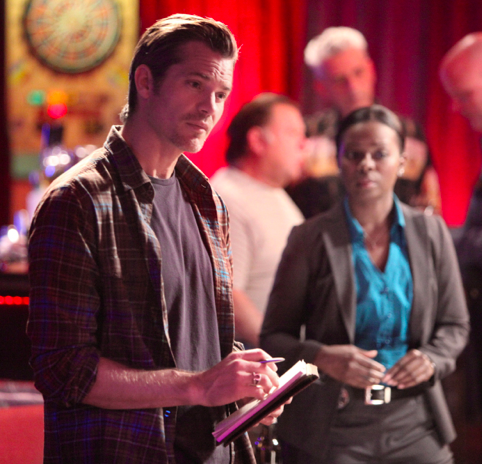
In the second week of it’s third season, “Justified” continues the compelling story of Kentucky’s small-time crooks and the federal marshals who must deal with them, particularly Boyd Crowder (Walton Goggins) and Raylan Givens (Timothy Olyphant) respectively.

In Tuesday night’s episode, Givens was reunited with an old partner — and an old flame, from the sexual tension on display — named Karen Goodall. The inside joke here is that Goodall is actually Karen Sisco, a federal deputy previously played in the movie “Out of Sight” by Jennifer Lopez and — in a TV series a few years back — Carla Gugino. Like “Justified,” Sisco’s stories are drawn from the works of author Elmore Leonard.

Gugino returns to the character in “Justified” — she’s apparently signed for a few episodes — and it’s fun watching her and Olyphant kind of circling each other, particularly since Goodall/Sisco returns just as Givens is about to settle down with his ex-wife, Winona.

Tuesday’s episode — dealing with the murder of another marshal — wasn’t as strong as last week’s season premiere. But you can’t beat any show that features Olyphant, Gugino, Nick Searcy as Chief Deputy Art Mullen and Goggins.

There’s also a good introduction of Mykelti Williamson as a new character, a bad guy who is as menacing as he is folksy.

As for “Alcatraz,” I think this week’s episode, “Kit Nelson,” was my favorite so far.

If you haven’t seen “Alcatraz,” the show’s mythology is that, in 1963, the San Francisco island prison wasn’t shut down because all the prisoners were transferred. No, it was shut down because 300 prisoners and guards disappeared.

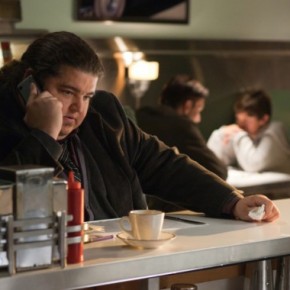
Now, a half-century later, those prisoners are reappearing, and a crew of cops and experts is pursuing them. Sam Neill, Sarah Jones and Jorge Garcia make up the solid cast of investigators.

This week’s show teased us with a little more mythology of the show. Remember Dr. Beauregard, the unseen medical officer of the modern-day prison in which Neill’s character is lodging recovered prisoners? This week’s episode revealed that Beauregard is not only Neill’s medical shaman in the present but was also the sinister doctor at the prison in the 1960s. And he hasn’t aged a day.

That little revelation, plus the beginning of a mystery involving Jones’ grandfather — a convict on the loose in modern San Francisco — and tidbits about the traumatic past of Garcia’s character are enough to allay my worries that the show might too easily fall into the “escaped prisoner of the week” trap.

And since the show is from “Lost” producer J.J. Abrams, I had to laugh when, out of nowhere, the show introduced a hatch in the middle of the woods from which a kidnapped boy escaped.

I’m not surprised to be enjoying “Justified” this much. I am a little surprised — pleasantly surprised — to be digging “Alcatraz” so much.