Tag Archives: end of the world

Classic SF: ‘The World, The Flesh and The Devil’

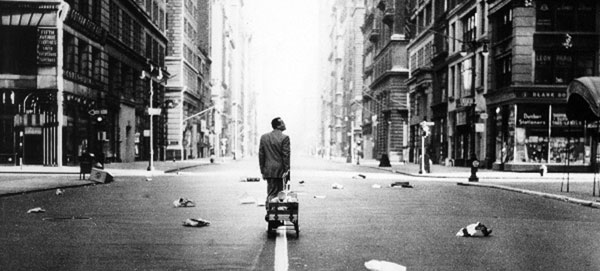
street scene world flesh and devil

There have been a lot of end-of-the-world stories – and many, many movies that told their own tale of mankind’s final days – since “The World, The Flesh and The Devil.”

Some have done it better, some have done it kickier (“Night of the Comet”), many have done it with bigger budget (“This is The End”) but only a handful – “I Am Legend,” “The Omega Man” and a couple of others – have so palpably portrayed the felling of abject loneliness as “The World, The Flesh and “The Devil.”

That’s kind of surprising, in a way, because the movie carried the added burden of tackling race relations in a very strife-torn time in this country.
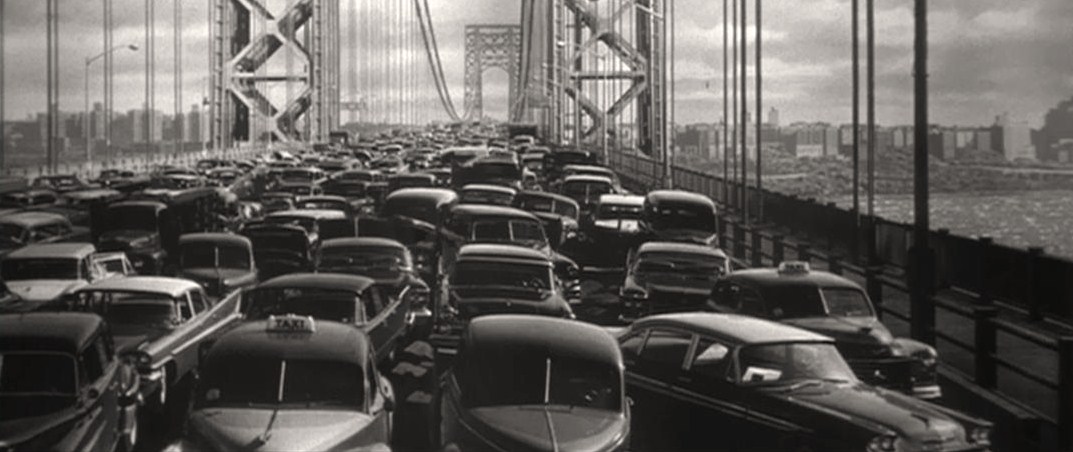
bridge world flesh and devil

Harry Belafonte, who was also a producer of the movie, plays Ralph Burton, a coal mine inspector who gets trapped in a mine cave-in. For a couple of days, he hears people digging, trying to get him out. Then the digging stops and, afraid he’s been abandoned, Ralph claws his own way out.

But when he gets out of the mine, he finds that everyone has gone. The mine site is deserted. So is the town. He finds newspapers with headlines screaming about the end of the world due to globe-girdling radioactive isotopes.

Ralph journeys from Pennsylvania to New York City, where he spends some time wandering the streets, shouting – and later shooting a gun – to try to find someone, anyone, else alive.

He doesn’t know that he’s being watched by Sarah Crandall, (Inger Stevens). Sarah watches as Ralph sets up housekeeping in an apartment, which he fills with food and supplies and populates with a couple of mannequins. He also sets up a short-wave radio and makes regular daily broadcasts, hoping to make contact with another survivor. (Eventually he does make contact with a lone voice in Europe.)

Sarah reveals herself when she cries out from the street below when Ralph tosses one of the mannequins off his balcony.

After an uneasy few moments, Ralph and Sarah become friends. But the conventions of the time – and, no doubt, the proprieties of movies – prevent anything else. Ralph is black, you see, and Sarah is white.

For months, the two go through the motions of courtship with no consummation in sight … until Sarah spots a boat coming up river. They meet the boat at the docks and find Benson Thacker (Mel Ferrer), who has tied himself in the captain’s chair. Thacker is ill and Harry nurses him back to health.

Fairly quickly, Thacker and Sarah begin the same courtship dance, but with a coupling more likely to result. Thacker, meanwhile, begins to agitate for Harry to move on and leave the “couple” alone.

By the end, Thacker is pushing Harry into a gun-toting showdown and the fate of the new world – depending on these three people – hangs in the balance.

The ending must have seemed daring for 1959, the year I was born. Today it seems like a little bit of a cop-out. Sarah doesn’t have to choose between Ralph and Benson. But there is a definite hopefulness about it, as emphasized by the final title – not “The End,” but “The Beginning.”

World_Flesh_Devil_poster

Although nothing but the premise is especially science-fictional, the ideas and imagery of director Ranald MacDougall’s “The World, The Flesh and The Devil” foreshadow so many later end-of-the-world films:
The three watch a movie newsreel at one point, making me think of Charlton Heston’s watching and re-watching of “Woodstock” in “The Omega Man.” And the deserted streets and radio station scenes call to mind “Night of the Comet.”
 

The end of the world as we know it: ‘The World’s End’

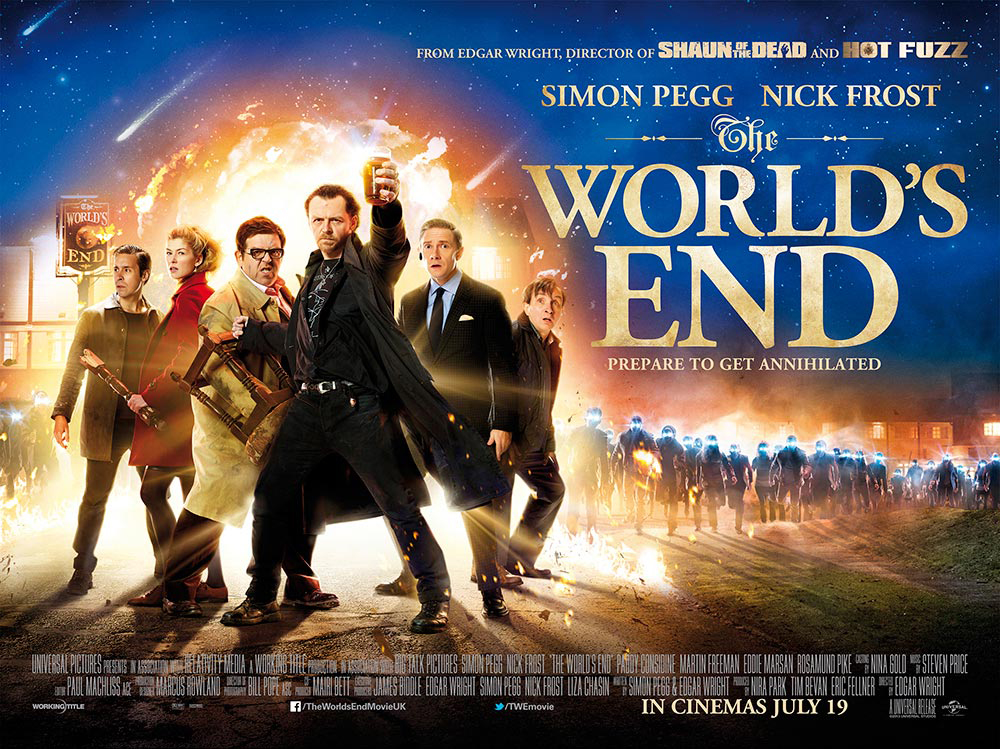
The-Worlds-End-poster

Edgar Wright, who might someday be known as the director of “Ant-Man,” has over the past decade given movie fans often-funny, often-touching glimpses into the lives of a few misfits and outcasts in the UK, from the dead-end zombie fighters of “Shaun of the Dead” to the small-town coppers of “Hot Fuzz.”

Now comes Wright’s “The World’s End,” which seems to cap this summer’s moviegoing (and end of the world-depicting) experience.

What Wright jokingly refers to as the third film in his “Cornetto” trilogy – named after a popular ice cream treat that shows up in all three movies, yes that’s how offbeat Wright’s humor is – is actually two movies in one: A “growing up is hard to do” reunion of old chums movie and an end-of-the-world comic thriller.

Needless to say, spoilers ahead if you haven’t seen the movie, which opened wide yesterday.

Two of Wright’s regular collaborators, Simon Pegg (Shaun as well as Scotty from “Star Trek”) and Nick Frost are among a group of friends who get together more than two decades after one of the most awesome but frustratingly incomplete nights of their lives: In 1990, before they went their separate ways and left their hometown of Newton Haven, they attempted an epic pub crawl that entailed drinking a pint at each of 12 pubs.

In fact, Pegg’s character, Gary King, only gets his four friends to join him by lying to them that the others have already agreed to meet to try to complete their challenge. That’s not enough for some, notably Andy (Frost’s character), who not only stopped drinking but holds Gary in contempt for his actions (only gradually revealed) that night. Andy comes along only after Gary tells him he needs the flashback to recover from the recent death of his mother.

Nevertheless, Pegg and cohorts played by Frost, Martin Freeman, Eddie Marsan and Paddy Considine return to Newton Haven and attempt the feat. Along the way, they run into Rosamund Pike as Freeman’s sister, who hooked up with Gary that night long ago.

The quest begins with a couple of disappointments for the hilariously self-centered Gary – played with gusto by Pegg – in that Andy no longer drinks and no one in their old town seems to remember them.

Those anomalies are resolved, however, when at one stop King impetuously confronts one of the townspeople and the fivesome is shocked to discover many of the residents of Newton Haven have been replaced by robots.

The rest of the movie plays out in a comic rush as the group of friends tries to get away without being absorbed and assimilated by the robots and their alien overlords – even while Gary, increasingly drunk, determined and frustrated, tries to complete the pub crawl.

Parts of “The World’s End” are laugh-out-loud funny and parts are poignant. There are some bizarre shock value special effects and a funny final encounter with the invaders who’ve turned Newton Haven into a bland lab experiment.

Driven by Pegg’s bravura performance and the propulsive “must get to the next pub” plot, “The World’s End” is a fun capper to Wright’s Brit-rich series of comedies.

Random observations:

Wright likes casting former James Bond actors in his movies. Timothy Dalton was in “Hot Fuzz,” while Pierce Brosnan is on hand here. I’m looking forward to Connery, Moore or Lazenby in “Ant-Man.”

The director gives us “call backs” to favorite moments in the earlier films, but none more obvious and beloved – it’s even in the commercials – than Pegg attempting to jump a fence.

It’s been a big summer for the end of the world, from “World War Z” to “This is the End” to this. It’s odd that the two more humor-inclined movies seemed to work best.

End of the world or not, “The World’s End” owes as much to “Invasion of the Body Snatchers” as to any other story.

Here’s a big spoiler alert, for discussion of the ending:

I was startled by it. When the little village of Newton Haven melts down thanks to the alien invaders and an electromagnetic pulse shoots out, the lights go out everywhere. I mean, around the globe. The final montage of scenes, narrated by Frost’s character, depicts the disparate members of the group living out their lives in the post-apocalypse. Most appropriately, Pegg’s Gary King is a wayfaring adventurer, moving across the wasteland as the now-teetotalling leader of a group of robotic duplicates of his friends’ younger selves. It feels like a climax that teases a sequel or spin-off film, but it’s really all we need to see to enjoy that premise.

It’s the end of the world as we know it, part 1: ‘This Is The End’

This-Is-The-End-

It’s a big year for the end of the world, with “World War Z” and “This Is The End” and the ongoing apocalyptic TV drama “The Walking Dead.” Later we can expect director Edgar Wright’s “The World’s End.”

It’s safe to say that few end-of-man stories besides “The World’s End” and co-directors Seth Rogen and Evan Goldberg’s “This Is The End” play the end of existence for laughs.

And while my expectations for “The World’s End” are high, I wasn’t sure quite what to expect from “This Is The End.”

Some of the early reviews indicated it was gut-bustingly funny, while others said the overdose of crude humor was just that.

I thought “This Is The End” was pretty funny, but your reaction to it will depend totally on your tolerance for penis and ejaculation jokes, as well as the modern-day Rat Pack of Rogen and other young actors that include Jay Baruchel, Craig Robinson, James Franco, Jonah Hill and Danny McBride.

A big part of the joke here is that the actors play themselves, or at least versions of themselves. Baruchel comes into L.A. to visit Rogen. Baruchel doesn’t like Los Angeles or the crowd that Rogen hangs with – including most of the above-mentioned bold-faced names, plus others – and is reluctant to go to a party at Franco’s house.

They do go, however, and Baruchel reluctantly mingles with the likes of Rhianna, Aziz Ansari, Mindy Kaling, Emma Watson and, most memorably, Michael Cera, playing a (presumably) warped version of himself as a bullying, sex-crazed cocaine user.

During the Franco party, something happens: A firestorm rolls over L.A. People are pulled up into the sky in shafts of blue light. The ground opens up and swallows some people whole.

Earthquakes and even a zombie apocalypse get the blame, but Baruchel comes to believe it’s the real apocalypse, as in the Biblical end time. That would explain the disappearance, into heaven, of all the good people – none of whom are at the party, by the way – and the eventual appearance of otherworldly beasts.

Much of the comedy derives from the contentious relationships between the group of “friends” who survive. They argue over the meager provisions that are left, over the sleeping arrangements and over the pecking order.

Rogen and Baruchel and their relationship are the core of the movie, but Hill – as a supernaturally nice guy who nonetheless gets on everyone’s nerves – and McBride as just an awful human being get the biggest laughs.

Some of the funniest moments come from not only the group’s reactions to the seemingly impossible happenings but also to each other.

One standout scene occurs when Watson takes refuge with the group and the hapless Baruchel initiates a discussion, unfortunately within her earshot, about making sure she’s at ease being the only woman in a house full of men. Before long, the others are accusing him of suggesting they rape her. Watson overhears and, wielding an axe, takes things into her own hands.

As trendy as the main cast and supporting actors are, there are a couple of cameos – I won’t reveal them here – that are surprising even in the context of this story.

As apocalyptic comedies go, “This Is The End” ranks pretty high. It’s quite crude but absurdly funny.