When i was a kid and young teen, I was a big fan of Edgar Rice Burroughs. I liked his Tarzan books, certainly, but I was crazy about his Pellucidar and Barsoom books.
For the uninitiated, the Pellucidar books were Burroughs’ series of books set “At the Earth’s Core,” while the Barsoom books were “A Princess of Mars” and others, including, “John Carter of Mars.”
This weekend, I only just got around to watching, on cable, “John Carter,” the 2012 Disney movie, directed by Andrew Stanton, writer of the “Toy Story” movies and director of, among others, “WALL-E.”
I didn’t go see the film in theaters three years ago. It’s fair to say that I was dissuaded by bad reviews. But I also didn’t want to see the stories that I loved handled ham-fistedly.
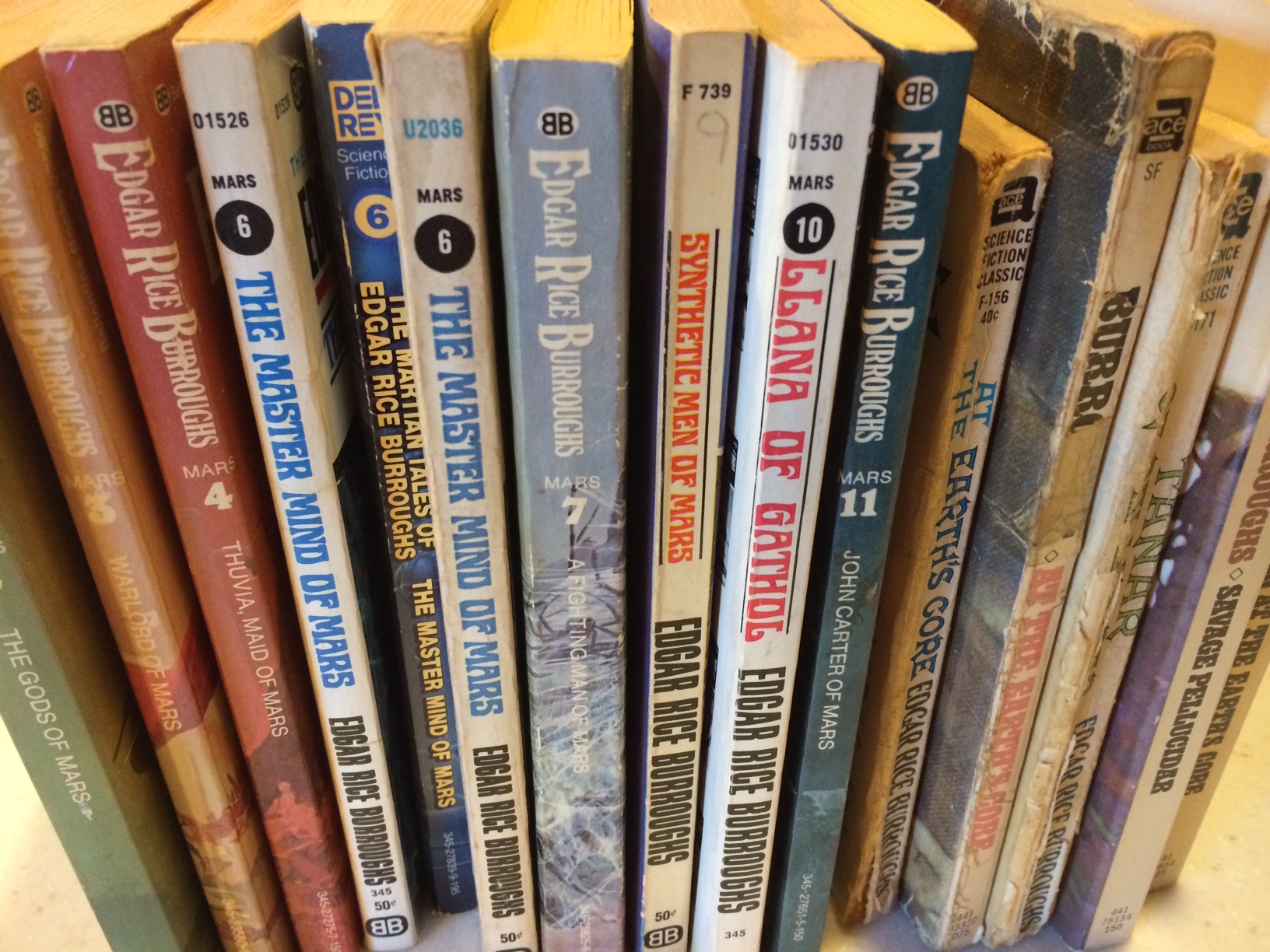
The photo above? Those are some of my Burroughs books – mostly Barsoom and Pellucidar books. I still have them. I’ve let some slip away including, strangely enough, the first, “A Princess of Mars.” But I read them all, back in the day.

I guess I should note that Stanton’s “John Carter” isn’t a terrible movie. It’s not even a bad movie. I’ve watched it in a couple of instances this weekend and was impressed by the effects and the scope. I like Taylor Kitsch pretty well as Carter, the Civil War veteran who inexplicably finds himself transported to Mars – there called Barsoom – and involved in a war.
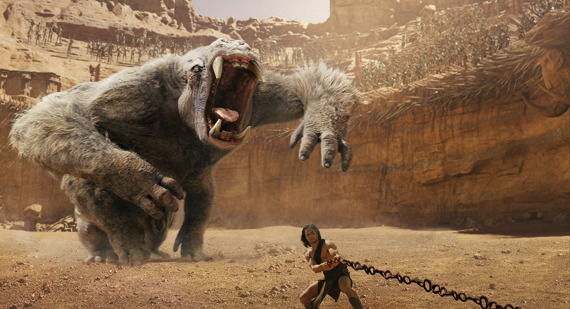
I thought Viola Lynn Collins was pretty good as Dejah Thoris, the female lead and Martian princess herself, and Willem Dafoe good as the voice of Tars Tarkas, the giant, four-armed Martian friend of Carter.
Mostly, though, I came away from watching “John Carter” and thinking I’d seen it all before.
That’s not the fault of the story, of course. It’s a fault of the timing of Stanton’s movie.
There have been attempts to film the story – which started as a serial in 1912 and sparked 10 sequels through the early 1940s – before.
If the story is familiar, it’s because many stories, comics and movies have cherry-picked some of the tale’s highlights and used them. It’s hard to imagine how different the “Star Wars” movies might have been without the desert settings and lumbering, bestial threats of the Carter stories. I can’t imagine “Avatar” without the work that Burroughs did.
I don’t wish that “John Carter” had been made decades ago. A live-action movie without benefit of today’s special effects would have been disastrous.
But by the time “John Carter” came out in 2012, the movie had a “been there, seen that” feel to it that probably doomed it with audiences who didn’t know the story and settings pre-dated the first “Star Wars” movie by more than a half-century.
So “John Carter” was fine. The story and its trappings were probably a little out of date by the time the movie was made. Or maybe the audience was jaded. That includes me, by the way.
At any rate, the books are still all there, on my shelf, to enjoy sometime I’m inspired to make another trip to Barsoom.
 keithroysdon