Tag Archives: pulp magazines

‘The Secret History of Marvel Comics’

secret history of marvel comics

“The Secret History of Marvel Comics” missed a great opportunity with its title alone.

“The Secret Origin of Marvel Comics” would have been a more accurate title for Blake Bell and Michael J. Vassallo’s book because it looks at the pre-history, in a way, of the artists and writers who shaped Marvel and its earliest incarnations but specifically focuses on publisher Martin Goodman, who published pulp magazines beginning in 1933 before riding the tide of reader interest into comic books in 1939.

You can tell the authors’ premise with the quote that begins the book. “Fans are not interested in quality,” Goodman is quoted as saying, and as much as that can be disputed – even a World War II-era kid knew the difference between a good Captain America comic and a bad one – it was a mantra that served Goodman well as he moved through the New York publishing world.

The book follows Goodman’s publishing enterprises through western and detective pulps and gives us some beautiful illustrations from covers and inside the magazines.

The text emphasizes, again and again, that Goodman was fairly ruthless in his dealings with artists and writers. Some of them were among the men and women who would go on to become the best in the comics field once it kicked into high gear in the 1950s and 1960s.

They’re all here, from Stan Lee (related to Goodman by marriage) and Jack Kirby – who would team to co-create classic comic characters for Goodman’s Marvel Comics – to Kirby’s Captain America co-creator Joe Simon to the likes of Dennis the Menace creator Hank Ketcham.

Everybody worked for Goodman, it seems, even if many of them came away not particularly enjoying the experience.

Although the first half of the book, with its assessment of Goodman’s character, feels repetitive, the second half is eye-opening, with reproductions of art by artist after artist. Here you’ll see Kirby’s art – raw and edgy – for detective pulps like “Detective Short Stories” and fantasy pulps like “Marvel Stories.”

kirbyqueenofvenus

Here’s a two-page spread by Kirby and Simon for “Queen of Venus,” from Marvel Stories 2 in November 1940.

The artists reproduced here gave readers an unending parade of gangsters and molls and tough guys and bad girls and aliens and murderers. That’s the best thing that “The Secret History of Marvel Comics” shows us.

Retro superhero: ‘The Phantom’

the phantom billy zane

Richard Donner’s “Superman” movies and Tim Burton’s “Batman” movies – and their sometimes regrettable sequels – came before, of course, but Bryan Singer’s “X-Men” really kicked off the big-screen superhero genre in 2000, and the trend was solidified a couple of years later by Sam Raimi’s “Spider-Man.”

But during the “lost in the wilderness” years of the the 1990s, the studios tried not once, not twice, but three times to capture the spirit of the superhero genre as typified by the great pulp magazine-style heroes, the forefathers to comics.

“The Rocketeer” came first in 1991 and was probably the most successful. “The Shadow” came in 1994 and did a pretty good job of hitting all the key elements of the most popular radio and pulp hero of them all.

Then there was “The Phantom.”

The 1996 Simon Wincer movie, starring Kristy Swanson, Catherine Zeta-Jones, Treat Williams and Billy Zane as the Ghost Who Walks, was certainly faithful to Lee Falk’s original comic-strip hero.

Maybe too faithful.

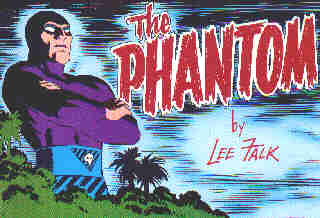
the phantom by lee falk

If you’re not familiar with the Phantom himself, the character was born in newspaper comic strips in 1936 and continues to this day. The Phantom is Kit Walker, the 21st in a series of fathers and sons who – following the 14th-century murder of a father, prompting a son to vow vengeance and the upholding of law and order – has kept the peace around the world and battled evil accompanied by his wolf companion, Devil, and his horse, Hero.

The Phantom is notable for some cool characteristics, including his twin handguns, the skull ring – whose imprint is left on bad guys’ jaws – and the legend that has been cultivated around him: He’s known as the Ghost Who Walks because criminals – a superstitious and cowardly lot, as Batman could tell you – believe he’s immortal rather than just the latest in a long family of crimefighters.

Falk created “The Phantom” after his newspaper syndicate asked for a follow-up to his “Mandrake the Magician.” In creating the Phantom, Falk invented a couple of superhero conventions, including the skin-tight costume and pupil-less eyes behind the hero’s mask.

“The Phantom” movie had the courage of its convictions, certainly. Its tale – the Phantom tries to protect a set of magical skull carvings and keep them out of the hands of a wealthy villain (Williams) – goes through the correct motions. Switching back and forth from the remote island home of the Phantom to New York City, the hero is aided by a spunky newspaper reporter (Swanson) and everything is complicated by the femme fatale played by Zeta-Jones. And what a revelation she was here. I really wanted her to play Wonder Woman after seeing her here and in another, better superhero 1990s movie, “The Mask of Zorro.”

There are pirates and submarines and seaplanes and immense sets and some action set-pieces, some better than others.

Zane leaves a lot of people cold – including me – but he’s really pretty good here as the Phantom. He nicely underplays the role, tossing off jokes and filling out the purple outfit about as well as anyone can. I was as frustrated as anyone by the black leather “X-Men” outfits, but maybe the world just wasn’t ready for purple spandex. And striped shorts.

As much as Zane underplays his part, Williams seems to have been told to overplay every line. I guess he’s being a good sport and the “Power Rangers” villain delivery would at least come across as non–threatening to kids in the audience. While the character is amusing, a villain who’s never truly threatening is not a great villain.

I’m not sure there’s ever been a big-screen movie that so desperately wanted to be “Raiders of the Lost Ark.” (I’m not counting the low-budget knock-offs here.) From the 1930s setting to the rickety bridge crossing that ends with the heroes swinging to safety to the ancient relics that magically illuminate a spot on a map to the villains that go “boom” at the end, “The Phantom” tries to strike so many “Raiders” grace notes it’s almost bizarre. Maybe that’s not a a surprise: Screenwriter Jeffrey Boam wrote “Indiana Jones and the Last Crusade,” a far better film.

“The Phantom” is worth seeing if you never have or if, like me, you haven’t in 18 years. It’ll seem like something of an awkward artifact because of the string of superheroes that followed it into theaters beginning just four years later, though.

Purple tights or no.

Essential geek library: ‘An Informal History of the Pulp Magazine’

history pulp magazines

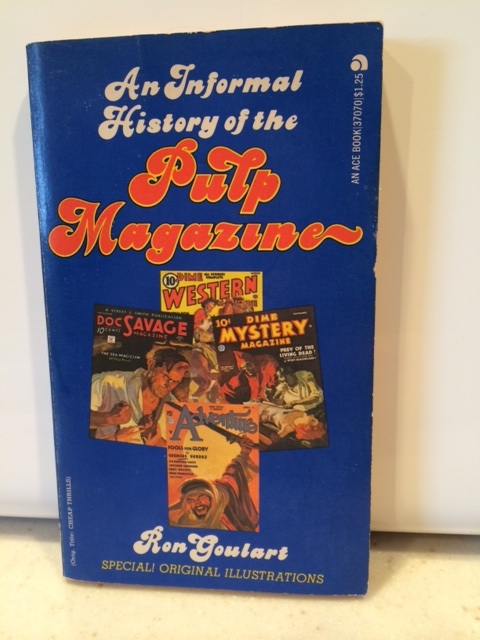
By the time Ron Goulart’s “An Informal History of the Pulp Magazine” was published in 1972, the pulp magazine – the art form and industry that gave millions of readers cheap thrills on cheap pulp paper and gave us all such heroes as “The Shadow” and “Doc Savage” – was already more than two decades dead. In the 40 (!) years since the prolific Goulart’s book was published, “Pulp Fiction” has come to mean little more than a Quentin Tarantino film.

But in 1972, when Goulart’s book came out, it was a bible to me, a look back into a colorful world of avenging heroes and penny-per-word writers that had been eclipsed by comic books.

Here in Muncie, a bookstore – long gone now – had shelves and shelves of old pulp magazines, which were so named because of the rough-edged, cheap paper they were printed on. I never bought any, although I wanted to. But I couldn’t even begin to start.

By the 1970s, I was enjoying the paperback reprints of pulp magazine stalwart Doc Savage, with those great James Bama covers, and that helped me appreciate the pulps in general and Goulart’s book.

In a relatively slim volume, Goulart gives an overview of pulps but concentrates on the best and brightest, the pulps featuring Doc Savage – precursor to Superman – and the Shadow, one of Batman’s contemporaries and inspirations.

Goulart gives us Tarzan and cowboys and detectives and jingoistic Yellow Peril villains and, best of all, a glimpse of the (mostly) men who created all those characters, working anonymously under pen names and turning out literally hundreds of novel-length yarns that were eagerly consumed by adventure-seeking readers.

Goulart interviewed many of the surviving writers and artists and even devotes the last chapter to their unfiltered memories.

Goulart’s topic has no doubt been covered by others since then, but even 40 years later, his book remains my favorite look back to that time and the pulpy art of storytelling.

An odd note: An inside page notes that the original title of Goulart’s book was “Cheap Thrills.” Although the cover doesn’t include that title, folios throughout the book refer to it as such. Did publisher Ace take the cheap way out, slapping a new cover on the interior text of Goulart’s book?

Considering the on-a-shoestring nature of pulp magazines, it would be appropriate if they did.

‘The Avenger’ is coming – the one you haven’t heard of

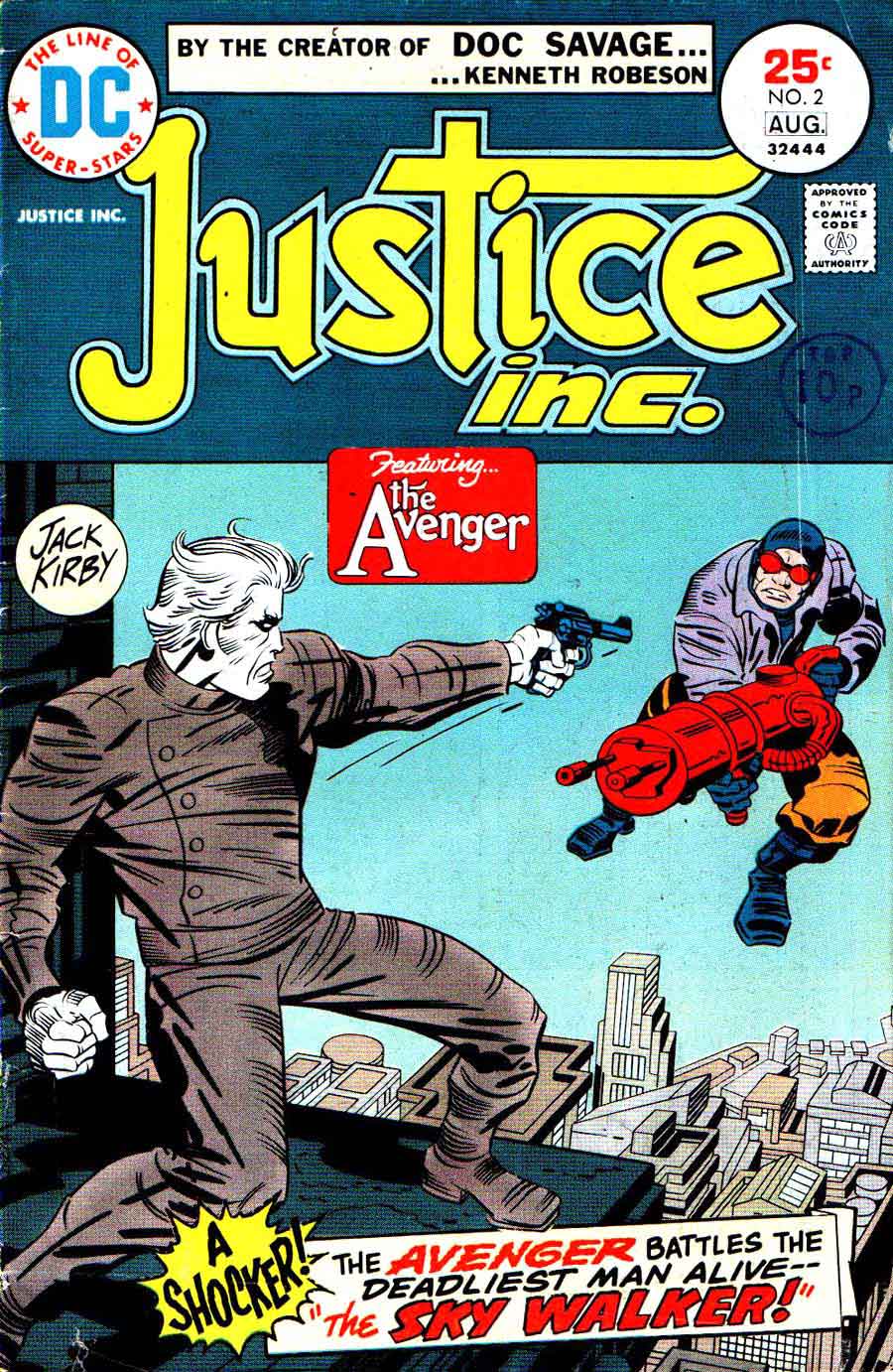
the avenger 1 justice inc

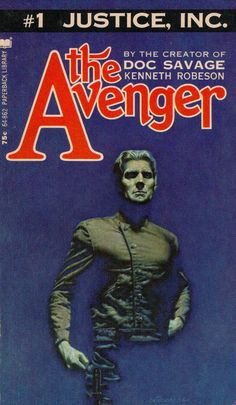
When the adventures of the 1930s pulp magazine hero The Avenger were reprinted in paperback in the early 1970s, they were right up my alley. I had already become a fan of the Doc Savage paperback reprints and the Avenger books were labeled as being by Kenneth Robeson, creator of Doc Savage.

I later found out that the stories – which originally appeared in Street and Smith pulp magazines from 1939 to 1942 – had actually been written, all those decades earlier, by Paul Ernst. Robeson was a Street and Smith “house name” that several action hero writers used. The Doc Savage books had been written by Lester Dent, to a great extent.

But the stories of The Avenger were so cool and so dire that it didn’t matter.

Like Doc Savage, the Avenger – originally a normal guy (if you call a wealthy world-traveler and adventurer normal) named Richard Henry Benson – fought crime with the help of a band of comrades and a healthy bank account.

But Benson/The Avenger drew his crime-fighting inspiration from the same dark well as Batman. Benson’s wife and daughter were brutally killed by gangsters.

Benson didn’t just take up the mantle of crimefighter. The shock of his family’s slaying was literally a shock to Benson’s system. His hair turned white. His eyes – somehow – turned pale. And Benson’s face froze. No longer could he voluntarily change his expression. His bleached face was described as like something out of a graveyard.

But Benson could suddenly mold his face, moving his jaw and nose and cheekbones and brow to resemble other people. With the help of makeup, colored contact lenses and wigs, Benson could now go undercover, infiltrating crime rings and mobs.

the avenger 2 the yellow hoard

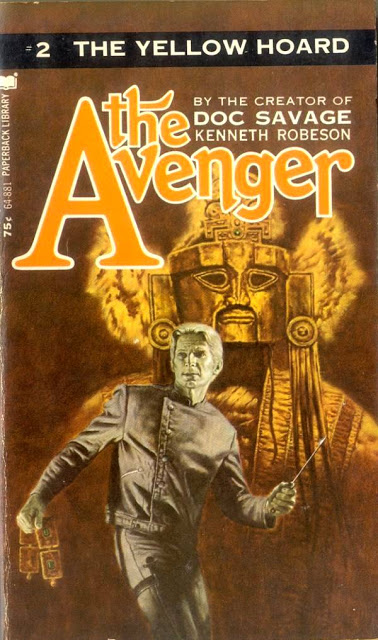
Armed with his ghoulish visage and high-tech weapons – including a streamlined gun and knife set he called “Mike and Ike” – Benson brought criminals to justice.

I was fascinated by all this. By the time i was reading the Avenger stories in the early 70s I was familiar with Batman’s tragic backstory, of course. Richard Henry Benson’s was perhaps even stranger and more tragic in that it also left him disfigured … but he turned the handicap into a crimefighting tool.

justice inc comic

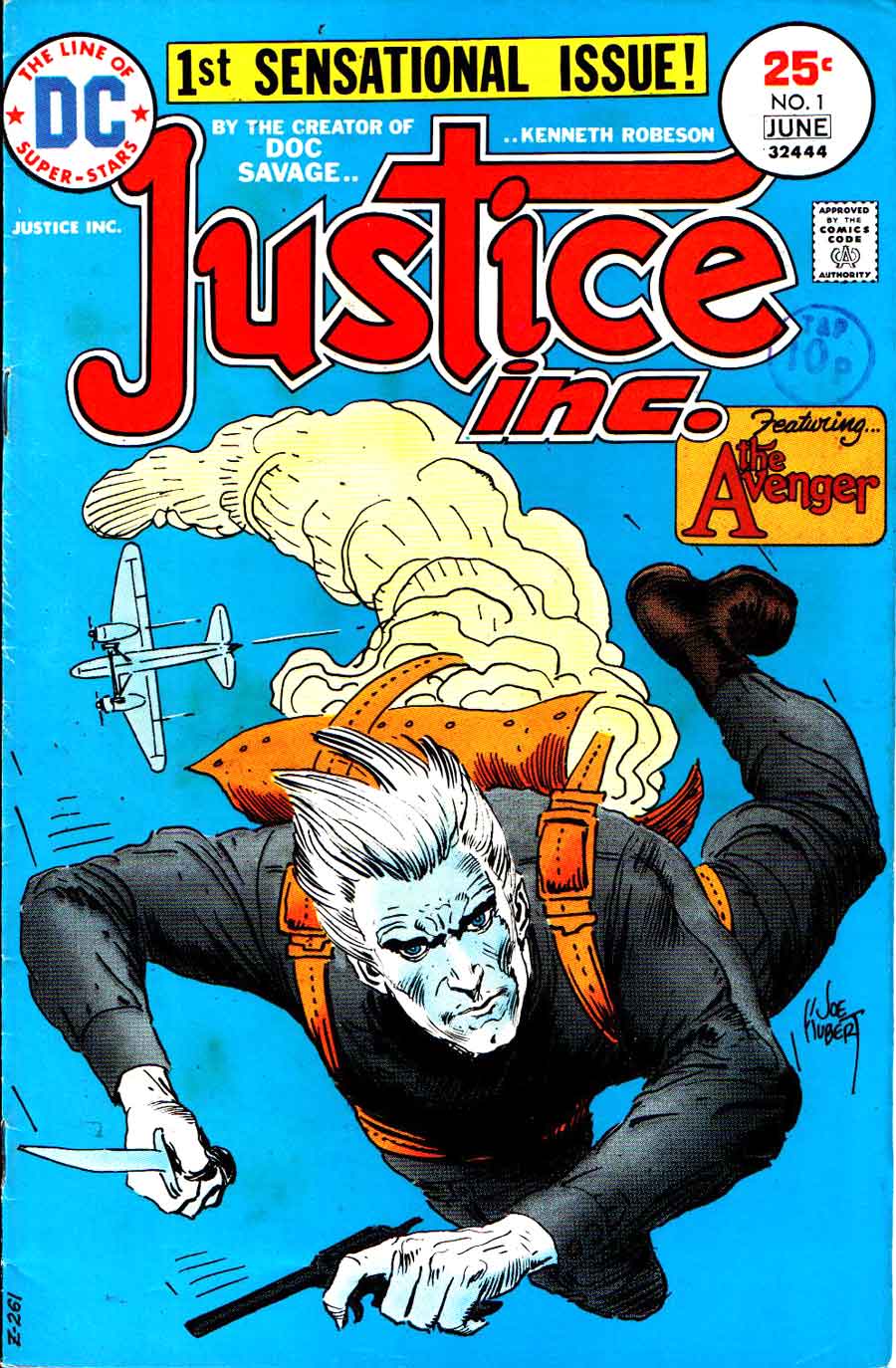
The Avenger had a couple of changes at revival after the paperback stories were published. DC Comics – which in the early 1970s had revived another great pulp hero, The Shadow – published an Avenger comic book in 1975. No doubt because DC competitor Marvel had been publishing “The Avengers” for more than a decade, DC called its Avenger book “Justice Inc. featuring The Avenger.”

justice inc kirby cover

Jack Kirby even did some work on the comic.

Besides the nostalgia factor, I’m noting all this now because of the recent news that producers are developing, for The CW network, a new TV series version of The Avenger, with several changes, of course. Instead of Richard Henry Benson, the heroine is Alice Benson. The new Avenger has the same malleable features and the same undercover missions as she investigates the deaths of her parents (rather than spouse and child).

I’m guessing in light of Marvel’s big-screen “The Avengers” movie, the TV series will be called something else.

It’ll be interesting to see if the new series can capture the same feeling of an adventurer – an avenger – with nothing left to lose in a hell-bent pursuit of evildoers.

‘The Shadow’ knows! (insert sinister laugh here)

Although they were gone long before my time, the old pulp magazines have a fond place in my heart. Heroes like “Doc Savage” — an adventurer named Clark who had a Fortress of Solitude years before Superman — and “The Avenger” — a frozen-faced revenge specialist driven by tragedy — intrigued me as a kid. The precursors to comic books had everything comics had … well, minus four-color layouts.

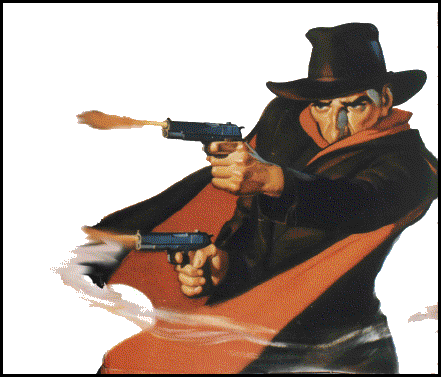
While “Doc Savage” might have been my favorite of the bunch, I also liked “The Shadow,” the pulp-turned-radio-series-turned-movie-series-turned-comic-book adventures of a crime-buster playboy named Lamont Cranston who, when it came time to battle bad guys, donned a black cape and roamed the city’s streets as “Batman” later would.

There were differences, of course. “The Shadow” wasn’t averse to gunning down criminals, although he seemed to prefer to drive them insane with his mocking laughter, often prompting them to inadvertently off themselves.

“The Shadow” had a complex story befitting any long-running adventurer. Introduced in 1930 as the narrator of a radio mystery, the character came to pulp novels a year later and Walter Gibson (writing as Maxwell Grant) kept the character going until 1949. Orson Welles lent his voice to the radio show for a while and several movies — including one starring Alec Baldwin in 1994 — were made.

The Alec Baldwin movie is pretty fun — I watched it just tonight — and hits all the right notes. The multiple identities (at various points over the years the writers played with the idea that no one really knew the hero’s secret identity), the shady background, the cadre of associates, the life of a vigilante outside the law are all explored.

But, like “The Phantom” and a few other modern-day adaptations of pulp heroes (we’re not even considering the campy 1970s version of “Doc Savage” here; it was off the charts goofy, probably intentionally) something just didn’t quite click.

Baldwin — and I can’t look at him now without thinking of “30 Rock” or his legendary temper tantrums — was good in the title role even though the movie, curiously, chose to slavishly recreate the character’s hook nose, necessitating Baldwin’s face morphing at a few points. It’s startling to see Ian McKellen, best known for his roles as Magneto and Gandalf just a few years later, as an absent-minded scientist in the movie.

While the theme of atonement for past sins doesn’t quite jell, the device of “The Shadow’s” network of operatives being made up of people who owe him their lives is a very neat one and pays off nicely at the end.

For years and years, there’s been talk of a new “Doc Savage” movie. A decade ago it was going to star Arnold Schwarzenegger. That improbable idea has certainly passed now — lets hope — and maybe we’ll get a serious Doc.

Who knows if we’ll ever get another outing for “The Shadow?”

I know, you’re thinking I’m going to say, “The Shadow knows.”

Cue sinister laugh.