Last time I tried to write about Sam Hamm’s legendary script for Tim Burton’s “Batman” movie, I got a cease-and-desist note from Warner Bros.
We’ll see what happens this time.
It was the late 1980s and there was a lot of anticipation for Tim Burton’s “Batman” movie, planned for 1989 release. This was pre-Internet, remember, but the letters columns of genre magazines and newspapers devoted to the movie were full of opinions, pro and con, about the movie and Burton’s choice of Michael Keaton – an actor best known for comedy movies and, shall we say, not having the strong chin of a comic-book-movie actor – had set people on fire.
This was just a couple of decades after the Adam West-starring TV series. A decade earlier, the Richard Donner-directed, Christopher Reeve-starring “Superman” was a huge hit and Warner Bros. seemed to want to follow the same formula with Burton’s “Batman.” In other words, an unknown or unlikely choice as the hero bolstered by a big star as the villain.
Burton had those elements firmly in place with Keaton – who would go on to surprise many with his performance and presence – and Jack Nicholson as the Joker (the movie’s equivalent of “Superman” and its two big stars, Marlon Brando and Gene Hackman).
What was crucial and a total unknown at the time was the tone of the “Batman” movie. The Adam West series, beloved more today than at the time, was still fresh in people’s minds. Would Burton and Keaton and Nicholson turn their “Batman” into a spoof?
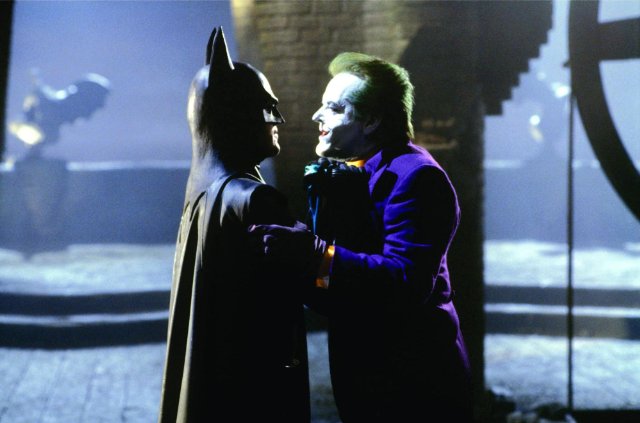
(That didn’t happen, of course. I still vividly remember seeing the movie on its opening weekend in 1989 on a trip to visit friends in Los Angeles. We stood outside the Chinese Theatre in a line that extended around the block and then waited only-a-little-impatiently for the movie to begin. The Chinese Theatre had a Bat Signal fired up and projected Batman’s chest symbol on the curtains before the movie began. We were not disappointed once we saw the movie.)
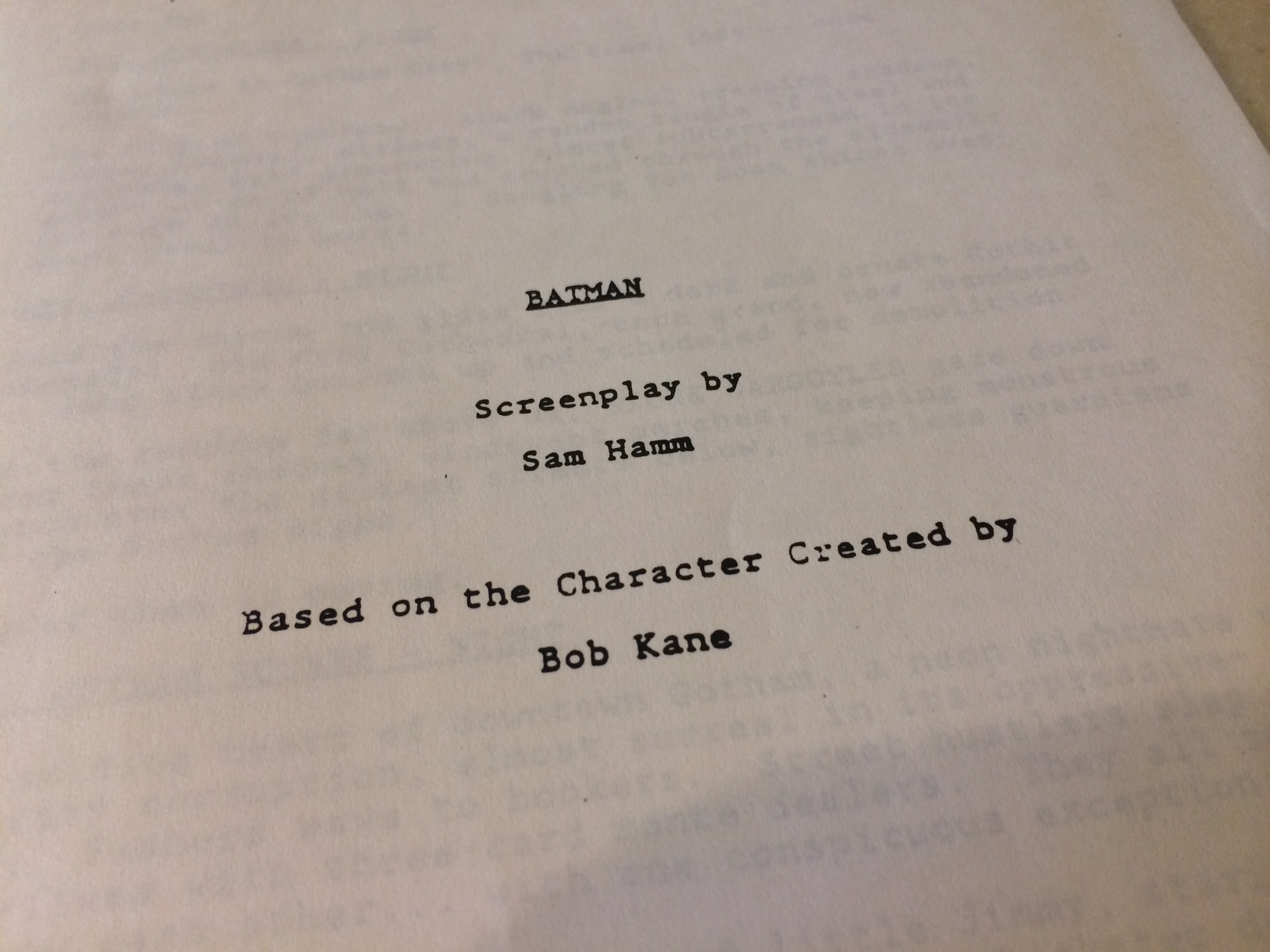
But at some point during all the anticipation and the aftermath, I came across a copy of a Batman script, written by Sam Hamm and noted, “Third Draft, February 29, 1988.” And yes, there was a February 29 that year.
I bought the screenplay at a sci-fi and comic-book convention within a few weeks of the movie’s release. As far as I knew then and know now, it was a legit Sam Hamm draft, one of several, done before the final script credited to Hamm and Warren Skarren.
Some of you might remember that there was a huge market for movie and TV scripts at the time. Today, you can do a Google search and find drafts of Hamm’s scripts online, in their entirety, going back to 1986. But back then, of course, you got your hands on a copy either through the mail order or at a comic book or sci-fi convention.
(There was a third source back then. During my regular tips to LA, I paid a lot of visits to a Hollywood Boulevard book store that sold scripts and movie stills. Most of the scripts, no doubt, came from studio functionaries or crew members who knew they could make a few bucks and clean off their desks by selling them to be resold.)
I got the Hamm script at a convention, though, although I honestly don’t recall now if it was in LA or here in the Midwest.
I really enjoyed the script and upon re-reading it today, I’m glad to see that it has held up nicely. There are some important differences between the script and the completed movie. One big difference is the late-in-the-movie introduction of Dick Grayson, who would go on to be Robin to Bruce Wayne’s Batman. Dick is out for vengeance after the Joker deliberately kills his parents – trapeze artists the Flying Graysons – when a chase with Batman encounters the Gotham City birthday parade familiar from the movie.
By the end of the script, Dick is under Bruce Wayne’s care and close to taking the first steps to becoming Robin.
The Bruce Wayne and Joker characters are different in Hamm’s script and I have to say I preferred them to the movie versions.
Joker – Jack Napier, underling to mobster Carl Grissom just like in the movie – is edgier, a dapper 30-something rather than Nicholson’s dapper 50-something. My biggest complaint with Burton’s “Batman” has always been that Nicholson was too old and simply not spry enough to be a credible physical match for Batman.
Bruce Wayne in the script isn’t the distracted billionaire he was in the movie either. Actually, the character is much more like the character as portrayed in the “Batman” animated series and Christopher Nolan’s Batman trilogy starring Christian Bale. He’s edgier and more dynamic. There’s a notable scene in the script – following the one in the movie where Joker and Bruce Wayne face off at Vicki Vale’s apartment – in which Wayne, clad in a suit and utility belt with a black stocking over his face – pursues the Joker across Gotham, stopping only to don the Batsuit after rendezvousing with Alfred along the chase route.
Batman is different too. He’s more tortured, if that’s possible, realizing that he played a role in creating the Joker in the first place. In the climactic struggle between Batman and the Joker in the belfry of Gotham Cathedral, Hamm implies that Batman considers the idea of ending his own life.
In a moment that surely inspired a similar scene in the Nolan movies, Bruce activates a sound-generating device that drives the bats in the cathedral into a frenzy. The bats ultimately make the Joker fall to his death.
Batman has also started the countdown on an explosive device on his utility belt and I swear Hamm makes it seem as if Bruce is considering ending it all.
The Joker has already plunged to his death by this point, disoriented by the bats and unable to reach his getaway helicopter.
“Six seconds remain. There is still time if he makes his choice now,” the script says about Batman.
“Surrounded by the flapping of leathery wings, his body working on pure adrenaline, he unbuckles the belt and HEAVES IT out into the darkness.”
The belt and bomb take out Joker’s helicopter.
But did you notice that part about Batman’s “choice?”
Much of the script is familiar from the movie. There’s the scene of Batman terrorizing street punks on a rooftop. There’s the charity benefit at Bruce Wayne’s house. Characters like Jim Gordon and reporter Alexander Knox are on hand, even though Knox briefly tries to blackmail Bruce Wayne – he knows Batman’s identity, just as Vicki Vale does – and is driven to do so by jealousy over Vale and her attraction to Wayne. Knox redeems himself by the end, however.
So at the time I first read Hamm’s script, I was settling into my newspaper career but still writing some freelance for other publications. I was a longtime admirer of Cinefantastique, the slick and intellectual magazine, founded in 1970, that covered the world of fantastic movies and TV. (It’s online only now, but I still have almost every issue in storage.)
I thought that a review of the original Hamm “Batman” script might be a good way to break into writing for Cinefantastique, so I wrote up a review and mailed it to them, along with my contact information.
Not long afterward, I got first a phone call and then a letter from a legal representative of Warner Bros.
How did I get a copy of the Sam Hamm script? Did I remember the name of the convention vendor that I bought it from (for something like $15)? Was I aware that, even though it wasn’t the version that was produced, it was still the property of Warner Bros? (Yes to the latter; it says “Property of Warner Bros” right on the title page.)
At the same time it seemed like overkill – remember, I was this about-30-year-old writer and longtime genre fan in Muncie. Indiana, who just wanted to get an article published in a national genre magazine – and I found it incredibly disappointing that Cinefantastique called Warner Bros. on me the minute they got my unsolicited article in the mail. I’m guessing they had their own copy of the script – if I could get one at a convention, anybody could – but chose not to write about it. At any rate, it was disappointing and I never looked at the magazine the same way after that.
I respected Warner’s demand that I not write about the script, however, and I haven’t – until today. I’m guessing the studio’s sensitivity about that particular script must have lessened nowadays when, thanks to the Internet, a half-dozen versions of the script are there for perusal.
Well, I’m guessing, anyway. I’ll let you know if I get another call from some lawyer in California.

 keithroysdon