Tag Archives: Walt Longmire

‘Longmire’ kicks off second season closer to the target

longmire logo

As a fan of Craig Johnson’s series of crime novels about Wyoming Sheriff Walt Longmire, I was a little disappointed with the first season of the TV series version that aired on A&E.

You can catch up with what I thought here, but it boiled down to: Not enough of Johnson’s trademark mix of tall, dark and quiet heroes and quirky plots.
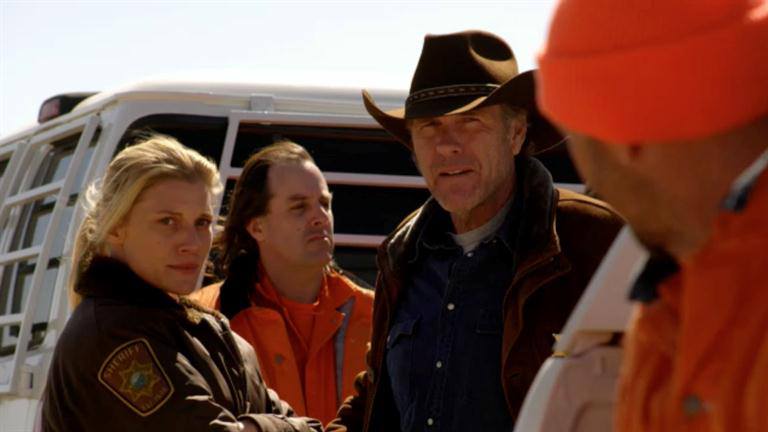
longmire and vic

Last night’s second-season debut, though, was closer to the target. The episode was based in part on a Craig Johnson book, “Hell is Empty,” which puts the sheriff in harm’s way as he transports a series of prisoners – including a man who killed a child several years ago – through his county and over a mountain … just in time for a blizzard.

The single hour of television couldn’t begin to capture all of Johnson’s straightforward plot and rich characters. But it came closer than any first-season episode.

The series is also coming closer to hitting the mark in the way it portrays Johnson’s characters. I’ve got to say I’m enjoying the heck out of Robert Taylor as Longmire, for whom “less is more” truly describes his spare speaking habit. Really, the less the writers give the sheriff to say the better – and not because Taylor’s not a good actor. He’s good, but he’s perfect with a long stare and grumble

I loved “Battlestar Galactica” vet Katee Sackhoff as Walt’s deputy – and is very tentative love interest the right way to describe her? – Vic Moretti from the moment she was cast and I’m still enjoying her.

Bailey Chase and Cassidy Freeman are quite good as Walt’s ambitious deputy and daughter, respectively.

I’m growing to like the terrific Lou Diamond Phillips as Henry Standing Bear, Walt’s longtime friend and confidant. Phillips is making questionable casting palatable.

One big plus for me with last night’s episode was an injection of the Native American mythos and mysticism that marks Johnson’s books. As Walt trudged through snow to track the prisoners, Henry and other figures – including an impressive owl – appeared to him. Thanks in part to Henry, spirit guides and the connection between the Wyoming characters and the earth are present throughout the books.

I’m still not convinced I’m buying the subplot about the death, before the show started, of Walt’s wife. She died from cancer in the books and, while her passing has left a huge shadow across Walt, it isn’t the stuff of an ongoing mystery.

I wasn’t sure I was going to check out “Longmire” this second season. The season premiere definitely encouraged me to come back for more.
Craig Johnson’s old sheriff ‘Longmire’ in books, TV

For a grizzled old sheriff in a small Wyoming county, Walt Longmire is getting a lot of attention lately.

“As the Crow Flies,” author Craig Johnson’s latest novel about Longmire, came out a few weeks ago and “Longmire,” a new weekly series about the character, debuts tonight on A&E.

It’ll be interesting to see how A&E does with the series. Robert Taylor plays Longmire and, in the few clips I’ve seen, looks like he might be a good fit for the character, a laconic modern-day cowboy who’s a dogged detective but wears his heart on his sleeve.

As the series of books opened, Longmire was still recovering from the death, from cancer, of his beloved wife. His daughter, Cady (played by Cassidy Freeman in the A&E series) is an attorney in Philadelphia trying to help her father get back on track. Longmire’s lifelong friend, Henry Standing Bear (Lou Diamond Phillips in the series) is not only his anchor but his backup when dealing with the dangerous types — meth makers, murderous backwoodsmen, escaped convicts — that drift through the county.

A big part of the series is its spirituality. Not in the organized religion sense, but in Longmire’s discovery of the Native American beliefs of Henry and his fellow Cheyenne people as well as the Crow and other nations that populate the area.

The tie between Longmire’s small-town policing and the world of the reservation is especially strong in “As the Crow Files,” Johnson’s latest book. Longmire and Henry investigate the death of a young Native woman who fell from cliff while they watched. Her infant was clutched in her arms and survived the fall. Now Walt and Henry have to piece together who would push a woman and baby off a cliff and why.

At the same time, Walt is preparing for Cady’s upcoming Wyoming marriage to Michael Moretti, brother of Vic Moretti (ideally cast with Katee Sackhoff of “Battlestar Galactica” fame), Walt’s tempestuous deputy, a former Philly cop.

As in all the Longmire books, there’s an undercurrent of humor. Walt and Henry and Vic are dryly funny characters.

Besides the humor, there’s a somber feeling to Longmire as well as the aforementioned spirituality. Henry’s beliefs, which might come across as mysticism to some, gradually seem more plausible to Walt, who gets spiritual guidance at just the right time in many of the novels.

The A&E series, which seems intended to appeal to the type of audience that likes “Justified,” the FX series about a Kentucky lawman, might do a good job capturing the character-heavy drama of Johnson’s stories. It’s hard to imagine how it will capture the humor and spirituality. We’ll see tonight.


Steve Jobs, books and time’s passing

I heard about the passing of Apple visionary Steve Jobs just a little while ago and, of course, I heard the news through my iPhone. I imagine I’m one of millions of people who found out through one of Jobs’ many ideas-brought-to-life.

Then, after watching a few minutes of a TV special about Jobs, I settled in and finished a book. It was Craig Johnson’s “Death Without Company,” the second in his series about Wyoming lawman Walt Longmire.

I just closed the Johnson book — it’s good, and typical of the Longmire stories, which feel like Westerns even though they’re crime novels and, above all else, character studies — and feel philosophical. More so than usual.

Part of that is because of the tone of the book, which is all about death and friendship and family and long-forgotten passions rekindled. Part is due to the passing of Jobs, whose inventiveness changed things for a couple of generations of people.

It’s important, for some reason, to note that I read “Death Without Company” not on Jobs’ iPad or Amazon’s Kindle or even BN’s Nook but on paper. I don’t have a tablet or e-reader, at least not yet. I’m not rushing to get one, in great part because there’s something that feels so right about reading a book on paper. Hardback, paperback, whatever. The experience of opening a book and getting lost is one that I’ve loved since I was a grade-schooler. I’m positive that love will never pass. I’m pretty positive my devotion to the old-school book experience will likewise stick around.

Jobs was the kind of guy who was always moving ahead, always innovating. I found myself wondering tonight if he still read books — or newspapers, or magazines — on paper. Was that ever an important thing to him? Did it ever stop being important?

I’m not sure what I’m going to read next. I have only one of the Longmire books left. I might crack that open or I might dip into a book about the Civil War in an attempt to remedy my woeful ignorance about that period in our history.

Maybe I’ll start reading “Killing the Blues,” the latest in a series of books about small-town New England cop Jesse Stone. Jesse was created, you see, by Robert B. Parker, a longtime mystery author who passed away last year.

“Killing the Blues” exists because Parker’s wife chose a successor. Michael Brandman is continuing the series after Parker’s passing.

Parker, like Jobs, was a master at his own game. He’s gone now, like Jobs, and others will try to fill the void, like they will with Jobs.

Parker’s successors — because it’s hard to imagine a replacement — will continue his various series, hopefully with some success and artistic accomplishment.

Jobs’ successors — because it’s hard to imagine a replacement — will continue his work, hopefully with some success and artistic accomplishment.

Books will still be published. Incredible advances in technology will continue to be made.

And the world will keep on spinning, albeit perhaps diminished.