
One of the greatest feats a novel, movie or TV series can achieve is world building. To create a world different from our own, in ways large and small, is an accomplishment.
There’s no TV series on the air now that is better at world-building than “Motherland: Fort Salem,” in its third and final season on the cable channel Freeform and streaming on Hulu.
“Motherland” is set in a present-day United States greatly shaped by a decision from the 1620s: Instead of killing women who had been judged as witches, the leaders of Salem, Mass., reached an accord with the women. They embraced the magic that the women possessed. Over the centuries that followed, women not only filled the leadership roles in the growing country – and in other countries – but became the core of the military machine that defended the country. Women run the armed forces and a woman (played by the always-wonderful Sheryl Lee Ralph) is president.
A dominant figure in the world of witches is General Sarah Alder (Lynn Renee), a hero of the American revolution, who over the couple of centuries since has used her magical abilities – and the magic of the witches in the series manifests through cooly weird “songs” they vocalize – to not only run the Army but the titular West Point-style military academy, training young witches who join the military (sometimes at the displeasure of their families, but a call to arms is a call to arms).
The world of “Motherland” is fantastic but utterly believable within the show, and early on focused on the battle against the Spree, a domestic terrorist organization made up of witches. But more recently, the war has focused on the Camarilla, an ancient, man-led group of murderers and would-be dominators. The witches and the Spree form an uneasy alliance against the Camarilla.
I was surprised to learn that a man, Eliot Lawrence, created and guides “Motherland,” although maybe I shouldn’t be. But as a male viewer I feel like the series very ably represents the points of view of the women, who form alliances and have relationships with men in some cases but don’t need men to rescue them. My favorite moment yet might be from early on, when Alder and the women are meeting and the children on the Army base are being shepherded out to play by a couple of male caregivers. No heavy-handed point is made and viewers might not even notice, but it was there and it was smart.
But all of the world building won’t make us tune in if we don’t care about the characters and their stories.
Alder is a complicated figure, not entirely trusted by the women under her in the military, and in the current, third season, her story is off in a wild new direction, post-rebirth thanks to the “mother” entity that lives within Earth.
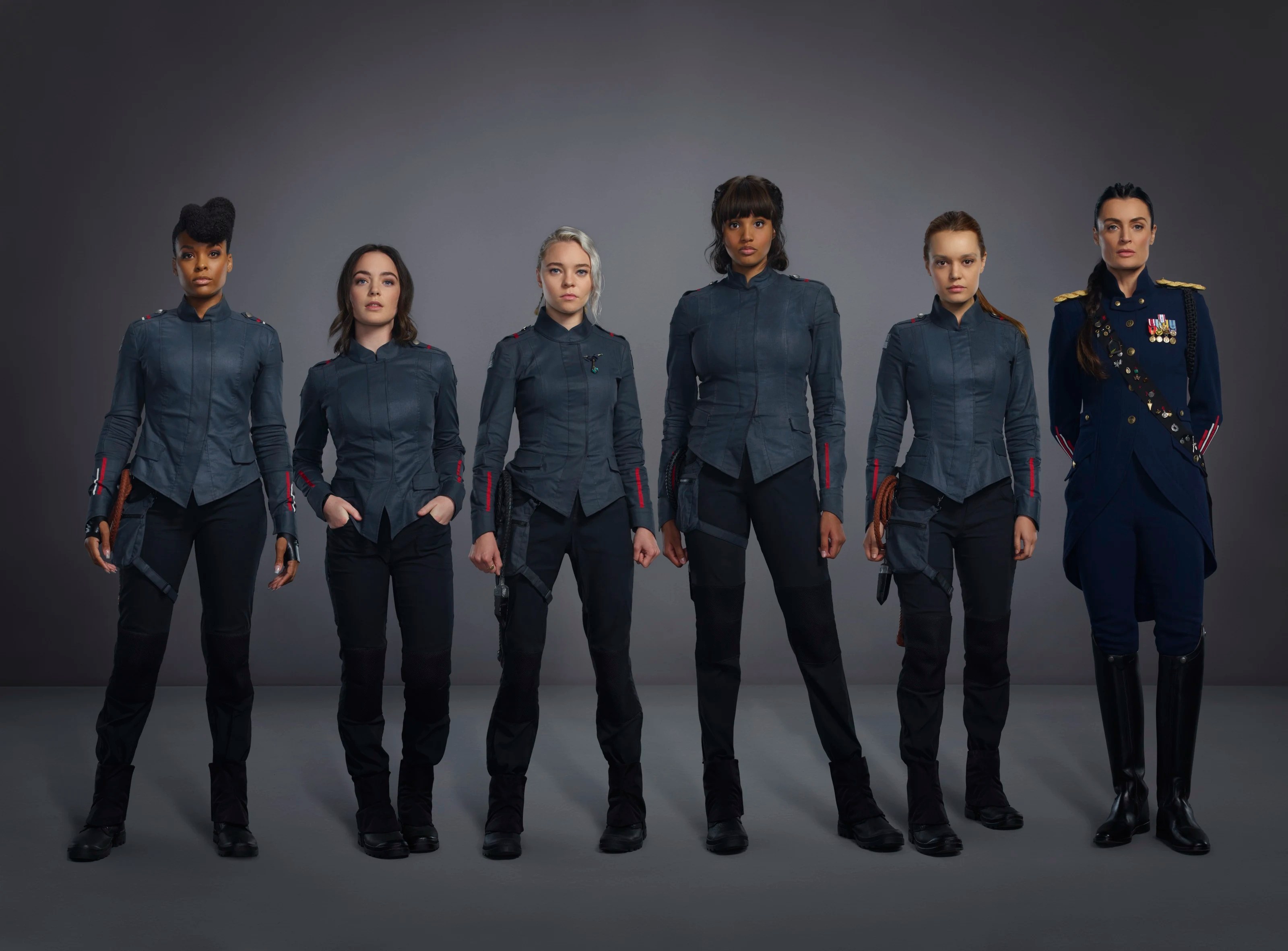
The series focuses on four young women: Raelle Caller (Taylor Hickson), Tally Craven (Jessica Sutton), Abigail Bellweather (Ashley Nicole Williams) and Scylla (Amalia Holm). The first three are Fort Salem cadets from diverse backgrounds; Bellweather is from a line of women who call to mind the Kennedys, for example. Scylla is a former Spree operative who falls in love with Raelle.
So there’s some soap opera-ish elements of “Motherland” and I’m totally cool with that. The characters in the expansive cast – especially Anacostia Quartermaine (Demetria McKinney), a savvy Army officer at Fort Salem – are varied and wonderful.
The show has a great, diverse cast (diverse in the sense of race but also gender identity and age) that has made some of its characters fan favorites.
I hated to hear that “Motherland: Fort Salem” would come to an end this season and I’m hoping that the very nature of the title means that it could morph and return as “Motherland: SOMETHING ELSEWHERE BESIDES FORT SALEM” because a lot of the action has moved away from the campus anyway.
But I’d urge you to check out the series by going back and watching it from the very first episode, on Hulu. It’s a must for us who love societies and worlds that are much like our own but viewed through a different prism.
 keithroysdon
Good little review. There is some really solid world building in this show; I note that all the TVs we see are CRTs; has magic slowed the development of technology? And it is good that the show covers diversity without being heavy handed about it. Though my personal role-reversal moment comes from the opening sequence of S1E3 . . . And also that episode gives another insight into how different the world is. Militaries tend to frown on male/female fratenisation within the ranks; at Fort Salem it is enthuiastically embraced & encouraged.
I have mixed feelings about the show ending with this season, yes there’s an awful lot more to see in this world. But OTOH I would hate to see MFS fall into the dreaded category of: a show wich has gone on tooo long . . .
But in the meantime, yep, MFS does deserve a much greater audience.