Category Archives: monster world

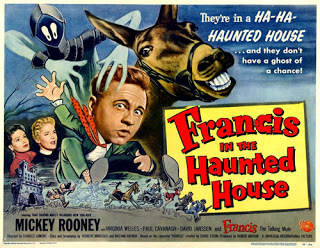
Movie classic: ‘Francis in the Haunted House’

francis in the haunted house poster

More than a half-century later, it’s hard to imagine a movie studio building a series of films around the exploits of a talking mule and his human sidekick.

Yet Universal, home of classic monsters and classic funny/scary movies, released seven pictures about Francis, an Army mule voiced by veteran character actor Chill Wills (in the first six) and accompanied by straight man Peter Stirling (Donald O’Connor in the first six flicks).

The movies were based on a book and were sent into theaters beginning in 1950 mostly as a post-war military comedy. Francis and Peter went to West Point, joined the WACs and the Navy. Inevitably, Peter got into some kind of jam, Francis dispensed wise-cracking good advice and nobody believed that the mule could talk. Until he did.

My introduction to the series was a 1960s showing on an Indy TV station of the last film in the series, “Francis in the Haunted House,” released in 1956.
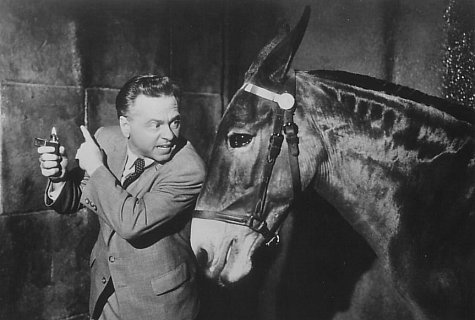
francis in the haunted house leads

My view is no doubt skewed by the fact that this, the first in the series that I remember seeing, had a different star – Mickey Rooney – and a different voice – veteran voice actor Paul Frees – replacing Wills as the voice of Francis.

But for a kid who grew up loving not only Universal monster films, including “Abbott and Costello Meet Frankenstein,” I found the mix of laughs and chills perfect.

In the movie, David Prescot (Rooney) meets Francis and, after the initial surprise at the fact this is a talking mule, they set off on an adventure. The two try to help a woman win her inheritance by staying in a supposedly haunted mansion.

In a formula that became familiar through “Scooby Do,” the haunting is being staged by crooks who want to win the mansion and Prescot is a patsy in more ways than one.

There is, however, a foe that Francis and Prescot can fight together: A ghostly knight on horseback.

It’s no doubt true that the Francis formula was more than a little tired by this point. O’Connor bailed from the series before this entry was made and was widely quoted as saying he knew it was time to go when the mule got more fan mail.

But there’s a lot of pleasure to be found in the final “Francis” movie. It’s perfect for “Abbott and Costello” fans.
Classic schlock: ‘The Brain That Wouldn’t Die’

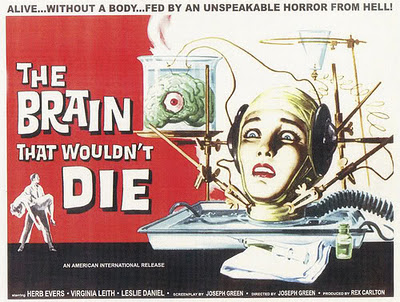
the brain that wouldn't die ad

Believe it or not, I hadn’t seen “The Brain That Wouldn’t Die” in its entirety until just recently.

It is, after all, one of those classic schlocky horror movies, those cult drive-in classics, that everybody is familiar with even if you haven’t seen it. It was the first Mike Nelson “Mystery Science Theater 3000,” for pete’s sake.

Yet I managed to never see more than random clips until I sat down to watch it on DVD the other day.

And what a treat.

Filmed in 1959 but not released until 1962, the movie’s original title was “The Head That Wouldn’t Die,” who was probably more accurate.

The movie stars Jason Evers – a familiar face from the “Star Trek” series episode “Wink of an Eye” – as Dr. Cortner, an arrogant surgeon who is secretly experimenting, Frankenstein-style, on creating life after death. He’s been saving random body parts and assembling a creature that’s kept in the laboratory closet downstairs in his family’s summer home.

Early in the movie, even Cortner’s surgeon father criticizes his lack of humility and unpleasant ambitions.

Then Cortner and girlfriend Jan are in a auto accident and Jan is decapitated. Jan is beheaded in the kind of car crash that is usually found in low-budget movies: Lots of shots of the car careening along a country road, then quickly approaching a guard rail. The crash itself isn’t seen. Neither is Jan’s head, which Cortner wraps up in his sportcoat and rushes from the scene (with as much footage of him running, bunched up jacket in his arms, as there are shots of the car speeding down the road).

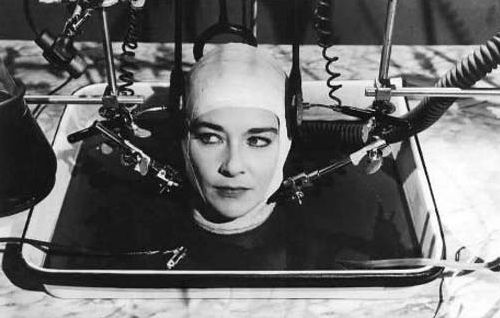
the-brain-that-wouldnt-die

So Cortner put’s Jan … in a pan … at least her head … in his basement lab. Then he begins scouting out a replacement body.

The movie certainly seems to have inspired scenes in “The Re-Animator,” with its head in a pan motif. And “Jan in the Pan” is apparently the nickname for the female lead once she’s … in a pan.

brain that wouldn't die monster in closet

Every cheap horror movie needs a monster and a woman’s head in a pan just wasn’t going to cut it. Hence … the stitched-together monster in the closet.

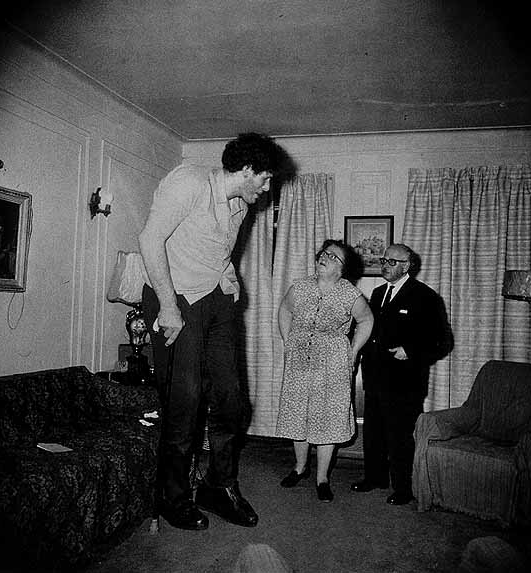
diane arbus the jewish giant

The creature, the result of Cortner’s previous experiments, is played by seven-foot, six inch Eddie Carmel, subject of a photo by renowned photographer Diane Arbus that depicts Carmel as “The Jewish Giant at Home with His Parents.”

As Cortner goes to a burlesque house to pick out a new body for Jan, he doesn’t seem like a tortured soul looking to save his girlfriend. He seems to be enjoying the view a little too much.

Adding to the overall aura of sleaze: Two dancers get into a catfight, boobs jiggling. Cut to drawings of two cats and a dubbed meow.

Jan, meanwhile, wakes up – well, her head wakes up – and she immediately begins talking to the still-unseen monster in the closet, talking up their mutual need for revenge.

There’s some choice dialogue:

“An operating room is no place to experiment.”

“Very well. The corpse is yours.”

Said during operation: “I’ve been working on something like this for weeks.” Well, tons of research then.

“I love her too much to let her stay like this.” Well, a disembodied head in a pan, yeah.

“The line between scientific genius and obsessive fanaticism is a thin one.”

“Horror has its ultimate … and I’m that.”

And cackling by Jan in the pan. Lots of cackling.

The end credit slide on the copy that I watched still had the original title: “The Head That Wouldn’t Die!”

RIP great writer Richard Matheson

Richard_Matheson

It’s impossible to neatly summarize how important author Richard Matheson was to the word of writing, fantasy and science fiction and movies and TV.

Matheson, who has passed away at age 87, left so many great works behind.

Here are just a few.

“I Am Legend,” which inspired movie treatments starring Vincent Price, Charlton Heston (“The Omega Man”) and Will Smith.

“The Shrinking Man,” adapted as “The Incredible Shrinking Man.”

Other works that were made as movies, some of them written for the screen by Matheson: “What Dreams May Come.” “A Stir of Echoes.”

Original movies and TV shows he wrote: “House of Usher.” “The Raven.” “Comedy of Terrors.”

Several of the best-remembered “Twilight Zone” episodes, including “Nightmare at 20,000 Feet.” The “Star Trek” episode “The Enemy Within.”

“Duel.”

“The Night Stalker” and its sequel, “The Night Strangler.”

“The Legend of Hell House.” “Trilogy of Terror.” “Somewhere in Time.” “Twilight Zone: The Movie.”

“Jaws 3-D.”

“Profile in Silver,” the great JFK assassination time travel story for the 1980s remake of “The Twilight Zone.”

“Steel,” the story that was the basis for the Hugh Jackman fighting robot movie “Real Steel.”

Matheson might have been the most versatile and most accomplished writer to ever move between books, short stories, TV and movies.

He will be missed, but his legacy lives on.


Cushing, Price and ‘Madhouse’

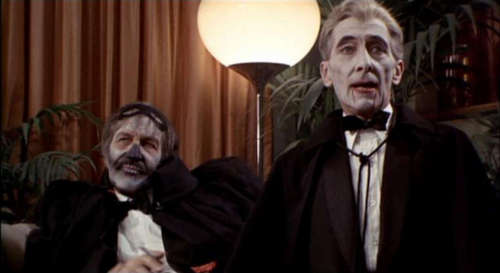
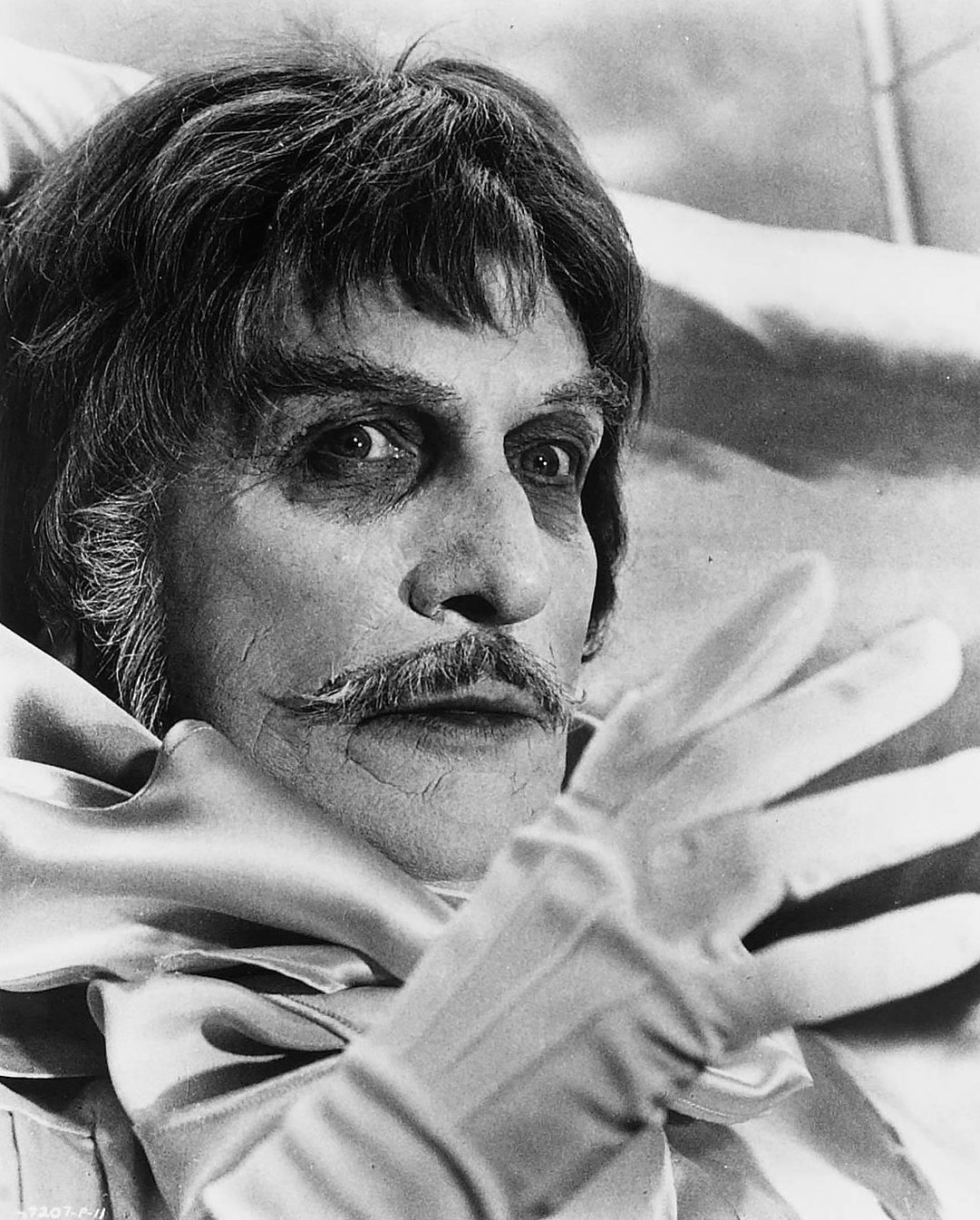
madhouse price cushing

Today, May 26, was the 100th anniversary of the birth of British actor Peter Cushing – best known in some quarters as Imperial Gov. Tarkin, who holds Darth Vader’s leash rather loosely in the 1977 classic “Star Wars” – so I marked the date by watching one of his later horror films, “Madhouse.”

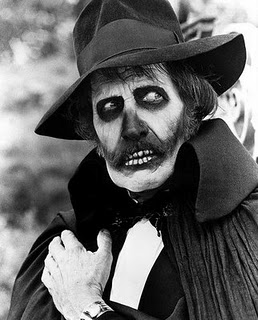
It isn’t a great role for Cushing, who died in 1994 after a long, distinguished and beloved career. He’s a supporting player to Vincent Price, who stars as Paul Toombes, an aging actor lured out of retirement to reprise his role as Dr. Death, anti-hero of a series of horror thrillers.

Released in 1974, “Madhouse” had the distinction of being the last movie Price made for American International Pictures, home of the classic adaptations of Edgar Allen Poe in which Price starred in the 1960s. The movie business was changing even by then and AIP was looking to replace Price with Robert Quarry, who was the third male lead here. Quarry had made a little splash as Count Yorga, a modern-day vampire, and it’s said AIP and producer Samuel Arkoff thought he, rather than Price, was the future.

But horror movies were about to see a huge change. Long the province of a particular breed of actor, like Price and Cushing, and director, like Roger Corman, and producer, like Arkoff, horror films were proven to be worthy of mainstream attention in 1973 when “The Exorcist” was a huge hit. Low-budget horror movies were still drive-in theater fare and would be for several years to come, but by the time “Madhouse” rolled around, people were looking for the new, the young and the shocking in their horror films.

madhouse price

“Madhouse” also held the distinction of being able to evoke the nostalgia, perhaps the last of its kind for its type of film, for earlier horror films. It could do this because of Price’s long-running screen presence. At various points, Cushing and Quarry screen some of Toombes’ earlier horror films, and they show scenes from some of Price’s films, particularly the Poe pictures conveniently (and inexpensively) owned by Arkoff and AIP. The presence of those clips led director Jim Clark to acknowledge former Price co-stars Basil Rathbone and Boris Karloff in the opening credits. It’s a nice gesture but also makes me wonder: Did Clark and Arkoff think the presence of those old-school names would add to the luster of “Madhouse?”

Cushing, whose role as Toombes’ longtime friend is so obviously an attempt to mislead that the final shot has someone referring to a red herring, might be a familiar face to legions of filmgoers from “Star Wars” but is best known to his many fans for his roles in British horror films made by Hammer studios beginning in the 1950s.

Cushing – whose fan club I belonged to in the 1970s and 1980s – sometimes played Dracula nemesis Van Helsing and sometimes played monster maker Dr. Frankenstein in the Hammer outings. He and cohort Christopher Lee always added a touch of class to every movie in which they appeared.

cushing tarkin star wars

Happy birthday, Peter.

RIP Ray Harryhausen

harryhausen skeleton

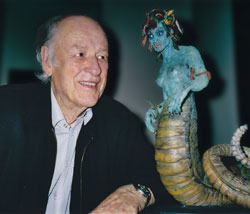
Ray Harryhausen, who passed away today in London at age 92, was certainly inspirational. He sparked a love of movies and special effects among not only lifelong movie fans but boys and girls who grew up to be directors and, like their idol, special effects wizards.

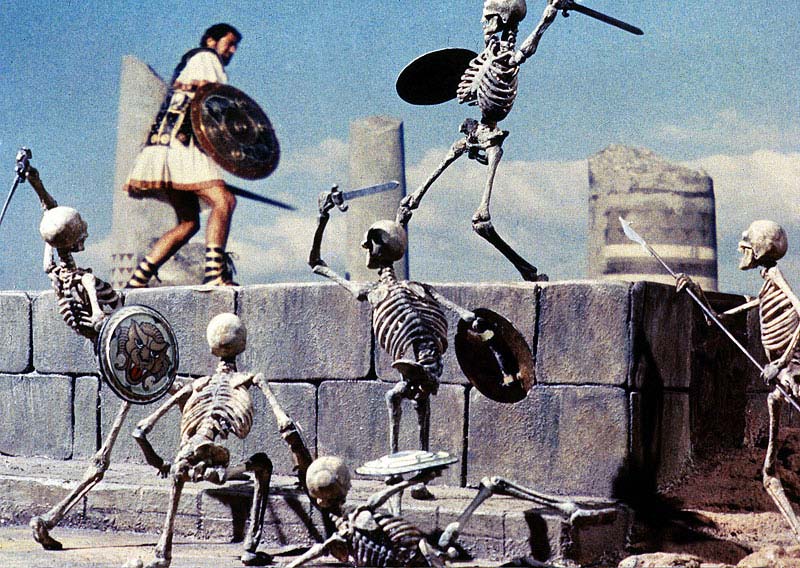
But for me, Harryhausen was more than just the creator of great movie creatures like Medusa in “Clash of the Titans” or the sword-fighting skeletons in “Jason and the Argonauts.”

Harryhausen lent an air of respectability to the wildest fantasy stories kids could hope to see in movie theaters.

jason argonauts skeleton sword fight

That’s because Harryhausen and his writing and directing partners adapted classic stories – a series of Sinbad movies or “The Beast From 20,000 Fathoms,” based on his friend Ray Bradbury’s melancholy “The Fog Horn” – that were almost impossible for parents to say “no” to. Really, faced with the possibility of letting your kid see Harryhausen’s version of mythology or a “Godzilla” flick, what would you say?

Harryhausen’s stop-motion animation techniques – not the first, since the process pre-dated him with “King Kong” – were also the kind of effect you could show your parents and prompt awe. Look, we would say: He moves the small model of the gorilla a fraction of an inch, then exposes a frame of film, then does it over and over and over again. This was moviemaking at its most artistic and most craftsman-like at the same time. Anyone could recognize it as hard work. Even parents.

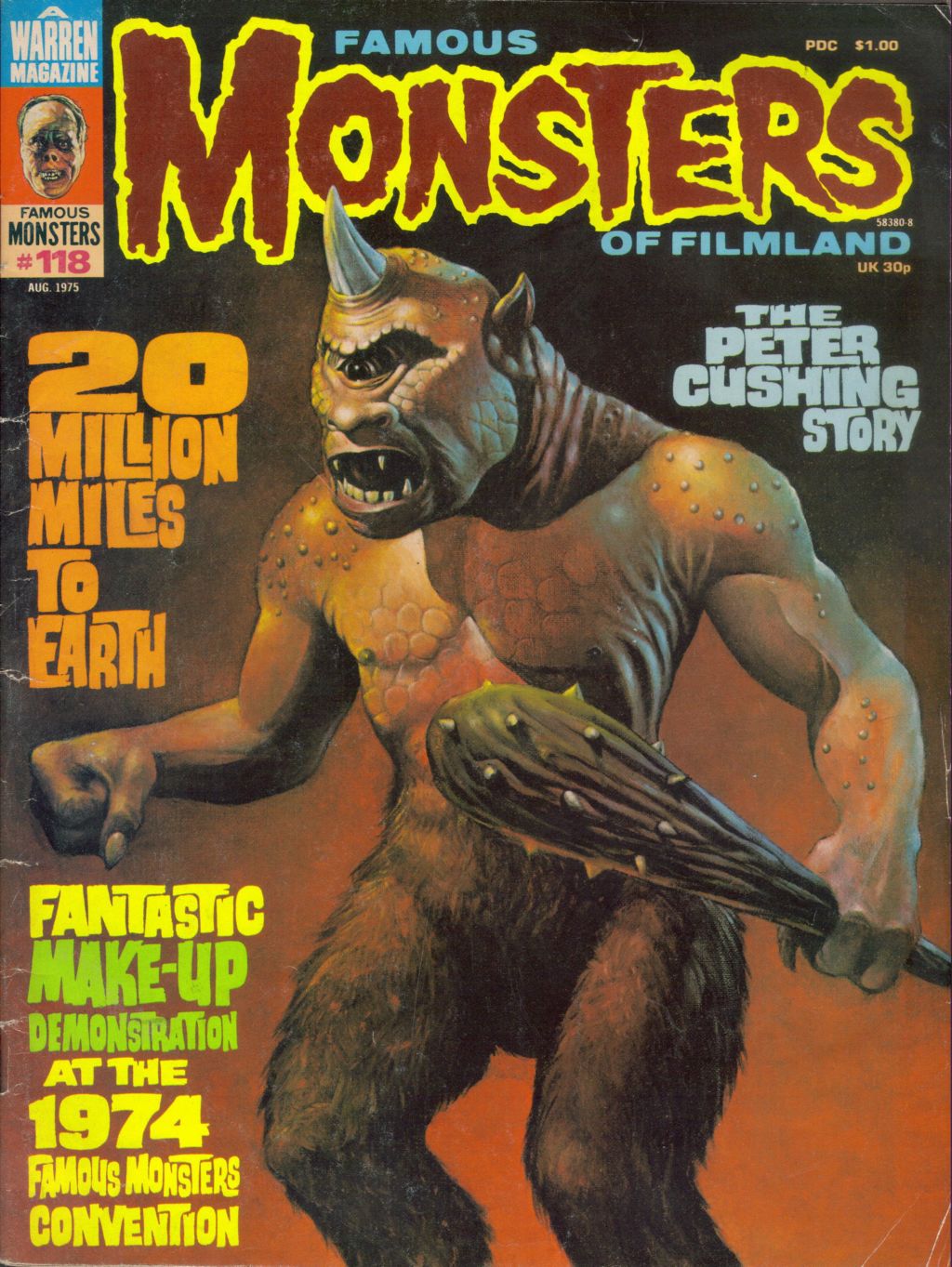
famous monsters 118 harryhausen

Magazines like Famous Monsters of Filmland – edited by another Harryhausen pal, Forrest J Ackerman – let us revel in the process and marvel over those detailed models.

Harryhausen is being memorialized all over the web tonight, and there’s not a lot I can add to that. Except for a few personal favorites:

Harryhausen worked on “Mighty Joe Young,” the 1949 follow-up to “King Kong,” and made a giant gorilla downright cuddly. Who wouldn’t love a simian who rescued tykes from a burning orphanage?

harryhausen medusa

Beginning with “The 7th Voyage of Sinbad” in 1958 and running through “Clash of the Titans” in 1981, Harryhausen made history his own, giving us cyclopses (cyclopsi?) and minotaurs and sabre tooth tigers and fantastic and eerie creations like Medusa, with her snaky body and hair.

The world changed and the world of moviemaking changed and by the time “Clash of the Titans” came out, two “Star Wars” movies had been released and the world was turning to a more sophisticated type of computer-controlled-camera-and-model animation that itself would be replaced within just a few years with computer effects.

But Harryhausen’s legacy was long since in place, as evidenced by the sly references to his work, including the restaurant named after him in “Monsters Inc.”

Harryhausen made us believe that legends, gods and monsters walked among us. And until his death today, they truly did.


Classic horror movie: ‘The Abominable Dr. Phibes’

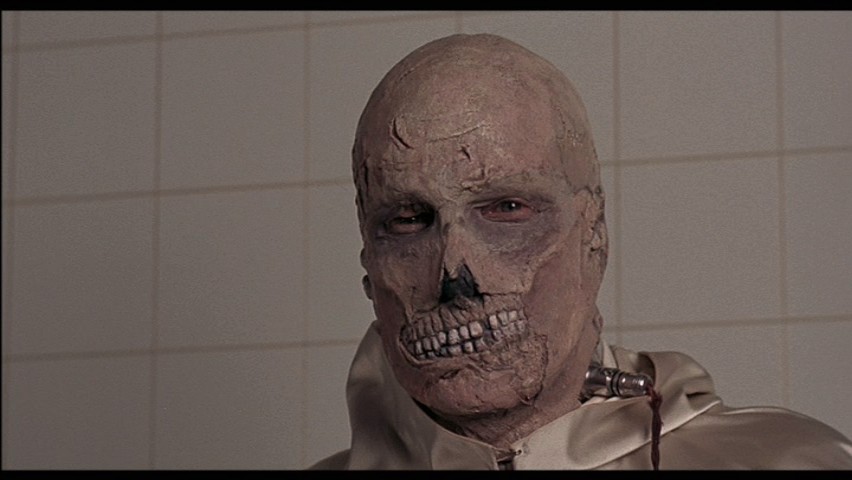
dr. phibes w mask

The 1960s saw Vincent Price, who had appeared in films at the tail end of the 1930s and onward, experience the beginnings of a second life at the movies. He had made the popular 3-D movie “House of Wax” in 1953, but it was still a few years before he delivered back-to-back-to-back horror hits: “The Fly” in 1958. “House on Haunted Hill” in 1959 and more. Not to mention – although I will – a series of Edgar Allen Poe adaptations for American International Pictures in the 1960s.

So by the time “The Abominable Dr. Phibes” was released in 1971. Price was something of a horror institution. Like Boris Karloff before him, he had transcended the role of horror movie actor and become a personality.

So the Phibes movie, and its sequel, “Dr. Phibes Rises Again” – with their revenge-driven plots, gory killings and campy trappings – might have seemed a little out there, but Price could be counted on by American International Pictures to deliver an audience of horror fans.

Keep in mind, the Phibes movies came out at the tail end of a particular era in horror films. Within just a half-dozen years, John Carpenter’s “Halloween” and its many imitators changed horror movies forever. (I’m deliberately overlooking “Texas Chainsaw Massacre” in 1974 because the effectiveness of the film was considered a fluke, a very nearly dirty pleasure, like the porn films that flirted with social acceptance at the same time.)

The first Phibes movie acquainted us with the character Price would immortalize: He played Anton Phibes, a physician who was apparently burned to death in a car accident as he rushed to the side of his wife in emergency surgery.

dr. phibes unmasked

Phibes survived, but was horribly disfigured. His wife did not survive her surgery. Now, years later, in 1925, Phibes and an always-silent assistant, Vulnavia (Virginia North), murder, one by one, the surgical team who Phibes believed botched his wife’s operation. Phibes’ revenge comes in the form of Biblical plagues: One doctor is stung to death by bees, while a nurse is eaten by locusts, for example.

As one of the doctors, played by Joseph Cotton, and Scotland Yard inspectors try to track him down, Phibes enacts his revenge and camps it up with Vulnavia and a clockwork orchestra even as his wife (a beautiful corpse played by cult movie actress Caroline Munro) awaits one final voyage with her beloved husband.

As oddball as “The Abominable Dr. Phibes” is, there’s a classic and classy feel to the movie because the murders are accomplished through such elaborate and arcane means. Within a few years, Michael Myers and Jason Vorhees and a host of other killers would chop and impale their victims and it all became so very ho-hum.

You might roll your eyes or even shake your head when Phibes enacts Biblical revenge on someone. But you won’t think, “Well, I’ve seen that before.”

Cool trailer for ‘Pacific Rim’

pacific-rim1

This isn’t “Transformers.” At least, I don’t think it is.

One of the buzziest movies due out next summer is “Pacific Rim,” director Guillermo del Toro’s epic-in-scale science fiction movie about a future Earth where giant, Godzilla-like creatures have risen from the sea to destroy mankind … and they’re confronted by the giant, pilot-driven robots mankind has created to beat them back.

“Pacific Rim” has been getting some good reaction from the fans so far. The new trailer went online today and I’ve gotta say that it looks good even to someone who isn’t the biggest giant-monsters-menacing-Japan fan in the world.

Check out the trailer on iTunes here.

Today in Christmas: Five secrets of ‘The Grinch’

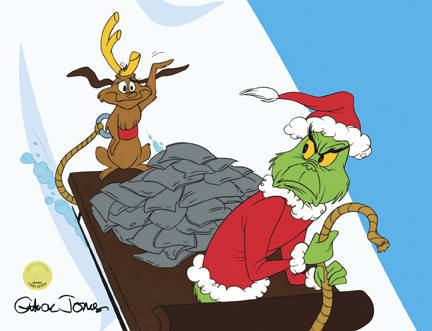
grinch and max

Since it first aired in 1966, “Dr. Seuss’ How the Grinch Stole Christmas” has become a pop culture institution. It’s one of the best animated films ever made. It’s a touchstone of the holiday season. It’s a common thread for generations of movie, TV and children’s book fans.

And yet there are a few things many of us don’t know about the special. Here are five things you might not know.

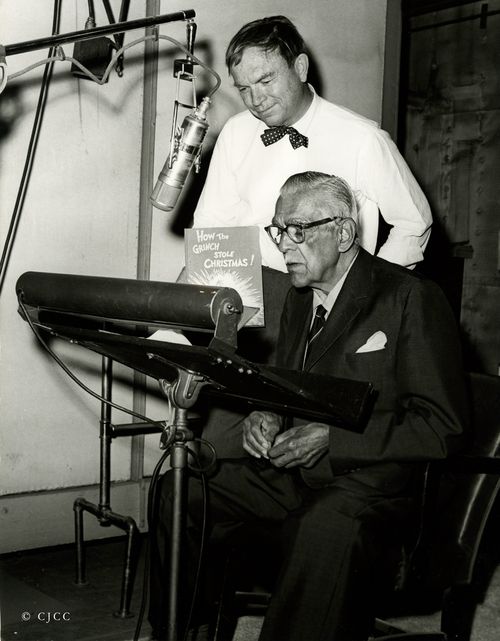
Boris-Karloff-Chuck-Jones-recording-how-the-grinch-stole-christmas

Boris Karloff. Yes, everyone knows that Karloff, immortalized forever as Universal’s Frankenstein monster in the studio’s movie series from the 1930s, provided the narration and the voice of the Grinch. But most probably think that Karloff had been in hibernation for decades before recording the Grinch and then passing from this plane of existence in 1969. But Karloff was active in show business even three decades after his Frankenstein heyday. He was memorable not only as the Grinch but also for appearances on “The Wild, Wild West,” “The Girl from UNCLE” and “I Spy.” He even hosted the “Thriller” anthology TV series for two years beginning in 1960.

thurl ravenscroft

Thurl Ravenscroft. Possessor of one of the great names of all time, Ravenscroft was the man behind the booming bass voice who sang “You’re a Mean One, Mr. Grinch.” Because Ravenscroft wasn’t credited, many people assumed that Karloff sang the song. Ravenscroft had, up until his death in 2005, a long and varied career. He was the voice of Tony the Tiger in Frosted Flakes commercials. His voice can be heard in the Pirates of the Caribbean and Haunted Mansion Disney attractions. He had a brush with another animated pop culture franchise by singing the song “No Dogs Allowed” in “Snoopy, Come Home.”

Chuck Jones. I’m of the opinion that the “Grinch” animated show wouldn’t be half as good if not for director Chuck Jones, seen above with Karloff. A legendary animation director, Jones – who died in 2002 – directed many great Warner Brothers cartoons, including two of my favorites, “What’s Opera, Doc” and “One Froggy Evening.” Jones’ talent permeates the “Grinch” special but is especially notable in the little touches, including the expressions on the Grinch’s canine sidekick, Max.

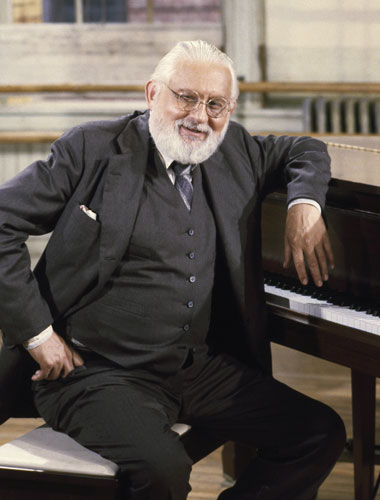
Albert+Hague

Albert Hague. Yes, Mr. Shorofsky from the “Fame” movie and TV series has a “Grinch” connection. He wrote the music for “You’re a Mean One, Mr. Grinch.” His 2001 obituary noted that Dr. Seuss himself, Theodore Geisel, said that Hague contributed greatly to the special. “Any man who slides an octave on the word ‘Grinch’ gets the job,” Geisel said upon hearing Hague’s work.

Other Grinches. I’m not talking about the Jim Carrey movie. Two other animated specials, “Halloween is Grinch Night” and “The Grinch Grinches the Cat in the Hat,” aired in subsequent decades. Although the wonderful Hans Conried performed the Grinch in the first, neither can compare to the original special.


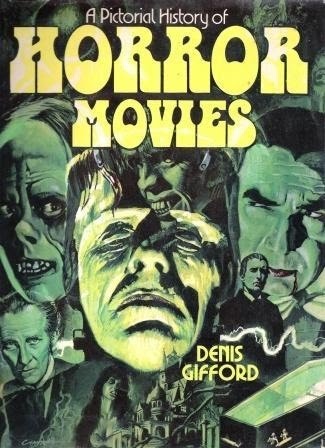
The Essential Geek Library: ‘A Pictorial History of Horror Movies’

As a young science fiction and horror movie fan, I watched every movie I could see, a challenge sometimes in those pre-home video days. So I spent endless hours checking out books about the genre. I’m noting a few of them here in this recurring space.

If Famous Monsters of Filmland was my favorite magazine, Denis Gifford’s “A Pictorial History of Horror Movies” was my standard reference, my bible.

Gifford’s book, published in 1973, was a scholarly but loving look at several decades of horror movies.

Gifford, a British writer of comic books and books about pop culture, apparently amassed what was considered one of the biggest collections of British comic books in existence.

But it’s his love for and knowledge of horror movies that endears him to me.

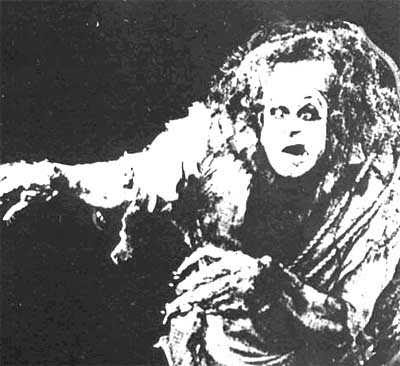
His book truly lived up to its name. “Pictorial History” is loaded with vintage photos from horror films from the 1920s to the 1970s. Even before I saw some movies, Gifford’s look at them gave me a good visual frame of reference. Some movies, like the silent version of “Frankenstein,” are completely represented in my mind by the pictures included in Gifford’s book.

As a young man who loved to draw, I would study those stills and try my hand at reproducing them with pencil and paper.

And Gifford’s book didn’t discriminate. He included movies from the Universal classics to low-budget movies made here and abroad.

Gifford passed in 2000. I’m hoping he knows what a milestone he left for all of us fans. I’m guessing he knew.

As a side note, by the way, the hardcover cost only a few dollars in 1973. In doing research for this, I found it for sale online as high as $199. I showed that to my son, who said, “You should sell it!” Never.

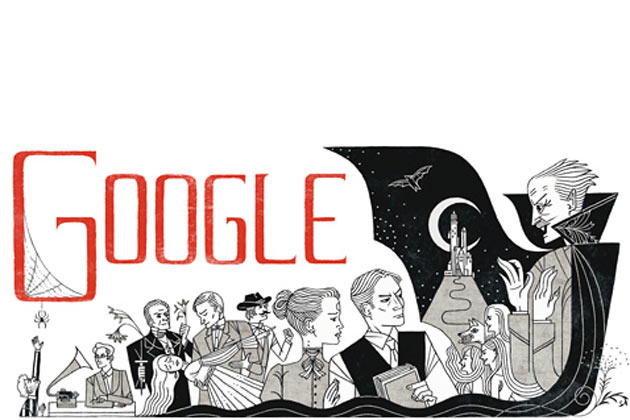
Lots at stake: Google’s ‘Dracula’ doodle

You don’t need me to tell you that Google comes up with some pretty fun and cool doodles.

Today’s doodle, marking the 165th birthday of “Dracula” creator Bram Stoker, is one of those.

And it’s inspired me to quickly try to re-read one of my favorite books.

Stoker’s “Dracula,” published in 1897, not only inspired a century (and counting) of adaptations, sequels, imitators and knock-offs, but sparked as many lurid daydreams and sweaty nightmares as any story ever.

I’ve got a nice stack of books on my night table right now. But the doodle reminded me of how much I loved Stoker’s book, how action-filled and suspenseful it is.

At least it’s that way in my memory from having read it last a few years ago.

So I’ll be dipping back into the book sooner rather than later and hoping to find the same gripping story I remember. I’ll share those thoughts with you when I do.