iPhoneography: The Christmas “Situation”

Yep, it’s time for more Christmas stuff. You remember how this works, from way back when we were finding oddball Halloween masks, costumes and decor. The Christmas selection is a little less oddball, but there is some offbeat stuff.

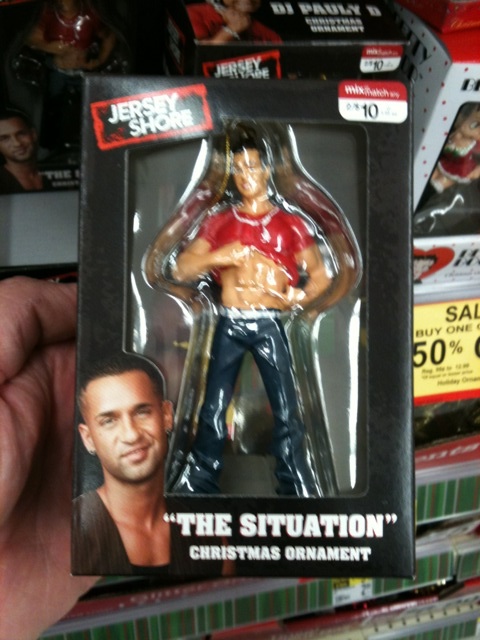
Not the least of which is that ornament above, of the guy from MTV’s “Jersey Shore” who calls himself “The Situation.”

I mean, really, who wouldn’t want this guy on their tree? Because really, nothing says the holiday season quite like drunken tanning.

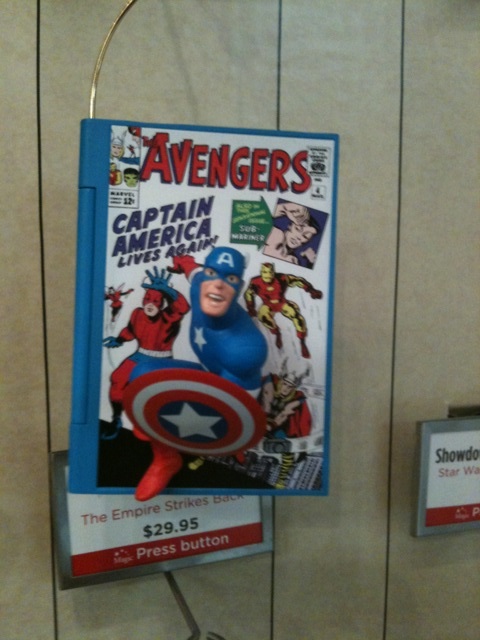
Now this is more like it: A Hallmark ornament depicting the cover of “Avengers” issue number 4, with Captain America leaping out in three dimensions.

That particular issue — the first comic I ever owned, given to me by an older neighbor — was famous for re-introducing Cap, in an arctic deep freeze since the end of World War II.

For a warm and fuzzy feeling, how about pink bunny slippers, part of the ensemble Ralphie’s aunt made for him in “A Christmas Story?” Now you too can feel like a deranged rabbit.

Ah, “Peanuts.” You are synonymous with Christmas for many of us of a certain age. This set of Charlie Brown and friends figures can be purchased separately but, when gathered together, play holiday classics.

As for stocking stuffers, how about Santa Claus’ brother-in-law, Caramel Claus?

And last but not least, you just know Walmart had to get into the Christmas village thing. This village square version of Walmart is a lot more quaint than your typical big box store, however.

More next time!

Can new ‘Dallas’ recapture the magic?

I’m not saying my friends and ever did this, but you could turn the old “Dallas” series into a pretty good drinking game.

During much of the original run of the series, which appeared on CBS on Friday nights from 1978 to 1991, my friends and I made watching the primetime soap a part of our “getting into the weekend” ritual. Before we would go out to a movie — often a midnight show — or otherwise fritter away our lives, we would gather at a friend’s house and watch the latest exploits of J.R., Bobby and the other Ewings.

Again, I’m not saying we did this, but you could get pretty hammered if you took a drink of some beverage every time one of the Ewings did. It was a given that the minute J.R. or Jock or Bobby or Sue Ellen — especially Sue Ellen — walked into the living room at Southfork Ranch, they would head for the bar tucked up against one wall. They would pour themselves a drink and settle in for some talk about the oil “bidness” or the latest family intrigue.

The show was a ratings sensation, of course, and its impact was global. I visited a friend in Vancouver, Canada in 1984 and talked to people who — kind of jokingly, kind of seriously – thought “Dallas” was an accurate depiction of the typical American family.

I’m looking forward to seeing TNT’s “Dallas” revival series next summer. Many of the actors will be back, not just Patrick Duffy and Larry Hagman, but favorites like Linda Gray as Sue Ellen and Steve Kanaly as Ray Krebbs, family patriarch Jock Ewing’s illegitimate son.

Of course, much of the focus will be on actors playing John Ross and Christopher, the children of J.R. and Bobby. I wish we could see some obscure favorites like Val and Gary Ewing and Punk Anderson. And we need to see a trip to the Cattlemen’s Club for lunch at least a couple of times.

I’ll be watching “Dallas” next summer. I won’t be playing a drinking game, even though I’m hoping the sudsy action sends the Ewings to the bar frequently. And I’m hoping the show is enough fun to entertain a new generation of fans.

Michael Connelly’s ‘The Drop’ has twists and turns

Michael Connelly, a Los Angeles newspaper reporter turned writer, has become something of a brand name among authors of crime novels. Connelly, who seems as cool as his star characters, Harry Bosch and Mickey Haller, could probably say how many New York Times bestsellers he’s written. Not that he needs to. For many readers, all they need to know is that Connelly is the guy who wrote “The Lincoln Lawyer.”

That book, about street-smart Los Angeles defense attorney Haller, has had a few sequels now and been turned into a pretty good movie. The success of the Haller books almost threatens to eclipse Connelly’s best and most accomplished character, L.A. police detective Bosch.

That might be because Bosch is anything but cuddly. The son of a murdered prostitute, the tough Vietnam veteran is nearing the end of his law enforcement career as “The Drop,” Connelly’s latest novel, begins.

The title refers to a process through which LAPD cops can pick their “drop” date, or retirement date, and Bosch — worried that he’s losing his skills as well as losing an opportunity to connect with his 15-year-old daughter — puts in for his. He signs up for retirement and looks at a little more than two years on the force.

Bosch, a veteran of the LAPD’s homicide squad, is currently working on cold cases for the department and applies himself to each new cold case — usually sparked by a DNA hit or some other fresh development — with the same single-minded drive he brought to new homicides.

Bosch and his often-callow partner, David Chu, are handed a cold case that seems impossible: A DNA match from a 20-year-old murder points to a local man as a suspect. But the the man was only eight years old at the time of the slaying. The suspect is a sex offender, but how could he have been involved in the homicide when he was still a child?

The title also refers to the fatal fall suffered by an L.A. man who happens to be the son of Bosch’s old nemesis, Irvin Irving, a police bureaucrat turned city council member. Bosch clashed with Irving on earlier cases, so why would the councilman ask Bosch to investigate his son’s death? Is Bosch being set up to prove that a case that looks like a suicide was really a homicide?

Bosch is his typically blunt, laser-focused self in “The Drop” and, while the cop’s personality makes him fascinating it also, truthfully, makes him kind of hard to like. Granted, I’d want a cop of Bosch’s demeanor investigating the slaying of a loved one. But I wouldn’t want to be his partner or superiors or pretty much anybody around, because Bosch is really, really good — despite his concerns that he’s losing his touch — and doesn’t hesitate to steamroller over anyone that stands between him and closing a case.

In his recent books, Connelly has mixed his wide-ranging L.A. cast, with Bosch appearing in Haller books and Haller appearing in Bosch books. There’s little of that going on here. Fans of Haller will enjoy a late-in-the-book reference to one of the best characters from those stories, though.

“The Drop” is, like most of Connelly’s work, the kind of story that almost demands you read it quickly once you’ve begun. The story, thanks to Harry Bosch’s driven personality, propels itself forward. It’s a fast-moving read with a development near the end that feels more like a lurch than a twist. But Bosch isn’t thrown for a loop. He goes with the twist and brings readers — happily and willingly — along.

Zombies from A to … well, Zombie

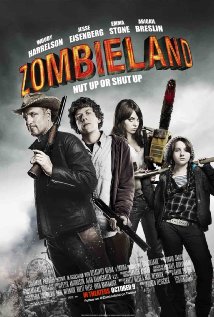
Maybe it’s because it’s Sunday night and I’m missing “The Walking Dead.” Maybe it’s because “Zombieland” is on TV.

But zombies are on my mind tonight.

What is it about zombies that make them ideal fodder for spooky fiction? Maybe it’s because they’re so inexorable, shambling toward us — or sprinting, in some movies. Maybe it’s because they are — or were, at least — us.

Maybe it’s because they’re fun.

Zombies have lurked around the edges of pop culture for much of the past century, first popping up in Depression-era stories, usually set in Caribbean countries.

The 1932 movie “White Zombie,” starring Bela Lugosi, popularized the idea of the zombie as a glassy-eyed, stiff-gaited creature, usually controlled by a voodoo master. Zombies became staples of cheap monster movies for decades … until another cheap monster movie changed everything.

In 1968, George Romero and a handful of investors released “Night of the Living Dead” and set the tone for zombie flicks for years to come.

The black-and-white film, with its cheap gore and shockingly downbeat ending, wasn’t topped for another decade and then only by Romero himself.

“Dawn of the Dead” came out in 1978 and succeeded on so many levels. The film, in eye-popping color, featured explicit gore — the film was released unrated to avoid an “X” — and biting social commentary as survivors and zombies alike flocked to the shopping mall for a comforting reminder of the past.

The movie was such a hit that imitators and rip-offs followed, including 1979’s “Zombie,” a European shocker that was marketed in some countries as a sequel to “Dawn of the Dead.” “Zombie” featured the first shark vs. zombie underwater fight. First and, probably, only.

In 1985, “Return of the Living Dead” gave us a real change-up. While Romero continued to make (only sometimes effective) sequels to “Night” and “Dawn,” the co-holders of the rights to his 1968 movie made the first of a series of flaky, crazy, gory zombie pics. Famous for moments including reanimated medical specimens and zombies calling for “more paramedics,” “Return” was the most fun you could have with zombies. At least for a few years.

An often-overlooked zombie movie was “The Serpent and the Rainbow,” a Wes Craven movie starring Bill Pullman in a story loosely based on real-life researcher Wade Davis. The 1988 film is offbeat and effective and finds as many chills in the bloody politics of Haiti as in the walking dead.

Beginning with 2002’s “28 Days Later,” and remakes of “Night of the Living Dead” and “Dawn of the Dead,” zombies started getting nimble, fast and, in many ways, scarier. All of a sudden, zombies didn’t shamble slowly across a sunny graveyard. They ran like hell at us. It was freaky.

By the time “Zombieland” rolled around in 2009, the trends of fast zombies and gruesome and funny zombie deaths were fodder for a great movie. A small group of survivors travels across the country, looking for Twinkies and trust and finding Bill Murray — in one of modern cinema’s great cameos — and an abandoned amusement park. Well, not totally abandoned, of course.

With “The Walking Dead” comic book and TV series and Max Brooks’ great 2006 book “World War Z” — being made as a movie starring Brad Pitt — zombies are riding a crest of popularity right now. Zombie costumes were huge this Halloween. They were cheap to make and, after decades of watching zombies in movies and on TV, everybody knows how to pretend to be a zombie, right?

I love me some good vampire stories, particularly “Dracula” and “Buffy the Vampire Slayer.” But zombies are the monster of the moment, maybe improbably, and that popularity doesn’t show any signs of slowing down.

And neither do those damn zombies.

‘The Dark Knight Rises’ poster a grim one

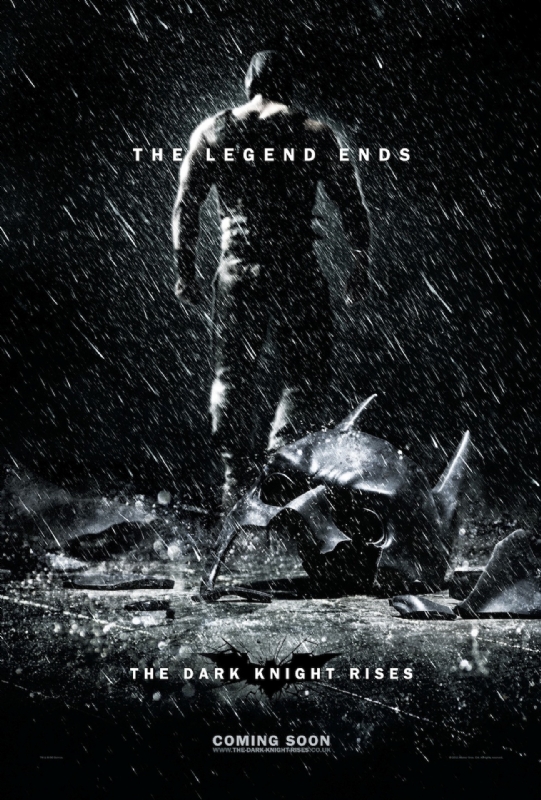
The geek universe was vibrating today with the release of the new teaser poster for “The Dark Knight Rises,” next summer’s finale for director Christopher Nolan’s Batman trilogy.

The poster is admittedly pretty vibe-worthy, even in the realm of comic book movie hype, because of what it implies.

For those who aren’t devotees of “Batman” in either comic or movie form, Nolan’s movies — starring Christian Bale as a growly, serious Batman — have taken the box office by storm. The last one, featuring Heath Ledger as a truly repulsive, homicidal Joker, made a bazillion dollars and earned credibility with critics.

The third movie — both Nolan and Bale say it will be their last — carries with it a lot of expectation, in part because of the quality of the first two movies and in part because when word got out that actor Tom Hardy was playing Batman villain Bane, comics fans knew what might happen.

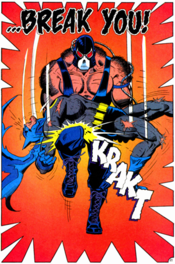
Bane appeared, as a big goofy strong guy, in an earlier “Batman” movie. But the Bane from the comic books is a real dangerous character, so much so that he did what none of the hero’s other foes have been able to do: He defeated Batman. Bane, smart as he is strong, engineered a series of challenges meant to sap Batman’s strength, then he literally broke Batman’s back. The injury put Batman out of commission for months while other heroes filled in.

Here’s what happened:

The poster released today implies that something equally bad is going to happen to Batman. To say the least.

As an illustration, it’s not that much of a departure from the hyped-up, apocalyptic drawings of many comic books. How many times have comic books teased us that it was all over for our hero? Heck, Superman has even been killed.

But considering that Nolan intends to make the new movie his final word on Batman, and that neither he nor Bale reportedly want their interpretation to be carried over into a “Justice League” movie … who’s to say that Nolan doesn’t intend to take the ultimate step with the character? What if, when the “Batman” franchise is rebooted in the future — and Warner Bros. has already announced that will happen — we see an entirely different Batman?

That might also explain the “rises” part of the title. The poster released today sure doesn’t imply Batman is going to be doing any rising anytime soon. Maybe a new Batman will be rising from the ashes of the old?

Barring any Internet spoilers, we’ll know next summer.

Counting the days to ‘Justified’

Jan. 17 can’t come quickly enough.

I’m not wishing for the depths of winter. (In fact I’m a little SAD about it.)

But since Jan. 17 brings the third season of “Justified,” I’ll put up with the wintertime blahs.

If you haven’t watched the first couple of seasons of FX’s “Justified,” you should. Go ahead. I’ll wait.

Back? Okay.

The series, about a tough U.S. marshal who gets disciplined for killing a bad guy in Miami by being sent back to his home territory of Kentucky, is typical in many ways of the more adult cable TV series airing on FX and AMC like “Mad Men,” “Breaking Bad,” “Sons of Anarchy” and “The Walking Dead.” “Justified” has “grown up” language and violence, but like those other shows, the draw is the characters and plots.

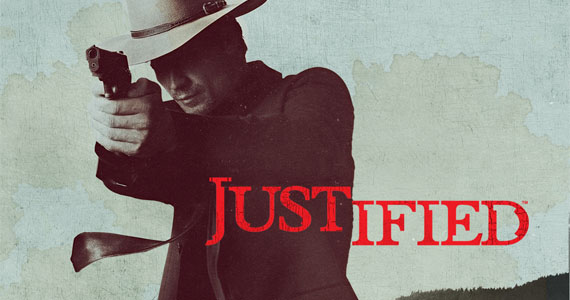
Based on stories by crime writer Elmore Leonard, “Justified” centers on Raylan Givens (Timothy Olyphant), the cop who is less than thrilled to be back in Kentucky. And who can blame him? Givens is back in the mix with his father, an aging crook, his ex-wife, the hapless but hot Winona (Natalie Zea) and, best of all, longtime friend and antagonist Boyd Crowder (the excellent Walton Goggins, from “The Shield”).

Raylan and Boyd have a long history. They grew up together and worked in the coal mines together but parted ways after that. By the time of the first episode, when the quietly disgruntled Raylan comes back to the town of Harlan, Boyd is the head of a white supremacist group and fond of blowing stuff up: Churches, cars, banks, you know.

But the relationship between Raylan and Boyd — the best thing about the show — is complicated. The two have a real bond that Raylan can’t ignore even as he works to link Boyd to crimes plaguing Harlan.

As the series has progressed, Raylan found Boyd at his side more often than he found him in his face. The characters are great antagonists but as complex as real-life friends would be.

The show has a real feel for danger and violence. Not just from the meth-heads and petty criminals that populate the backwoods but from Raylan and Boyd. Raylan is wry and smooth but there’s a reason Winona describes him in the first episode as the angriest man she ever met.

The first season revolved around the cat-and-mouse relationship between Raylan and Boyd, while season two introduced a great character, Mags Bennet, a small-town Ma Barker with a brood of scary sons.

I don’t know what to expect when the new season begins. Promotional clips have shown Raylan and Boyd working together and at each other’s throats. With this duo — one of the best on TV — I wouldn’t have it any other way.

‘Classics Illustrated’ gets an in-depth history

Did you read “Classics Illustrated” comics as a kid?

I have to admit that I didn’t.

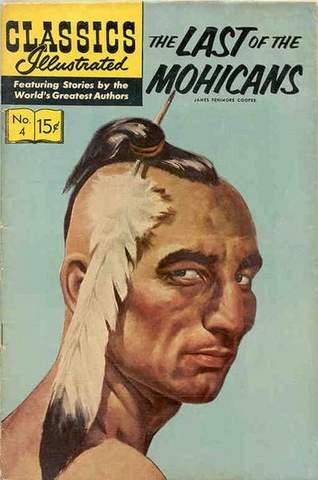
The comic book-style recaps of great works of literature like “Robin Hood” and “Last of the Mohicans” just didn’t appeal to me, a comic book nut.

The idea behind the series, created in the 1940s by the Kanter family — Albert and son William — was a good one. Take books that kids might enjoy if they gave them a chance, like “War of the Worlds” and “Treasure Island,” and turn them into comic books that kids might actually read.

The series began at a time when comic books were a top-selling — if totally disrespected by adults — part of kid culture and continued, somewhat amazingly, to the turn of the century.

Even if you weren’t a regular reader of “Classics Illustrated,” you’re probably aware of them. Their distinctive covers — dominated by the familiar yellow box in the corner and the boast that the comics featured “stories by the world’s greatest authors” — popped out from the dozens of “Fantastic Four” and “Superman” and “Archie” comics on the spinner racks.

While I was an avid reader of offbeat fare like Bullfinch’s Mythology and books about Man o’ War, “Classics Illustrated” seemed too much like cherry-flavored cough syrup to me: Something that was good for you but only barely disguised as something else.

But there’s a lot to admire about William B. Jones Jr.’s new book, “Classics Illustrated: A Cultural History,” a hardcover overview of the series, its creators, artists and writers.

Jones is an unabashed lover of the series and that shows. The book appears to be studiously researched and is definitely lavishly illustrated, with reproductions of interior art and covers in both black and white and color.

Jones looks at the writers and artists who made the series what it was, from founder Kanter to artist Henry Carl Kiefer, who defined the look of the series from its earliest days.

The series’ brief flirtation with horror stories — just as demagogues were leading the attack on comic books in general  — is genuinely surprising. So is the period in the 1990s when graphic novel versions of the classics attracted some of the comic book genre’s top artists.

There’s even a section about appearances by “Classics Illustrated” comics in movies, ranging from Elvis Presley vehicles to movies featuring Tom Cruise.

If you’re not a devotee of “Classics Illustrated,” Jones’ book is probably a casual read at best for you. If you’re as much of a fan as he was, you’ll love the book.


iPhoneography: Christmas ornaments

When I was growing up, the ornaments on the Christmas tree were almost always glass balls. Red and blue and gold and purple, with little wire hooks at the top that made it almost impossible for my clumsy fingers to hang on the branches of the tree, ornaments of that type are still what I think of when I imagine the decorations on the tree.

Some of them were probably the popular Shiny Brite ornaments pictured above, or imitations.

Ornaments — originally German-made glass baubles popularized by big American retailers like Woolworth and Macy’s — were so traditional for so long that it was inevitable that pop culture would eventually work its way into the product.

That point came in 1973, when Hallmark introduced its Keepsake ornaments collection. Those first few ornaments were snowmen and angels and Santa and look pretty primitive compared to the elaborate ornaments of today.

But the world of Christmas ornaments had changed. Before long, we could decorate our trees with Peanuts figures or Barbie or Mickey Mouse.

This year, the retailer is offering scenes from “Star Trek,” comic books like The Avengers and the Fisher Price Play Family Village.

Of course, for the latest iPhoneography Christmas entry, I thought I’d pass along some of the more offbeat pop culture offerings.

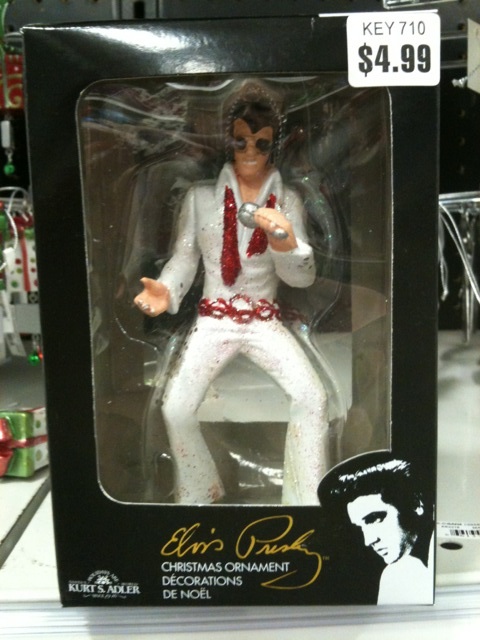
There aren’t many more instantly recognizable pop culture figures than jumpsuit-era Elvis Presley. Although this guy looks a little underfed, he’d be a good companion to a “Blue Christmas” theme.

How about Kiss frontman Gene Simmons? Nothing like an extra long tongue to say happy holidays.

And no, I’m not sure why he’s upside down in his box. Maybe that makes him more collectible.

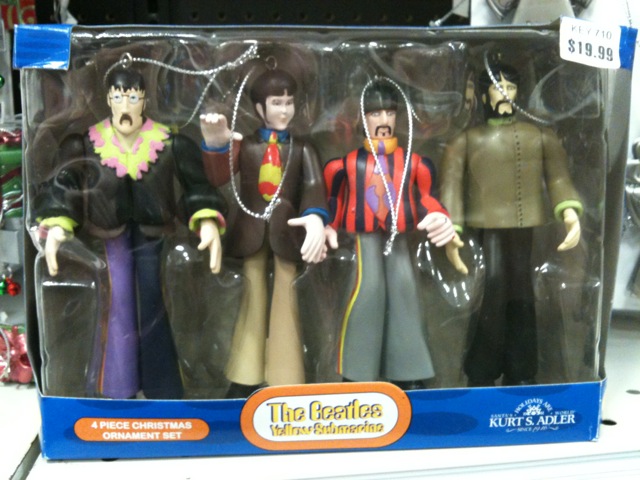
Now this is more like it. “Yellow Submarine”-era Beatles ornaments. If this ornament could talk … it wouldn’t be in the actual Beatles voices.

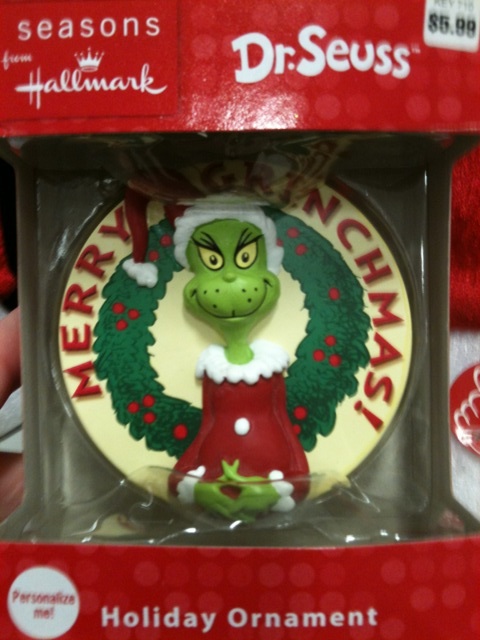
And you can’t spell Christmas ornament without Grinch. Well, you can’t really spell it with G, R, I, N, C and H. But you know what I mean.

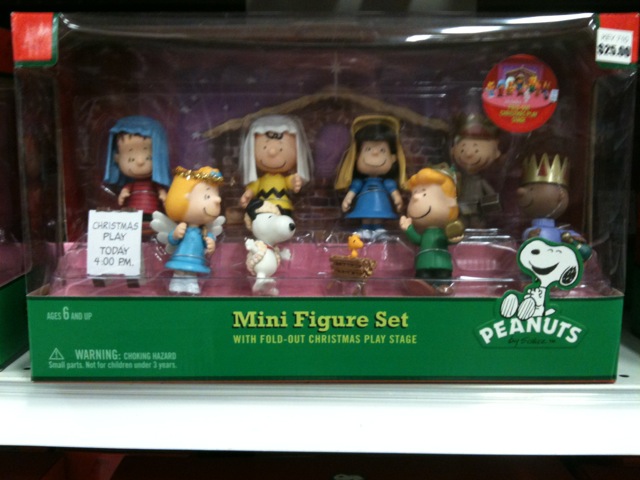
I mentioned Peanuts earlier but couldn’t resist coming back to this item, which isn’t really an ornament but is instead the Charlie Brown version of a nativity scene. Curiously, it’s not really labeled as such. Maybe they thought such a direct reference would offend someone. That would have to be someone who hadn’t seen the Peanuts Christmas special, of course.

More next time.


An unflinching but moving look at Jonestown

Most of us know how the story of Indiana preacher Jim Jones ended: Jones, a madman cloaked in the robes of a preacher, civil rights activist and would-be socialist, led nearly 1,000 of his followers to their deaths in a 1978 mass suicide in the South American country of Guyana.

But considering Jones grew up just a county over from where I sit as I write this, I didn’t know the full scope and breadth of Jones’ story. And I certainly didn’t know the lives and tragic deaths of his followers.

Until I read Julia Scheeres’ “A Thousand Lives: The Untold Story of Hope, Deception and Survival at Jonestown.”

Scheeres — whose previous book, “Jesus Land,” was a wrenching memoir of her early years in Indiana and, along with her brother, incarceration in a twisted South American youth camp run by a religious group — found a surprisingly similar theme when she chose Jonestown as the focus of her second book: The evil that people do in the name of their beliefs.

In the case of Jim Jones and his self-named South American settlement, those beliefs were, almost whole-heartedly, focused on the group’s leader. Jones, who had churches in Indianapolis and San Francisco before he moved his flock to Guyana, might have gradually succumbed to the the depths of his mental illness but was certainly fixated on exerting control over others even from his early days in the pulpit.

That control extended to every area of their lives. Jones took money from his followers — perhaps millions of dollars by the end — as well as their dignity. He seduced, coerced and outright sexually assaulted many of his people. He broke up families and turned spouses and siblings against each other.

Well before the end, Jonestown was a place where members of the Peoples Temple informed on each other and willingly — perhaps even with a heady sense of the control that Jones enjoyed — exacted punishment from their fellow church members.

Scheeres, who writes in a matter-of-fact tone that packs a punch, retells the story of Jones and his church through not only interviews with survivors but information gleaned from thousands of FBI documents.

The picture she paints is powerful and disturbing. She captures the anxiety and fear of a handful of Jones’ followers as well as the frightening tactics the Peoples Temple leader employed. Even while Jones worked to persuade his church members that “revolutionary suicide” — a term that Jones misunderstood or deliberately misstated — was their only possible fate, he staged fake assassination attempts and attacks to sell his plan.

In hindsight it’s hard to imagine how the authorities didn’t put a stop to Jones’ plan. But church members were so afraid and so mentally enslaved that, until the very end, many didn’t try to get away from their inevitable fate. And the authorities, both in the U.S. and in Guyana, couldn’t believe the warning signs. Who could possibly imagine that one man would convince nearly a thousand people to kill themselves?

Who would want, or could exert, that kind of control?

The Hoosier state, maybe not even the United States, might never again spawn such a man as Jim Jones. But Julia Scheeres’ “A Thousand Lives” is an eyes-wide-open look at how it happened once thanks to belief in a madman and the disbelief of those on the outside looking in.

iPhoneography: Christmas at the dollar store

As Calvin’s dad used to say, it’s a very special time! No, it’s not bath time. It’s time for more iPhone photos of Christmas stuff.

This time: Christmas at the dollar store.

This is too easy, really. Considering the offshore origin of most of these products, it’s probably no surprise that the packaging would contain a misspelling of the word ornaments.

I’m not sure if something got lost in translation here too. I always thought these were called snow globes. Maybe water balls is the acceptable name when there’s not really a lot of artificial snow included, which is the case here.

Here’s something for your jolly old elf and eight tiny reindeer: A tiny lunchbox. Actually, I suppose it’s intended as a gift box. But it would be perfect for taking your Christmas-themed Little Debbies to work.

Here’s some packaging that’s intentionally funny. If it’s too hard to read, the basic joke is that this Christmas cotton candy is guaranteed to prompt a smile in “typically pleasant individuals.”

“If you are a major grouch that doesn’t smile at a puppy or a rainbow then even we can’t help you.”

Cute.

More next time.