
Tag Archives: social media

To ‘stack or not to ‘stack: Substack

I’ve no idea when I first heard of Substack, the online writing and posting platform that a lot of people use and quite a few people forego. For the time being, and probably into the future, I’ll be in the latter camp. But Substack has become a hoppin’ place, especially for writers and other people who express their thoughts.

I was thinking about Substack today after reading the latest newsletter from writer Andrew Careaga. You should look him up and enjoy his writing, not only on his various platforms but also his fiction, including his short fiction story in the brand-new Bad Intentions anthology. (I’ve got a story in the anthology too; Michael Downing edited the book and Literary Kitchen published it. It’s out now.)

In the newsletter from Andrew I received today, he talks about the pros and cons of being on Substack and – this is oversimplifying, so I apologize – notes that he’s got his hands full, like a lot of us, with being ON EVERY FREAKIN’ PLATFORM IMAGINABLE. It’s the online presence writers feel they must maintain if they want to reach readers and, truth be told, people who will pay to read our work.

Andrew cites the good and bad points of Substack and links to a Guardian story from February reporting how Substack is generating revenue for and from what the Guardian calls “Nazi newsletters.”

Considering the number of people who are acquainted with Substack’s platforming of white supremacist groups and writers, it’s a little surprising that so many people who are definitely NOT Nazis, like Heather Cox Richardson, are so present on Substack. Richardson is one of 50 million Substack users worldwide, according to the Guardian.

There’s unlikely to be a mass exodus from Substack similar to that when the new owner of Twitter took over and threw the doors open wide for white supremacists and Nazis. The frequently-cited point is that if you start letting Nazis into your bar and more Nazis follow, you eventually become a Nazi bar,

And yes, I’m still on what used to be Twitter. I made the move to Bluesky for my social media platform of choice a couple of years ago. And I should note that a lot of people who temporarily left Twitter have come back.

I’m on social media platforms owned or run by truly reprehensible people and corporations, namely Meta – three separate Facebook pages – plus Instagram and Threads.

Don’t bother to tell me if Nazis own Pinterest. I have a page there, created just this year to promote my new crime novel SEVEN ANGELS. But I’ve all but given up on posting anything there because I have virtually no followers. So I don’t care if it turns into a Nazi bar with kicky hairdo and decorating ideas.

FFS, I’m even on LinkedIn.

There’s no social media or writing platform that is without concerns and extenuating circumstances. If we’re waiting for a platform owned by a corporation that isn’t reprehensible in some ways, we might have a very long wait. Why? Because there are few good corporations when it comes to mass communication. It’s their real estate, obviously, and we just toil there. That’s the case with virtually any social media platform.

And, of course, wherever people gravitate, dating back to the days of the town square, aberrant and abhorrent views will be presented.

I post on many of those social media platforms – I’m calling out my own compromised moral stance – and will continue to post here, a WordPress site I’ve had for 15 years and one on which I have subscribers (all unpaid) and which gets a couple of thousand views each month.

So my problem with Substack, overlooking the kind of moral compromise that allows me to keep using social media platforms that are equally awful, is that I’m not likely to start over and do anything but spin my wheels, i.e. the Pinterest Effect.

Is all of this thinking flawed? Yes. Is there a good solution that gives me and my work some exposure but doesn’t compromise my morals? No.

But Substack is, for the moment, a bridge too far for me. Your mileage my vary.

Here’s that Guardian story Andrew and I refer to:
https://www.theguardian.com/media/2026/feb/07/revealed-how-substack-makes-money-from-hosting-nazi-newsletters

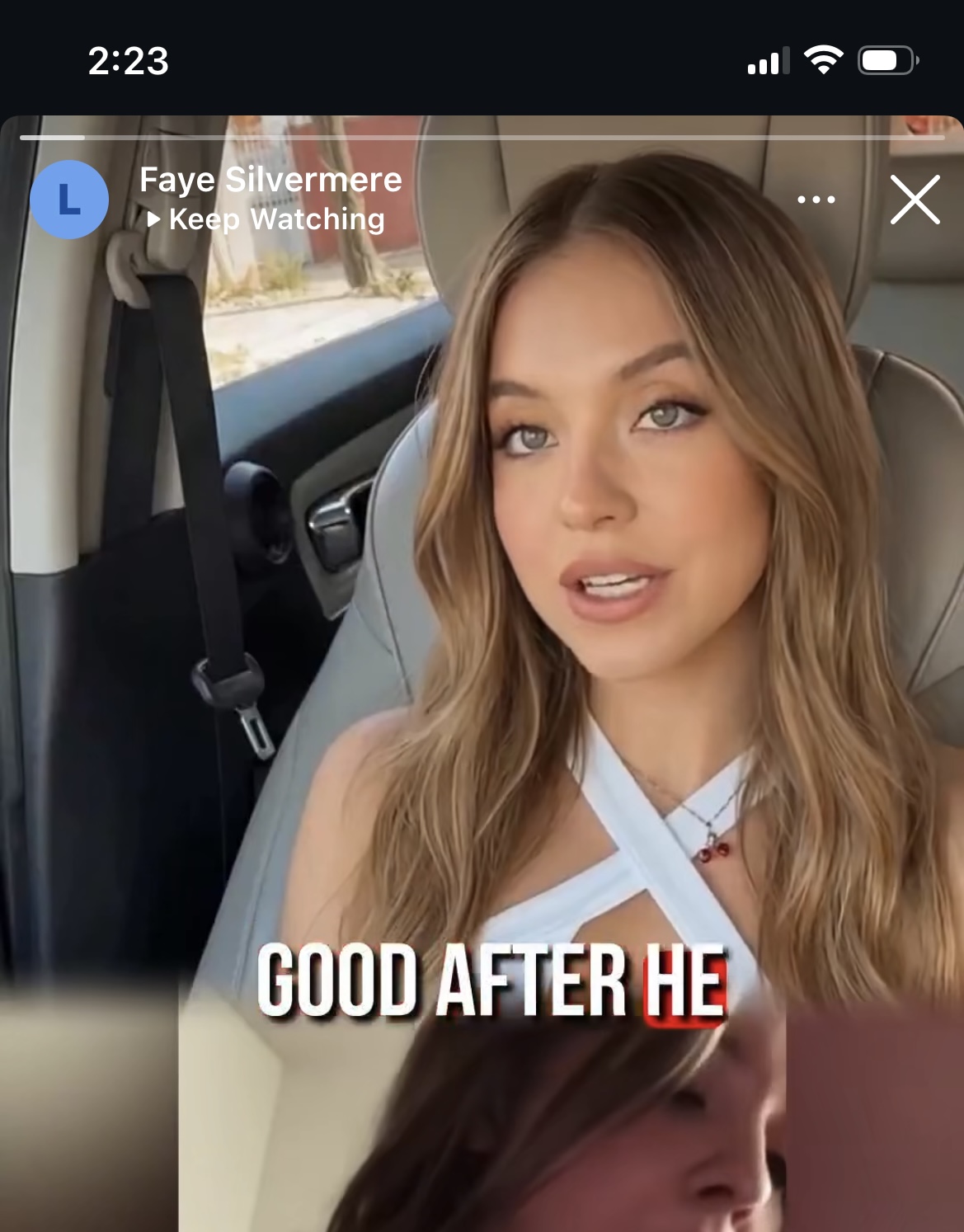
Instagram, Facebook running explicit porn in ads

Screenshot

I’ll say this at the top: I’m not an anti-porn crusader.

I think pornography is, on its own, a perilous thing for some people to consume. I think there can be enormous harm done to people, particularly women, who appear in it and are exploited for it. That being said, online porn, like any kind of sex work, can be financially beneficial to women, especially if they control every step of the process and make money from it.

But I think you could say – and this will come as no surprise to anyone who knows me or follows me on social media – I am an anti-hypocrisy crusader.

And yes, for my own little hypocrisy declaration, I am on social media, including Instagram and Facebook. I think the latter, much like modern-day Twitter, has done a lot to spread lies and disinformation that have ultimately hurt this country and our democracy. I’m on social media to promote my work and the work of friends (although the effectiveness of social media has never been great).

Having issued all those disclaimers, I’ll say that I was surprised recently to notice that Instagram in particular (and fellow Meta platform Facebook also; I don’t know about Threads) is running ads that include hardcore sex footage.

I’m not talking about the “I’ll be your AI girlfriend” ads that run on those platforms. Those are insulting (“I’ll never say no,” all those pretty pixel princesses coo) to everyone concerned but they’re not what I’m talking about here today.

I’m talking about explicit ads, usually popping up between Instagram stories, that are marketing something, I’m not quite sure what (I know that advertising fails if you don’t remember what product the ad is advertising) but this is a “click this link” medium, not a “hop on your Schwinn and pedal down to the corner sin store and ask for it by name” medium. And I didn’t click on any embedded links. So I’m not quite sure what they’re advertising. Pornhub or something? Dunno.

The screenshot at the top of this piece I have heavily cropped so you can’t see the bottom of the screen and its graphic depiction of oral sex. As for the top half, is that actress Sydney Sweeney? I wonder if she’s aware she’s used in porn ads?

But the fact that IG in particular is running ads with graphic sexual content when it bans that content among its users is hypocritical to say the least.

One account I know, for a genuinely legit artist and model, has to blur out her nipples in photos she posts. Yet IG users could conceivably see, after they see one of her IG stories, completely explicit sexual activity.

Even after seeing repeated examples of these ads – and yes, I’ve forever broken my algorithm in doing this research – I couldn’t quite believe what I was seeing. But I found a couple of news articles from 2025 that reported about the graphic ads, including a piece from Le Monde. “Thousands of pornographic ads go unmoderated on Facebook and Instagram” is the headline. (I’m not linking because most of the article is behind a paywall, but a cursory search found it.)

I’m very explicitly NOT calling for action or any kind of boycott of Meta social media platforms, especially Instagram and Facebook, that are running these ads. But I think people should know that Meta has two sets of standards: one for its users, who must toe the line over content, and one for its advertisers, who can follow an “anything goes” practice.

What’s the moral of the story? A friend of mine who has in the past placed ads on Instagram for legitimate, mainstream brands notes that the Meta platforms have been painstakingly trivial in their criteria for and criticism of said ads.

So I guess the bar is lower when it comes to the many, many dollars that can be made.

A few words on the correct social media lifts all boats

It’s crazy how much time we spend – okay, how much time I spend – on social media. And even crazier is how influential social media is in our lives. It’s fractured in many ways from what it used to be and while I’m on most of the social platforms, I spend more time on BlueSky than anywhere.

This is, however, a story about two platforms from the detested Meta stable of social media, Facebook and Instagram.

I really don’t like the Meta platforms and I like their owner even less. But they’re where the eyeballs are, unfortunately. Facebook still drives far more traffic to newspaper sites, for example, than any other platform. Many, many times more.

Two examples from my recent postings prove that the platforms have a long reach.

I follow the actress Sarah Herrman on Instagram. She’s funny and posts videos not especially related to her film work, which included the recent film “Chili Finger,” but posts videos of her attempts at baking and cooking. Those videos often feature, off-screen, her mother, who appears to have an acerbic wit.

In a recent video, Herrman tells her mother that she received two requests from followers for pictures of her feet.

“Only two?” her mother replied, with a tinge of “you can do better than that” in her voice.

In the comments, I quoted her mother in a two-word-and-two-word only comment: “Only two?”

So far, 4,296 people have “liked” my comment.

Crazy.

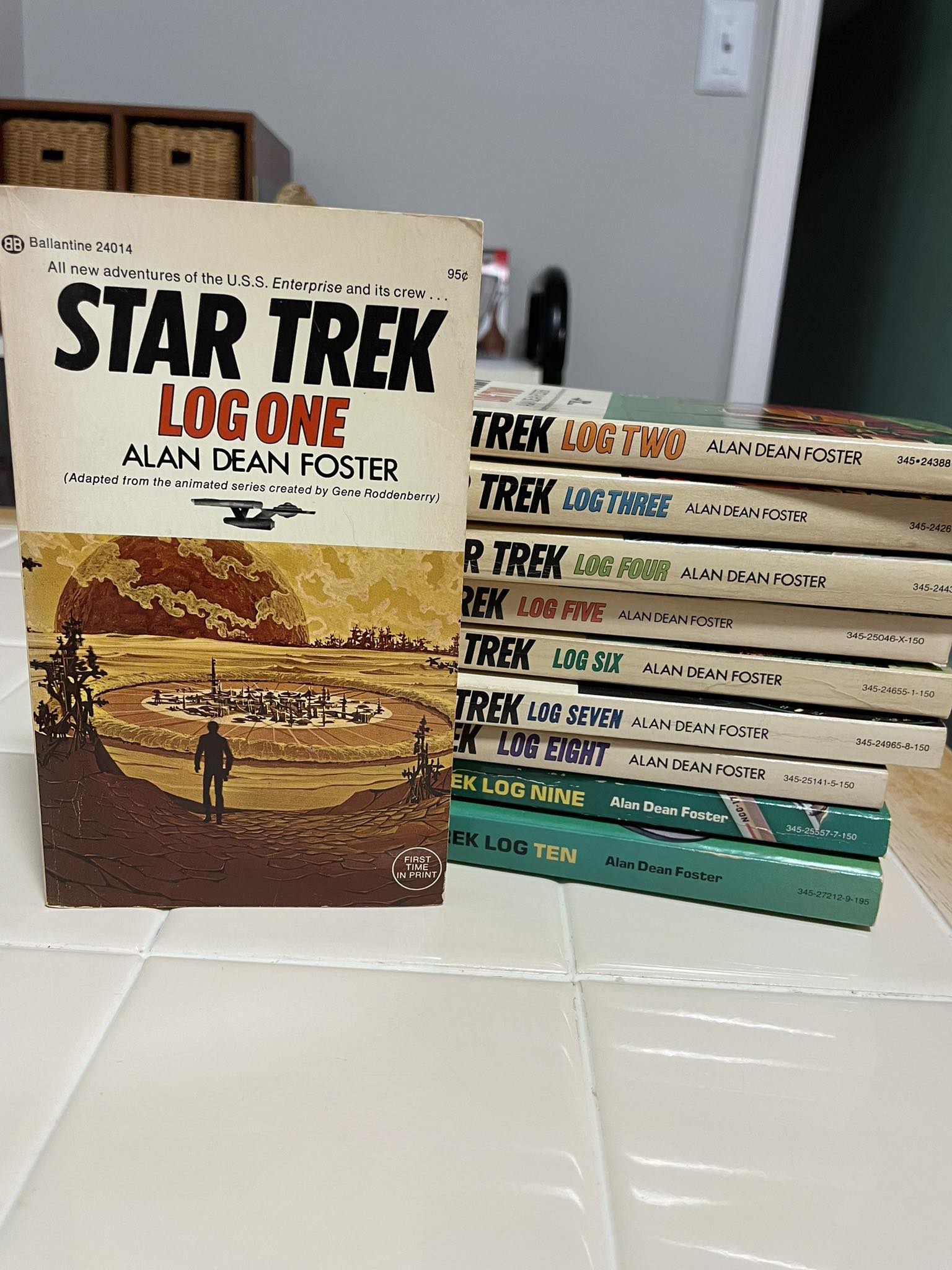
More recently, I found copies from the mid-1970s of the “Star Trek Log” books, in which author Alan Dean Foster adapted the “Star Trek” animated series into short story and novella form.

I posted my picture on the Facebook page “Vintage Paperback Books.” It was my first post, so it’s not like I’m a favorite of the page’s followers.

But those vintage “Star Trek” fans are fans of the books, apparently. As of right now, since Saturday the post has accumulated 503 likes.

Again, crazy.

Those are examples of social media’s reach. There are other, better, more important and relevant examples.

But those kinda boggled my mind.

Facebook is the worst. And yeah, I’m still on it.

The photo above appeared on the Facebook history page for my hometown and hundreds of people are commenting on it. The building in question was the headquarters of a long-gone local dairy operation that was a beloved part of the community. In the comments, people are mourning the loss of the building and, long before that, the dairy business, and they’re citing their favorite products.

Only one problem: As some of the comments point out, this photo is more than 10 years old. The building was torn down more than 10 years ago. Because it’s not a great picture, it’s hard to tell that this demolition, more than a decade ago, left a prominent part of the complex standing. And it’s still there this morning.

The caption reads only, “Demo of Riggins Dairy.” That’s it. It doesn’t note that the demo took place 11 years ago. That’s left up to a commenter.

There are soooo many problems with Facebook. (And yes, I’m still on there, because it’s a way to communicate with friends and family and promote my work and that of others.) The worst is that the parent company, Meta, actively supports the destruction of our democratic society.

But another huge problem is misinformation and, charitably, half-assed information. I suppose the original poster didn’t intend to mislead people – including many, many people who follow the page who haven’t been in the city in 10, 20, 30 or 50 years – into thinking the demo was actively going on today. It’s hard to say.

But even by omitting information and context, even if innocently intended, it’s given the impression that “they’re tearing down the old dairy building.” I thought that myself because I haven’t lived there in going on four years. Then I saw the comments giving some trimeframe context.

I can’t tell you to boycott Facebook because I’ve got three pages – my personal page, which has very limited access by readers, and my author page and Wicked Muncie page, created in 2016 to promote our true crime books.

But for pete’s sake, be aware that you’re not getting the whole story when you see something on Facebook. Sometimes all that means is that you’re misinformed about a building. Sometimes it means you’re misinformed about assaults on our democracy.

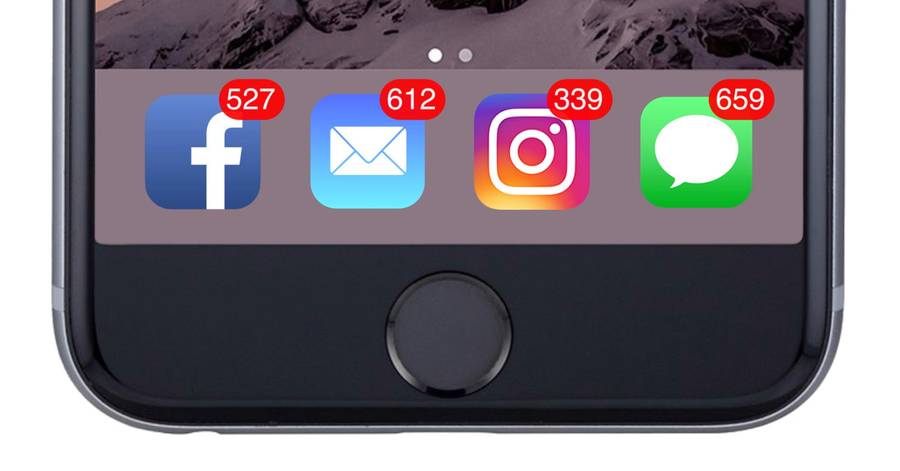
My love-hate – mostly hate – relationship with alerts and notifications (disclaimer: not my phone pictured here)

If I’m ever swept away by a tornado, you can blame the authorities in Tennessee.

I appreciate that I can get notifications on my phone. They’re often helpful. I just wish I could choose when I want them to be helpful.

Notifications – letting us know we’ve got a text message or a new email or if bad weather is on the way or a public figure has kicked the bucket – are a way of life for many of us now, and I’m not going to disable all my notifications – which are called “push alerts” by many newspapers, or just a “push” – because they can be useful.

These thoughts are occasioned by a couple of obnoxious instances of push alerts or notifications in the past couple of days, some of these of the health app variety. Yes, thank you, phone, for letting me know my trend in walking has changed lately. Did you happen to notice how rainy it was? And yes, thank you, other health app, for waking me up in the middle of the night to let me know of something that might otherwise have let me croak deep in peaceful slumber.

Part of my hate for pushes is that I’m obsessive enough to not only swipe them off my screen but actually go to my email inbox to delete the email that generated the push or, gasp, read it and even possibly respond.

(Don’t think we don’t understand that the Push Alert Industrial Complex is conspiring with our phone manufacturers to ensure we spend more time on our devices. It’s true. I read about it on the internet.)

Anyway, I’ve gradually over time changed my phone settings to end most push alerts from the authorities, who seem to abuse the tool.

The final push alert that broke the camel’s back was one recently that alerted me of a fatal shooting in Memphis, which is five hours and 47 minutes from me. Needless to say, this 2 or 3 a.m. push alert was not from a news outlet. It was from a state-run agency. I won’t comment on why this push was sent out but not why other fatal shootings are not sent out. You can guess.

So here I am, because the state insists on alerting me to things happening six hours away, perhaps expecting me to run down to the street at 3 a.m. and scan passing vehicles for the suspect, without any means of being woken in case of forest fire or flood or tornado or hurricane.

If I die, it’s on you, state officials.

Going viral, social media, dystopia and books

I went viral on social media – two different social media, with two different posts – over the Fourth of July weekend.

(This is not a pat myself on the back post. I think there’s something interesting that’s happened here, beyond the viral-ness.)

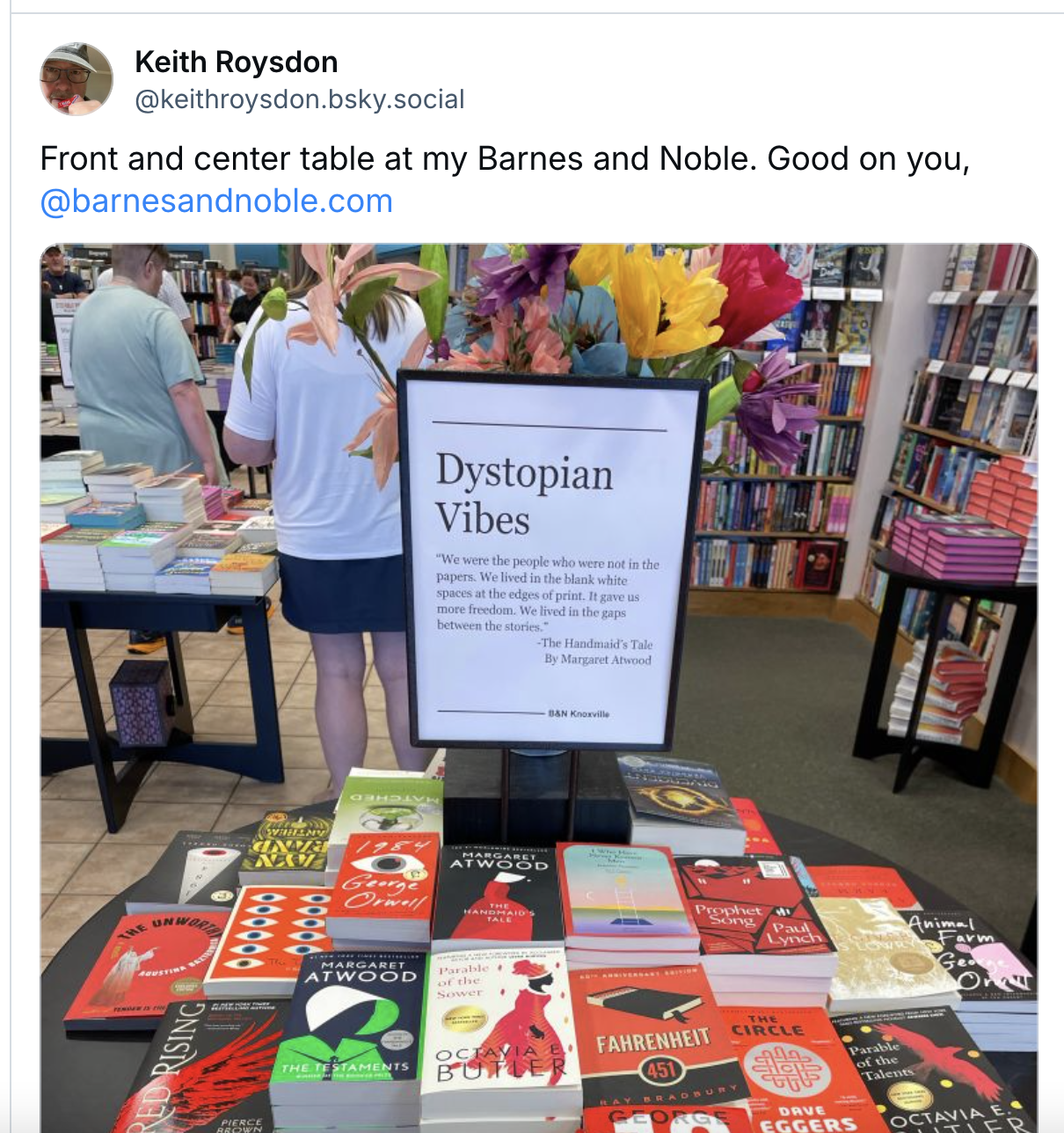
The first post that went viral is the one above. On Saturday, I was in the Barnes & Noble bookstore near me and took a picture of the first table inside the door. If you can’t tell from the picture, it’s a display marked “Dystopian Vibes” and offers books including “1984,” “Animal Farm” and the works of Margaret Atwood and Octavia E. Butler.

I thought I’d snap a picture and post it and thank Barnes & Noble for putting these books out there so prominently. Yes, that placement encourages sales. Yes, it’s ultimately a big corporation trying to move copies of books. But it’s something.

I thought the post might get some traffic, but I never get a lot of engagement, even with 3,000 Bluesky followers.

By Sunday afternoon, this was the response:

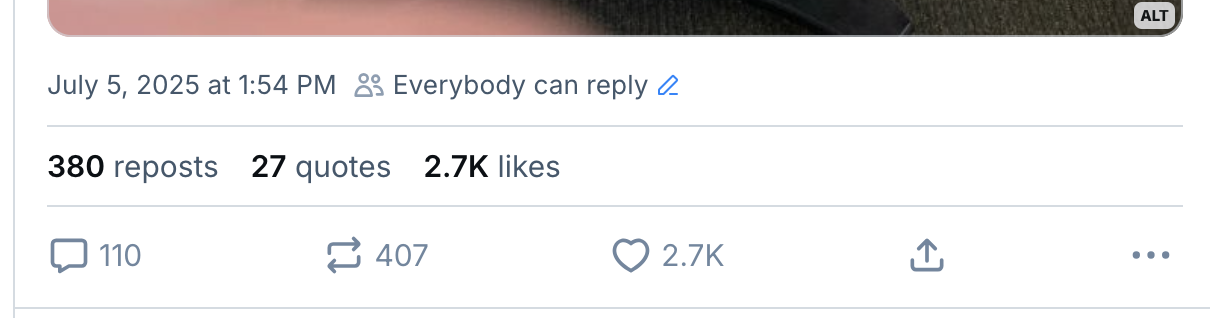
380 accounts reposted my post, which got 2,700 likes.

This is a multiple of thousands the reaction I was expecting. I had to mute notifications on the post.

That wasn’t all, though.

I saw a bitterly amusing meme on a friend’s Facebook account – there was no indication on the account who originally posted it – and I posted it on various social media, including Instagram, which shares posts to the social media app Threads (which I don’t use much).

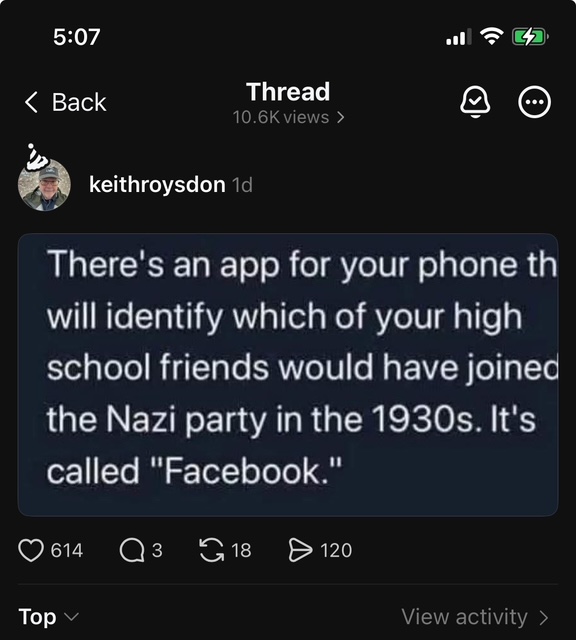
Here’s the post, and the reaction:

Believe me when I tell you, I usually don’t get 600 likes on Threads, a social media I barely use.

So what’s the upshot to all this, besides a little more engagement and traffic to the companies that own Bluesky and Threads, the latter the detested Meta? (The even more detested Twitter turned up with very little notice of either post, by the way.)

The upshot, it seems to me, is that there’s a lot of interest and engagement in posts about our currently untenable, dangerous and yes, dystopian path.

That’s a good thing, that people are engaging in posts critical or even acknowledging the path this country is on.

And, as a bonus, the Bluesky post shows a ton of engagement about books that forecast, define and address our society.

There’s nothing more encouraging than the realization that people are engaging with literature that calls to light our current peril.

So maybe a small percentage of the frogs in this slowly boiling pot of water are aware they’re in a slowly boiling pot of water. I hope.

Jumping into the discourse about Bluesky

If you’ve been paying attention, you’ve seen people argue that the social media platform Bluesky is a failure. It has “only” 36 million-plus users, compared to more than 600 million twitter users. (The latter is a number I think is highly suspect, but that’s a topic for another day.)

I joined Bluesky more than a year ago, I think, but I didn’t spend a lot of time on the social media site until last fall, when some odious thing the owner of twitter had done drove other people there. All of a sudden, Bluesky seemed populated – much more so than in the first few months after I had joined – and much livelier.

So-called “Starter Packs” on Bluesky – curated lists of writers, engineers, performers, artists, whatever – gave my follower count a boost early on, but the growth in the number of followers there has been pretty consistent. I have about 2,800 followers there now, compared to more than 4,000 at my peak on twitter. That Bluesky following was built in a matter of months, by the way, compared to all the years since 2009 I’ve been on twitter.

(I still have a twitter account, to keep in touch with friends who are still more active there than on Bluesky, but I spend much, much more time on Bluesky.) I’m also active on Facebook, where I started an author page this year despite my misgivings over the attitudes and behavior of the suck-up American oligarch who owns it, and I post regularly there and on Instagram (same owner, same dislike for the owner). The reason I’m still on all those platforms is, besides keeping up with friends who are on them, is to publicize my book, THAT OCTOBER.

But I spend most of my time on Bluesky, regardless of follower numbers and engagement, because it just feels like the least awful place on socials. I’m not choosing the lesser of evils here, I promise. I feel like using any social media is like building a new house (ie active thread that’s hopefully engaging) on somebody else’s property.

In other words, all of social media is someone else’s real estate. When they want to take it away from us, they can.

That’s also why Bluesky is the least reprehensible social platform. The owners of twitter and Facebook and other Meta platforms have shown themselves to be dishonest in how they treat the people who actively bring eyeballs to those platforms. They take the value of our work and bluster and censure us.

BlueSky seems the least likely social media platform to do this.

This might change if the semi-collective, not-especially-concentrated ownership of Bluesky changes, perhaps through a sale at some point in the future. Money talks and bullshit walks and aside from political ideology, there’s been no more certain death knell for various socials than how much their owners can make by selling them or just selling out.

So I’m spending time on Bluesky – too much time, probably – and little time anywhere else, although I have a presence everywhere. This site is a pretty reliable place to find my latest thoughts but it is not a two-way street, unlike even the worst social.

So I don’t think Bluesky is dying. I do think it is, right at this moment, a less reprehensible (there’s that phrase again) place than the alternatives.

We’ll see if that continues to be the case.

Social media and selling books

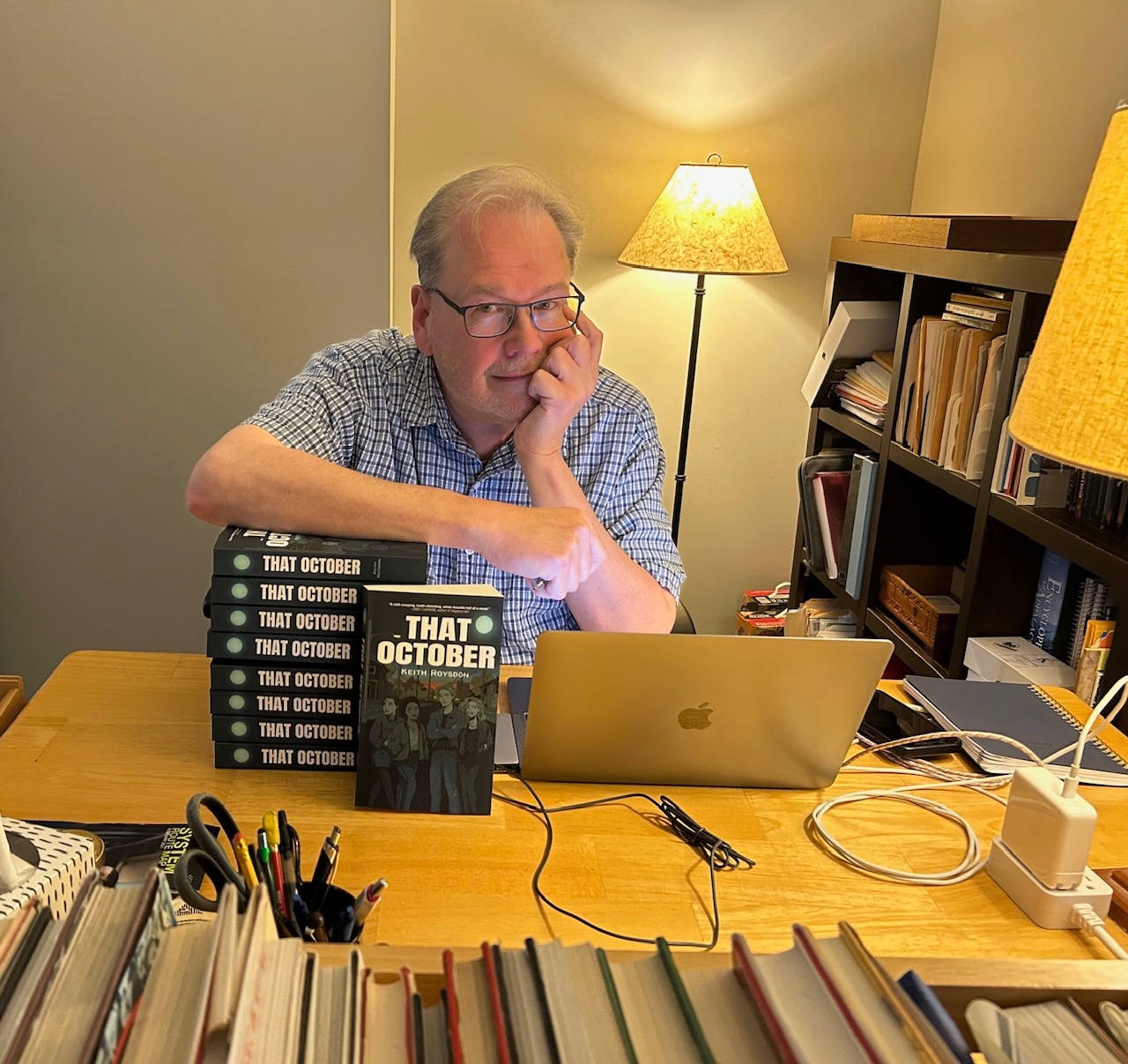
You think that guy looks insufferable there, wait until a few more weeks pass. You’ll be sick to death of him.

My 1984-set crime novel THAT OCTOBER publishes June 1. It’s available now for pre-order on the usual bookselling sites, although I encourage you to purchase it through the least harmful to society one.

I hope you like the book. The authors who were kind enough to read it and give me some comments that I could blurb seemed to like it, citing the 1980s nostalgia content and the twists and turns of the plot.

Although THAT OCTOBER is self-published, there’s nothing especially straightforward about marketing a book these days. Unless you’re a huge author, you have to flog your book to potential readers. That’s usually done through social media.

There are a lot of authors who innovate in how they market their books. Some include odd tidbits they came across while researching and writing their book, and I’ll probably do some of that. Some authors post recipes true to the time period or story. Others, notably Beau Johnson, make and post creative videos to publicize their work. Beau’s videos are hilarious and effectively promote his books, including LIKE MINDED INDIVIDUALS, which continues Beau’s multi-book storyline of anti-heroes who punish the worst criminals on Earth.

Since social media is important to promoting our books, it’s especially tricky to do so in a manner that doesn’t promote some of the worst humans around, including the owners of the former twitter and Facebook and related platforms.

I don’t spend a lot of time on the former twitter anymore, mostly just to check on friends who still post there as opposed to a slightly more “clean hands” site like BlueSky. For the past week, I’ve tried to observe a week-long boycott of Facebook-related platforms, breaking that only to note a rare earthquake in East Tennessee and a Mother’s Day post about my mom, who left us nearly 20 years ago.

But I’ll continue to post on my author page on Facebook to publicize my writing. It’s not a decision I’m entirely comfortable with, but Facebook is still a place where people go, and authors are expected to have a social media presence there.

Anyway, god go with you in the next few weeks (months? years?) as you see me posting here and on social media to promote THAT OCTOBER. I hope you tolerate me and I hope you like the book.

Once you’ve had Facebook, you’ll never go back

In watching the reaction to the new Facebook today — reaction that ranged from irritation to outrage — I was reminded of David Letterman’s straight-faced observation about pop star Madonna back in the 1980s. “I think she wants to shock us,” Letterman said, tongue in cheek.

Earlier today I compared FB to a significant other who flirts or picks a fight just to make sure we’re still paying attention and not taking them for granted.

Sure, there’s some legitimate reason for upgrading and offering your users the latest and best features. But I think FB wants to remind its bazillion users how much it means to us.

Even if that means pissing us off.

As someone who has been in the communications business since I was a teenager, I can testify to the feeling engendered by reader reaction. No matter if it’s a complaint about a controversial story or photo or, even worse, the removal of a beloved comic strip, the response is appreciated. It means people are paying attention, that you’re still part of their everyday lives.

Face it, most of us might never take up Twitter (although you should, because it’s really fun) or Google+ (yawn). But for those bazillion of us who check in to FB every day — even if our devotion is far more casual than “checking in” via Foursquare or more low key than posting our latest rant about an irritating co-worker or prodigious child — we’ll keep checking in, no matter how many times we threaten to quit FB.

And no silly revamping of the way our pages look will keep us away.

Now, let me tell you what I don’t like about the new Facebook …