iPhoneography: Albany, Indiana

The town of Albany, Indiana, several miles north of Muncie, has remained surprisingly robust during its history. While other Indiana and Midwestern towns have withered on the vine, Albany has maintained a population of more than 2,000 people. It has a thriving downtown and local businesses.

Here’s a summer 2012 iPhone look at Albany.

For much of the 20th century, the McCormick Brothers company was the town’s biggest business. Founded in 1907 and lasting until the last quarter of the century, McCormick Brothers made a variety of metal products over the decades, beginning with washboards, moving into metal kitchen cabinets and then products for the war and interstate highway efforts.

While other businesses have occupied the sprawling McCormick Brothers plant, the most notable landmark remains its water tower, seen above.

Albany has a number of businesses in its downtown, including C.J.’s Hardware Store. C.J.’s is an old-fashioned hardware store with wooden floors, rolling ladders to help the store’s employees reach products on high shelves and the kind of  broad but selective inventory that makes old-fashioned hardware stores fun to walk around in.

Albany has a five-and-dime store. For many years, McCord’s Five and Ten offered bulk candy, nuts, household goods and some curious items. The sign is still on display inside the store. Under new ownership now, the store still has what might be the area’s biggest selection of hairnets.

The great old-school packaging makes the hairnets look like leftovers from the 1960s, but the store still sells hairnets to food service workers around the area.

Mood rings, anyone? They have ’em.

One of the town’s churches was getting a new roof the day I was there.

This “ghost sign” for Colonial Break decorates the end of a building.

I’ve seen this sign, on the side of a building, before but never understood it. Would it light up, ring and alert passersby and police if a burglar alarm had been tripped? I’d like to know more about it.

One of Albany’s most popular restaurants, the Dairy Dream.

Freak out: Scary stuff that haunted me

Just ask anyone who’s ever walked up behind me when I was vacuuming and they’ll tell you I’m pretty easy to freak out.

Maybe it was the combination of an overactive imagination and a childhood home that was supposedly haunted, but I’ve always been spookable. I’m not squeamish; blood and gore don’t bother me particularly, especially not in horror movies.

But subtle stuff – a shadowy figure in the distance, a pallid face outside a window – in movies really makes me squirm.

Herewith, some stuff that freaked me out in my younger, impressionable years.

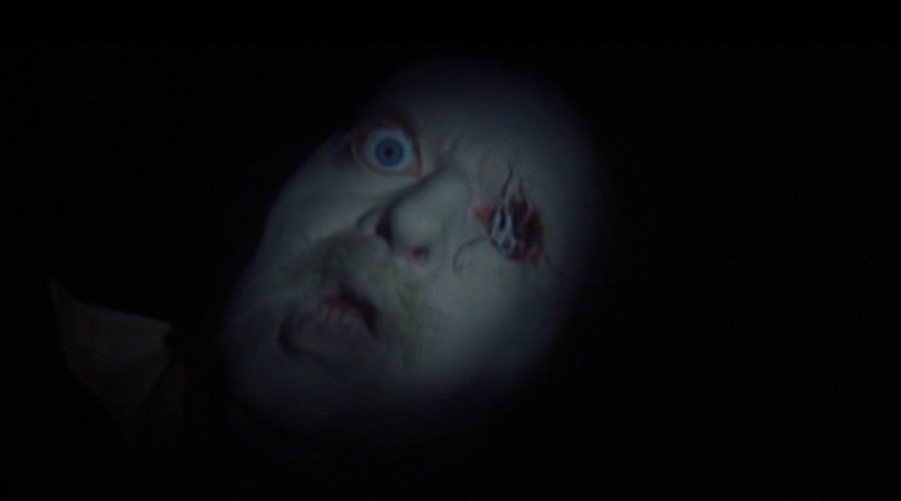
Lon Chaney in the 1925 “Phantom of the Opera.” Who wouldn’t be a little freaked out by that face? Mary Philbin and I were in good company in our reactions to Chaney’s masterpiece, both in terms of his film work and his makeup work. In Famous Monsters of Filmland I read all about how Chaney achieved this cadaverous look, manipulating his nose and cheekbones and eyes. But even though I knew Chaney’s secrets, that face made an impression.

The Suicide Song on Dr. Demento. If you’re not hep to what the nerdy kids listened to in the 1970s and 1980s, Dr. Demento hosted a syndicated radio show playing offbeat songs like “Fish Heads” and “Shaving Cream.” The oddball doctor introduced a nation of youngsters to the work of Spike Jones and helped launch the career of Weird Al Yankovic. But the song that Demento played that sticks with me, 30-plus years later, was “The Suicide Song.” What was it? Incredibly enough, I can’t seem to find it online. There’s a listing of songs played on the show that includes it but I can’t find an audio or video snippet, which makes me wonder if I’m mis-remembering the name. But once I hear the song again – and its dirge-like, monotone recitation of dire lyrics – I’ll get goosebumps all over again.

“Who are you?” from “Beyond the Door.” The 1974 Italian import “Beyond the Door” was considered little more than a rip-off of “The Omen” and “The Exorcist” with its plot about demonic possession. It’s a curiosity, maybe especially because of its star, British actress Juliet Mills, best known stateside for the sugary sitcom “Nanny and the Professor.” But when I think of “Beyond the Door,” I think of the late-night commercials for the movie showing clips of Mills levitating and twisting around and – unforgettably for me – intoning in a freaky bass voice “Who are  you?” I’m battling the heebie jeebies here.

The ghosts in “The Innocents.” I’m not sure any movie is scarier than “The Innocents,” director Jack Clayton’s adaptation of Henry James’ “The Turn of the Screw.” The story of a governess going to a remote castle to take care of two truly strange children, “The Innocents” introduces a couple of the creepiest ghosts ever. And it does so in a totally freaky way: By having them stand, motionless, across ponds or outside windows.

I don’t know about you, but as far as I’m concerned, silent, unmoving figures watching me from a distance is more unnerving than a chainsaw-wielding maniac.

Unless he taps me on the shoulder while I’m running the vacuum cleaner.


‘Spider-Man’ maybe not amazing, but good

There’s apparently a pretty crass motive behind the fact that “The Amazing Spider-Man” is playing in theaters around the world this week, and I know that you would be as shocked as I am to learn that money has something to do with it.

Only about a decade ago, of course, Sony/Columbia Pictures started releasing Sam Raimi’s “Spider-Man” movies and the first two entries in the three-film series are pretty good. Since that time, however, Marvel Comics has gone into the movie business itself – you might have heard about that – and, as Hollywood tells it, Sony decided to hang onto the rights to stay in the Spider-Man movie business so the rights to the character didn’t revert to Marvel.

This means, for the time being, no Spidey in “Avengers” movies.

It also means, because the producers decided against letting Raimi continue his series, that Spidey got a reboot in the hands of director Marc Webb (heh).

Webb’s movie, “The Amazing Spider-Man,” would be closer to amazing indeed if so much of it didn’t feel like the reboot that it is.

That’s because Webb seems to have a pretty good handle on the movie and strikes the right tone. But a big chunk of the movie seems just too familiar, as Webb presents a slightly altered version of Spidey’s origin again.

Can we all agree that we don’t need to see future superhero movies spend quite so much time on the origin of its hero? Especially if we’re seeing a reboot?

Spoilers ahead, by the way.

Anyway, Andrew Garfield stars as Peter Parker, NYC high school student who’s something of a high-school outcast but nowhere near as much of a hapless nerd as Tobey Maguire’s “puny Parker.” He stands up for a kid bullied by meatheaded classmate Flash Thompson and catches the eye of beautiful Gwen Stacy (Emma Stone) even before he gets super-powers.

In the new outing, Peter is driven by the mystery of what happened to his parents, Richard and Mary Parker, who left him in the care of his Uncle Ben and Aunt May when he was a child. Peter finds his father’s Oscorp briefcase, which leads him to contact scientist Curt Connors (Rhys Ifans), a scientist colleague of his father.

After that injection of mystery, the rest of Parker’s story unfolds fairly normally. Peter gets bitten by a very special spider and gains its powers. His Uncle Ben gets killed (in a manner that seems much more random and less effective than in the comic and Raimi’s movie, frankly) and Peter decides to become a vigilante, hunting his uncle’s killer.

In the meantime, Peter and Gwen fall in love – kind of quickly, really – and Peter helps Connors single-handedly pursues his dream of manipulating genetics.

Of course, things don’t work out for Connors and he turns into the Lizard, a development that was teased throughout the Raimi films as actor Dylan Baker popped up, in a one-armed lab coat, only to never see the conclusion of his story reached.

There are some really good elements in Webb’s version of the story … and some that don’t work out all that well. Here are a few:

The mystery of Richard and Mary Parker: To make this reboot seem a little different, Webb and the screenwriters sow through the movie seeds of a the mystery of what happened to Peter’s parents. It’s implied that something untoward happened to them. But it’s just a tease so far.

Spidey the smart-ass. Here’s one thing that works really well. In the comics, Spidey is a jokester. He quips and hurls insults about as often as he spins webs. The movie does a good job with this aspect of Peter’s personality.

The Stacys are perfect. Emma Stone is perfectly cast as Gwen Stacy, Peter’s first big love in the comics. The Raimi films reversed things by giving us redhead Mary Jane before Gwen. Aside from being adorable, Stone is quite good as Gwen. And comic and actor Dennis Leary is very good as her father, NYPD Capt. George Stacy. True to the comics, Capt. Stacy eventually learns Peter’s secret.

The bad guy is … eh. Movies always run a risk when they make the bad guy a sympathetic character. Raimi danced on the edge of disaster but triumphed with the often-sympathetic Dr. Octopus in “Spider-Man 2.” But there’s not much to Curt Connors here and what there is is sympathetic or even pathetic. He really feels like a minor Spider-Man rogue.

The little things are good. Besides Spidey’s penchant for wise-cracking, one of the nicest touches in the film was bully Flash Thompson’s end-of-the-movie admiration of Spider-Man. In the comics, Flash was Spidey’s biggest fan at the same time he hated his secret alter ego.

The stinger doesn’t work. In Marvel’s owned-and-operated movies, beginning with “Iron Man,” there’s a credits or after-credits stinger, or extra scene, teasing developments in upcoming movies. Those scenes worked perfectly. In “The Amazing Spider-Man” – here are those spoilers I warned you about – the mid-credits scene shows Connors, incarcerated, being confronted by a shadowy figure. I think we’re supposed to assume it was the mentioned-but-unseen Norman Osborn, but the payoff fell flat with a mention of the “secret” about Peter’s parents. Uh, really? You’ve just spent two hours telling us there’s a secret about Peter’s parents, then you tell us, in the surprise secret scene, that there’s a secret about Peter’s parents? I guess the scene is there in case we were out at the  concession stand during that part, huh?

There’s nothing in “The Amazing Spider-Man” that can top the average Marvel movie or Raimi’s first two tries at the character. But there’s nothing offensive either. It’s worth seeing if your expectations are low or manageable.


Classic movie: ‘Jaws’

What better movie to watch around the Fourth of July than “Jaws?”

Much of the movie’s plot – which, for a film made in 1975, feels fresh today – revolves around one panicked town’s reaction to the possibility a rogue shark will ruin tourism on the Fourth of July holiday.

And there’s no better summer movie than “Jaws,” Steven Spielberg’s adaptation of Peter Benchley’s best-selling novel.

Lots has been said about the impact of the movie and how it shaped our perceptions of summer movies, box office numbers and the very meaning of the word blockbuster. No more about those topics needs to be said here.

So some observations about the movie in general:

Two for one: I love how Spielberg mixes two movie genres – the horror film and the high seas adventure – so effectively. I’m not sure such an effective blending occurred again until James Cameron’s “Aliens” took the horror movie feel of the original “Alien” and combined it with a down-and-dirty war movie.

Revenge of the nerds: At the end, the schlubby scientist Hooper and the afraid-to-go-into-the-water police chief Brody survive. The two guys with glasses. The two guys with the backstories that can’t compete with Quint, the shark hunter.

The shark still looks good: Spielberg had so much trouble with his mechanical shark that he hid it, refraining from showing it through much of the movie, so he legend goes. But the shark – Bruce as he was called on the set – looks really pretty good. And the sparing use of the shark ratchets up the suspense. Really, would numerous scenes of the shark cruising along on top of the water have been as cool and suspenseful as the bobbing plastic barrels? Nope.

Robert Shaw should have starred in all the movies. Shaw, the scruffy and steely-eyed shark hunter Quint, made a series of pretty good movies but none could compete with “Jaws.” He died of a heart attack at age 51 in 1978, only three years after “Jaws” was released. How much fun would it have been to have Shaw around, making movies, for the past few decades?

Spielberg and company improved on the book: Benchley’s novel is a great summer read but the movie improves greatly on the plot and characters. The best example? Spielberg eschews the illicit affair between scientist Hooper and the police chief’s wife. What a totally false note said affair was.

It’s the very model of the modern blockbuster. Everything about the movie was duplicated and repeated, either solely or in combination, in summer hits for the next three decades. The spot-on editing (here by Verna Fields). The John Williams score. And, yes, the string of inferior sequels.

Andy Griffith and how TV has changed

Today’s news that Andy Griffith had died at age 86 was observered in predictable ways: Griffith’s role as TV icon, model father and reportedly very decent gentleman were dutifully noted.

But there was a little bit of disconnect – some of it generational – in reaction to Griffith’s passing.

Not because reruns of “The Andy Griffith Show,” the small-town sitcom in which Griffith starred from 1960 to 1968, aren’t readily available to younger viewers.

No. I think it’s because it’s hard to comprehend just how big a TV star Griffith was.

Griffith’s show was consistently in the top 10 highest-rated shows on TV for its entire run. At any given time, a quarter of the TV audience was tuned in to watch Andy, Barney Fife, Opie and the rest of the genial people of Mayberry.

Griffith was a big TV star in a four-channel TV universe. And that’s a big difference from being a TV star now.

A friend and I have often theorized that no modern-day TV stars or celebrities can ever hope to reach as many viewers as stars like Griffith, Johnny Carson or their like. That’s because, thanks to the proliferation of channels in basic cable dating back to the 1980s, the viewing audience is increasingly fragmented. A typical household receives dozens, even hundreds, of TV channels. Add to the mix DVDs, digital, streaming and on-demand shows and the 1960s standard of everyone tuning in to the same shows – a practice that brought big ratings, generated “water cooler” conversations and made stars of people like Griffith and Carson – is long gone.

Just look at listings of the top-rated programs of all time. If you discount the few remaining “water cooler” programs like Super Bowls, few shows of the modern era rack up huge ratings.

The top-rated TV episode remains the February 1983 – yes, 1983 – series finale of “MASH.” Sixty percent of households tuned in that night, making for a viewing audience of 50 million households.

The “Who Shot J.R.” episode of the original “Dallas” ranks right up there, followed by the “Roots” miniseries, big sporting events and a handful of other shows.

Very few broadcasts from the past two decades are near the top of the list. Most shows from today would be happy with a fraction of the viewers. In May, “American Idol” pulled in 16 million viewers.

Griffith, a canny entertainer with a way of knowing what viewers wanted, may have like-minded modern-day equivalents.

But none of them will ever have his reach or his impact.


Ant-Man, Guardians of the Galaxy: Marvel movie universe-building

Somebody asked me the other day if I planned to go see “The Amazing Spider-Man” next and I said, “Yeah, probably.” Right up until the time I saw Sam Raimi’s lackluster “Spider-Man 3” in 2007, my answer would have been much more emphatically positive about the cinematic adventures of the wall-crawling webslinger. The final Raimi film kind of burned me out on the character.

And the idea of rebooting “Spider-Man” yet again, with another origin story, no matter how overstuffed with a “mystery” about Peter Parker’s parents it might feature, makes me suddenly very, very tired.

So I have to say that while I’m sure I’ll see “The Amazing Spider-Man,” I’m not excited about it.

That’s also because I’ve been spoiled, frankly, by Marvel’s universe-building big-screen efforts.

The movie versions of “Fantastic Four” and “X-Men” are owned by Fox and “Spider-Man” is owned by Sony. That means that despite brief teases to the possibility of a cross-over like we heard earlier this year, those movie universes won’t mix with Marvel Films-owned and operated properties like “Iron Man,” “Thor,” “Captain America” and “The Avengers.”

So while I’m looking forward to “The Amazing Spider-Man” and “The Dark Knight Rises,” I’m more excited to see where Marvel goes next with its universe-building efforts.

Rumors circulated in the past couple of days that the long-rumored “Ant-Man” character might end up in “Iron Man 3,” which comes out next May. I’m not sure how some people are authoritatively saying this when so much time remains for last-minute changes, but … well, it would be quite cool to see one of the original Avengers – not to mention his partner, Wasp – finally make the big screen.

Today online sites were lit up with suggestions, primarily drawn from Latino Review, that Marvel is going to release a “Guardians of the Galaxy” movie in 2014. Despite the fact that the characters are little-known outside of comics fandom – they’re even more obscure than “Iron Man” was before 2008 – the diverse group of cosmic adventurers would make for a huge expansion for the Marvel universe.

And as many online sources noted, the “Guardians” also makes sense because one of their regular antagonists is cosmic bad guy Thanos, who appeared in the mid-credits teaser at the end of “The Avengers.”

While my lifelong appreciation of “The Avengers” doesn’t necessarily carry over to “Guardians of the Galaxy” – I’m just not as familiar with them – I would be happy to see Marvel’s movies continue to expand the Marvel cinematic universe.

And I’ll dream of the day when Spidey will bump into Captain America and Iron Man during battle in the streets of New York.

‘The Avengers’ hits $600 million … and 27th place????

Although I only contributed the cost of a couple of tickets – so far – I was pleased to hear that Joss Whedon’s “The Avengers” passed the $600 million box office milestone this week.

That puts “The Avengers” in third place, behind James Cameron’s “Titanic” and “Avatar,” in terms of total box office haul.

“Titanic” has topped a cool billion, so I’m not sure “Avengers” will be able to reach that peak.

Each time a new box office threshold is crossed, of course, some history-minded person considers the increase, over the decades, of ticket prices.

Boxofficemojo.com’s list of movie box office – as adjusted for inflation – is pretty illuminating and also a little disheartening for movie lovers.

Considering that ticket prices were less than a quarter in 1939, how amazing is it that “Gone With the Wind” sold enough tickets (in its original release and subsequent re-releases) to still top the charts, with a an-adjusted-for-inflation take of $1.6 billion? That’s a paltry $198 million in unadjusted numbers.

On the Boxofficemojo list, “The Avengers” and its $600 million haul come in at 27th place.

Here are the top ticket sellers of all time via Boxofficemojo:

1 Gone with the Wind MGM $1,600,193,400 $198,676,459 1939^
2 Star Wars Fox $1,410,707,200 $460,998,007 1977^
3 The Sound of Music Fox $1,127,929,800 $158,671,368 1965
4 E.T.: The Extra-Terrestrial Uni. $1,123,486,300 $435,110,554 1982^
5 Titanic Par. $1,074,383,500 $658,672,302 1997^
6 The Ten Commandments Par. $1,037,520,000 $65,500,000 1956
7 Jaws Uni. $1,014,384,200 $260,000,000 1975
8 Doctor Zhivago MGM $983,152,800 $111,721,910 1965
9 The Exorcist WB $875,945,400 $232,906,145 1973^
10 Snow White and the Seven Dwarfs Dis. $863,280,000 $184,925,486 1937^
11 101 Dalmatians Dis. $791,344,600 $144,880,014 1961^
12 The Empire Strikes Back Fox $777,590,600 $290,475,067 1980^
13 Ben-Hur MGM $776,160,000 $74,000,000 1959
14 Avatar Fox $770,261,700 $760,507,625 2009^
15 Return of the Jedi Fox $744,950,500 $309,306,177 1983^
16 Star Wars: Episode I – The Phantom Menace Fox $715,276,800 $474,544,677 1999^
17 The Sting Uni. $706,011,400 $156,000,000 1973
18 The Lion King BV $705,680,400 $422,783,777 1994^
19 Raiders of the Lost Ark Par. $698,083,500 $242,374,454 1981^
20 Jurassic Park Uni. $682,750,300 $357,067,947 1993^
21 The Graduate AVCO $677,755,200 $104,931,637 1967^
22 Fantasia Dis. $657,704,300 $76,408,097 1941^
23 The Godfather Par. $625,066,700 $134,966,411 1972^
24 Forrest Gump Par. $622,081,300 $329,694,499 1994
25 Mary Poppins Dis. $619,200,000 $102,272,727 1964^
26 Grease Par. $609,596,100 $188,755,690 1978^
27 Marvel’s The Avengers BV $600,377,080 2012 1978^
28 Thunderball UA $592,416,000 $63,595,658 1965
29 The Dark Knight WB $588,314,100 $533,345,358 2008
30 The Jungle Book Dis. $583,544,900 $141,843,612 1967^

Favorite authors: Dennis Lehane wages ‘War’

I’m pretty relentless in my appetite for new books. When I was a kid, I would go back and read and re-read books by my favorite authors, including Ray Bradbury, Robert Heinlein and Kurt Vonnegut.

But these days I’m always trying new authors or devouring everything by a newly-discovered favorite like Craig Johnson or Ace Atkins.

But every year or so, I dip back into the work of Dennis Lehane.

Considering how damn dark much of Lehane’s work is, it’s hard to imagine how it could feel like comfort food to me, but it does. Not so much “Mystic River” or “Shutter Island,” although I liked those (the former quite a bit).

No. When I want to relive my favorite Lehane experience, I jump back into his series of novels about working-class Boston private investigators Patrick Kenzie and Angie Gennaro.

The fourth book in the Kenzie and Gennaro series, “Gone, Baby, Gone,” was made into a pretty good movie in 2007 by director Ben Affleck. Not all of the novel’s grim appeal made it onto the big screen, but quite a bit did.

So now that I’m between new books to read, I’m starting the Kenzie and Gennaro series over again with the first, 1994’s “A Drink Before the War.”

If you’ve never read Lehane’s Patrick and Angie series, I’d highly recommend it. But you really have to read them from the beginning.

Lehane takes his characters, including not only the PI partners but their friends like Bubba, the former-Marine-turned-weapons-dealer-nutcase, through some pretty big – you might say dire – changes during the course of the series.

“A Drink Before the War” opens with Patrick and Angie working out of their customary office, the empty bell tower of a Boston Catholic church. Patrick is a smartass with a gooey center. Angie is a beautiful hellraiser with an awful home life.

The two accept a case working for some legislators and their toadies trying to find a statehouse cleaning woman who’s disappeared with some supposed “documents.”

Lehane gets to the nitty gritty quickly, touching on Patrick’s hellish childhood at the hands of his father, a now-deceased firefighter regarded as a homegrown Boston hero, and Angie’s regular beatings at the hands of Phil, her husband and Patrick’s childhood friend.

Patrick, of course, is deeply in love with Angie and seethes when he sees how Phil treats her. Patrick learned the hard way, though, about trying to intercede on Angie’s behalf.

The book manages to touch on class warfare, race relations and marital discord in a plot that’s liberally sprinkled with humor.

Make no mistake, however: Lehane’s vision of his characters is dark, dark, dark. Dark, I tells ya. It’s hard not to love Patrick and Angie and hard not to ache for the troubles that befall them.

But Lehane’s Kenzie and Gennaro books more than make the heartache worthwhile.

I’m planning to touch on the series here over the next few weeks. Pick up the series and follow along if you will.

But remember: Read them in order: “A Drink Before the War,” “Darkness Take My Hand,” “Sacred,” “Gone, Baby, Gone” and “Prayers for Rain.”

I can’t totally endorse Lehane’s 2010 return to the characters after more than a decade’s absence, “Moonlight Mile.” But we’ll get to that later.

Have fun!

The Great Newspaper Comics Challenge Part 18

Here’s our regular look at what’s funny (or not) in the funny pages. Because Cathy left us wanting more chocolate and redundant lists of things.

“Classic Peanuts” shows Lucy walking past Linus, in I’ve-got-my-blanket-and-I’ve-tuned-out-the-world mode, and hearing music. She whips the blanket away and finds … Linus listening to what’s probably a transistor radio. We remember those, right? Okay, just tell your kids it’s a Walkman. What? Okay, tell your kids it’s a Discman. What? Okay …

“Pickles” made me laugh. Grampa’s head yields a lifetime of bumps and scars and stories, like when he fell down a flight of stairs, fell out of a shopping cart and got hit in the head with a monkey wrench. “That might explain a lot about Grampa,” the kid says to the dog.

My standards must be low today. “The Wizard of Id” made me laugh. The prisoner asks for “fresh” food and the guard brings him a cooked organic chicken. The chicken came from the farm of a friend, where “it spent its days running around in the sunshine.” The prison sobs. “I just realized I’m jealous of a dead chicken,” the prisoner says from his dank cell.

Often, “Lio” is weird. Sometimes funny too. Today an old man gets a coupon for a free scoop of ice cream. Excited, he runs outside, only to see Lio, remote control in hand, setting off a nuclear explosion with resulting mushroom cloud. Hmmm.

Great “Speed Bump” today. On stage is a rock band, thrashing and shouting lyrics, with an excited crowd watching. At the back of the crowd, an older man and woman. “I hear the morning church service is less contemporary,” he says.

And finally, “The Family Circus” gives us another reason to love the Keane kids. Mom is looking exhausted as she ushers the kids out of the room. “How come when Mommy gets tired WE have to go to bed!” one of the boys complains. “It’s not even that dark outside yet,” Dolly (that’s the girl, right?) says. You know what would make this panel 100 percent better? Eliminating that second line of dialogue. The first was punchline enough.


‘Abraham Lincoln: Vampire Hunter’ – the book was better

I wanted to like the movie version of “Abraham Lincoln: Vampire Hunter.” At least, I wanted to like it a lot more than I did.

Seth Grahame-Smith’s 2010 novel is one of my favorite books in the least couple of years. It is audacious and clever and plays it absolutely straight in telling the hidden history of our 16th president: Lincoln spent much of his life killing the monsters that took his mother away from him (and their comrades), gradually discovering that vampires are at the heart of the conflict tearing the nation apart and propelling it toward Civil War.

Grahame-Smith made vampires among the forces bolstering the Confederacy because of the ready-made sustenance slaves presented for the undead.

Laugh if you want at the outrageousness of Grahame-Smith’s story, but it worked. Lincoln was never treated as a ridiculous figure. And blaming vampires for some of the tragic turns of Lincoln’s life served the plot well.

So I had fairly high hopes for Timur Bekmambatov’s film, adapted by Grahame-Smith himself and starring Benjamin Walker as Lincoln.

My hopes persisted even after I saw footage that seemed to indicate the movie replaced the somber tone of the book’s story with over-the-top action scenes.

After seeing the movie today, I have to say the film gets some things right but goes dreadfully astray with others.

First, the good:

Lincoln’s character is spot on. Walker plays him with the absolute correct amount of gravitas and sorrow. Since much of the movie’s plot – like the book’s storyline – takes place before Lincoln gets to the White House, Walker is quite good as a young, athletic Lincoln, the rail-splitter who knew how to handle an axe.

The mysterious Henry. Dominic Cooper is good as Henry, Lincoln’s mentor in vampire-killing, who has some secrets of his own. In the book, there’s a real tension between the two as Lincoln wants to take revenge on the vampire who killed his mother and Henry strings him along, setting him up to meet and kill other vampires. There’s a bit of that tension in the movie (although not enough).

The tone. While the movie is infinitely flashier and more action-filled than the book, the sorrowful feel of the story – which matches the tragic events of Lincoln’s life – feels right.

The action. Although they were out of left field, two big action set pieces in the movie are quite fun. In one, Lincoln pursues his mother’s killer through a herd of wild horses. In the second, the heroes fight the bad guys on a moving train. There’s the perfect amount of collapsing train trestles and moments when people almost slip off the tops of rail cars.

What doesn’t work, with the biggest minus saved for last (spoilers when we get there):

The Black Best Friend. In the movie, Lincoln has a lifelong friend, William (Anthony Mackie), a free black man who joins in the fight against vampires. William has some very cool scenes and dishes out punishment to vampires about as well as Lincoln does. But the character, which didn’t exist in the book, feels shoehorned into the story.

So does the villain, Adam, played by Rufus Sewell. In the book, a conspiracy of Southerners, sympathizers and vampires make up Lincoln’s shadowy enemies. In the movie, most of the emphasis is placed on Adam, a 5,000-year-old vampire who’s part of the slaves-for-food plot but mostly seems like a character created to give Lincoln somebody to kill in the final reel.

The de-emphasized role of slavery. In the book, slavery and vampires go hand-in-hand. In the movie, the relationship – and the foul strengths vampirism brings to the Confederacy – feel like it’s fairly glossed over.

The final scene (spoilers!). In the movie, after Lincoln and Henry triumph over evil vampire Adam, Henry urges Lincoln to allow him to turn the president into a vampire so the two can fight evil together through eternity. Lincoln dismisses the idea and goes off to Ford’s Theatre and his destiny. Flash forward to present-day when Henry appears to foil a presidential assassination attempt.

That’s it?

How about this for an ending, right out of the book: After the war is won, vampire John Wilkes Booth shoots Lincoln in Ford’s Theatre. Henry tracks Booth and kills him. Henry returns to Lincoln’s side. Flash forward a century. Two distinctive men watch as Martin Luther King Jr. gives his “I have a dream” speech, the Lincoln Memorial nearby. The men are Henry and Lincoln.

Henry observes, “Some men are just too interesting to die.”

The finale of the book was so much better, so much stronger, that changing it, taking Lincoln out of it, very nearly ruined the movie for me.

If you haven’t read “Abraham Lincoln: Vampire Hunter,” you might like the movie’s enjoyably wild action scenes and its heartfelt portrayal of our most tragic president.

If you’ve read the book, the movie will leave you wondering what happened.