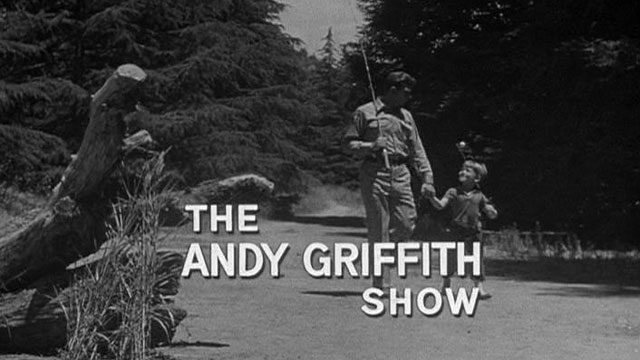
Today’s news that Andy Griffith had died at age 86 was observered in predictable ways: Griffith’s role as TV icon, model father and reportedly very decent gentleman were dutifully noted.
But there was a little bit of disconnect – some of it generational – in reaction to Griffith’s passing.
Not because reruns of “The Andy Griffith Show,” the small-town sitcom in which Griffith starred from 1960 to 1968, aren’t readily available to younger viewers.
No. I think it’s because it’s hard to comprehend just how big a TV star Griffith was.
Griffith’s show was consistently in the top 10 highest-rated shows on TV for its entire run. At any given time, a quarter of the TV audience was tuned in to watch Andy, Barney Fife, Opie and the rest of the genial people of Mayberry.
Griffith was a big TV star in a four-channel TV universe. And that’s a big difference from being a TV star now.
A friend and I have often theorized that no modern-day TV stars or celebrities can ever hope to reach as many viewers as stars like Griffith, Johnny Carson or their like. That’s because, thanks to the proliferation of channels in basic cable dating back to the 1980s, the viewing audience is increasingly fragmented. A typical household receives dozens, even hundreds, of TV channels. Add to the mix DVDs, digital, streaming and on-demand shows and the 1960s standard of everyone tuning in to the same shows – a practice that brought big ratings, generated “water cooler” conversations and made stars of people like Griffith and Carson – is long gone.
Just look at listings of the top-rated programs of all time. If you discount the few remaining “water cooler” programs like Super Bowls, few shows of the modern era rack up huge ratings.
The top-rated TV episode remains the February 1983 – yes, 1983 – series finale of “MASH.” Sixty percent of households tuned in that night, making for a viewing audience of 50 million households.
The “Who Shot J.R.” episode of the original “Dallas” ranks right up there, followed by the “Roots” miniseries, big sporting events and a handful of other shows.
Very few broadcasts from the past two decades are near the top of the list. Most shows from today would be happy with a fraction of the viewers. In May, “American Idol” pulled in 16 million viewers.
Griffith, a canny entertainer with a way of knowing what viewers wanted, may have like-minded modern-day equivalents.
But none of them will ever have his reach or his impact.
 keithroysdon