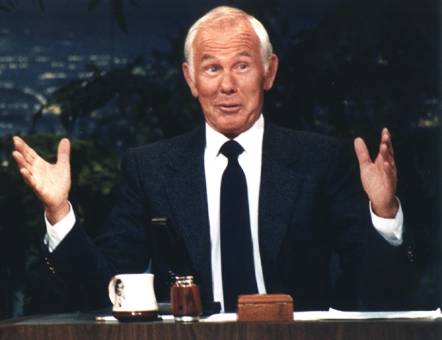
Every once in a while I’ll surprise my wife with a comment about some obscure musician or author or political figure from the past. Seeing the look on her face, I’ll say, “I saw him on Johnny Carson.”
I would argue that for the 30 years leading up to his abdication of the “Tonight Show” throne, Carson was one of our nation’s greatest cultural educators.
I’m not talking about the times that Carson had political figures on the air, although that certainly fits the description as well.
I’m talking about how Carson, a white-bread Midwestern kid, helped spread the culture of the day.
It’s a feat not unlike what more recent hosts, including Jon Stewart or Stephen Colbert, do. But Carson brought us authors and entertainers and experts of every stripe. Along with actors and starlets and newsmakers and ordinary people who had unusual-looking potato chips, we saw the great and the near-great in a parade that’s unequaled today, when TV guests (with the exception of a few, like Tom Hanks and Bill Murray) seem to appear only when they’re plugging their new movie or music.
A few ways that Carson broadened our cultural horizons stick in my mind:
Comedians of all kinds, but particularly Jewish comics. If Indiana boys like me know everything there is to know about Jewish mothers and can even spout a few words in Yiddish, it’s because of watching comics on Carson’s stage and couch.
Carl Sagan. Neil deGrasse Tyson’s recent TV appearances aside, you’d be hard-pressed to find a scientist and author who was better known to the public at large. Sagan’s “Cosmos” series on PBS aside, I think most people knew him from his appearances on “The Tonight Show.”
Truman Capote and Gore Vidal. Two very different men and two very different authors whose books were read by many. But they became personalities outside the New York literary scene because of their appearances on Carson.
Buddy Rich. The world’s greatest drummer, Rich often performed in front of the “Tonight Show” orchestra. What kid didn’t want to pound the skins after seeing Rich on Carson’s show?
Marvin Hamlisch and the leading lights of Broadway. I’ve never been to Broadway but I know a lot about the Great White Way because Carson’s guests included not only the performers but composers of those shows.
As an aside, Carson’s tropical monologues were the stuff of legend, of course, but he even had time to fit the topical into silly bits. I’ll never forget during one of the Apollo moon missions Carson cracking a joke about a new toilet paper that had been invented as a result of the space program. Its brand name? Splashdown.
 keithroysdon