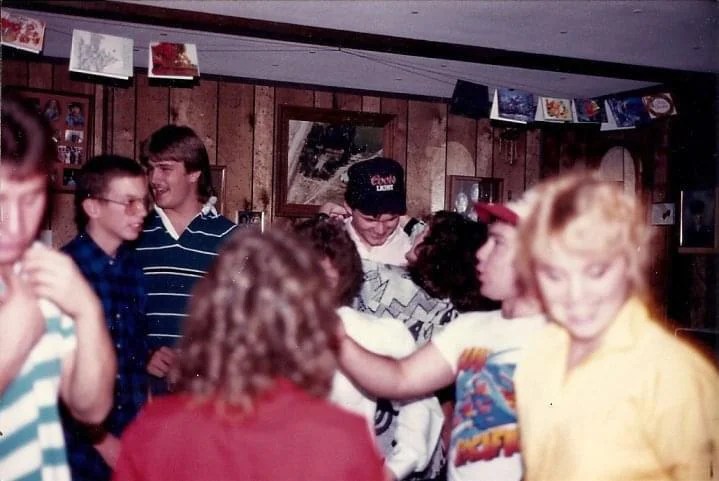
Okay, here’s something a little different.
For a few months now, I’ve been working on a book, “That October,” a crime novel set in October 1984. In the story, a group of high school-age friends take action when a friend is murdered, another friend is missing and the adults … don’t seem to care.
Here’s the first chapter.
Saturday October 6 1984
Jackie Rivers knew she was in trouble. Bill Terry had both her wrists in one of his big hands and was pulling her away from the partiers in the living room and toward a dark hallway.
The music – Jackie recognized that “Round and Round” song by Ratt – was pounding and disorienting enough. But Jackie’s brain was foggy and her vision was blurry. At first she thought she couldn’t see very well because the house was dark and the dark was cut only by colored lights and strobes. But she thought it was more than that.
I shouldn’t have drunk that drink, she thought.
Sammi and Toni and I should never have come to the party, she thought.
As Bill Terry pulled her along behind, Jackie looked to the right and could see Sammi Bradford and Toni Carter, her best friends, through the wall of windows. They were outside by the bonfire and Jackie could tell they were looking for her: Toni’s hands were out in front of her as she talked to a boy and she seemed to be making big gestures, which was how Toni talked when she was upset.
I should have never drunk some of that purple punch, Jackie thought again. It had Everclear in it and that is almost pure alcohol.
Whose house was this, even? Jackie thought. Why did we even come to this stupid party?
Just before Bill Terry pulled her into the hallway, she thought she saw Sammi, looking through the windows, spot her. Sammi’s eyes lit up and Jackie saw her mouth open to say something to Toni before Jackie was pulled into the dark hallway.
Oh my god, Sammi, I hope you saw me.
Outside one of the doors in the hallway, Bill Terry tried to kiss her and Jackie turned her head so his stupid sloppy open mouth landed on her ear.
Bill tightened his grip on her wrists and yanked downward and Jackie cried out in pain. With his other hand, he turned the doorknob and stepped into the dark bedroom, pulling her after him. He pushed her toward the bed in the room and closed and locked the door behind him.
I did a stupid thing by drinking that purple punch, but this is not my fault, Jackie thought. This is Bill Terry’s fault.
Bill moved toward her when she heard, even over the blasting volume of the music, fists drumming on the door. Out in the hallway, Sammi and Toni were hollering, although Jackie couldn’t make out what they were saying.
Bill Terry made a face then stepped close to where Jackie sat on the edge of the bed.
Jackie shook her head to clear it and made fists of her hands where they lay on the bed.
Bill saw the gesture and laughed, which sent a spike of anger through Jackie’s head. The fog cleared for a moment.
Jackie raised her left first toward Bill’s chest and he knocked it away, almost casually.
Then Jackie hit him hard, square in the crotch, with her right fist.
Bill Terry doubled over and staggered back, a look of fury quickly blossoming on his face.
Then the bedroom door blew open, the doorframe splintering, and Michael was there.
Michael, her stepbrother of the last nine months.
Michael, the big white kid with wavy blond hair, who usually had an almost unreadable expression on his face.
But at this moment, Michael’s face was scary. In the time since Jackie’s dad and Michael’s mom had been married, Jackie had never seen Michael look angry.
Bill Terry had turned when he heard the door burst in and faced a big, roiling package of angry white boy.
Michael grabbed Bill by the front of his shirt and pulled him forward, away from Jackie.
Bill tried to throw a wildly looping punch at Michael, but Michael raised his right arm and blocked it. He just shrugged it off, Jackie thought.
Then Michael struck Bill Terry once, twice, three times in the face, even while he held on to Bill’s shirt with his other hand. The punches came so fast Jackie almost couldn’t follow them. After the third punch, Michael let go of Bill’s shirt and Bill fell into a heap on the floor.
Sammi and Toni, who had apparently been standing in the doorway, edged around Michael and the crumpled form of Bill Terry and each grabbed one of Jackie’s hands.
“Can you walk?” Toni asked, and Jackie thought that was a stupid question until her friends pulled her to her feet and she realized she was still dizzy.
“I need some help, I think,” Jackie said, and even over the loud music she realized she sounded slurred.
Toni and Sammi got on each side and put an arm around Jackie.
Sammi looked up at Michael. One corner of her mouth turned up just a bit.
“You ready, Rambo?”
Michael, breathing hard but not from exertion, turned his attention from Bill Terry and to the three girls and nodded.
“Stay close to me,” Michael said. “Brian Terry is out there.”
“Jesus, all we need right now is another Terry brother,” Toni said.
The music had turned from Ratt to Duran Duran, but “The Reflex” was just as loud. Jackie was having trouble placing one foot in front of the other. But Sammi and Toni had her and they followed Michael into the hallway. A couple of girls pushed past them and Jackie heard them holler Bill Terry’s name when they got to the open doorway and saw him on the floor.
By the time Michael, with the girls behind him, got to the end of the hall and entered the living room, a couple of guys were moving toward them. Jackie heard Sammi say, “Watch out – there’s Brian Terry,” but Michael was ready.
Michael pushed one guy – Jackie didn’t recognize him, even if she had been able to focus – back and over a couch.
Brian Terry – wiry, like his brothers and their old man – raised his fists and tried to close on Michael.
But Michael, lean and tall but more muscled than any 17-year-old had a right to be, had a far longer reach than Brian Terry. His right fist connected with Brian’s jaw and then his left first struck Brian in the gut and Jackie could hear over the music well enough to think the punch sounded like one of those “baseball bats on a side of beef” sound effects from the “Rocky” movies. Jackie was pleased with herself for thinking of this even while she realized how bizarre the thought was.
“No fighting!” came a shout from a guy in a corner of the room. “This is my parents’ house and they’ll kill me if anything gets broken!”
But all the fight had gone out of Brian Terry, who was sitting on the floor behind the couch, trying to recover from having the wind knocked out of him.
Michael, his eyes on Brian Terry’s friend as he struggled to get up from the couch, half-turned to the girls.
“Out the front door,” Michael said. “My car’s down the block on the other side of the street. I’ll be right behind you.”
Sammi nodded and she and Toni started toward the door, still supporting Jackie. But Jackie thought she was a little less dizzy.
A classmate, Lee Ann Ingle, stood in the open doorway, a shocked expression growing on her face. Her boyfriend, David Kennedy, was behind her.
“Oh my god, Jackie,” Lee Ann said. “Are you alright?”
Jackie nodded but was afraid to open her mouth. Her stomach was rolling.
“She’s gonna be okay,” Sammi answered Lee Ann’s question. “The party is getting a little rough, though.”
Lee Ann and David stood to one side to let the girls through. “Do you guys need help?” Lee Ann asked.
“We’re good,” Toni said over her shoulder as they marched Jackie down the driveway. Lee Ann and David watched for a few seconds. “No party for us tonight,” David said, and he and Lee Ann turned and walked back down the street.
Back inside the house, Michael still stood over Brian Terry. He extended a hand. “Want some help up?”
“Fuck you,” Brian said.
Michael withdrew his hand and shrugged.
“You better watch your ass, you fuckin’ hillbilly,” Brian said.
“No reason to keep this scrap goin’,” Michael said as he turned away. “Wouldn’t have happened in the first place if your brother had kept his hands off my sister.”
Michael wasn’t sure Brian Terry had even heard him over the music, but it didn’t matter. They were done.
Outside, Michael found the girls leaning against his old Chevy Nova.
“Pile in,” he said. He looked at Jackie. “You better sit up front in case you’ve got to puke.”
“I’m not gonna puke,” Jackie said before leaning forward and vomiting onto the street.
“Uh-huh,” Michael said.
The girls got in the car, Jackie with her face out the open window, and Michael crossed to the driver’s side.
Michael looked across the top of the car and saw Steve Terry, the youngest of the brothers, standing in the yard of the party house. He didn’t make a move to walk toward them or stop them, despite the efficient beatdowns Michael had administered to his two brothers.
Michael turned the key in the ignition and heard the big V-8 roar to life. He touched the dash and thought of his father, who had left the beautiful old beast to Michael before Michael was old enough to drive.
Michael pulled out onto the street and maintained eye contact with Steve Terry while they pulled away.