
Tag Archives: Sherlock Holmes

What’s up, Docs? Two new mystery medical dramas, ‘Doc’ and ‘Watson’

Hollywood is forever looking for variations on Sherlock Holmes stories, although the “Sherlock” series starring Benedict Cumberbatch and Martin Freeman (a Brit production overseen by Mark Gatiss) is very hard to top. “Elementary” did a good job of modernizing the Arthur Conan Doyle detective and “House” focused the mystery to medical conditions diagnosed by a Sherlockian-level grump doctor.

Now there’s two series, one more directly tied to the Sherlock mythos, that cast Holmesian logic as medical diagnosis.
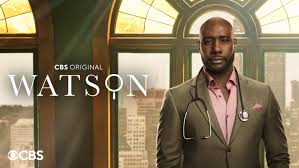
The more directly Conan Doyle-connected is “Watson,” starring Morris Chestnut in a very appealing turn as John Watson, who is running an elite clinic in the wake of the Reichenbach Falls confrontation between Holmes and his nemesis James Moriarty. Watson suffered a head injury as he tumbled into the water trying to save Holmes. Now he’s trying to recover, make a new life for himself and, as of the second episode, doesn’t realize that Moriarty isn’t dead and means to bring Watson down.

As we know from the Sherlock canon, the Falls were not the end of Holmes, so I’m wondering how long before the detective shows up to assist his best friend?

The cast is good but the show has some of the faults of network shows in that everything is explained too explicitly to ensure audiences who are barely watching the show while scrolling on their phones catch what’s going on.

Even if it is less Holmes-related, “Doc” is the better series for me right now. Molly Parker, from “Deadwood” and “Lost in Space,” plays a doctor who lost her memory of the past eight years after a head injury. (Lot of that going around.)

Now she must navigate a return to a personal life that, for her, is where she left it eight years ago. (Spoilers.) She doesn’t remember that one of her children died, she and her husband divorced, she began a new relationship and her former friend is now an enemy.

Parker is, like Chestnut, just incredibly appealing. I’d watch another couple of seasons of “Lost in Space” featuring her as Maureen Robinson if I could. And what wouldn’t we all give for several more seasons of “Deadwood?” “Doc” might be the best Molly Parker fans will get, and that’s pretty good in its own right.

‘Mr. Holmes’ a bittersweet look at the legend

mr holmes

If I actually get around to writing all of this, the blog will seem very Sherlock-centric for a while. I’m reading a Sherlock Holmes book now – the second in a row – and I’m mightily tempted to watch some early “Sherlock” episodes on Netflix.

And then there’s “Mr. Holmes.”

I didn’t know quite what to expect from the Bill Condon film, starring Ian McKellen as an older, retired Sherlock Holmes, and I haven’t read “A Slight Trick of the Mind,” the 2005 book by Mitch Cullin. I had an impression the story was about a mystery deep in the retirement years of the world’s greatest consulting detective.

Holmes’ retirement years have been fertile ground for writers, most notably Laurie R. King, whose “Beekeeper’s Apprentice” books featuring Holmes and Mary Russell, his younger love interest and deducting equal, have thoroughly explored this world in a dozen books.

(I can’t help but wonder if writers like King aren’t ticked off when they treat an idea with such care and originality and see others’ treatments get turned into movies.)

“Mr. Holmes” unfolds in 1947, when 93-year-old Holmes – long after the death of everyone important in his life, including his brother Mycroft and companion John Watson – is living in his house in Sussex and keeping bees. His only companions are his housekeeper (Laura Linney) and her young son Roger (Milo Parker).

Holmes, in failing health, struggles to remember the case, decades earlier, that prompted him to quit detecting. WIth some prompting from Roger, he remembers the bittersweet circumstances. The realization affects him in a couple of ways, including his dealings not only with his surrogate daughter and grandson but with a Japanese businessman who seeks answers that only Holmes can provide.

If you’re expecting a version of Holmes that’s like the aging astronauts of “Space Cowboys,” that’s not what Condon’s movie is about. It’s a low-key affair, more bitter than sweet, about a legendary figure fighting with the loss of his greatest tool: his mind.

But it’s also about how Holmes, notoriously aloof and superior, comes to realize – too late, tragically so in one instance – that the need for companionship is felt by everyone. Even him. The bitter realization, played out in one of the film’s flashbacks, stems from a moment that seems out of the blue but is ultimately understandable.

McKellen is wonderful, of course. We’ve seen so many decades of good work from him that we shouldn’t be surprised that he can play at least three different versions of Holmes here – at his deductive peak, at his most confused and vulnerable and at his saddest as he realizes what might have been and attempts to solve the mystery of his life.

What a week: ‘Sherlock,’ ‘Arrow,’ ‘SHIELD,’ ‘Walking Dead’

arrow heir to the demon

Like some kind of aligning of planets, the seven or eight days we’re in the middle of here is a heck of a week for episodic TV.

And that doesn’t even count “The Black List,” which didn’t have a new episode this week, but entertained the heck out of me with the episode from last week I finally got around to watching.

Quick impressions (and spoilers if you haven’t seen):

“Sherlock” finished up this year’s three-episode run on “Masterpiece Mystery” with “His Last Vow,” a quirky finale to a quirky season. Over the past three weeks we’ve seen Holmes return from the dead after his rooftop encounter with Moriarty last season, John and Mary get married and Mary exposed as a rather deadly former government operative. In “His Last Vow,” Holmes and Watson run up against a loathsome news magnate who can blackmail Mary. With no other way to save his friend’s wife, Holmes kills the man and Mycroft prepares to send Sherlock off on a nearly-certain-to-be-fatal mission. But then … images of Moriarty appear all over London and Sherlock is called back to investigate. And we wait until next year to see what happens next.

“The Black List” – last week at least – gave us “The Cyprus Agency,” in which the federal agents – with the help of James Spaders’ Red – broke an insidious group that kidnapped women and kept them in comas as well as pregnant to provide babies for adoption. Didn’t we see something like this – with organs instead of babies – in the movie “Coma” 40 years ago? Yeah, but that didn’t have James Spader in it.

“Agents of SHIELD” raised its somewhat low bar again this week with “TRACKS,” a high-stakes adventure that found the agents on – or thrown from – a train as they try to foil the plot of a villain. More good scenes with the agents – even Ward and especially May – some good Marvel movie references (Blonsky’s cryogenic cell is obviously now the holding place for the monster from “The Incredible Hulk”) and the return of Mike Peterson (J. August Richards) as the comic book character Deathlok.

“Justified” upped the stakes also this week with more peril and more bad-assery for Art (Nick Searcy), more misery for Boyd and Ava and more danger from those scumbag bad guys the Crowes. But we gotta have the return of Constable Bob soon.

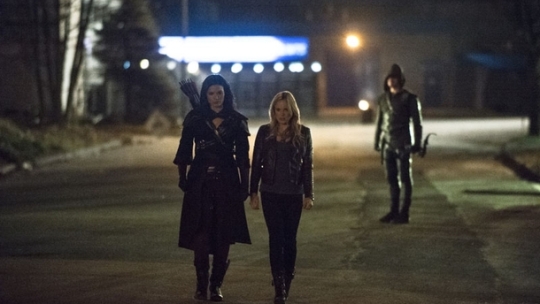
“Arrow” might have tied “Justified” for my favorite episode of the week. “Heir to the Demon” brought Nyssa, the daughter of Ras al Ghul, to town, seeking … well, not revenge on Black Canary. As a matter of fact, I totally did not see the true nature of their relationship coming. And neither did Oliver Queen. This series, the true TV embodiment of comic book adventure like “Batman,” just gets better all the time.

And then there’s “The Walking Dead,” which returns for the second half of its season this coming Sunday. With the destruction of the prison, the survivors are split up. We want to know what happened to Rick, Carl, Michonne, Daryl and Tyrese as soon as possible. And tell me Carol is coming back. I’ll be watching Sunday.

Heck of a week.

‘Sherlock’ returns with ‘Scandal in Belgravia’

One of the unexpected pleasures of TV in the past couple of years — along with “The Walking Dead” and a handful of other shows — has been “Sherlock,” Steven Moffat’s modern-day updating of Arthur Conan Doyle’s Victorian-age detective Sherlock Holmes.

There have been so many — hundreds — of stage, film and TV adaptations of the Conan Doyle books and short stories in the past century years that it’s hard to imagine crowning one as the best, particularly one that takes such liberties with the content of the canon. But “Sherlock,” a BBC production airing on PBS’ “Masterpiece” series (with two more installments to come May 13 and 20) is certainly near the top of the list.

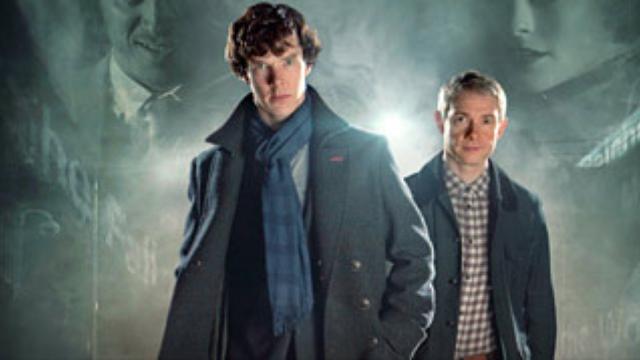
In the series, set in the present day, Holmes (Benedict Cumberbatch) and Watson (Martin Freeman) forge the offbeat relationship familiar to readers of the original stories. Holmes is a brilliant consulting detective, Watson a physician and soldier. Each man is troubled in some respects. Watson is recovering from physical and spiritual wounds suffered in Afghanistan while Holmes is, for all his British intellect and wit, a stranger in a strange land.

The updated series uses original Conan Doyles stories (and titles; tonight’s episode is a take-off on “A Scandal in Bohemia”) as jumping off points, mixing in high-tech touches along with Holmes’ old-school detective work. In other words, for every scene in which Holmes deduces someone’s life story by observing stay hairs on their pants or scuffs on their shoes, there’s another scene in which Holmes or one of the players is texting on their smartphone. Just as Conan Doyle’s original writing had Watson publishing stories about his exploits with Homes — much to Holmes’ bemusement — in the new series, Watson writes a popular blog about the detective.

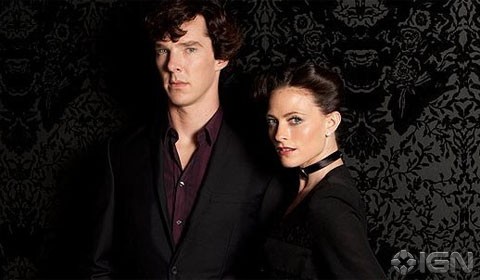
Tonight’s episode, like the 1891 original, introduced Irene Adler, a woman who is Holmes’ equal in sheer, cool intellect. In “Sherlock,” Adler is a high-society dominatrix who, as the  episode opens, is being sought for the compromising photos of a member of the royal family on her cell phone.

Adler is, as fans know, “The Woman,” the female who greatly intrigued Holmes, who was very likely his perfect match … if not for her habit of lawbreaking.

In “Belgravia,” we get some choice “Sherlock” scenes, as Holmes stays one step ahead of the police and the bad guys even as he struggles to keep up with Adler.

All the key ingredients to the “Sherlock” series are here: Holmes and Watson’s fond verbal jousting; landlady Mrs. Hudson; even Holmes’ nemesis James Moriarty. The opening of the episode resolves the standoff between Holmes and Moriarty from the end of the first season.

“Sherlock” revels in its modern-day ingenuity — the use of technology and London’s cool blue exteriors give the series a properly detached feel — as much as it encourages us to focus on Holmes’ never-out-of-style intensity.

Cumberbatch and Freeman are among the best portrayers of Holmes and Watson ever. Cumberbatch gets a showy role but Freeman — soon to star in “The Hobbit” with Cumberbatch providing the voice of the dragon Smaug — is an understated delight.

“John Hamish Watson. Just in case you’re looking for baby names,” Watson mutters at some point when Holmes and Adler are striking sparks.

And what an Alder Lara Pulver is. I love Rachel McAdams, who plays Adler in the current Robert Downey Jr. Holmes movies. But Pulver makes McAdams look like the high schooler she played in “Mean Girls.” Pulver, who matches Cumberbatch in cheekbones and ivory skin, is gorgeous and dangerous. She’s utterly believable as “the woman” in Holmes’ life.

Next week, “Sherlock” takes on “The Hound of the Baskervilles.” I’ll be watching.

New book captures Sherlock Holmes well

Quite unintentionally, I’ve been on a British pop culture kick lately. After enjoying the BBC America show “The Fades,” I started reading David Moody’s “Autumn,” and end-of-the-world-with-zombies story that’s the first in a series. More on “Autumn” later.

In between, I fell in with an old friend: Sherlock Holmes.

My enjoyment of Arthur Conan Doyle’s classic turn-of-the-19th-to-the-20th-century British detective series began when I was young. I loved Conan Doyle’s 56 short stories and, to a lesser extent, his four novels featuring Holmes, the world’s greatest consulting detective, and his stalwart soldier/doctor companion, John Watson. The novels, particularly “The Hound of the Baskervilles,” are fine, I should add. But a couple feel overly padded and drawn out. The character — at least in his creator’s hands — seems to work better in short-story form.

Since I tore through the stories as a kid, I’ve tried a lot of  the tributes and imitators. I loved what “Star Trek” film director Nicholas Meyer did with the characters in “The Seven Percent Solution” and “The West End Horror.” I likewise loved Mark Frost’s “The List of 7” and “The 6 Messiahs,” which took Conan Doyle on his own adventures.

Of course the various movie and TV versions, including the current, terrific modern-day “Sherlock,” have varied in quality. But the best among them have successfully captured the spirit of the stories and the characters: The aloof and driven detective and his loyal and capable companion.

I was looking forward to reading Anthony Horowitz’s “The House of Silk,” a new novel featuring Holmes and Watson, and was especially intrigued to realize that it was the first Holmes story officially sanctioned by the Conan Doyle estate.

It’s not hard to see why.

Horowitz “gets” the characters. “The House of Silk” isn’t the greatest Holmes story ever told. As a matter of fact, I was kind of startled to realize I had figured out the mystery of the title almost immediately, a couple of hundred pages before Holmes and Watson do.

But Horowitz’s mastery of the detective and his friend and biographer is perfect.

One of the greatest complaints about many film and TV versions of the characters, of course, is that Holmes so thoroughly overshadows, even patronizes, Watson. The early Basil Rathbone/Nigel Bruce movies portray Watson as a fool, nearly doddering and more of a hindrance than a help to Holmes, who makes fond fun of his friend’s incompetence.

In Conan Doyle’s stories and in Horowitz’s book, Watson is accurately portrayed as the man he likely would have been: A doctor and veteran of the British campaign in Afghanistan, Watson was handy with a gun and his fists and wasn’t a dunderhead by any means. That he couldn’t keep up with Holmes’ deductive reasoning was no surprise. No one could.

Besides the characters, Horowitz spins a neat tale of intrigue involving an upper-crust art dealer as well as the “street urchins” that make up Holmes’ Baker Street Irregulars. After something dire happens to one of Holmes’ youthful street-level eyes and ears, the detective feels compelled to right a wrong.

Horowitz hits all the right notes here, with Holmes as the master of disguise, an appearance by his brother, Mycroft, and even some love for Lestrade, the Scotland Yard inspector who was often Holmes’ antagonist.

By virtue of having written “The House of Silk” a century after the original Holmes stories, Horowitz is able to include plot developments that never would have been hinted at by Conan Doyle. There’s some pretty dark stuff going on behind the scenes, and Horowitz fits it into the story quite neatly.

One of the best elements of the book is the aura of regretful hindsight that Horowitz brings to the story. Watson narrates the story from years after the fact, and acknowledges what many of us feel: We don’t pay enough attention — and don’t acknowledge — the people in our lives often enough.

Horowitz has Watson noting, for example, that he didn’t relate to Mrs. Hudson, the detective’s landlady, enough. Saddest of all, Watson admits he didn’t even know Holmes’ birthday until he read it in the detective’s obituaries.

“The House of Silk” isn’t a mind-bending puzzler. But it is solid Sherlock Holmes fiction written for modern-day sensibilities. It’s a great addition to the official Holmes canon.