‘Justified’ returns tomorrow night

Oh yeah. The coolest show on TV is back.

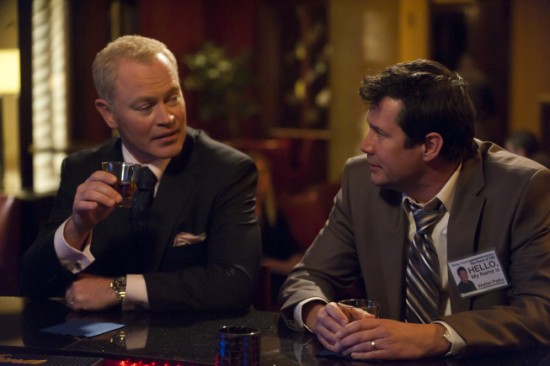
“Justified,” the crime drama based on Elmore Leonard’s writings about small-time Kentucky criminals and the U.S. marshal opposing them, returns Tuesday night on FX.

Timothy Olyphant is back as Raylan Givens, the slow-simmering marshal, as is Walton Goggins as Boyd Crowder, Raylan’s longtime friend, sometimes nemesis, sometimes ally.

FX has given us an idea about what to expect this season:

“In Season 2, Deputy US Marshal Raylan Givens (Olyphant) squared off against criminal matriarch Mags Bennett (the part for which Margo Martindale won an Emmy Award). The end of Season 2 brought about the end of the Bennett family’s hold over Harlan County and the return of Raylan’s old nemesis/friend Boyd Crowder to the criminal life. This season, Boyd and his crew will find they aren’t the only ones making a play to rule the Harlan underworld. Now Raylan finds himself facing off against dirty politicians, hidden fortunes, a mysterious man named ‘Limehouse’ and an enterprising and lethal criminal from the Motor City.”

The Motor City? Will Raylan run afoul of “The Detroit Connection?” (Sorry, inside joke.)

Even though this is the third season, you won’t be missing anything if you’re just jumping into the show.

Check it out, Tuesday night on FX.

‘The Simpsons’ approaching 500th episode

We’ve been watching a lot of episodes of “The Simpsons” in my household lately. Not new episodes, but classics from old DVD collections.

My son has discovered the show and is currently obsessively watching the fifth season which, I’m startled to realize, aired several years before he was born.

I haven’t watched “The Simpsons” in years. As I’ve noted previously in this blog, I think the show ran out of steam somewhere around the 10th season. The few episodes I’ve seen in the past decade seemed cheap and obvious.

The fifth season, currently in “play all” mode at my house, was a whole different story.

Consider this: Bill Clinton was president and “Buffy the Vampire Slayer” was still just an awful movie and had not yet become a classic television series.

But “The Simpsons” was at a creative peak.

The episodes of that fifth season included:

“Homer’s Barbershop Quartet,” in which Homer, Apu and Skinner form a chart-topping pop music group and even beat Dexys Midnight Runners for the Grammy award. Don’t worry, Homer assures, we haven’t hear the last of them.

“Cape Feare,” in which Sideshow Bob gets out of jail and vows revenge on Bart. It all ends up at Terror Lake, where Bob finally catches up with his tormentor … after stepping on dozens of rakes.

“Homer Goes to College,” in which Homer thinks the mean old dean from “Animal House” is typical of college administrators.

“Bart’s Inner Child,” in which a self-help guru advises the town of Springfield to “be like the boy,” “Boy Scoutz N the Hood,” in which Homer ruins a perfectly good father-and-son rafting trip and Ernest Borgnine proves himself more than a match for a bear, “Bart Gets an Elephant,” which introduces Stampy; and so many more.

“The Simpsons” is quickly becoming one of the longest-lived shows on TV, despite threats that come up every few years when the wonderful voice cast asks for a raise and Fox says the show isn’t making enough money to be able to afford it.

The show’s 500th episode is set to air Feb. 19 and I might tune in. I want to enjoy the show like I did when acid-washed jeans were all the rage. I’m afraid both are cultural icons whose time has passed, though.

‘The Walking Dead’ mid-season premiere poster

Yes, it’s come to this. We all want “The Walking Dead” back so much we’re excited about a poster advertising it.

And yet.

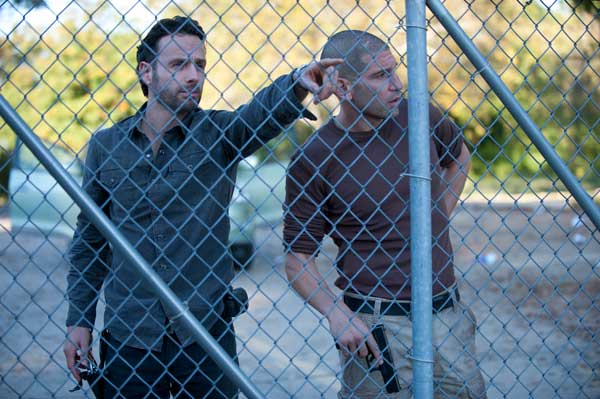
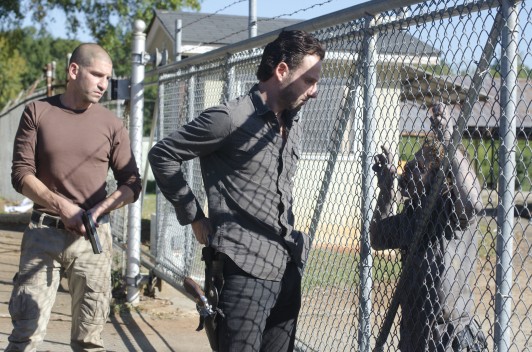
AMC released this poster over the weekend. It shows Rick (Andrew Lincoln) taking aim at … what? Zombie Sophia in the final minutes of the last episode? Bossy farmer Herschel? Crazy loco Shane?

We’ll see when the show returns on Sunday, Feb. 12.

About those ‘Starving Artists’

So when I’m sick I watch more TV than I normally do, and since I’ve been watching a couple of nostalgia TV channels recently added to our cable lineup, I’ve seen some cheap commercials, including ones for those house slippers you heat in your microwave.

(Slippers in the microwave? The hell?)

Anyway, the last couple of days, every commercial break has been broken up by ads for the latest “Starving Artists” sale.

I remember commercials for these sales when I was a kid. Inevitably, the sales were held over a weekend at a fairgrounds or motel and featured the work of “professional artists” but were selling for as low as a few dollars.

Most memorably, the sales offered “sofa-sized” paintings. A few years ago they were less, of course, but now these behemoths of art are going for $49.99.

I’ve never been to one of these sales. I don’t have a lot of art on my walls, but what is there is something meaningful to me. Hand-me-down favorites from relatives, or pictures or prints bought at a significant time. Couple of movie things too.

So I didn’t feel the need to go snap up some landscapes that looked, frankly, as if they were painted by unprofessional artists. Or maybe the artists are professionals but are so weakened by hunger that their technique is impaired.

But being the curious sort, I decided to look on the Internets for info about the sales.

I didn’t find much. A couple of sites featured columns that theorized the paintings are mass produced in China. Some say they’re done on an assembly line in sweatshop-style conditions, with artists standing for 14 hours at a time, painting the same tree and then passing the painting along to the next artist, who paints a hillside or ocean.

Perhaps entirely appropriately, the online pieces about the starving artists sales appear to crib from each other.

It’s not surprising that online “writers” steal from each other and post verbatim or nearly word-for-word versions of the same story.

But it’s pretty comical when you’re reading stories about mass-produced art and most of them end with:

“Now that you know the inside scoop on the starving artists sales, don’t you think that your $50 would be better spent on a good pencil sketch by a student artist at your local college or university? I certainly do.”

It’s good to know that the starving artists have comrades online.

High Priest(ess) of steampunk

Steampunk is kind of heard to explain.

Remember the rivet-covered, steam-powered flying saucers and such in the old 1960s “Wild, Wild West” TV series? Or the giant mechanical spider in the awful big-screen adaptation of the series, starring Will Smith?

Wait, let’s back up. I’m not sure anybody wants to remember that widescreen nightmare.

Anyway, steampunk — and the genre of fiction that bears that name — is, for the most part, a fanciful recreation of the latter half of the 1800s and early 1900s. Cowboys ride horses and use six-shooters and people travel on trains, but dirigibles are commonplace, people with missing limbs brandish elaborate false appendages and coal-or-steam-or-pedal-powered engines of destruction are the latest weapons of war.

Enter Cherie Priest.

Priest is a blogger and author of several works of fantastic fiction that falls into the “urban fantasy” category, where vampires and werewolves clash with criminals in big-city settings. I’m going out on a limb somewhat there, because I’ve just started reading one of Priest’s urban fantasy books, “Bloodshot,” so I’m not exactly sure what her books in that genre are all about.

But I can speak authoritatively about her steampunk books.

Priest isn’t the only person writing steampunk right now, certainly, but she’s one of the top practitioners. And her “Clockwork Century” series is not to be missed.

Priest’s steampunk series is set in the American 1880s, but one that’s markedly different from what we find in history books.

For one thing, the Civil War is dragging on. The battle between the North and South has been prolonged by the meddling of other parties, most notably the Republic of Texas, whose oil wealth and martial might — symbolized by the Rangers — have mustered on the side of the Confederacy.

Motivated by war and the profits to be had, inventors and captains of industry have pushed the 19th century’s technology and perfected lighter-than-air ships, trains bristling with armament, submarines and, most impressively, walking suits of armor.

Priest’s characters — many of them strong women, including a widow searching for her son in a ravaged city landscape, a nurse trying to make her way across country to find her father and a New Orleans madam eager to help the North and shake loose the bonds of the Confederacy — move through her plots in a matter-of-fact manner, wielding a gun or feminine wiles with equal skill.

Oh, and did I mention the zombies?

Yes, Priest has complicated matters by creating a wave of the walking dead — or rotters, as they’re called in their place of origin, Seattle.

In “Boneshaker,” Priest explains how the zombies were created. A drilling machine released a toxic gas from the bowels of the earth under Seattle. Much of the city’s population fled. Others turned into rotters, shambling through the streets in search of human flesh. Others Seattle-ites fled to the underground beneath the city, where they live in tunnels safe from the toxic gas because of an intricate series of tubes and pumps.

If they go topside, they must wear gas masks to avoid turning into rotters. And they must be on guard not only from the zombies but the criminal element that thrives in the city.

In “Dreadnought,” we get our first glimpse of how the zombie plague is spreading. Drug makers and dealers are distilling the gas and turning it into “sap,” a highly addictive substance that eventually turns its users into the walking dead. The title refers to an especially deadly war train on which much of the story unfolds.

In “Ganymede,” the addiction has spread to New Orleans, which is a hotbed of Civil War intrigue thanks to a missing submarine and efforts to get it in the hands of the Union.

One of the most fun elements of Priest’s books is how she weaves characters through all her stories. The protagonist of “Boneshaker” is a supporting player in “Ganymede,” while the nurse and a Texas Ranger from “Dreadnought” show up in “Ganymede.”

Priest is a nimble writer. If you’re worried that her books would be written in a pseudo-Victorian-era style, don’t be. While her characters are not anachronisms, they have enough modern sensibilities to be completely relatable.

The books are fun, fast reads. (One of my few quibbles can be blamed on my aging eyes. The print in the paperback editions is sepia-toned. It might be appropriate to set the mood for the period in which the stories take place, but it makes it a bit hard to read.) Priest keeps the plot moving and throws in just enough twists and turns to surprise the reader.

Priest announced some big news right around the end of November. “Boneshaker” has been  acquired for adaptation as a movie. It’s probably not surprising, considering how hot zombies are right now, with “The Walking Dead” a hit on TV and in comics and “World War Z” coming out later this year.

Besides, who can resist the pitch — included in the announcement — that “Boneshaker” was like “Jules Verne meets ‘Resident Evil?'”

Movies are tricky things. Sometimes they completely miss the flavor of the books on which they’re based. Sometimes they get everything right.

Priest’s steampunk stories — and more of them are on the way — are as entertaining as any movie adaptation could be. Don’t wait for the big-screen version.

And we’re back ….

That was supposed to suggest Jimmy Fallon in that old “Saturday Night Live” sketch about an obnoxious morning radio DJ.

Except I certainly couldn’t scream it like he did.

I’ve been under the weather for about a month now and still don’t really feel like myself, but I need to feed the blog. So I’m going to play pop culture catch-up some in the next few days.

Hopefully.

Can’t wait: Upcoming TV shows to watch for

Back in the day, TV networks threw all their season premieres into the same week in September. It made for a fun issue of TV Guide but was fairly suicidal. Even though there were only three or four networks back then, it was impossible to check everything out.

With the splintered and factionalized TV picture that came with the explosion of cable, TV series premiere virtually throughout the calendar year. Shows take mid-season breaks, stay off the air for months and years (I’m looking at you, “Mad Men”) and pop up whenever.

There’s something to look forward to in the coming weeks, however: The return of several new favorite dramas.

First up is one of my favorite shows, FX’s “Justified.” Based on characters created by crime novel legend Elmore Leonard, the show features Timothy Olyphant as U.S. Marshal Raylan Givens, back in his home state of Kentucky and, with cool Stetson and even cooler demeanor, running roughshod over lowlifes and bad guys.

“Justified” returns at 10 p.m. Tuesday, Jan. 17 on FX.

Not long after comes Feb. 12 and the premiere of the second half of season two of “The Walking Dead” on AMC.

The survivors of the zombie apocalypse, traumatized by the loss of young Sophie, forge ahead with their efforts to find their way through the wilds of Georgia and the end of the world.

I’m hoping — really, really hoping — that Rick, Lori, Daryl Dixon and the rest get off the farm where they’ve been all season so far, and get out of there quickly once the second half of the season begins.

How many years has it been since we last saw Don Draper and the rest of the cast of AMC’s “Mad Men?” Two? Three? Less than that? Really?

Well, the deliberately-paced 1960s character drama will finally return on March 25, if you can believe star Jon Hamm’s recent announcement.

Speaking of great characters: One of my favorite episodic dramas of the past couple of years is “Sherlock,” the modern-day retelling of Sir Arthur Conan Doyle’s classic Sherlock Holmes tales. Benedict Cumberbatch returns as the brilliant detective and Martin Freeman makes for one of the most satisfyingly irritable John Watsons ever.

Just three episodes aired on PBS’s “Masterpiece Mystery” last year and three more are coming in May. Best news: Three more episodes are now in the works.

I wish I could tell you with some certainty when A&E’s “Longmire” series will premiere, but I haven’t seen a date other than “sometime in 2012.”

I also wish I could tell you that the series is faithful to Craig Johnson’s wonderful mystery series about Walt Longmire, an old-fashioned modern-day Wyoming sheriff dealing with an odd assortment of characters and crimes. I wish I could say that it is — and it very well might be — but the casting is a little young and a little off.

The best bit of casting? Katee Sackhoff of “Battlestar Galactica” as Longmire’s funny, profane deputy, Victoria. The actress is perfect for the part.

Of course, there are other shows to look forward to. But that’s a pretty good start to any year.


‘Dragon Tattoo’ does the research

Who knew research nerds were so sexy? Not to mention so dangerous?

Well, everybody who has read Stieg Larsson’s “The Girl with the Dragon Tattoo” trilogy, I suppose, or those who’ve seen the original Swedish film adaptations or the new movie version of the original novel in the trilogy.

I guess it’s easy enough to say that all detectives — from Sherlock Holmes to Batman — are characters who do a lot of research because, after all, that’s what investigating is all about.

But Larsson’s characters, Lisbeth Salander and Mikael Blomkvist, spend more time scanning old photographic contact sheets, reading corporate histories, perusing personal scrapbooks and, of course, tap-tap-tapping on the keyboards of their laptops than any of their written word or big-screen contemporaries.

The thought occurred to me today after seeing David Fincher’s big-screen, big-budget adaptation of Larsson’s first book, starring Daniel Craig as Blomkvist and Rooney Mara as Salander.

Anyone who’s read the books or seen the earlier movies knows there’s a reassuring and even kind of humorous pattern of activity in the stories, much of it centering on Salander, the emotionally and socially estranged but brilliant investigator who helps Blomkvist, a discredited journalist, probe the long-buried secrets of a rich family.

Salander spends much of Larsson’s books smoking, buying frozen pizzas from convenience stores and riding her motorcycle. Blomkvist drinks enough coffee to float all of Sweden.

But seeing the movie today emphasized how much time the two spend poring over everything from the Bible to old newspaper archives to Google search results.

I should note that I’m a fan of Larsson’s books at the same time I recognize their shortcomings. Completed before the author’s untimely death in 2004, the books have taken on a life of their own, selling 15 million copies in the U.S. alone.

There’s some clunky moments in the stories, to be sure, and maybe that’s from the editing or translation. But the compelling characters and ingenious plots more than make up for it.

Blomkvist is, as has been noted elsewhere, a somewhat passive character. I think some people don’t realize, though, that Larsson’s background as a journalist probably contributed to that. Blomkvist is a social crusader and risk-taker — not only in his amorous personal life, but in his professional life too — but, like good journalists, is more of an observer than an agitator. His role, even when people are shooting at him, is to probe rather than instigate. Can you imagine how unlikely a reporter he would be if he pushed and provoked like Robert B. Parker’s Spencer?

But Salander … man, what a character Larsson has created.

If you haven’t read the books or seen the original movies, the new movie won’t give you too many clues to her background. But suffice it to say, Salander survived an incredibly abusive upbringing and traumatic events — both of her own making and at the hands of authorities — than wouldn’t be survivable by many people.

She lives in self-exile in the midst of bustling Stockholm, relating to most people sideways, out of the corner of her eye. In fact, it’s remarkable when, late in the movie, Salander trusts and likes Blomkvist enough to look at him head-on.

That’s not to say that Salander is a pliable character. Because she likes to disappear into the background doesn’t mean that she’s a pushover. After being brutalized by her government guardian, she lashes back in a most satisfying manner. Throughout the stories, Salander takes things into her own hands, achieving revenge and righting wrongs. She has a fierce personal code and protective streak and has the tools to back it up. One of the pleasures of the trilogy is seeing Salander unleash her fury. A small woman, she launches herself into a fight, devastating her opponents. Larsson called it “Terminator mode,” and while it might be as cliche as it is unlikely, it’s thrilling.

The new movie — which, of course, is not for younger audiences, considering the sex and violence quotient — necessarily telescopes some of Larsson’s story. Blomkvist’s troubles are given a thumbnail treatment and there’s little of the admittedly yawn-inducing thumbsucking over the operations of his investigative magazine. I really didn’t need more discussions of which staffer would take over which role if Blomkvist left. If the second book, “The Girl Who Played with Fire,” gets made into a movie, some of that internal magazine stuff will be necessary since two staffers from the magazine figure into the plot.

There’s a moment with Craig’s Blomkvist makes a joke about losing track of the members of the divisive Vanger family. Who can blame him? They’re all old and either Nazis or worse — yes, that’s possible — and mercifully off-screen for most of the movie, and that’s a good thing.

The movie doesn’t shy away from the book’s sexual, violent and sexually violent overtones. Really. Don’t go if you’re squeamish.

Craig, normally so take-charge and headlong as James Bond, is good as the journalist who isn’t really an action hero. When he gets rescued by Mara’s Salander, it’s believable.

Mara — like Noomi Rapace, who played Salander in the Swedish film versions — is very good as the damaged Salander. She’s appropriately spiky but vulnerable.

There’s been speculation that the box-office returns for “The Girl with the Dragon Tattoo” haven’t been good enough to warrant a sequel. That’s too bad in a way, because I’d like to see what Fincher, Craig and Mara do with “The Girl Who Played with Fire,” because it’s my favorite of the three books. If they don’t make another movie, though, that’s okay. The book is still there, right on my shelf, ready to take me back to the cold and barren world of Salander and Blomkvist.


Whatever happened to pudding pop culture?

Here’s another of those books that I wish I had written, not because it’s a great work of literature but because somebody had to do it and really, it looks like it was ridiculously easy.

“Whatever Happened to Pudding Pops?” written by Gael Fashingbauer Cooper and Brian Bellmont, might have been a years-long labor of love by the authors. Truthfully, it looks and reads like it took about a week to put together.

Not that there’s anything wrong with that.

Seriously, the authors’ bite-sized bits of pop culture history — the book is subtitled “The lost toys, tastes and trends of the 70s and 80s” — is the print equivalent of VH1’s addictive “I Love the 80s” series and its many spinoffs.

They’ve taken a few dozen topics — lawn darts, Judy Blume, John Hughes movies, and the title snack, pitched by favorite TV dad Bill Cosby — and turned out a couple hundred words on each. Pudding Pops were revived in 2004 but just weren’t the same, the authors say. I’ll have to take their word for it.

There’s not a lot of there there, if you know what I mean. And I can’t imagine actually buying this book — about the size of an old issue of TV Guide; how’s that for nostalgia? — for the $12.95 price.

But in the grand tradition of books you read in the bathroom, it’s fun enough.

James Bama: Artist of a thousand faces

For a compulsive credits-watcher like me, the revelation was dumbfounding: One artist was responsible for some of the most memorable pop culture images of my childhood.

James Bama is a well-known Western artist. For me, he’s always been the man who painted photorealistic but slightly surreal covers for the 1960s paperback reprints of old “Doc Savage” pulp novels.

Since I obsessively checked movie and TV credits and artist and author credits of books, magazines and comic books, Bama was a familiar name to me.

His drawings of pulp hero Savage no doubt helped sell a new generation of fans on the Depression-era adventure stories.

How could young readers not be interested in a hero and an adventure that looked like this?

But when goofing around on the Internets the other day, I realized that the Bama of “Doc Savage” fame was also the artist who painted the cover of  an early “Star Trek” novelization. It’s one that’s still on my bookshelf.

When I realized Bama had created that art, I began looking around and discovered that Bama had also painted the monster art used on 1960s Aurora model kits I loved as a kid.

How is it possible one man created so many pop culture — geek culture — touchstones?

Bama, a commercial illustrator for decades, gave up that life at his peak and left the fast lane behind to become a Western artist. He’s still going strong, painting and selling his art through a variety of galleries and websites.

He’s not drawing the colorful characters of my childhood anymore. But that’s okay. His classic work is already the stuff of pop culture legend.