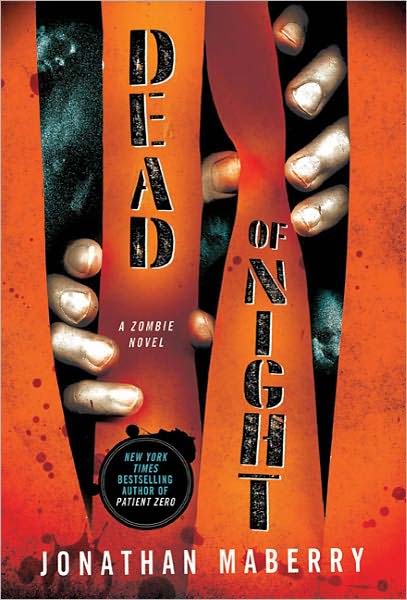
Cops and zombies: Jonathan Maberry’s ‘Dead of Night’

Shambling and slow as they might be, we just can’t get away from zombies.

There’s “The Walking Dead” on TV — the biggest hit on cable — and “World War Z,” the movie version of Max Brooks’ terrific book and starring Brad Pitt, to come out later this year.

And there’s Jonathan Maberry’s “Dead of Night.”

Maberry is a writer of suspense fiction, comic books and thrillers that take their cue from biological warfare and the queasy possibilities of modern-day laboratory horrors.

In “Dead of Night,” Maberry does a couple of things I’ve not seen in a zombie book before.

He gets inside the mind of a couple of zombies — yeesh — giving readers a feel for the zombie perspective.

And, most interestingly and importantly, he approaches the possibility of a zombie apocalypse from the perspective of small-town cops dealing with its early stages.

Think about it: Most zombie books and movies, even if they have a small-town or isolated setting, include characters who know the big picture.

While Maberry’s story has those characters, it follows, especially early on but throughout the book, the street-level shock troops dealing with the beginning of the end of the world.

Maberry’s small-town Pennsylvania cops and TV reporters don’t know, at least for a while, that a plague of zombies has broken out. They only know that a couple of people have been killed, in grisly fashion, and that a couple of bodies have disappeared. A suspect is on the loose, but it takes a while for them to realize that the suspect and the missing corpse are one and the same.

The characters try to puzzle this out but thankfully never seem oblivious to the mayhem developing around them. As a matter of fact, there’s nothing like a previously dead body attacking you to change your perspective.

“Dead of Night” is a well-written thriller with appealing, made-for-cable-TV characters and situations.

The ending is open just enough to allow for a sequel. I don’t know if Maberry is planning one, but I’m ready to rejoin the zombie hordes if it happens.

Wright, Depp to team on new ‘Night Stalker?’

Ever feel that mixture of eager anticipation and dread, that feeling that runs up your spine and messes with your brain when you’re thinking about something that could be so good, so cool … if it just doesn’t get screwed up?

That’s what I felt this afternoon when I heard that Johnny Depp and Edgar Wright, the genius director of “Shaun of the Dead” and “Hot Fuzz,” were teaming up to make a big-screen version of “The Night Stalker.”

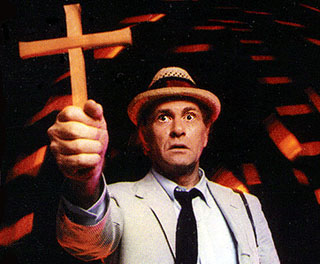
If you’re not familiar with it, “The Night Stalker” was a 1972 TV movie that starred character actor Darren McGavin as Carl Kolchak, a hard-charging newspaper reporter who — thanks to his willingness to buck authority and his his inability to kowtow to his bosses — has drifted from newspaper to newspaper, city to city, in search of steady work.

He’s at a paper in Las Vegas when a series of gruesome showgirl murders gets his attention. He starts covering the story and, much to the horror of city officials and the chamber of commerce, discovers not only that a serial killer is at work … the killer is a vampire (played to truly creepy, alien effect by Barry Atwater).

The movie unfolded like a modern-day police procedural, with Kolchak arriving at crime scenes and irritating the cops when he isn’t hanging out in the morgue. It builds to a genuinely suspenseful climax in which Kolchak takes things into his own hands … only to find himself run out of town by officials worried about the story’s impact on tourism.

Masterful writer Richard Matheson wrote the movie based on a terrific book by author Jeff Rice.

“The Night Stalker” was the highest-rated TV movie of its time and sparked not only a 1973 sequel, “The Night Strangler,” but a 1974 series, “Kolchak: The Night Stalker.”

In the series, which ran only one season, Kolchak worked out of a Chicago news service, frustrated the same boss (the blustery Simon Oakland), and kept running into monsters. The best episodes featured a zombie and a vampire who was one of the victims from the original movie.

News of the remake doesn’t fill me with quite the same level of anticipation and dread that I feel for the Tim Burton/Johnny Depp “Dark Shadows.” Maybe because Burton, a genuine artist who seems to have lost the ability to make a coherent movie, isn’t associated with this.

Maybe because, as much as I liked “Dark Shadows,” it isn’t the equal of “The Night Stalker” in my book. If Burton makes “Dark Shadows” an unwatchable mess, that’ll be a loss. If Wright screws up “The Night Stalker,” I’ll be in mourning.

Wright — who has also been working on a movie of the Marvel Comics character Ant-Man, a member of The Avengers — seems well-suited to the mixture of humor and horror that a proper adaption of “The Night Stalker” would need.

But I really would dearly love it if a “Night Stalker” movie was really good, spawning a new generation of fans and renewing attention for the original ABC movies and TV show.

‘Justified’ packs a punch with ‘When the Guns Come Out’

“I got no interest in shit-kicker on shit-kicker crime.” — Deputy U.S. Marshal Raylan Givens to lifelong friend/antagonist Boyd Crowder.

The third season of “Justified,” the FX series about good guys and bad guys in the hills of Kentucky, just gets better and better.

In tonight’s episode, “When the Guns Come Out,” Raylan Givens (Timothy Olyphant) finds himself dealing with the fallout from a burgeoning drug war in rural Harlan County.

As Boyd (the wonderful Walton Goggins) muscles in on the Oxycontin trade, gunmen working for Detroit mobster Quarles (Neal McDonough) start killing people.

Poor Raylan is befuddled by the sudden disappearance of Winona (Natalie Zea), his pregnant ex-wife, but he’s sufficiently on his game to not only banter with Boyd but pistol-whip a sleazy pimp whose hookers are victims/witnesses to the murders.

Off in the wings, homegrown mobster Limehouse (Mykelti Williamson) begins to maneuver his response to the growing threat of Quarles.

Tonight’s episode had a perfect mix of Raylan/Winona soap opera, Raylan/Boyd dramatic/comedic tension and violence so abrupt it’s almost funny.

There were great moments for Raylan’s boss, crusty marshal Art (Nick Searcy) and an appearance by Ava (Joelle Carter). And a return appearance by Stephen Root as a Harlan County judge.

It surprises me somewhat that “Justified” creator and producer Graham Yost makes this all look so effortless. But the show is better with every episode.

Your comic books died to make these valuable

When I was a kid in the 1960s, my neighbor Mike gave me several of his comic books, including the fourth issue of “The Avengers,” in which Captain America returns from being frozen in ice since World War II.

I built a small but beloved collection of comics around the issues that Mike gave me. I bought a lot of comics — mostly Marvels, but also some DCs — until they became a little too pricey for me: I could buy a lot of comics at 12 cents each, but when the cover price increased to 15 cents, around 1969, I cut back. By the time comics were selling for 20 cents a couple of years later or 25 cents a couple of years after that, I really curtailed my purchases.

I still vividly remember standing in the checkout line at a Southway Plaza dime store, trying to figure out which of the comics the cashier had just rung up I was going to put back on the rack. I had picked out more comics than my dollar would buy. And math, obviously, was not my strong suit.

Anyway, I kept my comic book collection — which was for reading, not archiving — in my family’s cedar chest on our enclosed front porch. Over the years I read and re-read those comics and they became pretty tattered.

Of course, the inevitable happened: My mom threw my dog-eared comics away.

It’s a familiar tale. It happened to most kids who bought comics over the decades. That so many comics fell apart or got tossed in the trash is what makes the surviving comics so valuable.

So it’s with a mixture of regret and pride that I read stories like this one by Jamie Stengle, who writes about how a guy in Texas discovered that the comic book collection that had always been promised to him by his aunt — his Uncle Billy’s collection — was worth a couple of million bucks.

Uncle Billy’s collection included such classic issues as Action Comics No. 1, which featured the debut of Superman, and Detective Comics No. 27, which introduced Batman.

Those two issues alone are likely to go up for auction and could fetch as much as $325,000 and $475,000, respectively.

If you’re mourning the loss of your beloved comics — or the loss of that valuable asset — it’s okay. If our moms hadn’t thrown out our comics, the comics inherited by these two guys in Texas wouldn’t be worth as much.

Wait, that’s not much comfort, is it?

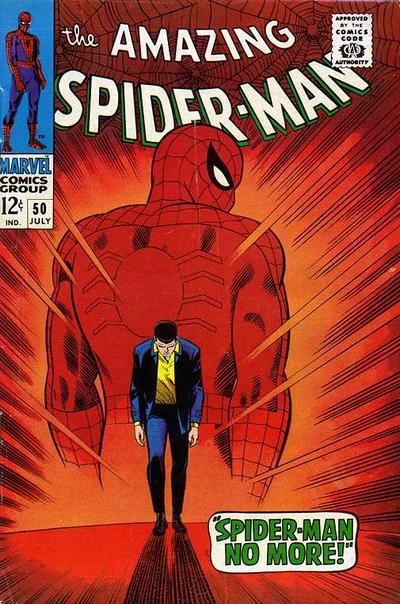
(Above: One that got away from me: Amazing Spider-Man No. 50)

‘Community’ returns March 15

For a while there, it looked like “Community” was finished.

The innovative, clever and — most importantly — funny NBC comedy seemed destined to fade into the land of dead-bef0re-their-time shows like “Freaks and Geeks” and “Undeclared.” A few months ago, NBC interrupted the third season of the show and said it would return to the air … sometime.

At least “Community” fans would have the comfort of knowing their show, about a collection of lovable oddballs hanging out at a second-rate community college, had lasted two, nearly three seasons.

But today, NBC announced that “Community” would return on March 15. True, the series will air at 8 p.m. Thursdays, opposite CBS’ uber-popular nerd comedy “Big Bang Theory.” But at least “Community” is coming back.

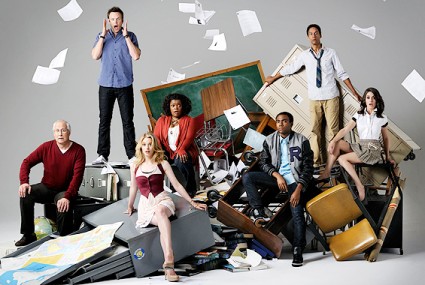
If all the talk about how offbeat “Community” is has discouraged you from trying it … don’t be discouraged. The show, created by Dan Harmon and starring a diverse and appealing cast, is a little odd. I mean, how many series can boast of a Christmas episode in which the characters act out a goofy, heartfelt fantasy set in “Rudolph” style Claymation?

Trust me. “Community” goes to extremes — the paintball episode that ended the first season was an amazing send-up of every action movie cliche ever — but it’s genuinely funny and doesn’t take a lot of effort to appreciate.

So check it out. For both of us.

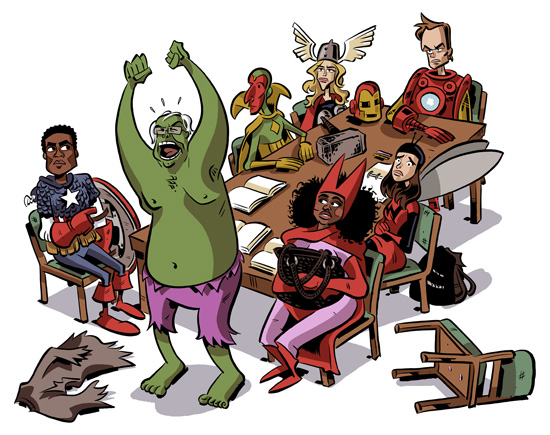
And, for no apparent reason, here’s a drawing by artist Chris Schweizer of the “Community” cast as Marvel’s “The Avengers.” No idea why. I just came across it and had to share it.

I think my favorite part is Abed as the Vision. Classic.

‘Alcatraz’ ponders bullies in ‘Johnny McKee’

Each week, the Fox thriller “Alcatraz” lets loose another former inmate of the island prison into modern-day San Francisco. And more than a few of those inmates, we’ve seen, have had some motivation for their criminal behavior.

Tonight’s episode of the series, “Johnny McKee,” offered the most overt explanation yet for what makes a killer a killer.

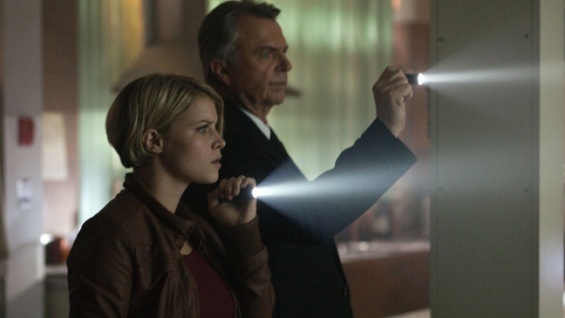
As Hauser (Sam Neill), Madsen (Sarah Jones) and Soto (Jorge Garcia) pursue McKee (Adam Rothenberg), a 1950s mass murder who killed with poison and is taking up his old habits in the modern-day, flashbacks show McKee as a man — admittedly unhinged and homicidal — bullied into killing another inmate while in prison.

There’s not a lot of sympathy to be had for McKee, of course. Ultimately he tells prison psychiatrist Lucy Banerjee (Parminder Nagra) — who also made the leap through time along with the inmates and Dr. Milton Beauregard (Leon Rippy) — the motivation for his first mass murder, more than a half-century ago. It’s pretty dire but doesn’t prompt viewers to think, “Yeah, I can totally see why he’s killing dozens of people.”

In the present day, Banerjee has been shot by a sniper and lies in a coma. Hauser, who knew Banerjee when he was a young guard, keeps careful — even loving — watch over the doctor.

The show, which has been struggling in the ratings, continues to tease with overall mythology and secrets. Madsen’s grandfather, an inmate on the loose in the present, is mentioned. There are also sinister overtones to the modern-day prison where Hauser — who we learn has the authority to eliminate viral videos from the Internet if they threaten to reveal the existence of his little project — keeps the recaptured inmates.

I’m still enjoying “Alcatraz,” but I’m increasingly worried that becoming involved in the show’s mythology — and that’s the best part of the show, really; the hunting down of inmates is becoming pretty routine — is going to pay off only in frustration when Fox yanks the show.

Next week’s episode, like an earlier one in which the first guard returned, looks to be interesting. An inmate who was innocent back in the day returns. But is he a killer now? (I’m guessing no.)


‘Walking Dead’ adds action in ‘Trigger Finger’

Okay, that was more like it.

Tonight’s episode of “The Walking Dead” on AMC, “Trigger Finger,” liberally mixed action with the soap opera storylines we’ve become accustomed to so far in this, the second season of the zombie apocalypse show.

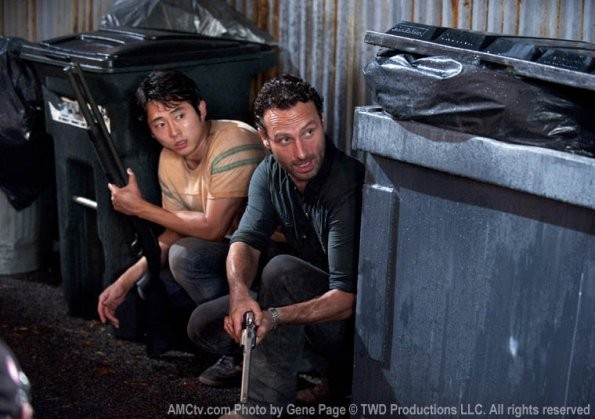
A follow-up to last week’s episode, in which Rick and Glenn went to town to find Hershel, only to meet — and in Rick’s case, kill — two dangerous human types, “Trigger Finger” opened as the companions to the interlopers from last week gathered outside the saloon and, for a while, kept our heroes pinned down by gunfire.

Meanwhile, Shane went off to find Lori, who crashed her car last week and found herself fighting off a walker attack this week.

The episode had the kind of action that too many episodes haven’t featured this year, including the opening gunfight between the good guys and the new and mysterious bad guys. The stand-off was complicated by the arrival of zombies and a serious injury for one of the interlopers. Rick decides to take the injured stranger back to the farm, which further antagonizes Shane.

I’m getting the sinking feeling that the remaining few episodes of this season will be spent on Hershel’s farm. The static nature of the farm setting — and the stories told so far this year — has been a sore point with fans, me included.

But — and this is a very big but — if the remaining episodes have the same mix of action and suspense and character drama as tonight’s “Trigger Finger,” I’ll keep watching.

On the interpersonal relationships front, Shane spilled the beans about Lori’s pregnancy and and Lori cautioned Rick that Shane believes that Lori and the baby are his … and very well might kill Rick to take what he believes he’s entitled to.

Also tonight, Glenn froze in action and dealt with the aftermath and Andrea and Shane seem to be drifting further away from the core of the group. And Daryl seems intent on pushing Carol away.

One thing I’d like to see: More to do for T-Dog. He’s barely in the series anymore.

Best thing about tonight’s episode: The new, improved, man of action Hershel. If we’re gonna hang out with him all season, I’m glad he’s capable of being more than a soft-spoken old scold.

Gruesomest thing about tonight’s episode: Lots of zombie chowing down, plus a grisly fence impalement.

‘The Simpsons’ marks 500 episodes

“The Simpsons” reached its 500th-show milestone tonight, in case you’ve been living off the grid for a while now and haven’t heard.

As has been the case since the mid-90s, the episode was pretty hit-and-miss. There were some funny moments, but all too often in recent years the show seems to trade clever for crude. (More on that later.)

The plot: The entire town of Springfield, tired of the antics of Homer and the clan, decides to exile them from town. The Simpsons leave Springfield and stumble across some folks “living off the grid” and decide to give it a try.

There were some nice touches. The opening credits ended with a montage of hundreds — maybe 500; I sure couldn’t count them all — opening credits couch gags.

The show, as it often does, took a shot at its network home.

Midway through the show, the newly off-the-grid Simpson family recreated their opening credits at their new rural location. The family assembles in the living room and, instead of watching TV, they’re watching a fox sleeping on a rock.

“I’m sick of watching Fox,” Homer complains.

The episode also contained what might be the dirtiest joke I’ve ever heard on TV.

When someone acknowledges that Springfield is full of jerks, Lenny (I think it was Lenny) says, “Want me to spray some of my Jerk Off on you?”

Other good jokes:

Moe, the proprietor of Moe’s Tavern, sets up shop in a cave. The name: Moe’s Cavern.

Chief Wiggum’s acknowledgement: “I’m not the sharpest pencil in the … pencil thing.”

At the movies: Some favorite theaters

I love movie theaters.

Granted, I don’t enjoy some of the modern-day accoutrements of movie theater-going, like people talking, people talking on their cell phones and people coughing directly on the back of my head.

But I have been a lifelong movie fan — even before 1978, when I started reviewing movies — and a lifelong moviegoer.

One of my earliest memories is of going to see a Jerry Lewis movie at the Rivoli Theatre, which would ultimately enjoy its status as the last of the downtown Muncie movie palaces until it was razed in 1987.

CNN International ran a list of the world’s top movie theaters the other day, including the famed Alamo Drafthouse in Austin, Texas, as well as some in India and Japan.

The list prompted me to make a list of some of my own favorite movie theaters, both past and present.

To start with the past:
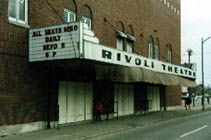
The Rivoli Theatre, downtown Muncie, Indiana: I spent a lot of hours in the Rivoli as a kid and young adult. I saw the re-release of “Gone with the Wind” there as well as Disney classics.

The Rivoli, built in 1927, was a beautiful theater marred only, in its final few years of operation, by a smaller, second theater built inside the larger auditorium. The little theater took up seats in the main auditorium and detracted from the looks of the big theater — jutting out into the line of sight of some seats in the little-used balcony — but the extra revenue probably kept the theater open a little longer. This was the days of the multiplex boom and theaters with one screen were rare.
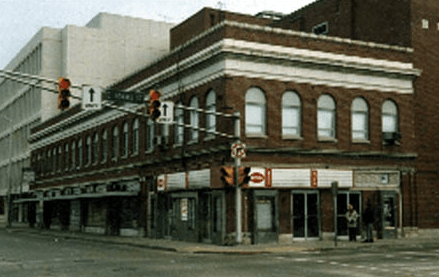
The Rivoli was demolished in 1987 to make way for a local office building. I reported on the decision to raze the theater and the demolition and it was one of the most disheartening stories I wrote in the early years of my journalism career.

The Eastwood Theatre, Indianapolis: The Eastwood had a comparatively short lifespan for a movie theater. Opened in 1968 and demolished sometime post-1980s, the Pendleton Pike cinema was known for its size — 800-plus seats — and the staying power of the movies it screened. “Star Wars,” opening in May 1977, played for months at the Eastwood. (This was, of course, in the days when movies could play almost indefinitely at theaters. There was no home video, so studios and releasing companies made all their dollars from theatrical screenings. And the longer a movie played, the better percentage of ticket sales the theater received. Not to mention all that popcorn sold.)

I didn’t see “Star Wars” at the Eastwood — that experience came at the Northwest Plaza Cinema in Muncie — but my friends and I saw a number of other movies there, including “The Empire Strikes Back” in 198o and “Return of the Jedi” in 1983. I still vividly remember standing in line to see the “Star Wars” sequels with a big group of my friends and fellow geeks.

The Eastwood, according to the Cinema Treasures website, was torn down — no date specified — and its spot is now a Menards home improvement warehouse.

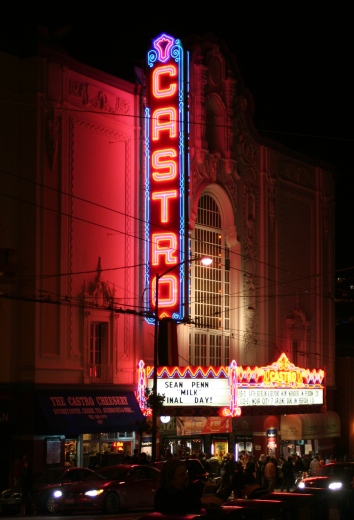
The Castro Theatre, San Francisco: I’ve only seen one movie at the Castro — “The Third Man” — but the Castro, built in 1922, is in many ways a wonderful example of a neighborhood movie palace. It’s an art movie cinema now, unspooling classics to an appreciative neighborhood and audience.
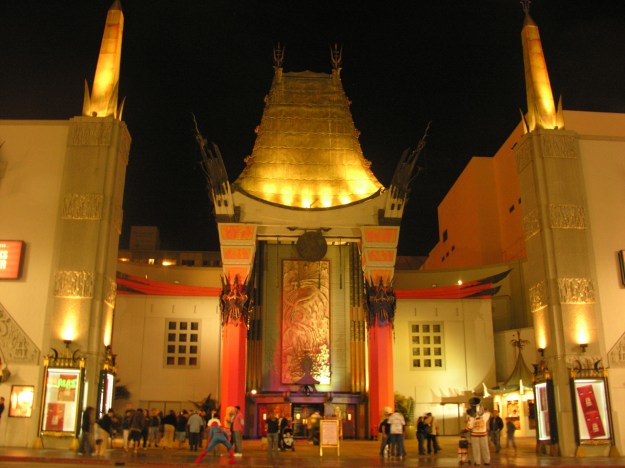
The Chinese Theatre, Hollywood: One of the most famous theaters in the world, the Chinese is where footprints and handprints in wet cement adorn the courtyard.

On one of my once-regular trips to the Los Angeles area to visit my friend Brian, we saw the 1989 Tim Burton “Batman” movie at the Chinese. Years later, Robin and I saw the movie “Mambo Kings” there.

Built in 1927, the Chinese has been the setting of almost as many movie scenes — remember the climax of “Blazing Saddles?” — as movies that have screened inside.
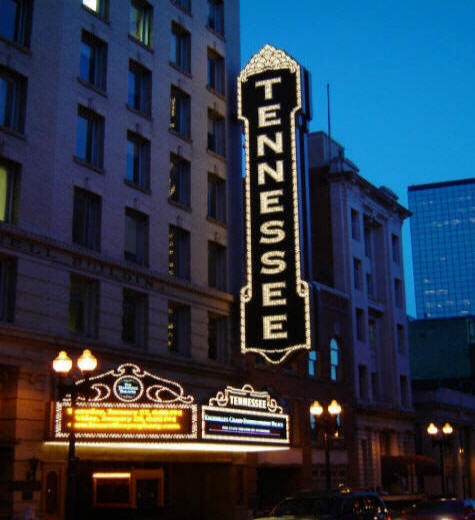
The Tennessee Theatre, Knoxville: One of my favorite theaters I’ve discovered in recent years is the Tennessee. Opened in 1928, the theater closed in 1977, reopened, closed again in 1978 and was ultimately restored and reopened as home to classic films and live performances.

The Tennessee is a big part of Knoxville’s historic downtown and is worth a visit to see the best case scenario for a downtown movie theater.

Cinebarre, Asheville, North Carolina: Cinebarre is an example, like the Alamo Drafthouse, of what a theater can do to attract customers tired of the worst of the moviegoing experience.

Cinebarre offers not only comfortable movie viewing but the ultimate in movie theater dining. The menu goes way beyond popcorn and warmed-over hotdogs and includes beer, wine, burgers, pizza and more.

Your food is served to you in the auditorium — you eat at a counter in front of your seat; no juggling food on your lap — while the movie is underway. You can even order dessert.

I enjoyed a lot of movies in theaters last year and, with a cool bunch of movies like “The Avengers” on tap for summer 2012, I’ll be seeing plenty again this year. I only wish I could see every movie as comfortably and memorably as my moviegoing experiences at these favorites.

What was ‘The Walking Dead’ whisper?

Here’s one for fans of the AMC series “The Walking Dead” as we wait for another new episode — the second in the latter half of the second season — to premiere Sunday night.

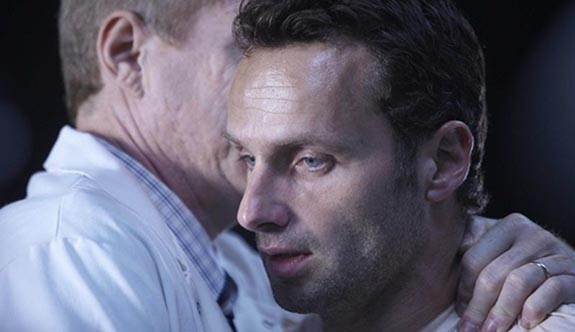
What did Dr. Jenner, the scientist at the Centers for Disease Control, whisper in Rick’s ear near the end of the final episode of the first season?

If you remember, the survivors of the zombie apocalypse made their way to the CDC at the end of the first season but abandoned it when Dr. Jenner, the last remaining scientist, became despondent and decided to blow stuff up real good.

Before Rick led the survivors out, Jenner whispered something in Rick’s ear.

The Associated Press asked Andrew Lincoln, who plays Rick, about the whisper.

Lincoln — who maintains he knows what the whisper was intended to be, but says he hasn’t even told his wife — hints that the whisper was not good news.

“This is a scientist who seemingly held all the cards to what this epidemic is about and I do think, you know, you would imagine he would have something of value to say on that matter,” Lincoln told the AP. “Well, he chose to kill himself.”

Well.

A friend, co-worker and fellow “Walking Dead” devotee of mine, Mark, says he believes the doctor whispered the word “Airborne,” which would not be good news for the survivors.

Having read some, but not all, of the comics upon which the show is based, I don’t know if the whisper was a part of the storyline or if it has been revealed.

I’ve heard other speculation about the whisper, including “No cure.” Also a dark scenario.

Lincoln indicated that the answer would be revealed this year.

As long as the doctor didn’t whisper, “Stay on the farm forever,” I’m good with whatever happens.