Tag Archives: social media

Going viral, social media, dystopia and books

I went viral on social media – two different social media, with two different posts – over the Fourth of July weekend.

(This is not a pat myself on the back post. I think there’s something interesting that’s happened here, beyond the viral-ness.)

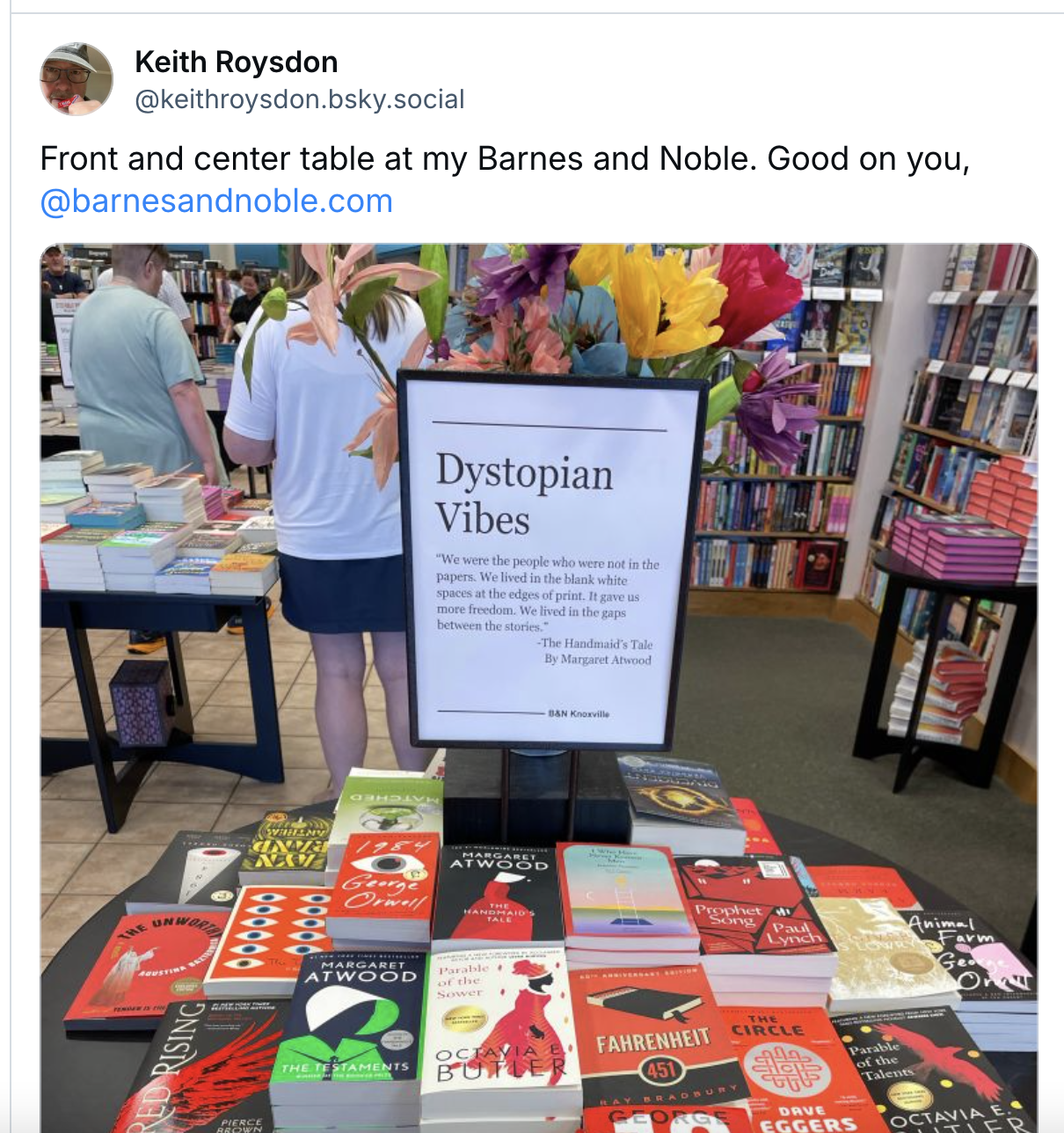
The first post that went viral is the one above. On Saturday, I was in the Barnes & Noble bookstore near me and took a picture of the first table inside the door. If you can’t tell from the picture, it’s a display marked “Dystopian Vibes” and offers books including “1984,” “Animal Farm” and the works of Margaret Atwood and Octavia E. Butler.

I thought I’d snap a picture and post it and thank Barnes & Noble for putting these books out there so prominently. Yes, that placement encourages sales. Yes, it’s ultimately a big corporation trying to move copies of books. But it’s something.

I thought the post might get some traffic, but I never get a lot of engagement, even with 3,000 Bluesky followers.

By Sunday afternoon, this was the response:

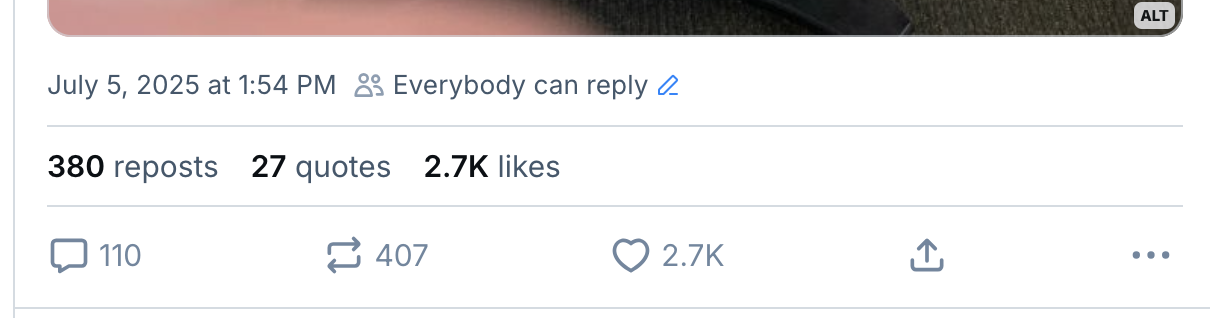
380 accounts reposted my post, which got 2,700 likes.

This is a multiple of thousands the reaction I was expecting. I had to mute notifications on the post.

That wasn’t all, though.

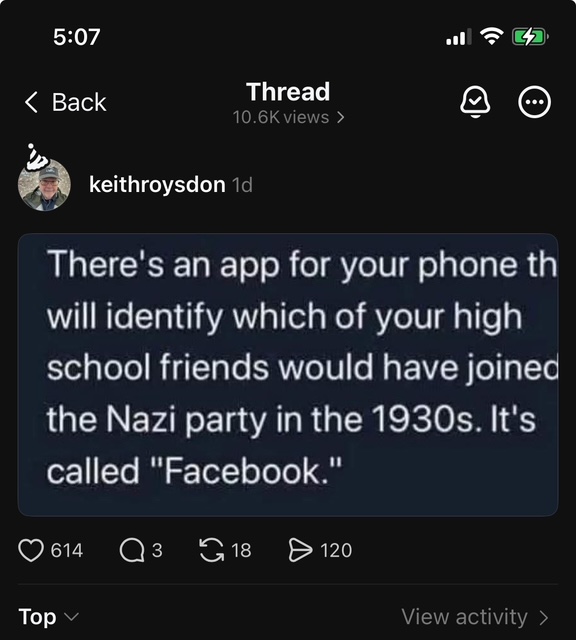
I saw a bitterly amusing meme on a friend’s Facebook account – there was no indication on the account who originally posted it – and I posted it on various social media, including Instagram, which shares posts to the social media app Threads (which I don’t use much).

Here’s the post, and the reaction:

Believe me when I tell you, I usually don’t get 600 likes on Threads, a social media I barely use.

So what’s the upshot to all this, besides a little more engagement and traffic to the companies that own Bluesky and Threads, the latter the detested Meta? (The even more detested Twitter turned up with very little notice of either post, by the way.)

The upshot, it seems to me, is that there’s a lot of interest and engagement in posts about our currently untenable, dangerous and yes, dystopian path.

That’s a good thing, that people are engaging in posts critical or even acknowledging the path this country is on.

And, as a bonus, the Bluesky post shows a ton of engagement about books that forecast, define and address our society.

There’s nothing more encouraging than the realization that people are engaging with literature that calls to light our current peril.

So maybe a small percentage of the frogs in this slowly boiling pot of water are aware they’re in a slowly boiling pot of water. I hope.

Jumping into the discourse about Bluesky

If you’ve been paying attention, you’ve seen people argue that the social media platform Bluesky is a failure. It has “only” 36 million-plus users, compared to more than 600 million twitter users. (The latter is a number I think is highly suspect, but that’s a topic for another day.)

I joined Bluesky more than a year ago, I think, but I didn’t spend a lot of time on the social media site until last fall, when some odious thing the owner of twitter had done drove other people there. All of a sudden, Bluesky seemed populated – much more so than in the first few months after I had joined – and much livelier.

So-called “Starter Packs” on Bluesky – curated lists of writers, engineers, performers, artists, whatever – gave my follower count a boost early on, but the growth in the number of followers there has been pretty consistent. I have about 2,800 followers there now, compared to more than 4,000 at my peak on twitter. That Bluesky following was built in a matter of months, by the way, compared to all the years since 2009 I’ve been on twitter.

(I still have a twitter account, to keep in touch with friends who are still more active there than on Bluesky, but I spend much, much more time on Bluesky.) I’m also active on Facebook, where I started an author page this year despite my misgivings over the attitudes and behavior of the suck-up American oligarch who owns it, and I post regularly there and on Instagram (same owner, same dislike for the owner). The reason I’m still on all those platforms is, besides keeping up with friends who are on them, is to publicize my book, THAT OCTOBER.

But I spend most of my time on Bluesky, regardless of follower numbers and engagement, because it just feels like the least awful place on socials. I’m not choosing the lesser of evils here, I promise. I feel like using any social media is like building a new house (ie active thread that’s hopefully engaging) on somebody else’s property.

In other words, all of social media is someone else’s real estate. When they want to take it away from us, they can.

That’s also why Bluesky is the least reprehensible social platform. The owners of twitter and Facebook and other Meta platforms have shown themselves to be dishonest in how they treat the people who actively bring eyeballs to those platforms. They take the value of our work and bluster and censure us.

BlueSky seems the least likely social media platform to do this.

This might change if the semi-collective, not-especially-concentrated ownership of Bluesky changes, perhaps through a sale at some point in the future. Money talks and bullshit walks and aside from political ideology, there’s been no more certain death knell for various socials than how much their owners can make by selling them or just selling out.

So I’m spending time on Bluesky – too much time, probably – and little time anywhere else, although I have a presence everywhere. This site is a pretty reliable place to find my latest thoughts but it is not a two-way street, unlike even the worst social.

So I don’t think Bluesky is dying. I do think it is, right at this moment, a less reprehensible (there’s that phrase again) place than the alternatives.

We’ll see if that continues to be the case.

Social media and selling books

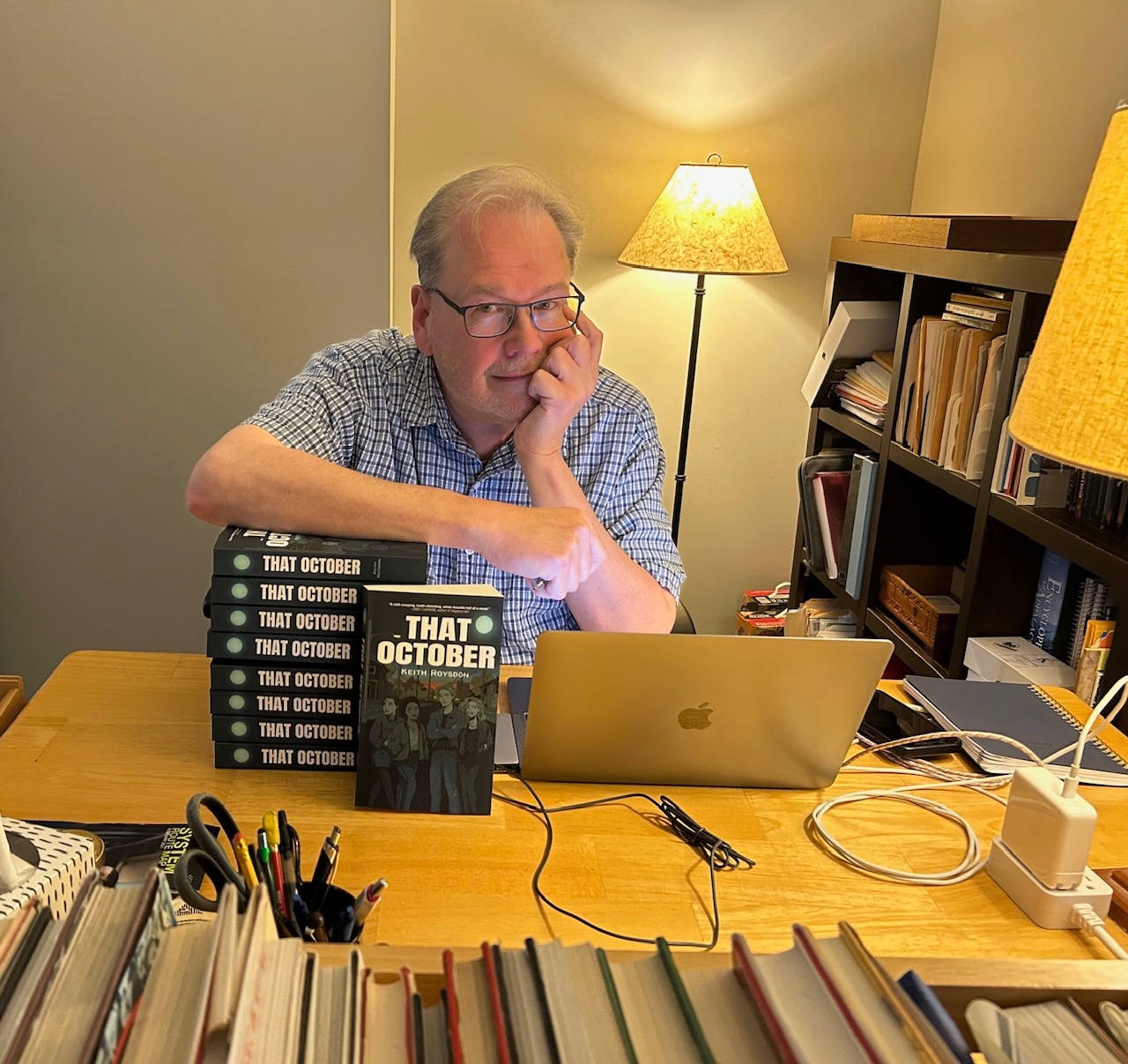
You think that guy looks insufferable there, wait until a few more weeks pass. You’ll be sick to death of him.

My 1984-set crime novel THAT OCTOBER publishes June 1. It’s available now for pre-order on the usual bookselling sites, although I encourage you to purchase it through the least harmful to society one.

I hope you like the book. The authors who were kind enough to read it and give me some comments that I could blurb seemed to like it, citing the 1980s nostalgia content and the twists and turns of the plot.

Although THAT OCTOBER is self-published, there’s nothing especially straightforward about marketing a book these days. Unless you’re a huge author, you have to flog your book to potential readers. That’s usually done through social media.

There are a lot of authors who innovate in how they market their books. Some include odd tidbits they came across while researching and writing their book, and I’ll probably do some of that. Some authors post recipes true to the time period or story. Others, notably Beau Johnson, make and post creative videos to publicize their work. Beau’s videos are hilarious and effectively promote his books, including LIKE MINDED INDIVIDUALS, which continues Beau’s multi-book storyline of anti-heroes who punish the worst criminals on Earth.

Since social media is important to promoting our books, it’s especially tricky to do so in a manner that doesn’t promote some of the worst humans around, including the owners of the former twitter and Facebook and related platforms.

I don’t spend a lot of time on the former twitter anymore, mostly just to check on friends who still post there as opposed to a slightly more “clean hands” site like BlueSky. For the past week, I’ve tried to observe a week-long boycott of Facebook-related platforms, breaking that only to note a rare earthquake in East Tennessee and a Mother’s Day post about my mom, who left us nearly 20 years ago.

But I’ll continue to post on my author page on Facebook to publicize my writing. It’s not a decision I’m entirely comfortable with, but Facebook is still a place where people go, and authors are expected to have a social media presence there.

Anyway, god go with you in the next few weeks (months? years?) as you see me posting here and on social media to promote THAT OCTOBER. I hope you tolerate me and I hope you like the book.

Once you’ve had Facebook, you’ll never go back

In watching the reaction to the new Facebook today — reaction that ranged from irritation to outrage — I was reminded of David Letterman’s straight-faced observation about pop star Madonna back in the 1980s. “I think she wants to shock us,” Letterman said, tongue in cheek.

Earlier today I compared FB to a significant other who flirts or picks a fight just to make sure we’re still paying attention and not taking them for granted.

Sure, there’s some legitimate reason for upgrading and offering your users the latest and best features. But I think FB wants to remind its bazillion users how much it means to us.

Even if that means pissing us off.

As someone who has been in the communications business since I was a teenager, I can testify to the feeling engendered by reader reaction. No matter if it’s a complaint about a controversial story or photo or, even worse, the removal of a beloved comic strip, the response is appreciated. It means people are paying attention, that you’re still part of their everyday lives.

Face it, most of us might never take up Twitter (although you should, because it’s really fun) or Google+ (yawn). But for those bazillion of us who check in to FB every day — even if our devotion is far more casual than “checking in” via Foursquare or more low key than posting our latest rant about an irritating co-worker or prodigious child — we’ll keep checking in, no matter how many times we threaten to quit FB.

And no silly revamping of the way our pages look will keep us away.

Now, let me tell you what I don’t like about the new Facebook …