
Tag Archives: blogging

To ‘stack or not to ‘stack: Substack

I’ve no idea when I first heard of Substack, the online writing and posting platform that a lot of people use and quite a few people forego. For the time being, and probably into the future, I’ll be in the latter camp. But Substack has become a hoppin’ place, especially for writers and other people who express their thoughts.

I was thinking about Substack today after reading the latest newsletter from writer Andrew Careaga. You should look him up and enjoy his writing, not only on his various platforms but also his fiction, including his short fiction story in the brand-new Bad Intentions anthology. (I’ve got a story in the anthology too; Michael Downing edited the book and Literary Kitchen published it. It’s out now.)

In the newsletter from Andrew I received today, he talks about the pros and cons of being on Substack and – this is oversimplifying, so I apologize – notes that he’s got his hands full, like a lot of us, with being ON EVERY FREAKIN’ PLATFORM IMAGINABLE. It’s the online presence writers feel they must maintain if they want to reach readers and, truth be told, people who will pay to read our work.

Andrew cites the good and bad points of Substack and links to a Guardian story from February reporting how Substack is generating revenue for and from what the Guardian calls “Nazi newsletters.”

Considering the number of people who are acquainted with Substack’s platforming of white supremacist groups and writers, it’s a little surprising that so many people who are definitely NOT Nazis, like Heather Cox Richardson, are so present on Substack. Richardson is one of 50 million Substack users worldwide, according to the Guardian.

There’s unlikely to be a mass exodus from Substack similar to that when the new owner of Twitter took over and threw the doors open wide for white supremacists and Nazis. The frequently-cited point is that if you start letting Nazis into your bar and more Nazis follow, you eventually become a Nazi bar,

And yes, I’m still on what used to be Twitter. I made the move to Bluesky for my social media platform of choice a couple of years ago. And I should note that a lot of people who temporarily left Twitter have come back.

I’m on social media platforms owned or run by truly reprehensible people and corporations, namely Meta – three separate Facebook pages – plus Instagram and Threads.

Don’t bother to tell me if Nazis own Pinterest. I have a page there, created just this year to promote my new crime novel SEVEN ANGELS. But I’ve all but given up on posting anything there because I have virtually no followers. So I don’t care if it turns into a Nazi bar with kicky hairdo and decorating ideas.

FFS, I’m even on LinkedIn.

There’s no social media or writing platform that is without concerns and extenuating circumstances. If we’re waiting for a platform owned by a corporation that isn’t reprehensible in some ways, we might have a very long wait. Why? Because there are few good corporations when it comes to mass communication. It’s their real estate, obviously, and we just toil there. That’s the case with virtually any social media platform.

And, of course, wherever people gravitate, dating back to the days of the town square, aberrant and abhorrent views will be presented.

I post on many of those social media platforms – I’m calling out my own compromised moral stance – and will continue to post here, a WordPress site I’ve had for 15 years and one on which I have subscribers (all unpaid) and which gets a couple of thousand views each month.

So my problem with Substack, overlooking the kind of moral compromise that allows me to keep using social media platforms that are equally awful, is that I’m not likely to start over and do anything but spin my wheels, i.e. the Pinterest Effect.

Is all of this thinking flawed? Yes. Is there a good solution that gives me and my work some exposure but doesn’t compromise my morals? No.

But Substack is, for the moment, a bridge too far for me. Your mileage my vary.

Here’s that Guardian story Andrew and I refer to:

https://www.theguardian.com/media/2026/feb/07/revealed-how-substack-makes-money-from-hosting-nazi-newsletters

A few words on the correct social media lifts all boats

It’s crazy how much time we spend – okay, how much time I spend – on social media. And even crazier is how influential social media is in our lives. It’s fractured in many ways from what it used to be and while I’m on most of the social platforms, I spend more time on BlueSky than anywhere.

This is, however, a story about two platforms from the detested Meta stable of social media, Facebook and Instagram.

I really don’t like the Meta platforms and I like their owner even less. But they’re where the eyeballs are, unfortunately. Facebook still drives far more traffic to newspaper sites, for example, than any other platform. Many, many times more.

Two examples from my recent postings prove that the platforms have a long reach.

I follow the actress Sarah Herrman on Instagram. She’s funny and posts videos not especially related to her film work, which included the recent film “Chili Finger,” but posts videos of her attempts at baking and cooking. Those videos often feature, off-screen, her mother, who appears to have an acerbic wit.

In a recent video, Herrman tells her mother that she received two requests from followers for pictures of her feet.

“Only two?” her mother replied, with a tinge of “you can do better than that” in her voice.

In the comments, I quoted her mother in a two-word-and-two-word only comment: “Only two?”

So far, 4,296 people have “liked” my comment.

Crazy.

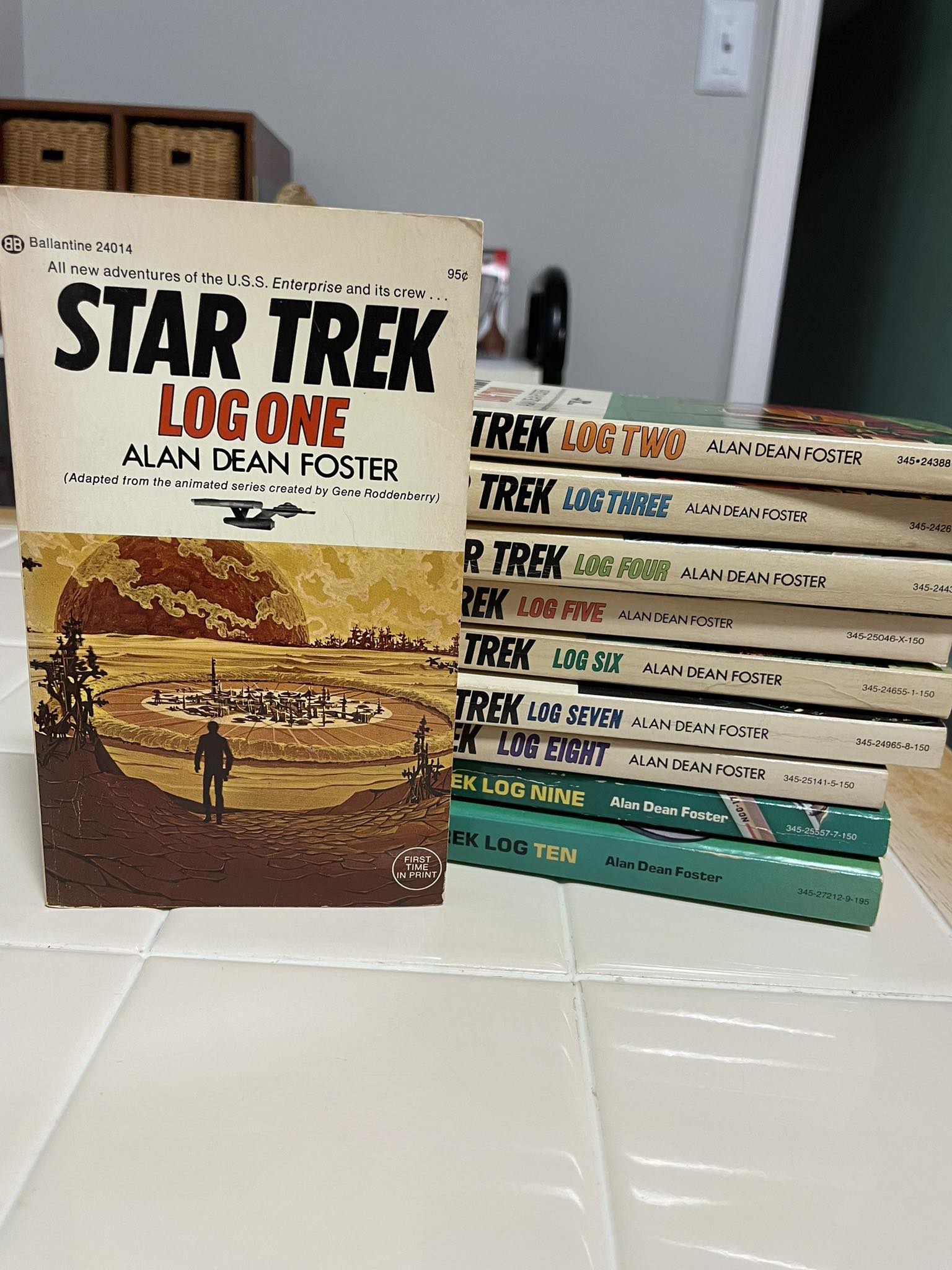
More recently, I found copies from the mid-1970s of the “Star Trek Log” books, in which author Alan Dean Foster adapted the “Star Trek” animated series into short story and novella form.

I posted my picture on the Facebook page “Vintage Paperback Books.” It was my first post, so it’s not like I’m a favorite of the page’s followers.

But those vintage “Star Trek” fans are fans of the books, apparently. As of right now, since Saturday the post has accumulated 503 likes.

Again, crazy.

Those are examples of social media’s reach. There are other, better, more important and relevant examples.

But those kinda boggled my mind.

Going viral, social media, dystopia and books

I went viral on social media – two different social media, with two different posts – over the Fourth of July weekend.

(This is not a pat myself on the back post. I think there’s something interesting that’s happened here, beyond the viral-ness.)

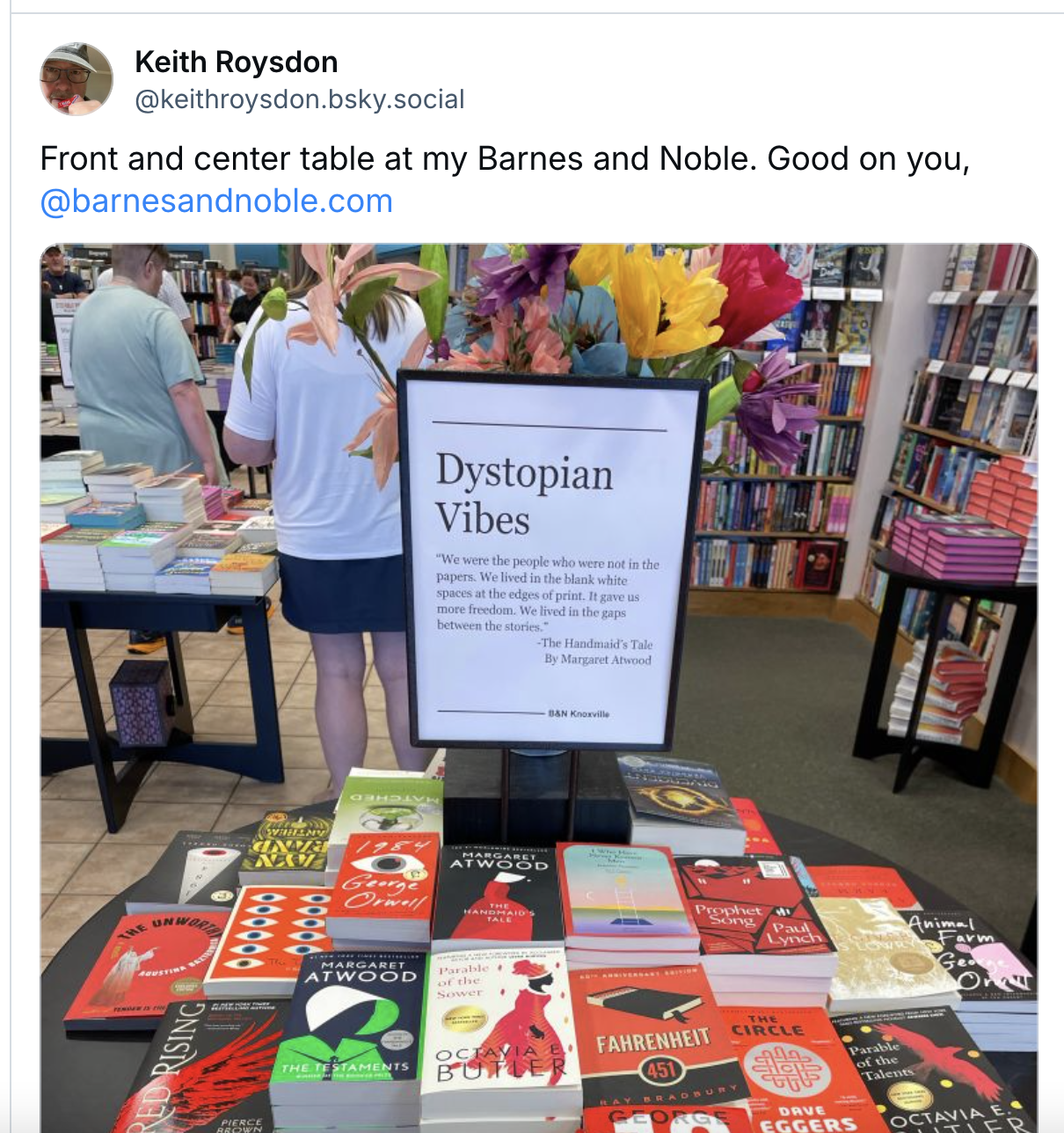
The first post that went viral is the one above. On Saturday, I was in the Barnes & Noble bookstore near me and took a picture of the first table inside the door. If you can’t tell from the picture, it’s a display marked “Dystopian Vibes” and offers books including “1984,” “Animal Farm” and the works of Margaret Atwood and Octavia E. Butler.

I thought I’d snap a picture and post it and thank Barnes & Noble for putting these books out there so prominently. Yes, that placement encourages sales. Yes, it’s ultimately a big corporation trying to move copies of books. But it’s something.

I thought the post might get some traffic, but I never get a lot of engagement, even with 3,000 Bluesky followers.

By Sunday afternoon, this was the response:

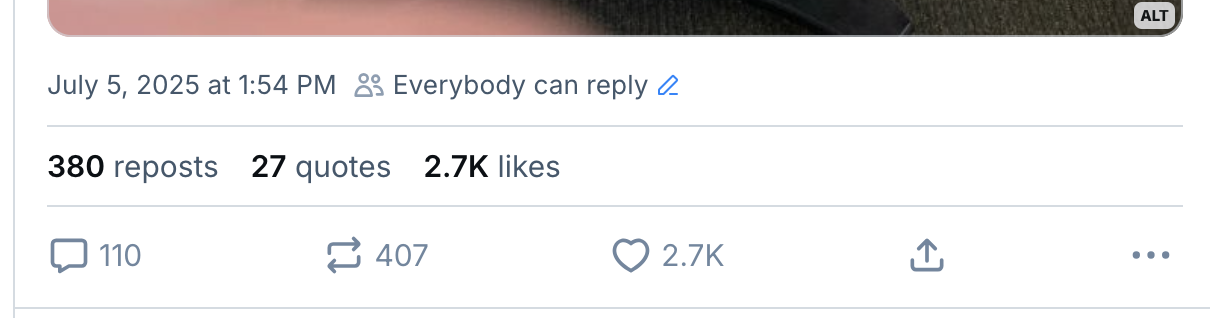
380 accounts reposted my post, which got 2,700 likes.

This is a multiple of thousands the reaction I was expecting. I had to mute notifications on the post.

That wasn’t all, though.

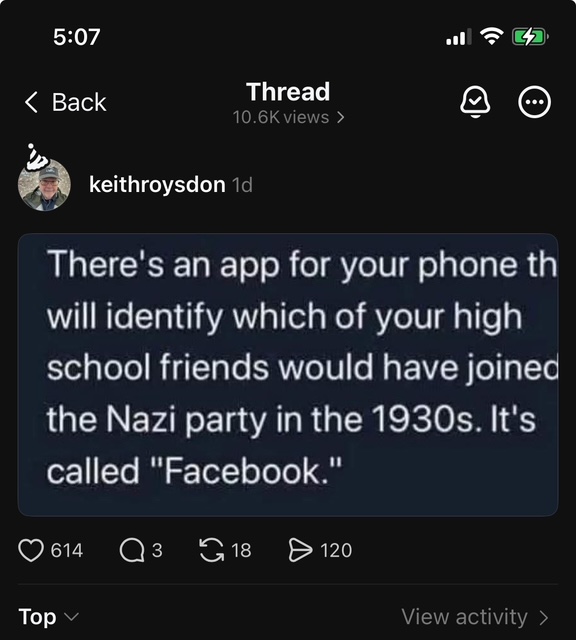
I saw a bitterly amusing meme on a friend’s Facebook account – there was no indication on the account who originally posted it – and I posted it on various social media, including Instagram, which shares posts to the social media app Threads (which I don’t use much).

Here’s the post, and the reaction:

Believe me when I tell you, I usually don’t get 600 likes on Threads, a social media I barely use.

So what’s the upshot to all this, besides a little more engagement and traffic to the companies that own Bluesky and Threads, the latter the detested Meta? (The even more detested Twitter turned up with very little notice of either post, by the way.)

The upshot, it seems to me, is that there’s a lot of interest and engagement in posts about our currently untenable, dangerous and yes, dystopian path.

That’s a good thing, that people are engaging in posts critical or even acknowledging the path this country is on.

And, as a bonus, the Bluesky post shows a ton of engagement about books that forecast, define and address our society.

There’s nothing more encouraging than the realization that people are engaging with literature that calls to light our current peril.

So maybe a small percentage of the frogs in this slowly boiling pot of water are aware they’re in a slowly boiling pot of water. I hope.