I’ve always loved watching Halloween horrors on TV. That didn’t change when it became easy to find classic horror films on first cable TV and VHS and later online and on streaming.
There’s still something wonderful about the communal experience of watching horror films, old and new-ish, on TV, even if the communal watchers are all over the world. That’s one of the reasons I love TCM – Turner Classic Movies – in October.
A few years ago, AMC was a go-to place for horror films and documentaries in October and the channel still shows the genre, but TCM has the largest and most diverse and often strangest selection of films each October.
That’s again the case this year, with Fridays devoted to Creepy Cinema, Sundays devoted to Hitchcock and weekends featuring classic horror films. Look for Hammer horror on Monday October 20, Boris Karloff on the 21st, sci-fi horror on the 22nd and horror marathons the last few days of the month.
Here’s a link to TCM’s offerings this month. Happy Halloween!
When my short story “A Fighting Life” was published in the past couple of weeks in the FIGHTING WORDS anthology, it contained the latest reference to the fiction worlds I operate in.
Since I wrote four or five novels back in the early 2000s – books that’ll probably never be seen, unless radically rewritten with what I’ve learned about writing in the meantime – I’ve enjoyed writing in a universe where, despite some timey-wimey variations, most of my characters and storylines play out in a shared world mostly consisting of the small city of Middletown, Indiana – based on my hometown of Muncie, Indiana, which was referred to in 20th century sociological studies as Middletown – and Seven Angels, a Tennessee town based on Jamestown, the small town my parents came from.
The early 2000s books featured Jack Richmond, a Middletown newspaper reporter, and a group of friends including Jess Peterson, an affable cop on the Middletown police force. There are lots of other characters too, including Luna, a topless dancer Jack falls in love with. By the end of the series of books, the two are married and have a son, Cody, and the final, still-to-be-completed book features Jack and Peterson’s desperate efforts to get Cody back after Luna’s ex brutally assaults her and kidnaps the boy.
When I wrote SEVEN ANGELS in 2019, my first crack at writing a novel in 15 years or more, I set it in the titular small Tennessee town with a side trip to Middletown and a pivotal appearance by Peterson.
My next novel, the also unpubished GHOST SHOW, is set in Middletown, but in 1948 and follows the Anderson family, who came to the big industrial town from the small Tennessee town of Seven Angels. No crossover characters, though.
My third novel, THAT OCTOBER, which was just published in June 2025, is set in 1984 Middletown and includes, among secondary characters, Richmond and Peterson at the beginning of their newspaper and police careers, respectively.
I won’t detail it all here, but I’ve returned to the Middletown and Seven Angels wells numerous times in short stories. The foul-mouthed, fightin’ siblings in “A Fighting Life” are pulled from GHOST SHOW. My very first published short story, “Independence” from the MOTEL anthology, is set in little Seven Angels, complete with the sheriff/main bad guy from the SEVEN ANGELS novel.
The seeding of characters from my earlier stories – like Butcher Crabtree, who I posted about here recently – throughout my fiction just goes on and on.
And so do I. To quote one of my (hopefully) self-deprecating quotes, “Enough about me. What do you think of me?”
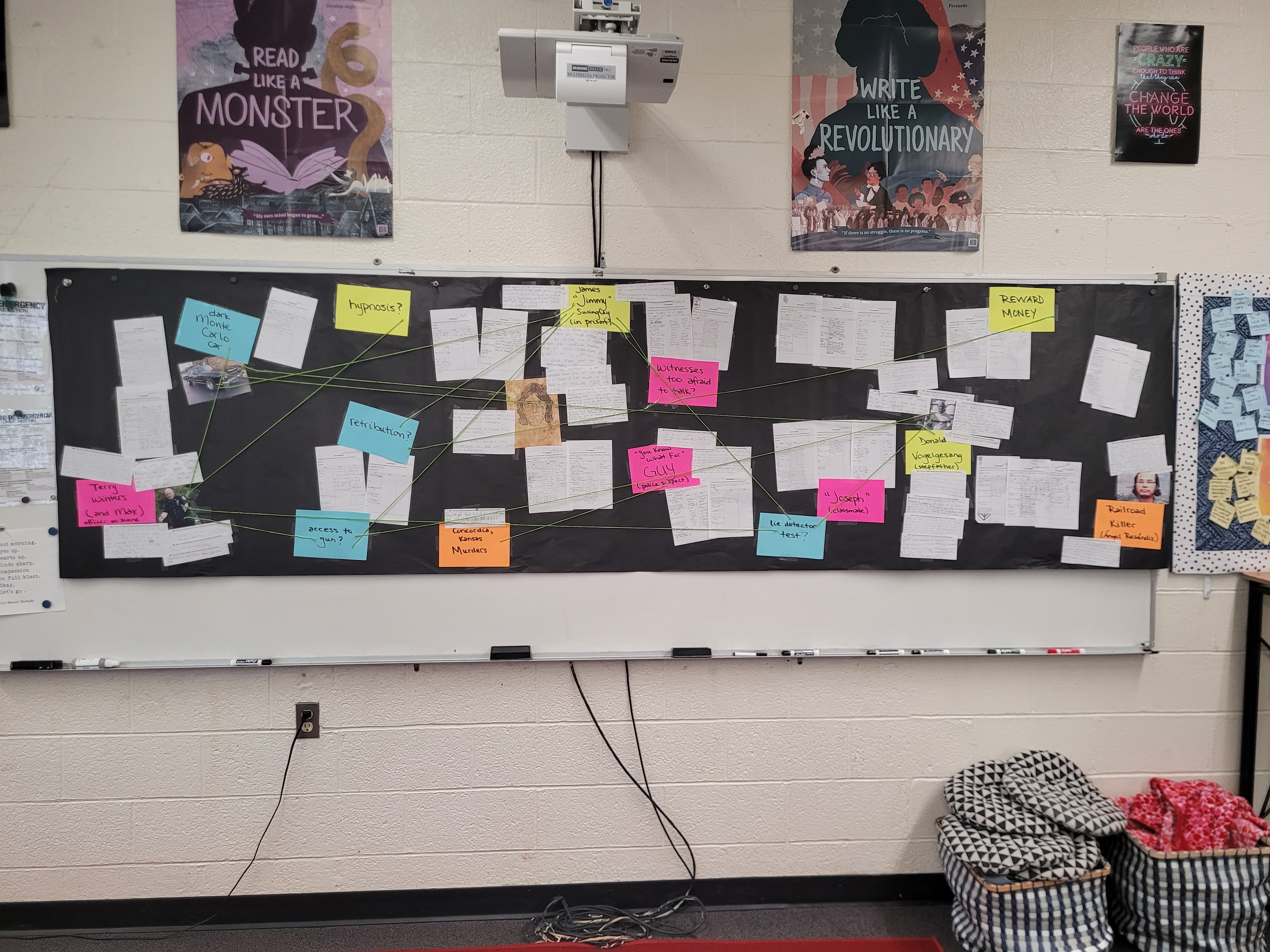
That’s a murder board. You’ve probably seen them in movies and TV shows. You might have made one yourself.
But have you ever seen a murder board, based on two real-life unsolved murders, put together by 13-and-14-year-olds? I didn’t think so.
Earlier this week I spoke to teacher Megan Byard’s middle-school class at Inspire Academy in Muncie, Indiana, my hometown. Ms. Byard had approached me and Douglas Walker, my longtime writing partner at Muncie newspapers and in four true crime books, including “The Westside Park Murders: Muncie’s Most Notorious Cold Case,” published by History Press in 2021, about talking to the class about Westside.
In September 1985, teenagers Ethan Dixon and Kimberly Dowell were shot to death in Muncie’s Westside Park. No one was ever charged with the crime, although police have had a person of interest for a few years now. In our book, we name that person, who is in prison following a conviction for a separate murder years after the Westside slayings. We explain the line of reasoning that prompted police to suspect him. We reached out to him in prison to ask about the case against him. He did not respond to written questions and a self-addressed, stamped envelope. In addition to naming him, our book explores many other theories and suspects connected to the case.
Since it came out, our book has received a lot of attention. Popular podcasts have been based on our book and the crime. On Amazon, the book has 163 ratings for 4 out of 5 stars. It prompted a Peabody-winning producer of non-fiction television to contact us about turning it – and some of our other writing – into a multi-part true crime series, but no networks or channels took the producer up on the pitch.
Of all the attention that our book has received, I think one of the coolest and most interesting was from Ms. Byard’s class. The students, who are interested in journalism and writing and true crime, studied the book and the crime in advance of having me do an online talk for their class. They asked good questions.
I think I was most impressed with the murder board, though. Made me feel like I was working in a police precinct, hoping for a breakthrough.
And I guess all of us are still waiting for a breakthrough.
Thanks to Ms. Byard and her class at Inspire Academy. Your interest and care made my week.
Here’s a link to the book on Amazon, although you can find it anywhere, including many libraries, including the Chicago Public Library.
I’ve never been accused of being cool about writing successes, whether it was awards for journalism or publication of pop culture pieces at CrimeReads or elsewhere or short stories at several sites or in anthologies.
One thing I’ve not been able to experience is seeing my work in a bookstore. Indie authors who self-publish, as I did with THAT OCTOBER, can see their works for sale at a million online sites like Amazon or Barnes & Noble, but seeing an indie book in a bookstore is a very rare thing. I’ve been turned down twice when I’ve taken formal steps to see THAT OCTOBER on shelves.
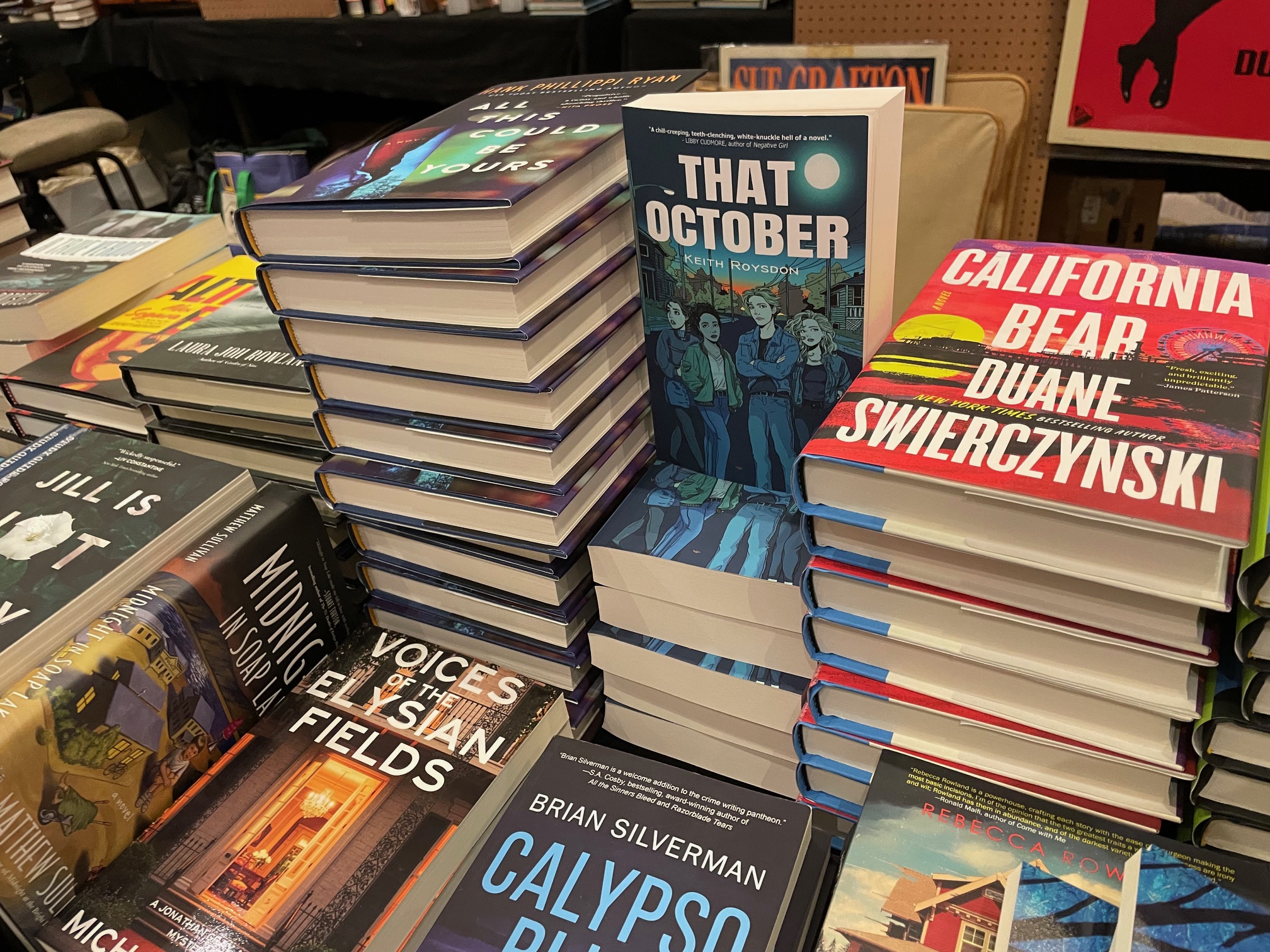
That’s why it was such a thrill to see my 1984-set high school crime novel in the bookstore at Bouchercon in New Orleans earlier this month.
There’s a picture of the book above, nestled in with other books on the long tables of books available for sale.
By Sunday morning, the final day of Bouchercon, two copies remained of the several they stocked.
A huge shoutout to the Bouchercon 2025 NOLA books team and the wonderful people at Garden District Book Shop, 2727 Prytania Street, New Orleans, LA, 70130. I told them several times how grateful I was that they went to the trouble of getting copies of THAT OCTOBER.
At some point I’ll write a little bit about Bouchercon, held last week (as of this writing) in New Orleans. Many of you know this is the annual worldwide convention/conference of crime writers and readers. This was my second Bouchercon and they’re a lot of fun because they’re a chance for writers like me and many much more accomplished to meet with other writers and readers.
I’ll write more about Bouchercon in the coming days, or I intend to, but a quick anecdote:
On Saturday, I was one of the authors at the debut authors’ breakfast at Bouchercon. The annual event was sponsored by Lee (“Reacher”) Child and his brother Andrew, who now writers most of the Reacher books. Another sponsor is Michael Connelly, creator of Harry Bosch and Renee Ballard and other great crime fiction characters.
Connelly also kindly hosted the breakfast.
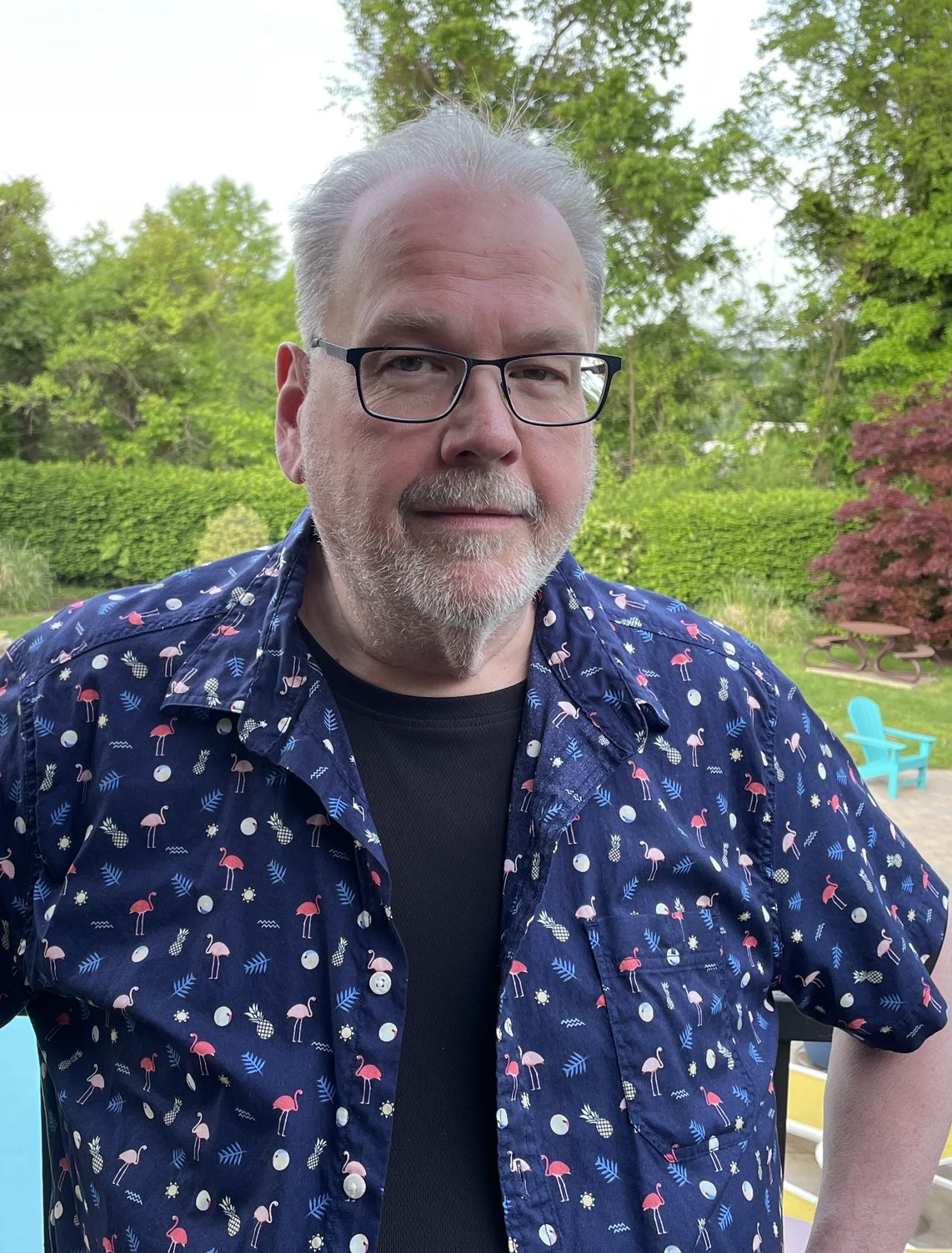
At some point I’ll tell you how I had a quick breakfast with Connelly, but today I’ll talk about the shirt you see me wearing in the photo above.
In the photo, I’m wearing a colorful shirt with pink flamingoes and other images and it’s pretty memorable. This was the photo of me that I submitted weeks or months ago for them to use in the program book for the breakfast.
This was also the shirt I managed to wear that day to the breakfast.
I realized this only after I’m sitting at the table and about to be introduced by Connelly to speak for one minute about myself and my book, THAT OCTOBER.
So, in the interest of transparency, I opened my one minute of remarks by noting the coincidence.
“If you notice, in the our program book, I’m wearing a particular shirt and I’m wearing it today as well.
“You could assume from that that I apparently have a favorite shirt.”
I went on to talk about my book briefly but the line about my favorite shirt got a good laugh.
And I had people come up to me afterward and later in the day remarking, “Your favorite shirt!”
It’s Labor Day and the beginning of fall – don’t argue – and the beginning of Spooky Season – that cannot be argued with – and it’s e-book day here on the ranch.
Just a quick note that THAT OCTOBER, my 1984-set high school crime novel, is available for quick and easy download beginning today on Kindle.
Here’s the link:
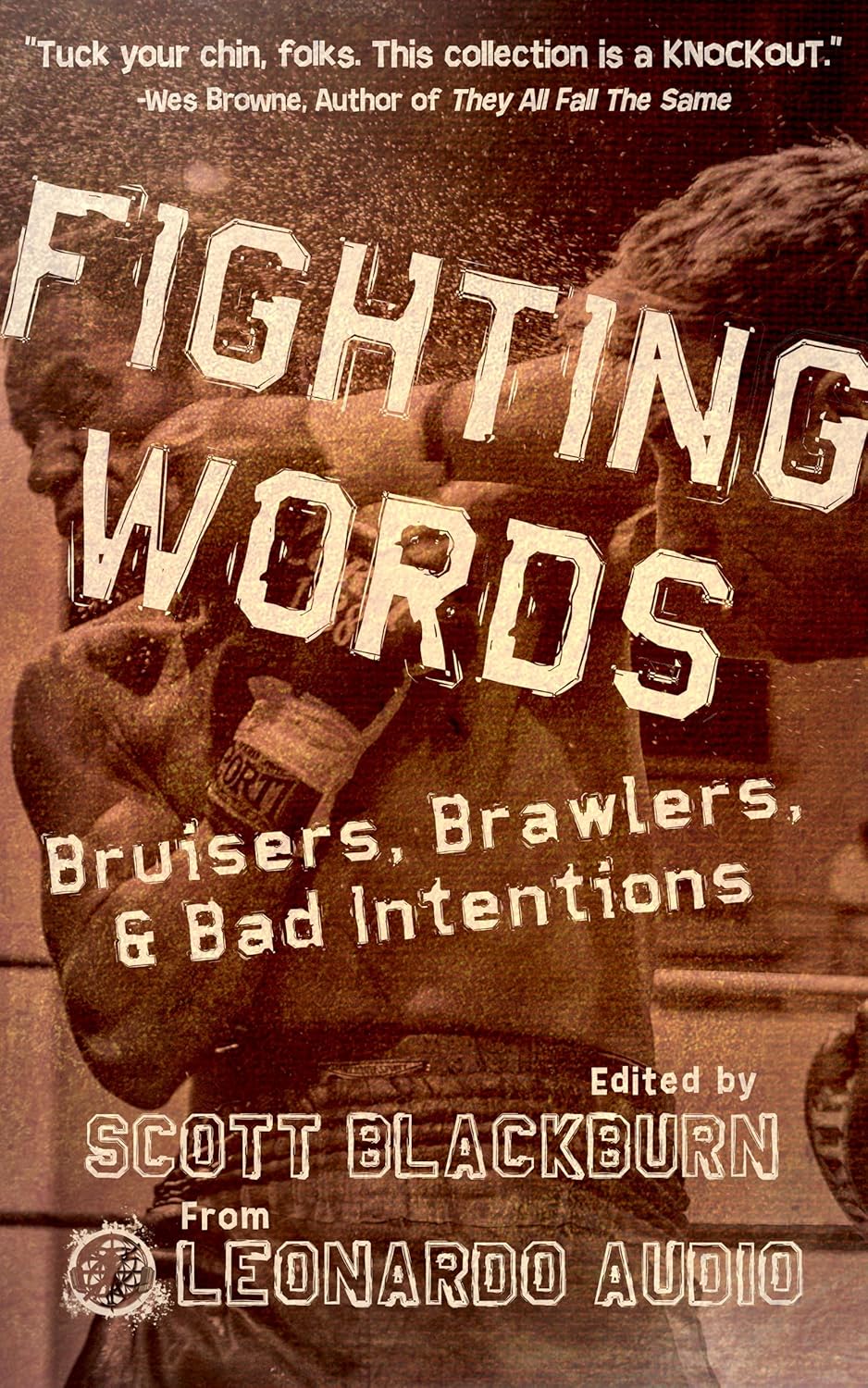
Also today, FIGHTING WORDS: BRUISERS, BRAWLERS AND & BAD INTENTIONS is out on Kindle.
The anthology, put together by writer and editor Scott Blackburn, features stories about fighting, fracases, brawlers, pugs and the sweet science, especially when it’s not so sweet.
My story, “A Fighting Life,” begins in 1948 and follows three young siblings – Marie, Peter and Saul – as they discover there’s money to be made, a nickel at a time, taking on other neighborhood kids in bare-knuckle challenges in vacant lots and abandoned buildings.
But besides my story, there are nine other great stories from some of the hottest authors today, including:
Saint Bullethead by Nick Kolakowski, narrated by Chris Andrew Ciulla
Where the River Breaks by L.S. Goozdich, narrated by Victor Clarke
Pure Wrath by A.M. Adair, narrated by Linda Jones
Fight Club by David Moloney, narrated by Chris Andrew Ciulla
Conor McGregor Was a Friend of Mine by J.B. Stevens, narrated by Michael Orenstein
Call Me Mina by Laura Brashear, narrated by Stacy Gonzalez
A Fighting Life by Keith Roysdon, narrated by Courtney Fabrizio
The Grit by Meredith R. Lyons, narrated by Suzanne Elise Freeman
Bourbon BrawI by Ashley Erwin, narrated by Matt Godfrey
The Cleaner by Jason Allison, narrated by Chris Andrew Ciulla
And what’s that “narrated by” element there? That’s because in addition to the e-book, which is available now, there’s an audiobook edition coming right away.
I got to work a little bit with Courtney Fabrizio, who narrated my story, and she is fabulous.
The e-book was upon its debut the Number One new release in martial arts books and it’s a firecracker.
Don’t be fooled by that headline. 2025 is very much a shit show. I’m talking my writing year so far and that ONLY.
I published my 1984-set high school crime novel THAT OCTOBER in June and the reception so far has been pretty good. I have no complaints about how kind and generous people have been. If you’ve read it, please leave a review on Amazon. But buy it from one of the dozens of sites that sell it, especially bookshop dot org or Ink Drinkers Anonymous, the woman-owned, Black-owned bookstore in my hometown of Muncie, Indiana.
Other than THAT OCTOBER, I’ve been pleased to see a number of short stories published or purchased for upcoming publication, including in a future anthology that I can’t wait to tell you about.
In September, I go to my second Bouchercon, the world convention of mystery and crime writers and readers, and I’ll be on my second Bouchercon panel, with a hugely talented group of authors. This one is at 3 p.m. Wednesday, Sept. 3, the first day of Bouchercon. This Bcon is in New Orleans, which I’m pretty sure should be mild and breezy by September, right? Right?
But very nearly overshadowing all this is that I submitted, earlier today, a short story to the crime fiction genre’s preeminent market. Now I don’t have any great hope that the story will be published. There are a hell of a lot of great writers out there submitting stories.
But the submission was a goal of mine for 2025. Not to get a story published in that magazine, I will note. Nope. Just to submit a story to them again.
I subbed once before, a few years ago, and their rejection was so perfectly justified but so devastating that I didn’t submit to them again for several years. Hell, I didn’t submit anywhere for a year.
So aside from publishing THAT OCTOBER, and attending and speaking at another Bcon and winning a place in this cool anthology that’s coming up in just a few weeks, getting up the nerve to submit to the Big Show again was a 2025 goal realized.
A lot of writers, maybe most of us, have characters that we love to play with. They might be heroes or villains, but we love to return to them again and again.
Mine is Butcher Crabtree, a character I created back in the early 2000s in DEATH AND TAXES, the first novel I wrote. It was the first of a series of books I wrote about Middletown, Indiana, my version of my hometown, Muncie, Indiana. That first book was about Jack Richmond, a newspaper reporter who investigates the death of the head of the local chamber of commerce and finds that the chamber chief was involved in shenanigans with some unsavory characters.
One of them was Butcher Crabtree, at the time a muscled and menacing, fire hydrant-shaped tough guy who was working as the bouncer at the Gilded Cage, the strip bar in Middletown. In his spare time, Butcher was up for committing murder on behalf of his bosses.
I’ve returned, in the past few years, to some of those characters. Reporter Jack Richmond was a novice newshound in 1984, the time period for my novel THAT OCTOBER, which was published just this past June.
Butcher is in that book, too, although in a blink-and-you’ll-miss-him cameo at a Halloween party. He’s referred to as “Uncle Butcher,” but it’s good old Butcher. Complete with his characteristic baseball bat.
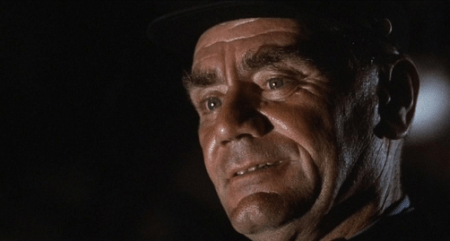
(By the way, that’s not Butcher above, but it is Ernest Borgnine in the great 1973 thriller “Emperor of the North.” In that movie, Borgnine is a vindictive and murderous Depression Era-railroad guard. I didn’t have Borgnine in mind when I created Butcher, but at least in that movie, he’s a pretty good illustration of Butcher. George Kennedy is also a passable doppleganger.)
But Butcher isn’t just a tough guy. I’ve enjoyed casting him in a variety of roles, from the threatening old uncle in THAT OCTOBER to his role in my story “Rousting,” published just recently by Pistol Jim Press. In that one, Butcher is a racist sheriff’s deputy who pushes his luck too far.
Butcher also showed up in “The Devil’s Cut,” my story in HOOSIER NOIR 7. In that one, Butcher is once again a sheriff’s deputy and is again murderous.
Is Butcher ever a good guy? Well, in my book SEVEN ANGELS – winner of the 2021 Hugh Holton Award for Best Unpublished Novel from Mystery Writers of America Midwest – he’s a mentor figure for Travis King, a troubled young man trying to make sense of his violent life.
I’ve included Butcher in a couple of other stories, too, and those – like SEVEN ANGELS – might see the light of day sometime, as THAT OCTOBER has.
Butcher often meets his end in my stories. He did way back more than 20 years ago in DEATH AND TAXES and he has since.
I don’t mind that Butcher’s lives and deaths conflict and contradict and that he seems to move back and forth through time at my whim.
When you’ve got a fun character, you don’t want to let them go.
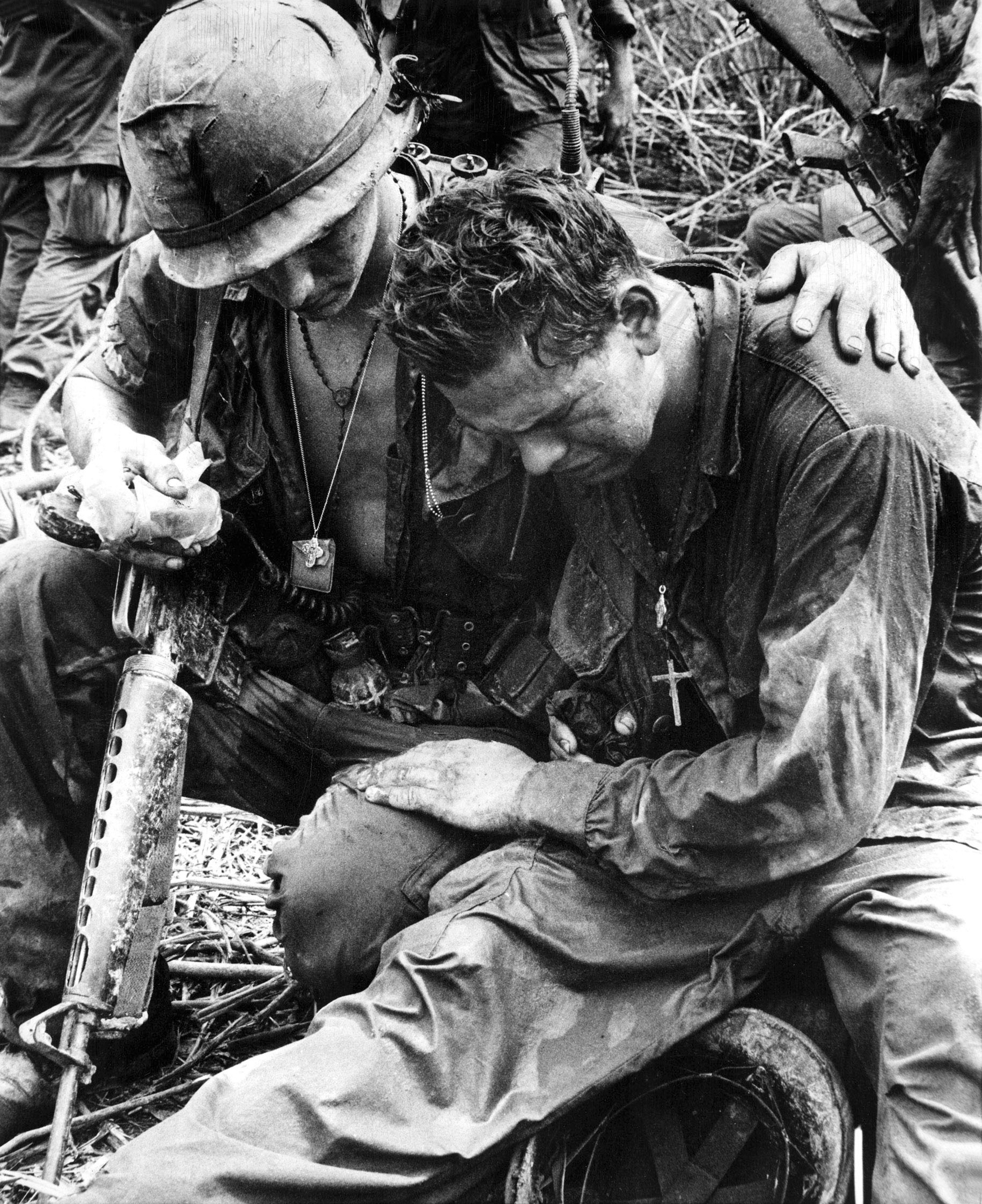
BTJFXP Two soldiers comfort each other under the strain of combat in Pleiku, South Vietnam, 5/26/67.
Some folks who’ve read my novel THAT OCTOBER know there’s more going on than a murder mystery among teenagers in 1984. I won’t get too far into spoilers here, but there’s a point in the book when it becomes less about a killing in Indiana in 1984 and becomes about the echoes of Vietnam.
I knew from when I started writing THAT OCTOBER in 2021 that I’d make the Vietnam War a part of the book. I couldn’t write a book set in 1984 and ignore Vietnam. As one character, a grizzled old newspaper reporter, explains, the war had been over less than 10 years by that point.
People my age and even younger know that war was something a lot of us carried around most of our young lives. Our fathers and mothers had served in WWII and Korea and our brothers and sisters served in Vietnam. War was something we “played” in the backyard. But by 1984, Vietnam was the past.
That’s why THAT OCTOBER was my chance, maybe my only chance, to write about the ripples of the war in Vietnam, which had begun “officially” in 1955. To center a major character’s experience beginning in 1960 in Vietnam felt right.
If you read THAT OCTOBER, you’ll know what I mean. It might strike you as strange that at the end of the book a character gets a Purple Heart for their service in Vietnam, but the war – if often not top of mind – still had ripples in 1984 and still does today.
I’m not a stranger to my work being made available in different formats. Most – maybe all? – of my co-authored true crime books are available in e-book formats and “The Westside Park Murders” is available in an audiobook format from Audible and other platforms.
But there’s something neat about the e-book format of THAT OCTOBER, my 1984-set high school crime novel.
The book has been out in paperback since June 1 in an edition that shows off my friend and editor Jill Blocker’s beautiful interior design and my friend and artist Sara McKinley’s gorgeous covers. I’ve been really gratified by how good the response has been.
So last week I uploaded THAT OCTOBER to Kindle Direct Publishing and it drops, as the cool people say, on September 1.
The e-book is available for preorder now and I really appreciate the response so far.