Atkins takes over for Parker with ‘Lullaby’

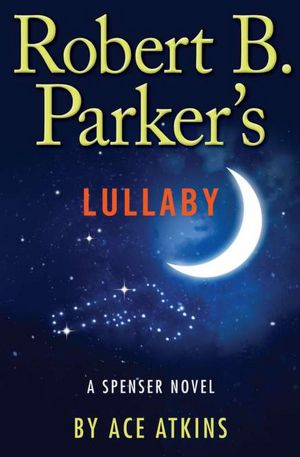
Maybe the greatest compliment that I can give Ace Atkins is that “Lullaby,” his debut taking over the reigns of Robert B. Parker’s Spenser crime novel series, reads link vintage Parker.

Parker had been turning out books featuring Spenser, the boxer-turned-private-eye, since the Vietnam War and straight up until his death in January 2010. Parker told stories about Spenser, his longtime girlfriend Susan Silverman and Spenser’s dangerous cohort Hawk in a relaxed but muscular style that mixed hard-boiled action, genuinely funny witticisms and relaxed, likable characters.

Atkins — one of two writers taking over a couple of Parker series — is an accomplished author on his own. He’s written a series of crime novels that take place in the steamy modern-day south.

With “Robert B. Parker’s ‘Lullaby,'” Atkins has continued the Spenser series with all of the wit and a little more effort than Parker was putting into the books at the end.

Spenser is hired by Mattie, a tough Boston 14-year-old whose drug addict mother was killed four years ago. A neighborhood mook is serving time in prison for the murder but Mattie — hardened beyond her years and raising her younger siblings with no help from an alcoholic grandmother — is convinced that someone else killed her mother. She saw some goons push her mother into a car a few hours before her death.

With Mattie frequently insisting on tagging along, Spenser and Hawk shake down the Boston underworld, top to bottom, looking for the real killers. The good guys take their lumps but there’s little doubt of the outcome.

Most of the Spenser supporting cast is here, from cops Quirk and Belson to loyal hoodlum Vinnie, even gym owner Henry and Pearl the Wonder Dog.

Atkins gets it right when it comes to Parker’s portrayal of Spenser’s style: The PI pushes and pushes and waits for some lowlife to come unglued.

I’m very glad the Parker estate chose Atkins to continue the Spenser series. In just his first outing, he’s found the style that Parker fans have appreciated for decades. And he just might have improved on recent Parker outings.


iPhoneography: Farmland, Indiana

Just down the road from me is the town of Farmland, Indiana. Farmland — which, true to its name, is surrounded by farm fields — is a town of about 1,300 in Randolph County.

Although it’s a small town, Farmland is something of a tourist attraction. It has a couple of good family restaurants — the Chocolate Moose is an old-fashioned burger-and-milkshake soda fountain — some interesting shops and an active cultural life.

It’s a very picturesque little town, with rehabbed streets, sidewalks and streetlights.

I was there the other day on a semi-work-related visit and took a few iPhone photos.

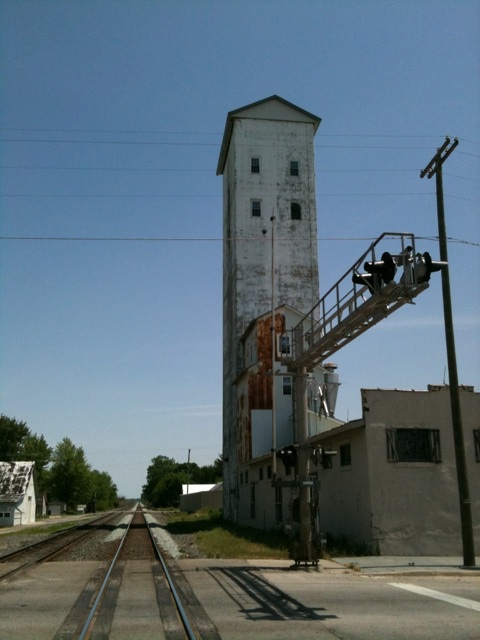
Like a lot of Heartland towns, the center of activity was once the local grain elevator, a towering structure near the rail line that cuts through the heart of town. The elevator isn’t in use for grain anymore; shops occupy the lower level. On a clear Indiana day, though, it’s still a focal point.

The rail line that cuts through Farmland just says “Indiana” to me, and stretches for miles and miles.

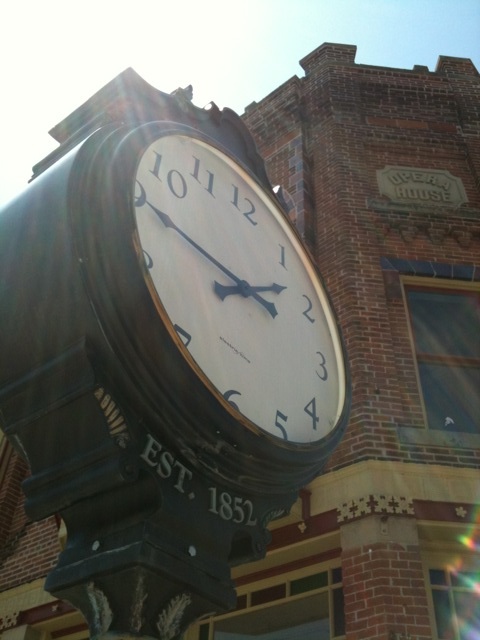
There’s not a town square, per se, but a neat old clock outside what used to be the opera house.

Farmland’s a nice place to go have lunch and look at shops. Definitely worth the trip.

Elvis (Cole) lives in ‘Taken’

Sherlock Holmes and John Watson. Spenser and Hawk. There are some pretty amazing duos in crime fiction. I’d put Elvis Cole and Joe Pike right up there with the best of them.

Cole and Pike, the creations of crime novel author Robert Crais, return in “Taken,” Crais’ latest book about the cool Los Angeles detective and wiseguy Cole and his man-of-few-words-but-lots-of-deadly-action partner Pike.

Crais has played change-up a bit in recent books, sometimes concentrating more on Pike and less on Cole. In “Taken,” the author splits the story pretty evenly between Cole and Pike with a little attention paid to Jon Stone, Pike’s equally deadly but much more flamboyant associate.

As usual, Cole is a practical but noble example of the classic “knight for hire” crime novel character. Here he’s hired by a LA businesswoman to find her college-age daughter. Cole quickly determines that the daughter and her boyfriend have been taken by ruthless criminals who prey on human traffickers and the undocumented immigrants they smuggle into the country.

The twist in the story is that Cole himself gets taken by the bad guys and it’s up to Pike and Stone to get him back.

Crais, like Robert B. Parker did with his Spencer books, makes his protagonists immensely likable. Although Pike is quiet and mysterious, Cole is a flippant hero, needling the bad guys in his efforts to push them into mistakes.

It’s hard to imagine that Crais has been writing about Cole and Pike since 1987. He’s written 15 books about the two as well as some stand-alone novels that have fed into his series.

While the last few books haven’t had the punch of the first several, Crais has deepened our understanding of Cole and Pike — particularly Pike — and fleshed out their personalities. While the books might not carry the emotional weight of the early entries in the series — especially now that Cole’s relationship with attorney Lucy Chenier seems to be on the back burner — they’re still absorbing, entertaining reads and time spent with familiar characters.


‘Sherlock’ runs with the pack in ‘The Hounds of Baskerville’


Since it was published in serialized form in 1901 and 1902, Arthur Conan Doyle’s “The Hound of the Baskervilles” has become one of those touchstone Sherlock Holmes stories. As much as everybody knows (often wrongly) that Holmes was a “difficult” genius and that John Watson was always a step behind him, everyone knew that Holmes took on a huge, mysterious hound in this Conan Doyle novel.

So the makers of “Sherlock,” the BBC production airing on PBS’ “Masterpiece Mystery” series, had to do an adaptation and had to do something different.

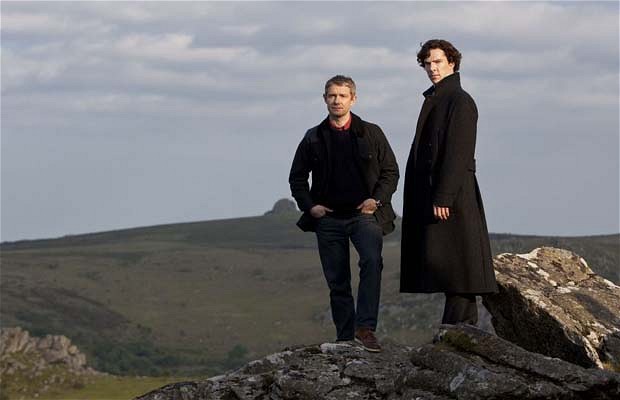
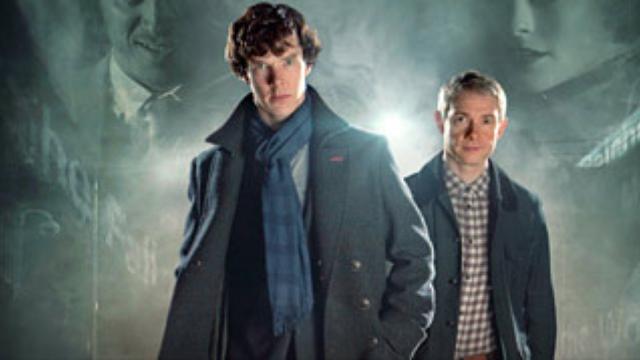
In “The Hounds of Baskerville,” the second of three “Sherlock” episodes in this season, Holmes (Benedict Cumberbatch) and Watson (Martin Freeman) take on the case of Henry Knight, who remains traumatized by seeing his father killed by a huge hound 20 years before. The two venture into the English countryside, specifically to the Baskerville military research base, to find out if giant glowing dogs with red eyes really do exist.

In the process, they have brushes with Sherlock’s brother Mycroft (the top-level British intelligence agent) and even James Moriarty, the warped genius who has become Sherlock’s nemesis. The ending of tonight’s episode forecasts the return of Moriarty next week.

Of course, Holmes and Watson also have the misfortune of running into that hound — as well as a couple of levels of conspiracy.

A few thoughts about the episode:

I loved that Holmes at one point notes that the CIA has a top-secret facility in Liberty, Indiana. That’s just down the road from me and I can assure you that if the Company has set up shop there, it’s pretty well hidden. Made me wish, for a moment, that they had chosen Muncie like everyone from “Tom Slick” to “The Simpsons” to “Hudsucker Proxy” to “Angel” has.

Not that there’s anything wrong with that: Not for the first time in the run of the series, someone mistakes Holmes and Watson for a couple. Cute.

Watson mockingly refers to Holmes as “Spock” after a scene in which Holmes is shaken by his failure to keep his emotions in check. Comparisons between the two have always been made and “Star Trek” episodes have obliquely referred to Spock’s ancestor Holmes (possible, as Trek fans know, because Spock’s mother is human). But for a joke that trumps all, Cumberbatch plays the bad guy in the now-in-production “Star Trek” movie sequel.

This Sherlock turns to cigarettes when he’s bored and anxious between cases, and not a seven percent solution.

Tonight’s episode had the misfortune of airing in the US following a couple of successful movies that had similar elements. The Baskerville hound looked a bit too much like the “mutts” in “Hunger Games,” while the idea of mind-altering gas released into outdoor settings echoed “Cabin in the Woods.”


The Great Newspaper Comics Challenge Part 12

It’s our weekly look at what’s funny in the funny pages. Because surely we’re still enjoying the “tip of the hat” from “They’ll Do It Every Time.”

“Classic Peanuts” gets an “awww” from us this Mother’s Day. Charlie Brown calls Snoopy to the phone. It’s Snoopy’s mom on the other end of the line. Snoopy sniffs and Charlie notes, “On Mother’s Day, you should have called her.” What do you want to bet we’re going to get a lot of Mother’s Day premises today?

Once again, “Baby Blues” hits the target as the kids watch clouds, spouting the scientific names for the types. Dad says somebody invented a lot of new cloud names since he was in school. Mom says, “Probably the same guy who keeps coming up with new ways to confuse me about math.” Right there with ya!

Finally, a good “Wizard of Id,” and it’s a Mother’s Day gag. The king’s mom comes for Mother’s Day and Rodney persuades the king to let his mom be queen for a day. The end result is the king is in irons, hanging in “Wizard of Id’s” Amnesty International-approved dungeon.

“Pickles” has old guy Earl making a BLT but using the dog snacks Beggin’ Strips instead of bacon by mistake. Finally the comics page addresses the societal problem of old people being forced to eat dog food.

Can anybody explain today’s “Speed Bump?” A rainbow leads to a pot of gold. A man finds it and the leprechaun offers his treasure … a french fry? I just don’t get it.

“Hi and Lois” addresses Mother’s Day, of course. Hi notes that Lois doesn’t want anything for Mother’s Day but to be left alone in bed. Marital counselor on speed dial?

“Dennis the Menace” marks Mother’s Day by that age-old gag of male incompetence in the kitchen. Dennis and his dad burn all the bread trying to make toast — in a toaster, for frak’s sake — and burn the eggs. Guess what? the family goes out to eat, just like in “Blondie and Dagwood.” Authorized and paid for by the National Restaurant Association.

Finally, you thought “The Family Circus” would have some maudlin Mother’s Day panel, didn’t you? The strip begins with PJ crying in a store. “I’m right here, PJ,” mom says from nearby. “Heh-heh — Just checkin,'” PJ thinks. When did PJ become that round-headed kid from “Family Guy?”

Big easter egg in ‘The Avengers?’

Did writer/director Joss Whedon include a huge easter egg/teaser for future storylines in “The Avengers?”

That’s the theory circulating online since earlier this week, when Quint wrote a geeky, fun piece on aintitcool.com about one of the most dramatic plot points in “The Avengers” and what it might mean for the future of the movie series.

If you haven’t seen the movie yet, read no further.

Okay?

The dramatic turning point in the movie comes when likable SHEILD agent Phil Coulson is killed by Loki. Coulson (Clark Gregg) is impaled on Loki’s scepter. His death gives the Avengers a rallying point — something to avenge.

SHIELD’s Nick Fury heightens the sense of loss by showing Iron Man and Captain America Coulson’s bloody Captain America trading cards. SHIELD agent Maria Hill later notes privately to Fury that Coulson’s cards couldn’t have been bloody because they were in his locker at the time of his death. Fury is a master manipulator, no doubt.

But is Whedon?

After word got out that Whedon assembled his cast following the Hollywood premiere to shoot another scene, some Internet message boards indicated it was a scene in which the Avengers would gather in Tony Stark’s lab to turn Coulson into the Vision, the classic Avengers android character created by Ultron, longtime Avengers enemy. (Of course, it was the enjoyable “Avengers assemble … to eat” scene.)

Quint expands on the “Coulson as Vision” theory by noting that the movie makes passing reference to Life Model Decoys, the robot duplicates SHIELD created in the comics, as well as noting that not once but twice in the movie reference is made to Coulson dating a cellist.

Who’s a cellist in Marvel Comics, according to Quint? Wanda Maximoff, the Scarlet Witch, sometime Avenger and ultimate wife of … the Vision.

Like the earlier rumors that Spider-Man would be in “The Avengers,” this line of reasoning is just too geeky, too fun, to possibly be true.

Right?


After ‘Avengers’ — What we want from Marvel movies

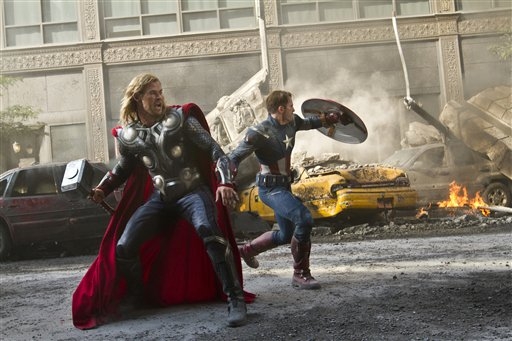
We’ve all seen “The Avengers” by now. Some of us have seen it twice. “Iron Man 3” comes out next year, followed by “Thor 2” and, inevitably, another “Captain America” movie and an “Avengers” sequel.

So what else do we want to see from Marvel Comics-based movies?

Carried to extremes, the fan wish list could include a Marvel Team-Up movie featuring Aunt Petunia and Aunt May. (Surely Marvel has published that comic book?)

So here are some reasonable requests:

Iron Man and the Hulk: Apparently, until just before “The Avengers” opened and moviegoers saw how much fun the Green Goliath could be in the right (Joss Whedon’s) hands, Marvel didn’t plan on making another “Hulk” movie. After two misfires (although I liked the Edward Norton movie just fine), the studio couldn’t get the Hulk right.

Well, Whedon realized that the Hulk is best when used judiciously. Mark Ruffalo was great as Bruce Banner and his mo-cap performance as the Hulk was terrific. But Hulk was a supporting character in “The Avengers.” So why not make him a supporting character in someone else’s movie? And although “Iron Man 3” is probably pretty well defined by now, surely there’s room for a couple of scenes of Banner and a couple of Hulk-outs? After all, didn’t “The Avengers” show Banner and Tony Stark leaving together, presumably so Stark could show the sympatico scientist his R&D facility?

Ant-Man and the Wasp: Leading up to “The Avengers,” there was a lot of speculation about who would play Hank Pym and Janet Van Dyne, the loving, bickering adventurers who, as Ant-Man and the Wasp, were founding members of the Avengers in the comics. Heck, socialite Van Dyne even gave the team its name.

So the characters didn’t appear in “The Avengers.” An Ant-Man movie might be in the works, but the characters don’t appear headed for the big screen anytime soon. Which is too bad. Wasp could be a very fun female role that’s very different from Black Widow. And Pym is a natural, especially considering his multitude of sizes and identities: Giant Man,  Goliath, Yellow Jacket. This must happen!

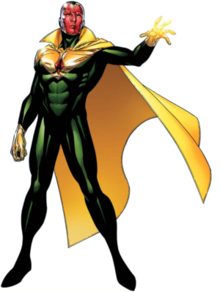
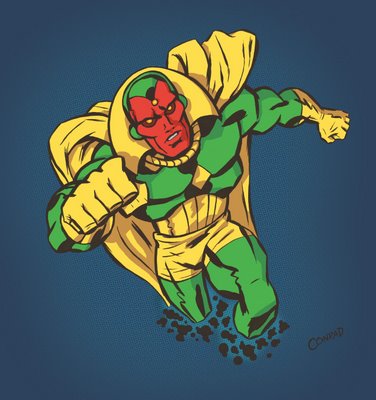
The Vision: If you have Henry Pym, why not the Vision? Pym’s murderous robot creation, Ultron, created the Vision as a means of killing the Avengers. Turns out the Vision preferred to side with the good guys, however. Over the years, Vision, in his distinctive red-and-green-and-yellow outfit, became one of the key members of the group and fell in love with, and married, the Scarlet Witch. The Vision is like Spock and Data from “Star Trek” — only cooler, if that’s possible.

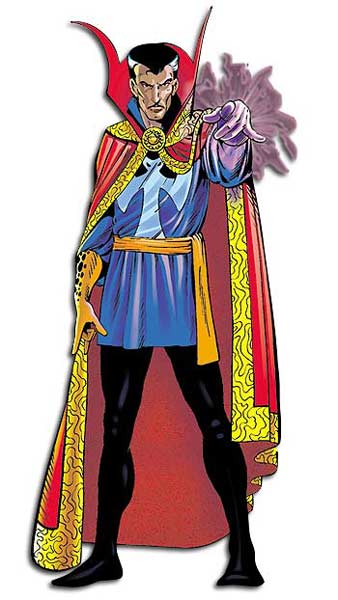
Dr. Strange: There’s been rumblings of a movie featuring Marvel’s sorcerer supreme for a while now. Since magic — or at least otherworldly science that can pass for magic — has been established in the on-screen Marvel universe, there’s no reason this mystical adventurer wouldn’t fit.

Superhero cameos, AKA rooftop encounters with Spidey: Marvel’s animated version of its super team, “The Avengers: Earth’s Mightiest Heroes,” has introduced an expanded Marvel universe that live-action movie fans can only dream of: On the Disney XD series, the Avengers regularly run into other New York-based heroes like the Fantastic Four. One episode from the first season showed the Avengers rumbling on the NYC streets with some bad guys when, out of the blue, the Human Torch and the Thing show up to help.

It’s the casual world-building that I loved about Marvel when I was a kid, the idea that all these Marvel characters shared the same universe. With the Fantastic Four and Spider-Man owed by other studios, it’ll be tough to pull off crossovers.

But we can dream, can’t we?


‘Sherlock’ returns with ‘Scandal in Belgravia’

One of the unexpected pleasures of TV in the past couple of years — along with “The Walking Dead” and a handful of other shows — has been “Sherlock,” Steven Moffat’s modern-day updating of Arthur Conan Doyle’s Victorian-age detective Sherlock Holmes.

There have been so many — hundreds — of stage, film and TV adaptations of the Conan Doyle books and short stories in the past century years that it’s hard to imagine crowning one as the best, particularly one that takes such liberties with the content of the canon. But “Sherlock,” a BBC production airing on PBS’ “Masterpiece” series (with two more installments to come May 13 and 20) is certainly near the top of the list.

In the series, set in the present day, Holmes (Benedict Cumberbatch) and Watson (Martin Freeman) forge the offbeat relationship familiar to readers of the original stories. Holmes is a brilliant consulting detective, Watson a physician and soldier. Each man is troubled in some respects. Watson is recovering from physical and spiritual wounds suffered in Afghanistan while Holmes is, for all his British intellect and wit, a stranger in a strange land.

The updated series uses original Conan Doyles stories (and titles; tonight’s episode is a take-off on “A Scandal in Bohemia”) as jumping off points, mixing in high-tech touches along with Holmes’ old-school detective work. In other words, for every scene in which Holmes deduces someone’s life story by observing stay hairs on their pants or scuffs on their shoes, there’s another scene in which Holmes or one of the players is texting on their smartphone. Just as Conan Doyle’s original writing had Watson publishing stories about his exploits with Homes — much to Holmes’ bemusement — in the new series, Watson writes a popular blog about the detective.

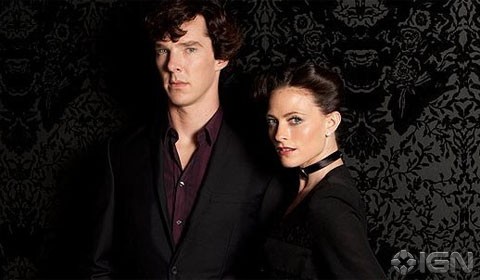
Tonight’s episode, like the 1891 original, introduced Irene Adler, a woman who is Holmes’ equal in sheer, cool intellect. In “Sherlock,” Adler is a high-society dominatrix who, as the  episode opens, is being sought for the compromising photos of a member of the royal family on her cell phone.

Adler is, as fans know, “The Woman,” the female who greatly intrigued Holmes, who was very likely his perfect match … if not for her habit of lawbreaking.

In “Belgravia,” we get some choice “Sherlock” scenes, as Holmes stays one step ahead of the police and the bad guys even as he struggles to keep up with Adler.

All the key ingredients to the “Sherlock” series are here: Holmes and Watson’s fond verbal jousting; landlady Mrs. Hudson; even Holmes’ nemesis James Moriarty. The opening of the episode resolves the standoff between Holmes and Moriarty from the end of the first season.

“Sherlock” revels in its modern-day ingenuity — the use of technology and London’s cool blue exteriors give the series a properly detached feel — as much as it encourages us to focus on Holmes’ never-out-of-style intensity.

Cumberbatch and Freeman are among the best portrayers of Holmes and Watson ever. Cumberbatch gets a showy role but Freeman — soon to star in “The Hobbit” with Cumberbatch providing the voice of the dragon Smaug — is an understated delight.

“John Hamish Watson. Just in case you’re looking for baby names,” Watson mutters at some point when Holmes and Adler are striking sparks.

And what an Alder Lara Pulver is. I love Rachel McAdams, who plays Adler in the current Robert Downey Jr. Holmes movies. But Pulver makes McAdams look like the high schooler she played in “Mean Girls.” Pulver, who matches Cumberbatch in cheekbones and ivory skin, is gorgeous and dangerous. She’s utterly believable as “the woman” in Holmes’ life.

Next week, “Sherlock” takes on “The Hound of the Baskervilles.” I’ll be watching.

Secrets of ‘The Avengers’

After seeing “The Avengers” for a second time, I thought I’d note a few moments from the movie that didn’t make their way into my review.

In some cases, they might be elements from the movie that blew right past the general audience.

And there’ll be a spoiler alert before the very end, if you still haven’t seen the movie — and contributed to the record-breaking $200 million opening weekend take.

Loki did it: Thor’s brother, Loki, is a troublemaker, a trickster god of the first order. He’s the force that sets the plot of Joss Whedon’s movie in motion by materializing on Earth and stealing the Cosmic Cube. Later, Black Widow, using unconventional interrogation techniques, determines that Loki is trying to get to the Avengers through the Hulk.

That’s perfectly appropriate, because in the first issue of the Avengers comic, released in September 1963, Loki uses tricks and illusions to get superheroes Iron Man, Ant Man and Wasp to go after Hulk. Thor shows up and, after some typical Marvel hero in-fighting, the team is formed. And stays together until the next issue.

Life Model Decoys: When SHIELD agent Phil Coulson calls Tony Stark early in the movie, Stark answers and says he’s not the real Tony Stark, he’s a Life Model Decoy. The geekiest among us know that Life Model Decoys were a creation of SHIELD early in the organization’s Marvel Comics history. In Strange Tales comic in 1965, SHIELD deploys LMDs — perfect copies of agents including Nick Fury — as … well, decoys.

“Puny god:” In one of the funniest moments in “The Avengers,” Hulk thoroughly wallops Loki. The audience is still laughing as Hulk walks away, muttering to himself. (Yes, the Hulk spoke in “The Incredible Hulk” and speaks again here.) What does Hulk say after giving Loki a (literal) smackdown? “Puny god!” It’s a play on Hulk’s patented “Puny humans!” declaration.

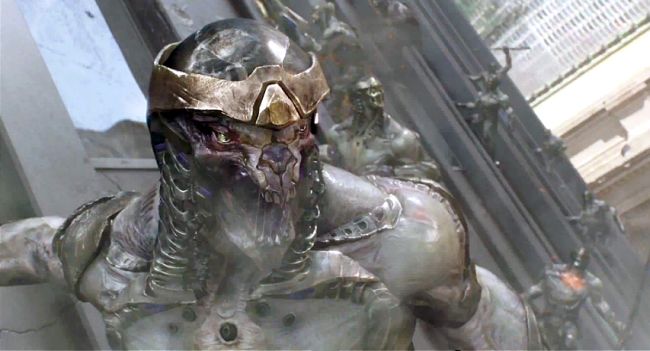
The Chitauri: After months of speculation about Loki’s alien army in “The Avengers,” it’s mentioned in the first moments of the movie, during voice-over narration, that the alien warriors are the Chitauri. Who? The Chitauri are, in the Ultimate Marvel comic book universe, the contemporary equivalent of the Skrulls. Apparently the Skrulls are considered part of the “Fantastic Four” movie universe and were not available for Whedon’s use here. Clever writer that he is, he got around that by using the Chitauri.
Stark Tower/Avengers Tower/Avengers Mansion: One thing the movie does, as did many Marvel comics over the past 50 years, is thoroughly establish a setting in New York City. As a kid who didn’t know he would ever visit the Big Apple — still haven’t, actually — I soaked up everything I could about New York from hundreds of Marvel Comics set there.

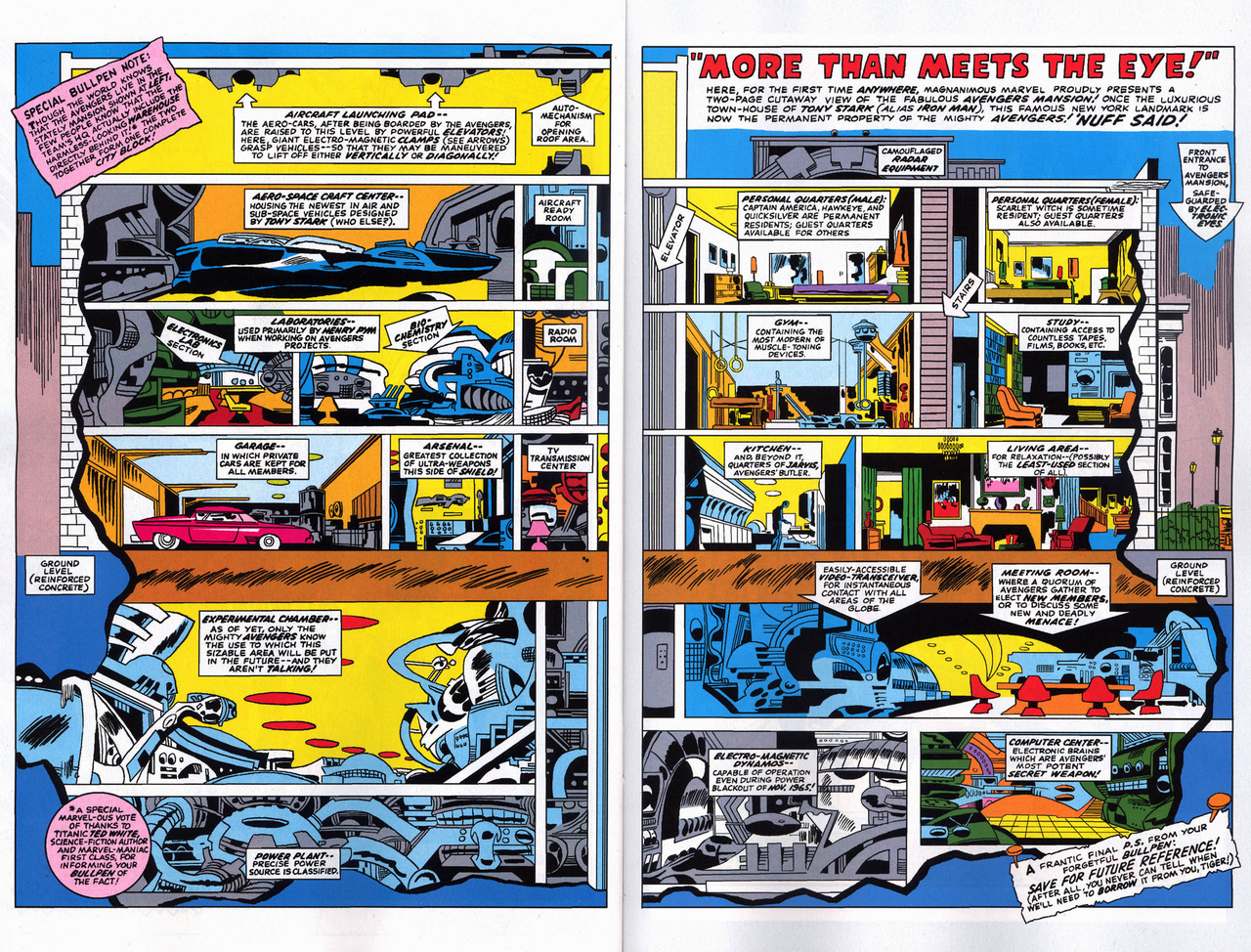
Second only to the Baxter Building — home of the Fantastic Four — on Marvel’s Landmarks of New York Tour is Avengers Mansion. Originally belonging to Tony Stark, the mansion is loaned to the Avengers for use as their home base. Jarvis, Tony’s butler, even becomes the butler for the Avengers.

In the movie, Stark is building a NYC skyscraper emblazoned with his name. During the battle with Loki and the Chitauri, most of the STARK lettering gets knocked off, leaving only a bold “A.” We notice this at the end of the movie and can assume that, for the inevitable sequel, the Avengers will hang out here.

Here’s the big “Avengers” movie secret. Once again, if you haven’t seen the movie, spoiler alert in …

3

2

1

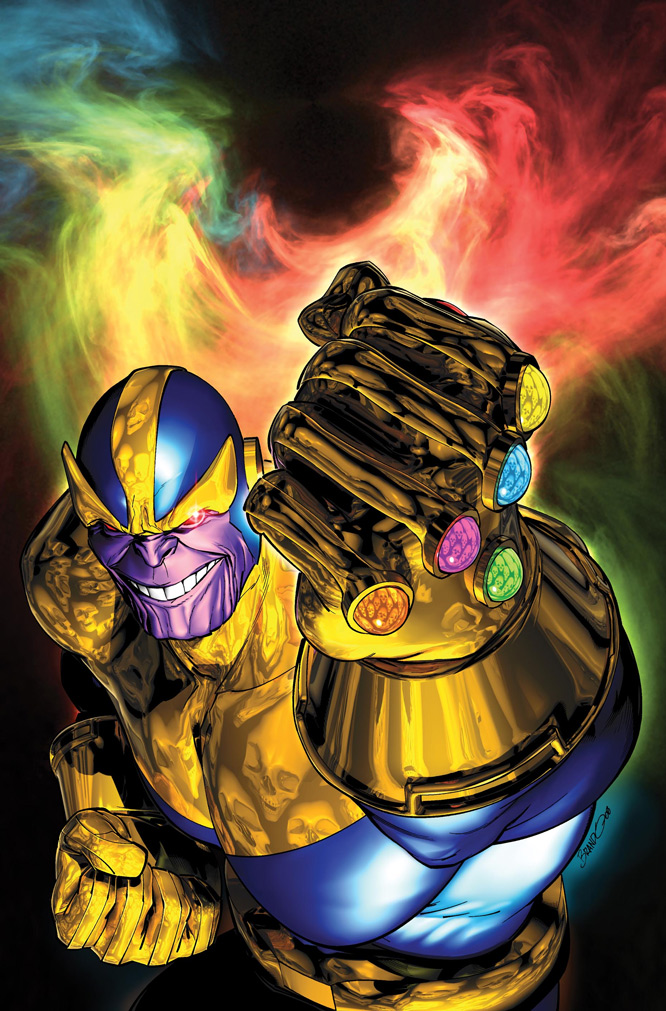
Thanos: Partway through the end credits, the mysterious alien who had been talking to Loki is seen, on a crumbling asteroid in space, talking to a creature seated on a throne.

To go to Earth and take on the Avengers would be to “court death,” the alien says.

The massive figure stands up from the throne, turns his head and smiles.

It is Thanos, the Marvel Comics alien introduced in Iron Man comics in 1973. Thanos, created by writer/artist Jim Starlin, is based on Thanatos, the god of death from Greek mythology. In the comics, Thanos is to some extent Marvel’s counterpart to DC’s Darkseid, an extremely powerful and dangerous alien creature who has crossed over from comic to comic, posing a threat to many of the heroes of the Marvel Universe.

Whedon is a comic book fan (and writer) and, by including Thanos in “The Avengers,” sparked shivers down the spines of fans everywhere. If Thanos shows up in an “Avengers” sequel, the threat he poses will be far greater than that posed by Loki.

Just sayin’.

 

‘Shocking’ drive-in movie ads!

There’s something about this weather that reminds me of going to drive-in movies.

Around here, we had two — the Muncie Drive-In and the Ski-Hi Drive-In — in or near the city and another — the Blackford County Drive-In — just to the north. The latter wasn’t the type of drive-in your parents took you to, however. The Blackford showed “adult” movies — porn, in other words.

As for the Muncie and the Ski-Hi, I spent many, many hours there as a kid and young adult.

One of my earliest drive-in moviegoing memories was of seeing the 1967 flick “Born Losers” at one of Muncie’s two drive-ins. “Born Losers” was a low-budget action movie that introduced the cult character of Billy Jack (played by Tom Laughlin), a returning Vietnam vet who takes on a motorcycle gang. The movie actually inspired sequels.

I remember seeing it with my parents and paternal grandmother. Why my parents decided to take me or my grandmother to a (in my memory) sleazy, bloody action movie I can’t imagine.

I just remember my grandmother nearly fainting into her concession-stand pizza after the bad guys push a young man’s face into the windshield of a car, resulting in a bloody, slobbery mess. Onscreen, I mean.

From time to time in this spot I’ll share some memories and some great old drive-in movie ads.

How about this one for a re-release of “The Mask” Not the Jim Carrey comedy but a bizarre 1961 horror movie about an ancient mask that has the power to drive people crazy. Some remember “The Mask” from the early 1980s, when it was re-released at the height of the 3-D revival.

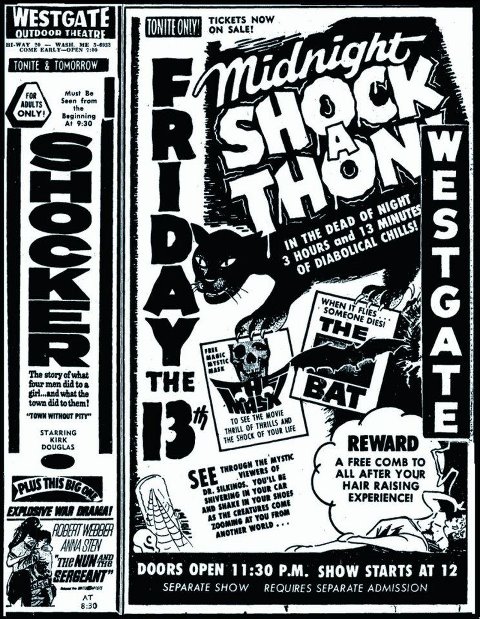
This “midnight shock-a-thon” ad features not only “The Mask” but “The Bat,” probably a 1959 Vincent Price thriller and “Town Without Pity,” a 1961 Kirk Douglas movie that is sold, as you can tell from the ad, in the sleaziest way possible:

“The story of what four men did to a girl .. and what the town did to them!”

This ad has some exploitation/drive-in advertising gems, including “A free comb to all after your hair-raising experience!” I can hear it now: “Mom, Dad, can we go to the drive-in tonight? They’re giving away free combs!”

Lastly, how about the exploitation double-feature classic “I Drink Your Blood” and “I Eat Your Skin.” The former is a 1970 movie about Satanists terrorizing a town. The latter originally came out in 1964 and was about zombies. The combination of titles was drive-in movie gold.

The canny drive-in operator offered a free buffet of “skin chips and dip” and “flesh fries” and provided free Tums.

Who wouldn’t turn out for this drive-in combo?