
I’ve noted on social media in recent days that we recently spent a little time in Muncie, Indiana, promoting THAT OCTOBER and getting together with family and friends and looking around the city that was my lifelong home until we moved to Tennessee almost three years ago.
It made perfect sense to promote the book there because 1.) more people know me there than here and B.) the book is set in my version of Muncie as it was in 1984. The novel’s not a documentary, obviously, but it’s got the overall vibe of Muncie more than 40 years ago and the teenage characters do some of the same things my friends and I did in Muncie when we were that age or a little older – going to movies, watching MTV, going to house parties. I never prowled through a junkyard, I admit, but that part of the book was inspired by my late Uncle Si Stewart, who talked about when he took a shortcut home from school through a Muncie junkyard when he was a kid in the 1950s.
We get back to Muncie once or twice a year since we’ve moved down here, and I’m always so grateful that I get to see family and friends there and get to look around the city I knew so well and covered for the newspaper for most of my life.
I always come away with gratitude for the people I get to see, those that I get to meet and the places that are familiar to me.
But I always feel sad when I’m there. I’m nearly swamped with melancholy while I’m there and for a while after.
It’s not just that the city has changed. It has, and not just in the three years we haven’t lived there. It was changing most of the time I lived there too.
I always explain to people who don’t know Muncie as the city where David Letterman went to college, where the first half of “Close Encounters of the Third Kind” was set, where Garfield the cartoon cat was created and is still produced and where Ball canning jars were made dating back to the 1890s.
It’s the city where four true crime books I co-wrote with Douglas Walker, my frequent collaborator at Muncie’s newspapers, are set. There’s no getting around that Muncie – one of several Midwestern cities that were nicknamed “Little Chicago” – was sometimes a violent and murderous place.
It’s a city that in some ways peaked when I was young, as young as the teenage protagonists of THAT OCTOBER. Its population peaked at just over 76,000 in 1980 and has fallen regularly since to an estimated 64,000 now. Most of the big industrial employers went away, some of the most recent in the 2000s, although luckily there’s some stopping of the bleeding thanks to growth in employment in the education and healthcare fields.
Still, Muncie has struggled and is struggling. The city can’t keep the streets paved. The mall is all but dead. Some, not all, of the government leadership seems determined to wipe out all the welcoming efforts that groups and private individuals have made over the years. And at the same time there’s decades-long efforts to bolster downtown, there’s a proposal to pull the last few hundred government workers out of downtown and put them in an ill-advised government center miles to the south, outside the city limits. (When one of the downtown government buildings was being built in the early 1990s, there was discussion of metal detectors inside the doors. An attorney who oversaw the project said it was insulting to frisk people who were on their way to pay their taxes. Yet here we are, decades later, and metal detectors are a way of life because life is cheap and murder is easy. That said, I think it’s insulting to tell people who pay their taxes that they can’t even pay those taxes or go to court or talk to their representatives without leaving the city, ffs.)
It’s depressing to contrast the city currently with the city as it was in the 1970s and 1980s. I don’t even get into a lot about how thriving the city was in 1984 in THAT OCTOBER, but as strange and upsetting as it was for murder and mystery to envelop the city and the young protagonists of my book, 1984 in the real-life Muncie was a boom time. Life in the city had peaked, in some ways, and in the decades since, it has not struggled its way back.
My friend Tammy told me this morning, as I was ruminating on all this, that my hometown’s struggles reflect this country’s stuggles and she’s right, of course. I take that as personally as I take what’s happened to Muncie.
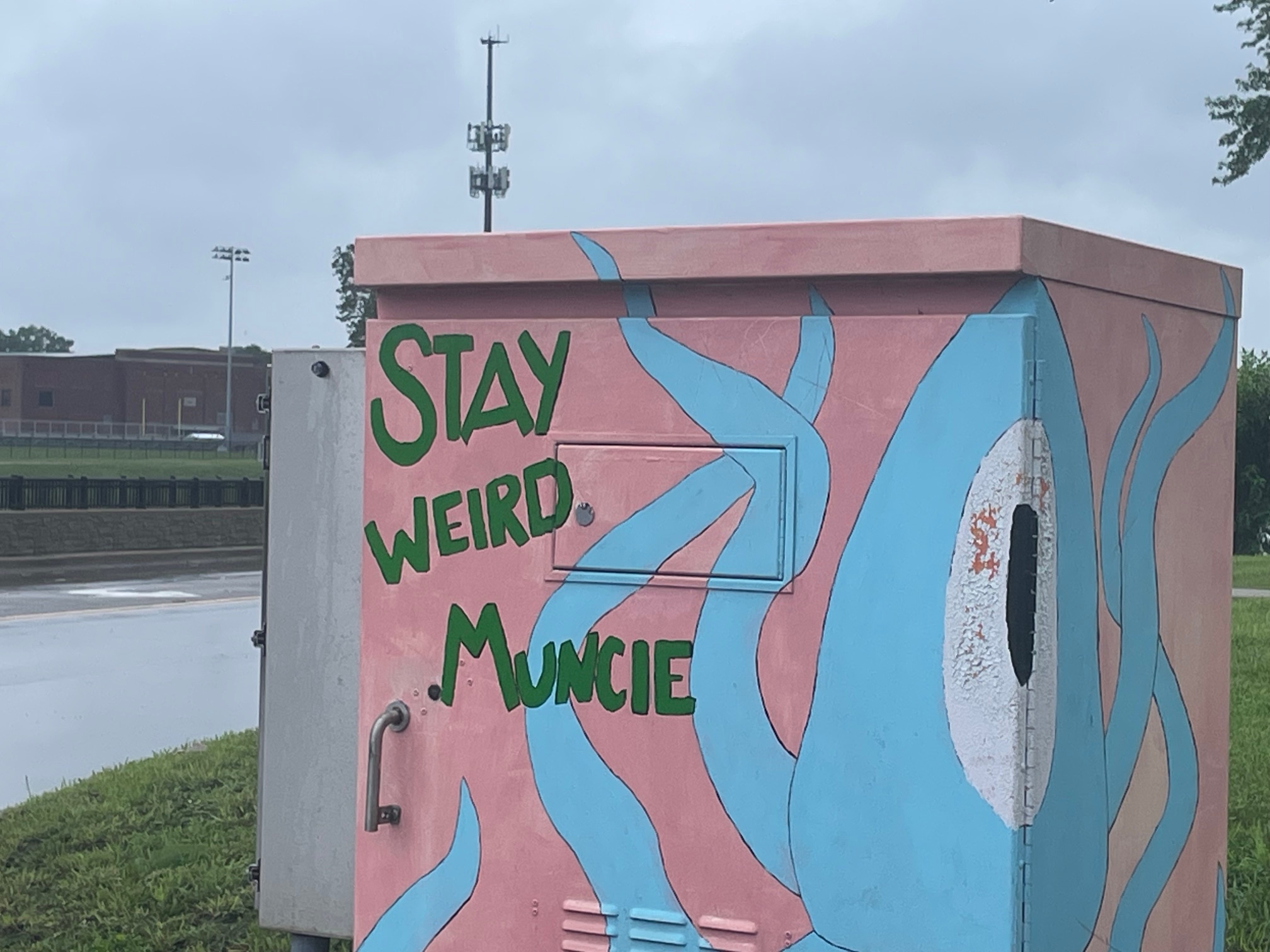
One of the consistently amusing sights around Muncie is a public art project from a few years ago that prompted artists to decorate traffic light control boxes. The art was contributed by a lot of different artists and ranged from the beautiful to the abstract to the whimsical like the “Stay Weird, Muncie,” message above. I took that picture our first day back and I’ve thought about it a lot.
I’d like to think that my hometown can be weird, interesting, welcoming, fulfilling, progressive but comforting and I like to think it can be a good hometown, either for someone who’s still living there, someone who’s just visiting or someone who’s come home again.
I’d like to think that, and maybe take comfort from that once I shake this profound melancholy I feel. But I’m not sure its possible.

 keithroysdon