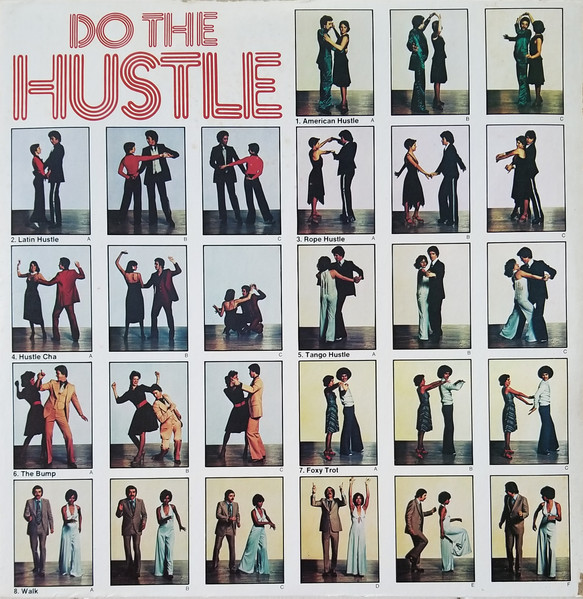
(And yes, you’re welcome for injecting that 1975 Van McCoy earworm into your brain.)
Every day, I see dudes in our apartment complex walking through the parking lot and down the hill to the busy commercial street below. They’re wearing knit shirts with restaurant logos and I’m assuming they’re going to work in the kitchens of said eateries.
In these hotter-than-the-hinges-on-the-gates-of-hell summer days, they’re walking to work, maybe because they don’t have cars and, luckily, there are so many places to eat nearby.
Increasingly, they’re turning out for work every day at some risk: getting swept up by state-sanctioned kidnappers.
Whatever the risks and whatever the meager rewards – nobody working in a restaurant kitchen is making more than minimum wage – they’re hustling every day.
They’re an echo of their parents and, honestly, my parents. My dad worked for 30 years in an auto parts factory. The days were hot and dirty and noisy; he was half-deaf by the time he retired. And when he retired, he ran pay-to-fish ponds down the hill and behind our house. Once a week he drove to another city, his old Chevy pickup with a waterproofed wooden tank that he built on the back, to pick up catfish and bluegill to stock the ponds. He’d owned and ran an apartment house years before I was born and sharpened saws after he retired.
My mom’s story was similar, and I tell some of it in my upcoming novel GHOST SHOW. She and her sisters gathered wild-growing plants near their little town in Tennessee – the place that inspired the town in my novel SEVEN ANGELS – to sell to reps of pharmaceutical companies. They collected the plants in burlap sacks and sold them, at the end of the day, for pennies.
My mom ran our 20-acre farm for those 30 years my dad worked in the factory. She cleaned houses and factories, a job I helped with before I started working in the newspaper business.
I have only a portion of the hard work, the sheer hustle, of my parents. Or those guys walking to work in a hot kitchen every day.
And I’m acutely aware of that.
“I need to work more and work longer hours if I’m gonna write all these books,” I said the other day.
“You know, you can take downtime,” the reply came.
And I do take down time. Too much of it. I need to work harder and smarter. I need to hustle.
As I write this, Word – a needy little bitch if ever there was one – is notifying me once again that I should update. Nevermind that I see these pleas when I’ve opened Word on my Macbook Pro and I’m trying to get some work done so no, I don’t plan on updating now.
Not to mention the number of times Google Chrome asks me to update.
I wouldn’t mind the updates if I thought they’d have a good outcome. But too often lately it seems like companies update their products – I’m not even talking about just tech products here – based on bad design.
Example: I had to buy a new Mr. Coffee coffeemaker recently when our old one – about seven years old – began leaking water I’d poured in. I got a new one because I didn’t relish the idea of getting electrocuted before I’d had my coffee.
So I picked out the basic model, which seemed to be the same 12-cup coffeemaker as I’d had and began using it. Immediately I noticed that the water level indicator is tucked away on the side, presumably to make the coffeemaker more narrow and more sleek. (Nevermind that I could only find it in black, which might hide coffee stains better than white but is harder to tell how much water you’ve poured in.) If I want to double-check how much water I’ve poured in, because of the place Mr. Coffee is tucked away in our tiny kitchen, I have to pull it forward on the counter and turn it to peer at it.
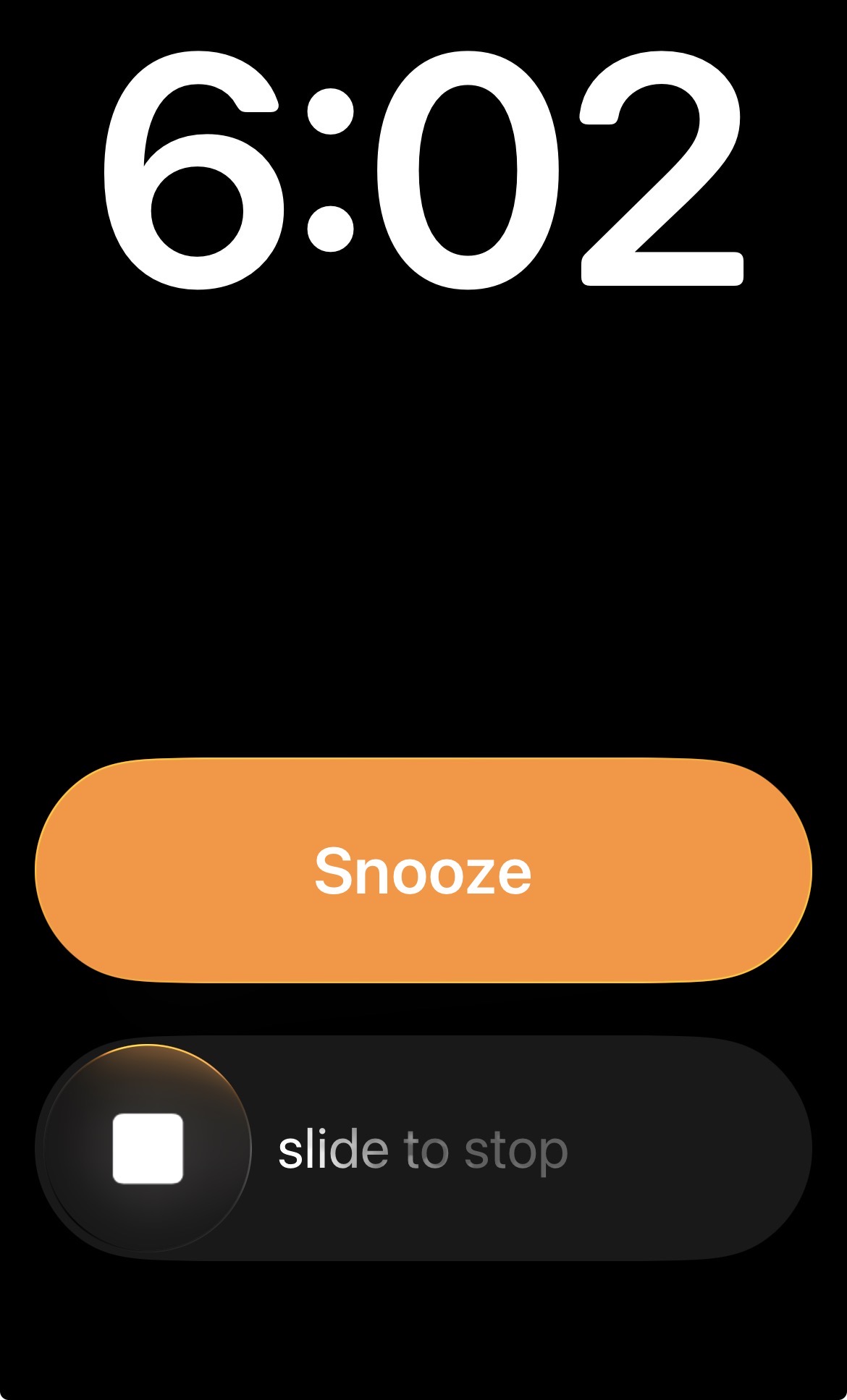
More annoying is a recent upgrade to my iphone – I bet you wondered wtf I was going to get to that – changed the way you can turn off notifications like the alarm indicator you see above.
In the past, the phone has offered a single button to tap to end an alarm or notification. Now you have to slide the notification.
No one at Apple thought about how hard this was to do with one hand. I can’t any longer turn off a notification casually with a single tap. Now I have to hold my phone in one hand and “swipe” with the other.
This change seemed to occur right about the time Apple introduced liquid glass, its “unified visual theme for the graphical user interfaces.”
Yes, by all means, you techboy schmucks, make apps and labels on your products transparent and harder to see.
You’d think someone could get paid hundreds of thousands of dollars – maybe millions in stock – to advise these companies on how not to piss off their low-vision or low-dexterity or low-mobility users?
I’ve noted on social media in recent days that we recently spent a little time in Muncie, Indiana, promoting THAT OCTOBER and getting together with family and friends and looking around the city that was my lifelong home until we moved to Tennessee almost three years ago.
It made perfect sense to promote the book there because 1.) more people know me there than here and B.) the book is set in my version of Muncie as it was in 1984. The novel’s not a documentary, obviously, but it’s got the overall vibe of Muncie more than 40 years ago and the teenage characters do some of the same things my friends and I did in Muncie when we were that age or a little older – going to movies, watching MTV, going to house parties. I never prowled through a junkyard, I admit, but that part of the book was inspired by my late Uncle Si Stewart, who talked about when he took a shortcut home from school through a Muncie junkyard when he was a kid in the 1950s.
We get back to Muncie once or twice a year since we’ve moved down here, and I’m always so grateful that I get to see family and friends there and get to look around the city I knew so well and covered for the newspaper for most of my life.
I always come away with gratitude for the people I get to see, those that I get to meet and the places that are familiar to me.
But I always feel sad when I’m there. I’m nearly swamped with melancholy while I’m there and for a while after.
It’s not just that the city has changed. It has, and not just in the three years we haven’t lived there. It was changing most of the time I lived there too.
I always explain to people who don’t know Muncie as the city where David Letterman went to college, where the first half of “Close Encounters of the Third Kind” was set, where Garfield the cartoon cat was created and is still produced and where Ball canning jars were made dating back to the 1890s.
It’s the city where four true crime books I co-wrote with Douglas Walker, my frequent collaborator at Muncie’s newspapers, are set. There’s no getting around that Muncie – one of several Midwestern cities that were nicknamed “Little Chicago” – was sometimes a violent and murderous place.
It’s a city that in some ways peaked when I was young, as young as the teenage protagonists of THAT OCTOBER. Its population peaked at just over 76,000 in 1980 and has fallen regularly since to an estimated 64,000 now. Most of the big industrial employers went away, some of the most recent in the 2000s, although luckily there’s some stopping of the bleeding thanks to growth in employment in the education and healthcare fields.
Still, Muncie has struggled and is struggling. The city can’t keep the streets paved. The mall is all but dead. Some, not all, of the government leadership seems determined to wipe out all the welcoming efforts that groups and private individuals have made over the years. And at the same time there’s decades-long efforts to bolster downtown, there’s a proposal to pull the last few hundred government workers out of downtown and put them in an ill-advised government center miles to the south, outside the city limits. (When one of the downtown government buildings was being built in the early 1990s, there was discussion of metal detectors inside the doors. An attorney who oversaw the project said it was insulting to frisk people who were on their way to pay their taxes. Yet here we are, decades later, and metal detectors are a way of life because life is cheap and murder is easy. That said, I think it’s insulting to tell people who pay their taxes that they can’t even pay those taxes or go to court or talk to their representatives without leaving the city, ffs.)
It’s depressing to contrast the city currently with the city as it was in the 1970s and 1980s. I don’t even get into a lot about how thriving the city was in 1984 in THAT OCTOBER, but as strange and upsetting as it was for murder and mystery to envelop the city and the young protagonists of my book, 1984 in the real-life Muncie was a boom time. Life in the city had peaked, in some ways, and in the decades since, it has not struggled its way back.
My friend Tammy told me this morning, as I was ruminating on all this, that my hometown’s struggles reflect this country’s stuggles and she’s right, of course. I take that as personally as I take what’s happened to Muncie.
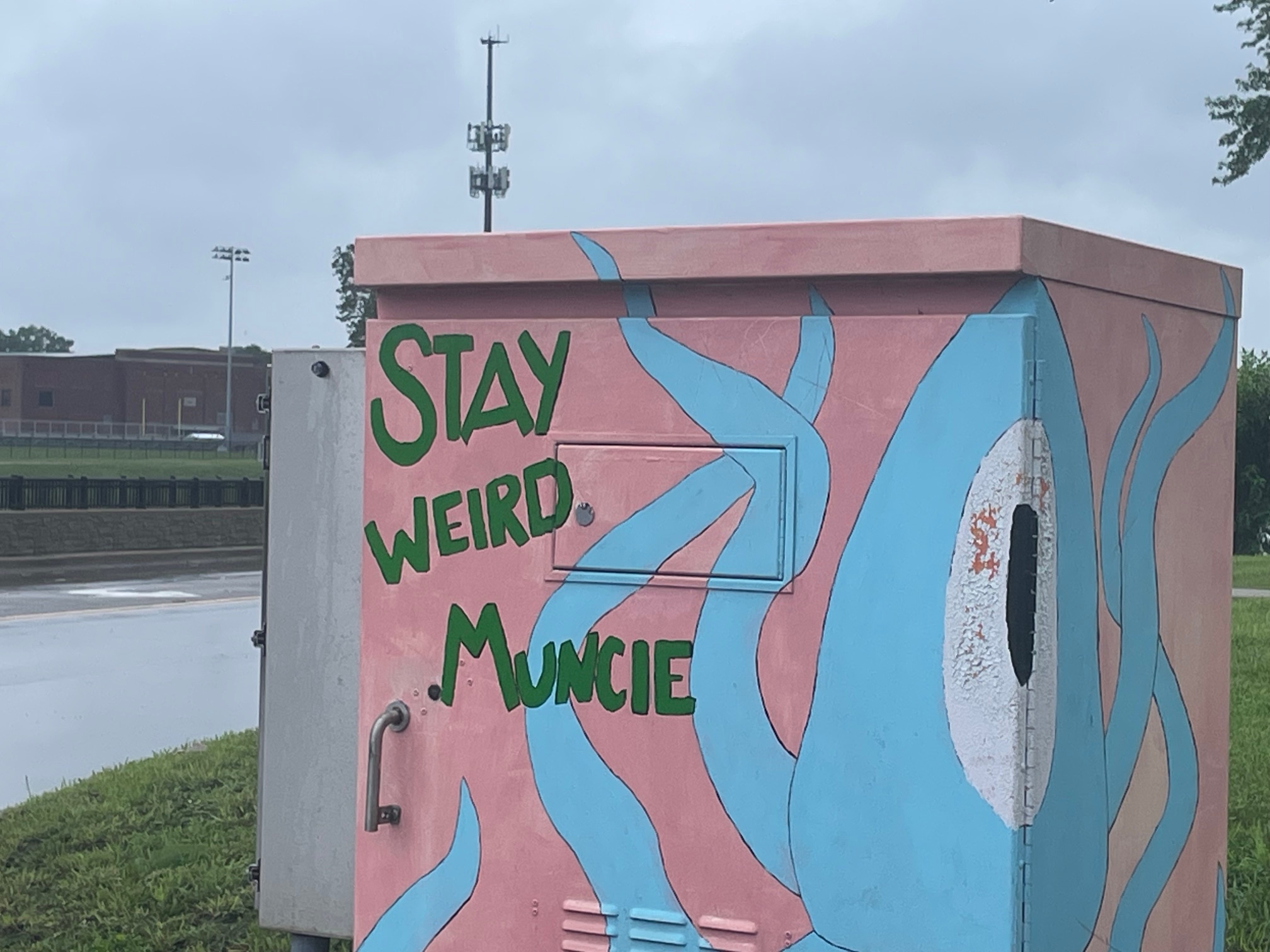
One of the consistently amusing sights around Muncie is a public art project from a few years ago that prompted artists to decorate traffic light control boxes. The art was contributed by a lot of different artists and ranged from the beautiful to the abstract to the whimsical like the “Stay Weird, Muncie,” message above. I took that picture our first day back and I’ve thought about it a lot.
I’d like to think that my hometown can be weird, interesting, welcoming, fulfilling, progressive but comforting and I like to think it can be a good hometown, either for someone who’s still living there, someone who’s just visiting or someone who’s come home again.
I’d like to think that, and maybe take comfort from that once I shake this profound melancholy I feel. But I’m not sure its possible.
Every once in a while, I’m taken aback when a writer who I kinda thought I knew isn’t actually who I thought they were. I’m not talking about any kind of betrayal here, dire or otherwise. I knew them only as a pen name and didn’t realize that fact.
There are a lot of worse identity crises out there, such as what happens when you deadname someone. But I still get surprised when Facebook suggests I send a friend request to someone and I don’t recognize the name but I know the face.
I realize, stupidly, belatedly, that they publish under a pen name.
I am, unfortunately, 50-some years past the time I could have used a pen name. That’s because in a very small circle of people, I’ve been known since I was in high school. That’s when my first article, under my byline, was published in the newspaper. I haven’t been out of print since 1977.
And when you have an unusual last name like mine, you’re pretty easy to find. Remember the days we were all listed in phone books, no less city directories? (The latter, if you don’t remember them at all, were phone book-style directories that let you look someone up not only by name but by address and, in reverse-directory style, by phone number. And when you looked them up, it told what they did for a living. I’m not sure city directories were any worse than the many ways you can find out about someone now, but they were handy tools for newspaper reporters and probably nightmarish for everyone else.)
(I literally remember using the city directory to find people who, according to court records, might have been victimized by a corrupt judge, some willingly. It made for some awkward conversations when someone came to the door, let me tell you.)
So I’ve never been able to take refuge in anonymity. I know this was frustrating for me and for my family, particularly when someone would call on our home phone – remember those? – to give me grief about something I’d written.
My relative high profile, as compared to people who didn’t work for a newspaper, led to some pretty awkward moments. Sometime I’ll recount one for you over a beer or coffee. You might throw your drink in my face when you hear it, though.
Anyway, it’s too late now for me to adopt an anonymous personna like the superhero the Question, pictured above. Moving to another state has given me some relief from running into people I wrote about, though.
If I get that kind of “hey, it’s that guy” notoriety again, maybe I’ll start wearing a full-face mask and fedora.