Category Archives: Uncategorized

‘Hoosiers’ took us all the way to state

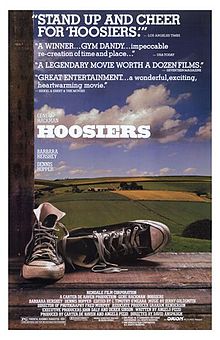
When “Hoosiers” came out in 1986, I don’t think most of us here in Indiana appreciated what a singular accomplishment it was.

Sure, writer Angelo Pizzo and director David Anspaugh got plenty of accolades for their homespun story of second chances and redemption. But I was reviewing movies and writing about Indiana’s fledgling status as movie location at the time and while a few movies like “Close Encounters of the Third Kind,” eight years earlier, had been partially set in Indiana — here in Muncie, as a matter of fact — they weren’t shot here. The state film commission was trying to attract moviemakers here and “Hoosiers” seemed like the state’s entry into the grand and grandiose world of filmmaking.

It was not to be.

So we can appreciate “Hoosiers” for what it is: A touching, old-fashioned story about a former college hoops coach (Gene Hackman) trying for a second chance at a tiny Indiana school. The story is loosely based on the 1954 state championship game between Milan (called Hickory in the movie) and Muncie (with South Bend substituting in the film).

There’s a lot to like about “Hoosiers.” Here are a few of our favorite things:

Yep, that’s Indiana. The movie was filmed in the state and there’s no mistaking its lonely two-lane roads, flat cornfields and historic brick school houses. Not to mention the well-known Hoosier resistance to change.

“I thought everybody in Indiana played basketball.” One of the biggest things the movie gets right is the decades-long Hoosier love of high school basketball. The crowded little school gyms, the caravan of cars to away games, the hoops hanging on the sides of barns and in rural yards. We loved it all, right up the end of class basketball.

The casting. The players, the townspeople, the people at the games. There’s rarely a jarring moment.
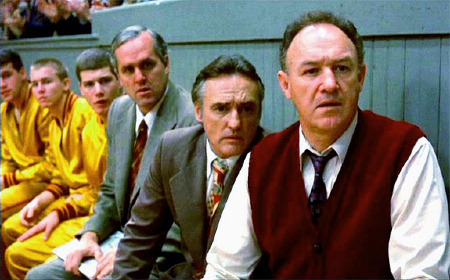
Dennis Hopper. As the town drunk who knows basketball but invariably shows up at games and embarrasses his player son, Hooper was rightly nominated for an Oscar. It’s a comeback role for him.

Gene Hackman. It’s easy to forget just how good Hackman — who is apparently retired from acting these days — is, how easy he makes acting look. He’s perfect as the single-minded, not especially cuddly coach who doesn’t take any grief from players or parents.

And finally, the tape measure scene. When the players get to the state finals at Butler in Indianapolis, Hackman has them measure the distance to the rim. It’s the same as back in their gym in Hickory, he notes. The players laugh, releasing tension, but they’ve also been reminded that it’s just a game and it’s the same game they’ve been playing, every Friday night, in gyms big and small.

New trailer for ‘Abraham Lincoln: Vampire Hunter’

I’ve mentioned before that I really enjoyed Seth Grahame-Smith’s novel “Abraham Lincoln: Vampire Hunter.” It’s a fast, fun read that plays its story straight: The nation’s 16th president discovers, as a young man, that vampires are a plague upon the nation.

Grahame-Smith’s story, in which Lincoln has an unlikely mentor in his war against vampires, has a title that invites smirks. But the book is a compelling and somber read. The addition of a supernatural subplot to Lincoln’s life fits, bizarrely enough.

Director Timur Bekmambatov’s movie version comes out on June 22. There’s a new trailer out for the movie that emphasizes both the story’s tragedy-infused tone as well as what looks like crazy action.

End of an era: Encyclopedia Britannica stops printing

A belated moment of silence for home phones, videocasette recorders and now, the Encyclopedia Britannica.

After 244 years, the print version of Encyclopedia Britannica is no more.

The company has decided that the 32-volume set for 2012 will be the last to be published on paper.

The decision was an easy one for the company, CNN reported today. Sales of the printed and bound encyclopedia account for only about a percent of the company’s revenue. Even the online version, available since 1994, accounts for only about 15 percent. The company makes most of its money from teaching tools.

Still, for many of us from a certain era of students, the end of the encyclopedia is a nostalgic thing.

Decades before Wikipedia and even sketchier online information sources, encyclopedia sets were the end-all-and-be-all of do-it-yourself learning.

I can’t count the number of times I went to the library and looked up a subject — Egypt, for example, or agriculture — and found the materials I needed for a report. I sometimes — I’m not afraid to admit this — even read encyclopedia volumes when I didn’t have to.

The encyclopedia had what I consider one of the best features of a modern-day print newspaper or magazine: A strong editor’s hand exercised on authoritative material.

Sure there’s a ton of information out there online, much of it valuable. But neither Wikipedia nor most online sources, unless they’re backed by a university, a news publication or Snopes, can be trusted almost without fail.

The Britannica, and most encyclopedias, could.

I’m sure some mistakes crept in. No one could list every export of Brazil in order of importance without making some mistakes.

So it’s a sad day that Encyclopedia Britannica is soon to be gone, at least from between hardcovers.

But I don’t have a current — even a not-so-current — set of Encyclopedia Britannica in my home, so what do I know?

Not enough, apparently.

Cherie Priest says get ‘Hellbent’

I have to admit the “urban fantasy” genre was new to me. Or maybe it wasn’t, but I just never heard it called that. I gather it’s a genre of fiction that involves vampires and werewolves and things of that nature (emphasis on the “things” part) but instead of hanging out in Transylvania they’re duking it out in the streets of NYC or San Francisco.

I became a Cherie Priest fan through her “Clockwork Century” steampunk books like “Boneshaker,” which is being made into a movie.

But I decided to try Priest’s urban fantasy book “Bloodshot” and was impressed. Priest is a master at finding the right tone for the period of her stories. The steampunk books are set in the late 1800s and “Bloodshot” and its sequel, “Hellbent,” are modern-day urban fantasies (there’s that phrase again) featuring a vampire named Raylene Pendle.

Pendle wears a lot of hats (not literally, although we do find out a lot about her wardrobe) here. She’s a vampire, a master thief, a kick-ass fighter and someone who acknowledges her own “issues,” including a healthy dose of obsessive compulsive disorder.

I don’t mean the “check the stove, check the door, check the stove” type of OCD (all too familiar to me). Raylene is self-proclaimed OCD in her worries over planning her missions. She acknowledges she takes too much stuff when she’s about to knock over a stronghold and steal some artifact (for a price). But Raylene doesn’t get bogged down in details when a case heats up. She’s got the super strength and super speed of a supernatural being and not afraid to take risks.

In “Bloodshot,” Raylene found her solitary existence in a made-over warehouse in Seattle changed by a couple of young humans she protects as well as a blind vampire, Ian, and a Navy Seal/drag queen named Adrian. About Adrian: Strangely enough, the character works and is totally appealing. A lot of pop fiction characters have a sidekick and Adrian is like Spencer’s Hawk — only he knows how to apply makeup.

In “Hellbent,” Raylene takes on one task for pay — the retrieval of several artifacts that are offbeat, to say the least — and one (maybe two) tasks that are personal in nature — working to clear up Ian’s status with his old vampire “house” (read family) and looking for Adrian’s missing sister.

That’s a lot of plot strands already, but Priest introduces another to the mix: Her competitor for the artifacts is the ultimate version of a woman wronged: A middle-aged woman with her own mental illness who uses magic to get vengeance.

The storylines don’t jell as well as they should, but there’s an appealing quality to the unsettled nature of the plot. “Hellbent” feels like a book that’s building to something, but there’s a good resolution to the story at the end so readers won’t feel cheated.

Above all, Priest’s characters are winning. None are more so than Raylene herself, who is as likable as an undead killing machine can possible be. How likable is that? Pretty damn likable, as it turns out.

It’s impressive that Priest has created two book series that feel as different as her steampunk and urban fantasy books. They read as if they’re by different authors, although both have Priest’s knack for appealing characters.

And “Bloodshot” and “Hellbent” have something else: A funny, dangerous heroine who will, hopefully, grace the supernatural world with her presence again soon.

Hitting the convention floor

Tickets for San Diego Comic-Con International went on sale this morning and, as blogger supreme Mark Evanier tells us, were mostly gone within 90 minutes. When you consider that upwards of 120,000 people attend Comic-Con — which has become a geek mecca as well as the symbol of Hollywood’s newfound interest in geek culture — the pace of ticket sales is pretty remarkable.

I’ve never been to Comic-Con, which is held in San Diego, and I’m not sure that I ever will. As much as experiencing the unimaginable appeals to me, I’m not sure I’m up for that particular experience anymore.

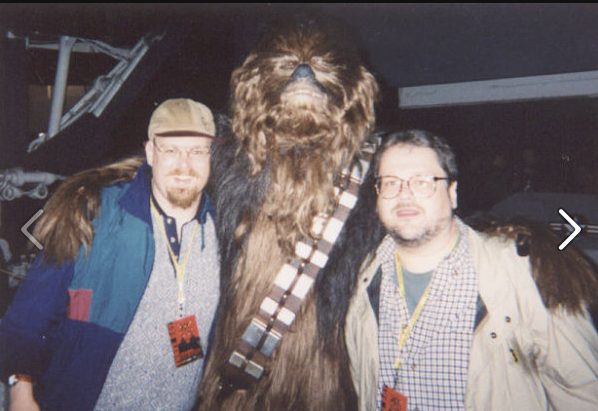
The photo above is of (left to right) my friend Andy, Chewbacca and me and was taken in the spring of 1999 at the first Star Wars Celebration, held in Denver. Andy was a Denver resident then and invited me out to experience the convention, which was in later years staged closer to home (for me) in Indianapolis.

Star Wars Celebration — particularly the later versions, held in the mammoth Indiana Convention Center — is as close as I’ve ever come to attending something of the size of Comic-Con.

If you’ve never attended a convention and you’re even a casual fan of science fiction books and movies, comic books and the like, you should try one, even if only for a day.

During my most active period of fandom, the late 1970s and the 1980s, my friends and I attended conventions all over the Midwest. Chicago, Indy, Cleveland, Columbus … we spent a lot of time on convention floors.

Much of that time included visits to the dealers room, where we bought movie posters, lobby cards, books, magazines, comic books and original art. As our bags got heavier, our wallets got lighter. But we didn’t mind.

Conventions can be overwhelming experiences — the growth of Comic-Con has prompted complaints in recent years — but they’re also fun and self-affirming. If you’ve ever thought you were the only person who truly appreciated “Doctor Who,” “Star Trek” or something much more obscure, conventions will open your eyes. Right in front of you, all around you, you’ll find thousands — sometimes tens of thousands — of other people who share your interest.

Sure, most of them will be standing in the autograph line in front of you, but hey, that’s just demonstrating shared interests, right?

After a decade of con attendance, I grew a little weary of the experience. There’s only so many times I’m willing to go elbow-to-elbow with some unwashed geek in a too-small T-shirt for the chance to get an autograph from Kenny Baker (R2D2 of “Star Wars,” of course).

But conventions remain the source of some of my favorite fandom memories.

I’ll never forget standing in line with Andy at the first Star Wars Celebration, which was held outdoors on a former military base. That spring, Denver was seeing some uncharacteristically nasty weather. It was raining and sleeting and, much to our surprise, Anthony Daniels (C3PO of “Star Wars”), a guest at the convention, walked up and down the line, making chit-chat with soggy fans.

Only at a convention.

And we’re back ….

That was supposed to suggest Jimmy Fallon in that old “Saturday Night Live” sketch about an obnoxious morning radio DJ.

Except I certainly couldn’t scream it like he did.

I’ve been under the weather for about a month now and still don’t really feel like myself, but I need to feed the blog. So I’m going to play pop culture catch-up some in the next few days.

Hopefully.

Paul isn’t dead, but I’m not feeling great

I haven’t been feeling well recently, so of course I thought about Paul McCartney.

Okay, let me retrace my steps there.

I stayed home sick today and saw, on TV or the Interwebs, mention of the rumor that Jon Bon Jovi was dead. Specifically, I saw debunking of the rumor by the New Jersey rocker himself.

Which made me think of the fan furor over the “death” of Beatle Paul McCartney in the 1960s.

I wasn’t the most discriminating music fan as an elementary schooler. I liked the Beatles but I also liked the Monkees, Rolling Stones and yes, even the Dave Clark Five.

I’m not positive I was aware of the McCartney rumors, but if I wasn’t before a visit to my doctor’s office, I certainly was after.

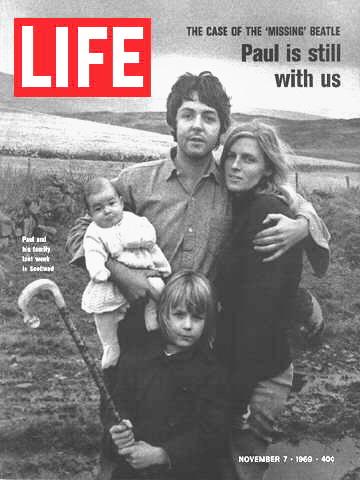
There, in the waiting room of Muncie’s Children’s Clinic, was the Nov. 7, 1969 cover of Life magazine, with Paul and Linda and their kids on the cover.

“The Case of the ‘Missing’ Beatle: Paul is Still With Us,” the headline read.

If you don’t remember the “Paul is dead” rumor, it was basically that McCartney had been killed in a 1966 car accident. The Beatles had quietly replaced him with an impostor but then had, improbably, included clues as to his death in music and album cover images. (“Turn me on dead man,” Paul facing backward, Paul not wearing shoes, etc.)

Flash forward to the summer of 1969, when a radio DJ began publicizing the rumor. Reports of Paul’s death circulated quickly, prompting Life to send a reporter and photographer to McCartney’s farm in Scotland.

I don’t remember a lot about the Life article, but I remember eagerly reading it. I’m not sure it was my first dose of reality about the scary possibility of death — I was an avid viewer of the “Combat!” TV series, after all, and battlefield deaths were commonplace in the show — but it affected me enough that I remember it all these years later.

The other day I found out about the death of North Korean “dear leader” Kim Jong Il from the Twitter feed of comedian and writer Patton Oswalt. The Associated Press Tweet about the story came later.

The lightning speed of news today —  not only genuine breaking news but also rumors like those that hit Bon Jovi — means that stories circulate more quickly than ever.

That means the resolution to those stories circulates more quickly too. None of us had to wait three years for Life magazine to debunk the Bon Jovi rumor.

Thank goodness. I’m already sick and wouldn’t want to deal with that on top of a bad cold.

An unflinching but moving look at Jonestown

Most of us know how the story of Indiana preacher Jim Jones ended: Jones, a madman cloaked in the robes of a preacher, civil rights activist and would-be socialist, led nearly 1,000 of his followers to their deaths in a 1978 mass suicide in the South American country of Guyana.

But considering Jones grew up just a county over from where I sit as I write this, I didn’t know the full scope and breadth of Jones’ story. And I certainly didn’t know the lives and tragic deaths of his followers.

Until I read Julia Scheeres’ “A Thousand Lives: The Untold Story of Hope, Deception and Survival at Jonestown.”

Scheeres — whose previous book, “Jesus Land,” was a wrenching memoir of her early years in Indiana and, along with her brother, incarceration in a twisted South American youth camp run by a religious group — found a surprisingly similar theme when she chose Jonestown as the focus of her second book: The evil that people do in the name of their beliefs.

In the case of Jim Jones and his self-named South American settlement, those beliefs were, almost whole-heartedly, focused on the group’s leader. Jones, who had churches in Indianapolis and San Francisco before he moved his flock to Guyana, might have gradually succumbed to the the depths of his mental illness but was certainly fixated on exerting control over others even from his early days in the pulpit.

That control extended to every area of their lives. Jones took money from his followers — perhaps millions of dollars by the end — as well as their dignity. He seduced, coerced and outright sexually assaulted many of his people. He broke up families and turned spouses and siblings against each other.

Well before the end, Jonestown was a place where members of the Peoples Temple informed on each other and willingly — perhaps even with a heady sense of the control that Jones enjoyed — exacted punishment from their fellow church members.

Scheeres, who writes in a matter-of-fact tone that packs a punch, retells the story of Jones and his church through not only interviews with survivors but information gleaned from thousands of FBI documents.

The picture she paints is powerful and disturbing. She captures the anxiety and fear of a handful of Jones’ followers as well as the frightening tactics the Peoples Temple leader employed. Even while Jones worked to persuade his church members that “revolutionary suicide” — a term that Jones misunderstood or deliberately misstated — was their only possible fate, he staged fake assassination attempts and attacks to sell his plan.

In hindsight it’s hard to imagine how the authorities didn’t put a stop to Jones’ plan. But church members were so afraid and so mentally enslaved that, until the very end, many didn’t try to get away from their inevitable fate. And the authorities, both in the U.S. and in Guyana, couldn’t believe the warning signs. Who could possibly imagine that one man would convince nearly a thousand people to kill themselves?

Who would want, or could exert, that kind of control?

The Hoosier state, maybe not even the United States, might never again spawn such a man as Jim Jones. But Julia Scheeres’ “A Thousand Lives” is an eyes-wide-open look at how it happened once thanks to belief in a madman and the disbelief of those on the outside looking in.

Nostalgia with a cap on it

I drink a couple of bottles of Diet Pepsi — Diet Coke when necessary — a day, but when I was growing up, pop — as we called it — was a fairly rare thing for us.

Maybe that’s why the memories associated with it — the taste, the smell but also the look of the bottles and various Pepsi accoutrements — are so memorable.

We ate dinner tonight at a local restaurant with lots of nostalgic decorations, the kind of place that Moe from “The Simpsons” described as “a place with a whole lot of crazy crap on the walls.”

Among the nostalgic decor was something I’d never seen before: Metal Pepsi bottle carriers.

I don’t have any memory of those and I wonder if they had even been available around here.

I do have vivid memories of the thick paper cartons that six glass bottles of Pepsi, Mountain Dew and other drinks came in. We would get a six-bottle carton of Pepsi on a trip to the grocery store and, a week or so later when we made our next shopping trip, we would buy another.

A big part of that return visit, of course, was returning the empty glass bottles for deposit.

We would save the bottles as they were emptied over the course of a week — remarkable that they lasted that long, but we drank things like milk and water more than pop in those days — and return them to the store in the paper carton. We would show the carton full of bottles at the supermarket office and get the deposit back — a nickel or quarter or whatever it was for the six pack.

I also have vivid memories of the liners of the Pepsi bottle caps. For much of the time that I remember, the bottle cap liners were made of plastic and, at least some of the time, the caps were imprinted with pictures of American presidents. You could collect all the presidents and paste them on some sort of official game card and then … well, I have no idea. I don’t remember ever collecting all the presidents, even though there were only about 17 chief executives to that point.

Kidding.

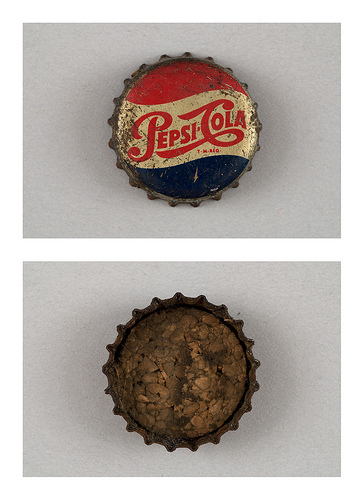
Before the plastic liners, which the Interwebs tells me were introduced in the 1960s, were cork bottle cap liners. I can’t remember if Pepsi ever conducted games with the cork liners, although I do remember digging them out of the bottle caps for some reason. I remember that because of how easily they fell apart.

I know soft drink companies still do the occasional bottle cap game. But it’s hard to imagine kids today laboring over fragile cap liners, carefully pulling them out of the caps and collecting them for some unimaginable prize.

iPhoneography: Fall is here

Yes, yes, I know that fall officially arrived more than a month ago, and we’ve had enough cool temperatures in Indiana to warrant switching on the furnace.

But there’s something about November that really reinforces the idea: It’s fall.

With Halloween over and the holiday season rushing toward us like an oncoming train, maybe there’s time to take a breath and contemplate the change of seasons.

These photos were taken with my iPhone in my neighborhood in recent days.

This green leaf — hanging precariously on a gate above a pile of leaves waiting to be raked — sums up how I feel about fall sometimes. I see it coming but I hate to give in because of what follows.

Most have given in already.

Fall’s colors are beautiful.

Just a few months ago, this little ditch was teaming with wildlife. This morning it’s frosty.

A nice spot for watching the change of seasons.

Enjoy fall!