My movie role: Thug in a Batman fight

Did I ever tell you about the time I got beat up by Batman and Robin in a movie?

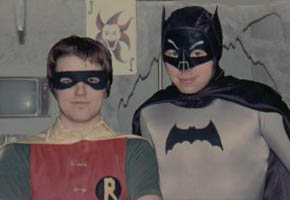
It was about 30 years ago and my circle of geek friends included Mark Racop, a Ball State University student from Logansport, Indiana, who was a fan of all things Batman. Racop did more with his fandom, however, than read comic books or sit around watching reruns of the 1960s “Batman” TV series, however.

Racop made Batman movies. And a Batcave. And, most impressive of all, Batmobiles.

My friends and I had flirted with movie-making a few times, writing and shooting a short thriller masterminded by my pal Brian McFadden. But Mark was serious as a heart attack about his desire to make Batman movies.

Now mind you this was before the 1989 Tim Burton “Batman” movie starring Michael Keaton. Nobody had put Batman on film since the 1960s and then it was the campy “Blam!” “Kee-runch” Batman.

Mark enlisted a bunch of us to appear in “Eyes of the Cat,” a 45-minute Batman movie featuring himself as Batman — in costume quite like Adam West’s outfit from the TV series — and various other friends as Robin, Catwoman and assorted henchmen.

That’s where I came in.

Because Racop shot his movie over the course of months (maybe years), I was only in a few moments of the movie. I played Figgy Pudding, a thug rousted and roughed up by Batman and Robin. My friend Brian played Harry Beefmelons.

We spent a couple of days roughing each other up, throwing punches and working out our own fight choreography. It was a blast.

Mark went on to a number of enterprises, including his latest. His company, Fiberglass Freaks, is officially licensed by Warner Bros. and DC Comics to make and sell replicas of the 1960s Batmobile.

The Batmobile he had back in the day was one that he had cobbled together from a 1974 Monte Carlo and it was cool for a fan effort. The vehicles he makes today are gorgeous.

You can check out a webpage about “Eyes of the Cat” here. Sorry, no pics of me as Figgy Pudding.

And you can check out Mark’s custom superhero vehicle website here.

If you buy a Batmobile and decide to make a movie, I’d love to have a part. Maybe a speaking role this time.

‘Mad Men’ tunes in and turns on with ‘Far Away Places’

This season of AMC’s “Mad Men” is one of the most enjoyable — if hard to predict — because you never know what’s going to happen next. In any given episode, Don Draper might be choking an old fling — at least in the depths of a fever dream — or Lane Pryce might be handing young Pete a beat down.

In tonight’s episode, “Far Away Places,” the plot was appropriately odd and disjointed, especially considering all the sex, drugs and rock and roll.

The show continues its headlong plunge into the heart of the most turbulent part of the 1960s as Peggy (Elizabeth Moss, who is always wonderful) gets fed up with the Heinz beans people and insults them, much to everybody’s shock. So Peggy, who earlier had an argument with her boyfriend, decides to take in a matinee.

Peggy gets offered a joint by a guy (in very loud striped pants) in the theater and doesn’t react with dismay when he makes a pass. As a matter of fact, Peggy administers an “Animal House”-style handjob — minus the Greg Marmalard plastic gloves — right there in the theater.

Meanwhile, Roger (the likewise always wonderful John Slattery) and wife Jane (Peyton List) go to a party and partake of LSD. The middle part of the episode finds Roger and Jane tripping out. When they come around, Roger tells Jane he’s moving out, a decision based on her acid-inspired comments.

Also meanwhile, Don (Jon Hamm) and Megan (Jessica Pare’) go out of town on a trip to a Howard Johnson’s. It’s ostensibly to check out a client, but Don plans the same uncomfortable mixture of business and pleasure that he’s been practicing with Megan all season. When they get into a fight and Megan disappears, Don’s anxiety skyrockets.

To top it all off, Bert Cooper (Robert Morse) — who’s spent how many seasons wandering in the wilderness of the conference room? — administers a brisk slap across the face to Don. Bert calls him out on how little work he’s done lately. Holy crap!

Other highlights:

I’m enjoying the little glimpses of Ginsberg and his father (“I’m the original,” the elder Ginsburg tells Peggy) but I’m curious where the characters are going.

Has “Mad Men” been employing flashbacks? Tonight we get a glimpse of the past in Don and Megan’s Disney vacation with Sally and the little Draper boy, whatever his name is.

In the preview for next week, Roger says he’s had a life-changing experience. Does he mean the acid trip? At the end of tonight’s episode, he was pretty damn cheerful.

“Mad Men” continues to keep us guessing.

‘Itchy and Scratchy and Poochie:’ Totally in your face

Leave it to “The Simpsons” to have the final word on adding unwanted — and hated — characters to a TV show.

I’m talking about Poochie, the “proactive” and “totally in your face” canine added to the show-within-a-show, “Itchy and Scratchy,” in the eighth season of “The Simpsons,” way back in 1997 (!).

It was far from the “worst episode ever.”

As the show opens, Krusty the Clown and Rogers Meyers Jr., the creator of “Itchy and Scratchy,” are trying to re-invigorate the ratings for the show. A network type has the idea of adding a character because we’ve seen how well that works (Cousin Oliver on “The Brady Bunch,” any character Ted McGinley played on various sitcoms).

After a frustrating round of focus groups with kids who don’t know what they want, Meyers and company add Poochie, a dog. But not just any dog. He’s a “surfer dude,” complete with board, sunglasses and attitude.

Inevitably, Homer auditions for the role of Poochie’s voice and debuts in an episode in which Itchy and Scratchy pick Poochie up along the road on their way to a fireworks factory.

As Poochie raps and poses and dunks basketballs to heavy metal guitar riffs, the audience gathered in the Simpsons’ living room grows restless.

“When are they going to get to the fireworks factory?” a frustrated Milhouse whines.

The introduction of Poochie is a disaster, with even Kent Brockman weighing in, noting that kids won’t be sad when the canine is “put to sleep.”

Meyers decides to kill Poochie off on the cartoon, but Homer insists on recording a heartfelt bit of dialogue first.

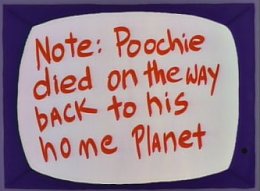
Meyers and the crew appear to be touched. But when the episode airs, instead of Homer’s moving words, Poochie simply announces he must return to his planet. The animation cel bearing his likeness is crudely pulled upwards and out of view.

Then a slide appears:

Ah, Poochie. We hardly knew ye.

Other highlights:

This was the episode that introduced the catchphrase “Worst. Episode. Ever,” intoned by Comic Book Guy. The show’s writers have some fun by having the geeky character declare he will be hurrying to the Internet to air his complaints.

Homer and the voice actress who performs Itchy and Scratchy make a personal appearance at the Android’s Dungeon. In a riff on the “Saturday Night Live” sketch in which William Shatner is asked insane questions about “Star Trek” episodes, a nerd in the audience asks about a mistake in an “Itchy and Scratchy” cartoon.

The show features a fun in-joke as the Simpsons also get a new character, Roy, who moves in with the family. By the end of the episode, Roy is out the door.

Troy McClure makes another appearance. The ham actor, voiced by the sadly missed Phil Hartman, also auditions for the voice of Poochie. “I’m Troy McClure. You may know me from such cartoons as ‘Christmas Ape’ and ‘Christmas Ape Goes to Summer Camp.'”


Maberry’s ‘Ghost Road Blues’ has some King in it

You’ve heard of Christmas in July? How about some Halloween in April?

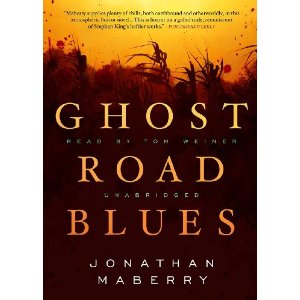
If that sounds good to you, I’ll recommend Jonathan Maberry’s “Ghost Road Blues.” It’s not a new book but it’s new to me. I sought out Maberry’s book because I enjoyed his zombie thriller “Dead of Night” and wondered what he could do with something on a grander scale.

With three books in the Pine Deep trilogy — “Ghost Road Blues” is the first — Maberry has written a story that, at least in the first volume, feels like something from Stephen King. With supernatural lurking in the shadows of a small town and all-too-human characters nearly outdoing the monsters for evil — even while an apocalypse draws near — “Ghost Road Blues” reads like some of King’s best, including “The Stand” and “Salem’s Lot.”

Best of all, it gave me a real feeling of Halloween approaching — without the actual onset of winter not far behind.

“Ghost Road Blues” takes place in the town of Pine Deep, Pennsylvania, in the weeks leading up to Halloween. The holiday is an important one because the town is famous for its over-the-top celebration of Oct. 31. The town attracts thousands of visitors from the eastern U.S. with its shops, restaurants, haunted hayrides and ghostly attractions.

Three characters are central to the novel: Crow, a former cop and recovering alcoholic who runs the hayride attraction and owns a holiday-themed store; Val, Crow’s lifelong friend and girlfriend; and Terry, another lifelong friend who’s also mayor of Pine Deep.

Into the mix this year comes a carload of drug dealers, thieves and killers led by Ruger, a mass murderer wanted by the authorities up and down the East Coast. Ruger and his cohorts end up in Pine Deep as they try to elude police.

Crow, Val and Terry have a lifelong bond because of something they experienced as children 30 years ago: A mysterious serial killer struck Pine Deep, killing Terry’s little sister and leaving all three survivors scarred.

Town vigilantes ostensibly killed the serial killer but in reality they killed a black drifter, the Bone Man, who was innocent. In fact, the Bone Man himself had earlier dispatched the killer.

What none of the players know: The killer from 30 years ago was the embodiment of evil and now he’s back, ready to begin where he left off.

“Ghost Road Blues” is nearly 500 pages long but rarely lets up. Crow and his friends are great, sympathetic characters and Maberry puts them through the wringer. It’s hard to imagine what he has in store for them in “Dead Man’s Song” and “Bad Moon Rising,” the remaining books in the trilogy.

Like King, Maberry draws some of his best characters from flesh-and-blood types, including Iron Mike Sweeney, a teenage monster movie fan who is befriended by Crow. Iron Mike, who prefers to live in a fantasy world in which he is a hero, is as lovable a character as you could ask for.

On the other hand, Iron Mike’s stepfather, Vic Wingate, is one of the most detestable characters I’ve read in a long time. Iron Mike lives in a fantasy world because Wingate is a brutal bully, abusing Mike and his mother.

But Wingate is something else as well. He’s the right-hand-man of the evil force, long believed dead, manipulating the modern-day players.

With its moody imagery of corn fields, pumpkins and lonely farms, “Ghost Road Blues” perfectly captures the macabre melancholy of small-town Halloween. It’s a genuine treat even well in advance of the ghostly holiday.

The Great Newspaper Comics Challenge Part 10

In which we look at today’s comics page offerings. Because we can depend on “Batman” for all our laughs anymore.

“Classic Peanuts” shows Charlie Brown’s frustrations when his all-girl outfield leaves during a game to attend a tea party. Snoopy comes to the rescue with a bunch of blue birds. I don’t think I’ve ever seen Snoopy with any birds besides Woodstock before. I’m a little concerned about their relationship.

“Baby Blues” shows the harried mom picking up toys. Ooops, she put the baby in the toy box. The expression on her face in the last panel perfectly captures parental guilt and the feeling of “Did anybody notice that?”

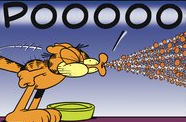
“Garfield.” Two words. Projectile spitting.

“Blondie:” Dagwood uses Earth Day as an excuse not to mow the lawn. What’s the final panel? If you guessed Dagwood on the couch … you’re read “Blondie” before.

“Curtis” has an idea for a different kind of zombie movie. Instead of attacking people and eating brains, the zombie is an annoying houseguest: He leaves the refrigerator open, accidentally deletes his host’s iTunes playlist and … leaves a toe in the breakfast cereal? I can’t count the number of times that’s happened.

Another Earth Day message from “The Family Circus.” The family stands on top of a hill, looking out over a landscape. “God does a lot of coloring in the spring, doesn’t he?” Dolly says. Awww!


Here’s the ‘Cabin in the Woods’ whiteboard

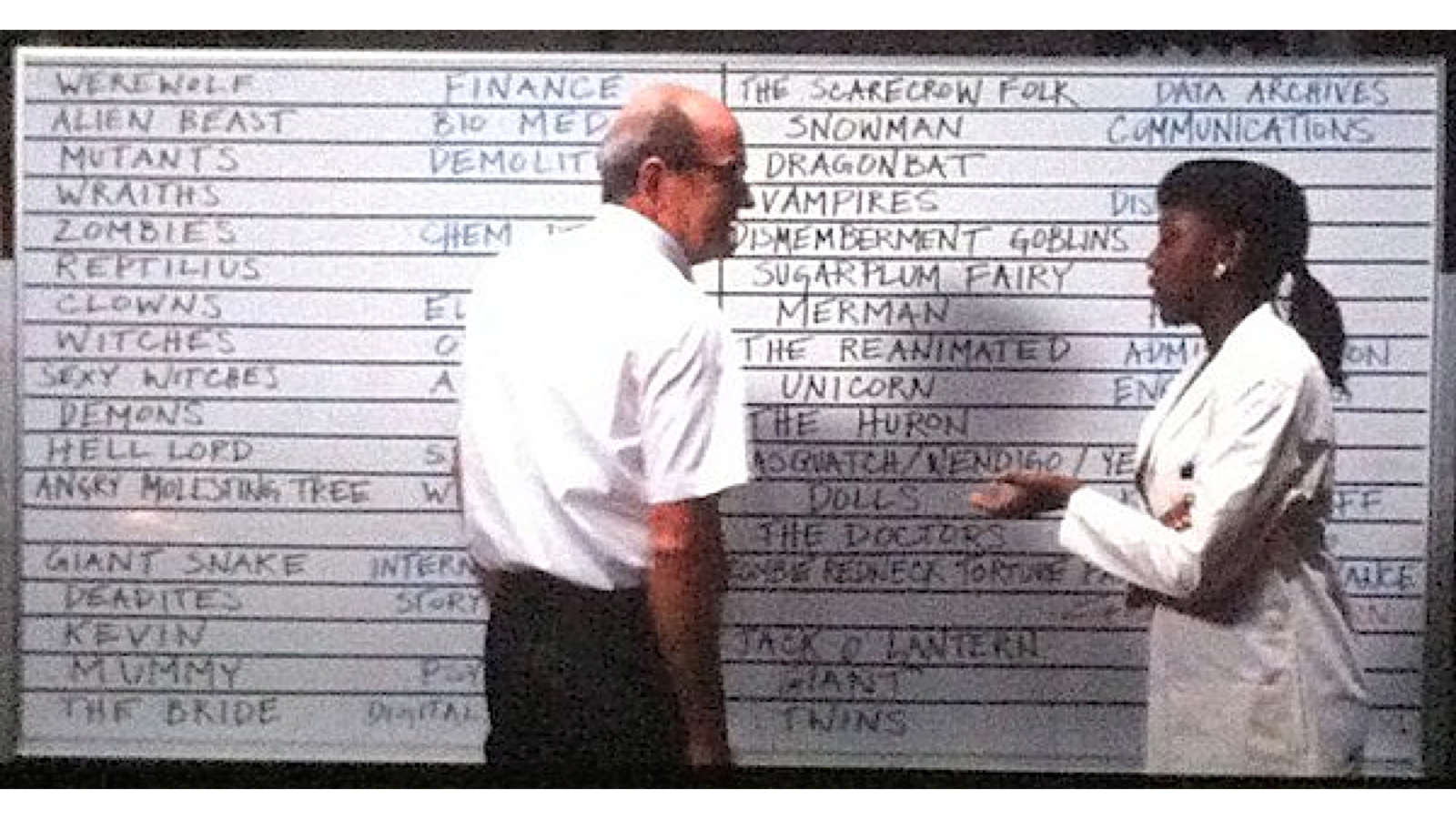
Here, on the heels of my entry about “The Cabin in the Woods,” is a shot of the whiteboard from the movie.

If you’ve seen the movie, you know the lab geeks running the horror show from behind the scenes have a whiteboard listing all the monsters possible in various scenarios at the cabin. “Giant snake,” “Deadites,” “Hell Lord” and — best of all — “Kevin” are among the choices.

A few online sites have posted this shot of the whiteboard. Here it is, for your viewing pleasure.

Wouldn’t it be cool if “Kevin” was not some Jason or Freddy figure but just some annoying guy from down the street?

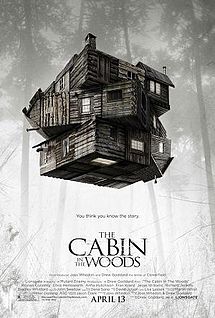
‘Cabin in the Woods’ a fun thrill ride

A lot of people are comparing “The Cabin in the Woods,” the new thriller, to other movies that simultaneously exploited, explored and expanded on horror film themes, notably “Scream.”

But besides being better than “Scream,” “Cabin” reminds me more of a grown-up and bloody “Monsters Inc.,” the Pixar animated movie about a company that specializes in giving kids nightmares with monsters under their bed and in their closet.

Since I didn’t see “Cabin” until a week after it opened, I’m going to assume anyone reading this has either seen the movie or heard the basic story by now. So there might be some spoilers ahead. I won’t spoil the ending, though.

“Cabin” was written by “Avengers” director and “Buffy the Vampire Slayer” creator Joss Whedon and directed and co-written by Drew Goddard. On the surface, it plays like a “Friday the 13th” throwback: A group of college students — a jock, a stoner, a brain, a shy girl and a slut — go to a remote cabin to party.
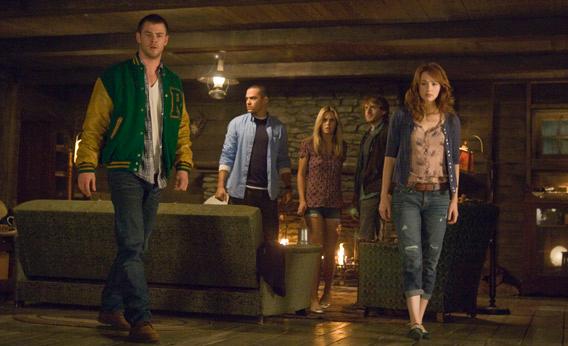
From the very start, though, the audience knows something else is going on. The group is being monitored by office monkeys/scientists in a war room-style bunker. Not only are the watchers seeing everything that happens as the five get to the cabin; they’re manipulating the players and events. Gas is pumped through vents that prompts the partiers to behave in particular ways. A mild electric shock runs through the handle of a knife to make the person holding it drop it.

A few spooky things happen in the cabin — not the least of which is the uncharacteristic behavior of the five — but the movie shifts into high gear when they venture into the cabin’s basement and find hundreds of old and obscure items, including a necklace, reels of film, a studded metal ball (more than a little reminiscent of the mechanical nightmare box from the “Hellraiser” movies) and a diary of the former occupants of the cabin.

The partiers choose — and seal — their fate when they become engrossed in the diary, even reading aloud a passage in Latin. It is here when the movie seems most like “Scream,” as the stoner warns against reading the words aloud. He’s seen enough movies to know what might happen.

Before long, the long-dead cabin occupants have crawled out of their graves and begun stalking the teens.

Of course, it is the lab scenes that set “Cabin” apart from the “Evil Dead” films. We quickly find out that the lab workers are monitoring the goings-on at the cabin — as well as other sites around the world — and causing terror and mayhem. The reason? They’re servants of the ancient, Lovecraftian gods, the old ones, that once dominated the earth. And they know that bad things will happen if those gods aren’t appeased by their sacrifice.

The lab workers are also the source of much of the film’s humor, which is as crass and mean-spirited as it is funny. The scientists, led by Bradley Whitford and Richard Jenkins, are cold-hearted (mostly) and unfeeling as they must be. Their jobs are to stage modern-day human sacrifices. There’s no room for bleeding hearts here — except for the ones being ripped out on the lab’s monitors.

It’s hard to imagine, given the ending, how a sequel to “Cabin” could happen, but I guess a prequel is possible. What’s more likely is the Internet will fill up with speculation/fan fiction set in the world in which “Cabin” takes place that will fill in the backstory of the lab and its workers, how their system was set up and maintained and how it otherwise interacted with the outside world. Do the lab workers commute? Is the lab government-sponsored?

The lab workers, who also include Amy Acker and Tom Lenk from Whedon’s “Buffy” and “Angel,” are perfectly cast and always believable.

The archetype young people offered up for sacrifice are likewise terrific. The movie was made a couple of years ago and sat on the shelf not because of its quality but because its original studio, MGM, was having money problems. Since then, Chris Hemsworth (who plays the jock) has become a star as the Marvel comics character “Thor.” He’s got a big summer between this and “The Avengers.” Hemsworth is good and he and his four co-stars — Kristin Connolly, Anna Hutchison, Jesse Williams and Fran Kranz — are well-cast and play their parts perfectly. Kranz, who was in Whedon’s “Dollhouse” TV series, is very Shaggy-reminiscent as the stoner.

Random thoughts:

The sterile, underground labs and monster holding cells of “Cabin” reminded me of the Initiative, the secret military experiment from the fourth season of Whedon’s “Buffy.” Only instead of stocking a compound full of monsters to kill teenagers, the Initiative captured monsters to experiment on them.

Another “Buffy” echo: “Cabin” builds on the idea of thousands of years of human sacrifice to appease evil. Of course in “Buffy,” the Slayers and Watchers were created, thousands of years ago, to fight evil.

I hope someone’s working on a detailed analysis of the whiteboard in the war room that contained all the monsters and scenarios. I tried to read as much of it as I could and caught some of the other threats like “Kevin” — a Jason stand-in, possibly? — but I would love to see everything that was up there.

Do you think the monsters in the movie were supposed to be real in their world? Or were they created, “inspired” by old horror tales and movies? Or does — as one clever person I know suggested — “Cabin” take place in the same world as all those old horror movies, finally taking us behind the scenes of Jason, Michael Myers, Freddy and all the rest?

“Cabin” is, for those with strong hearts and stomachs, cool, geeky fun. Maybe best of all, it made me want to re-watch “Buffy” episodes and some favorite recent horror movies.

Saying goodbye to Jonathan Frid

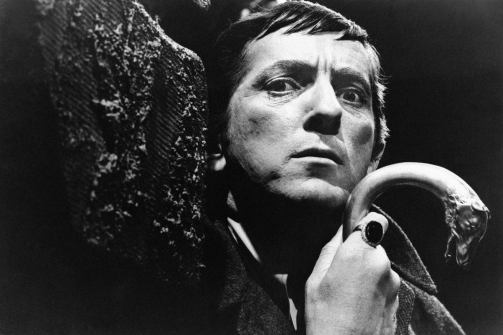
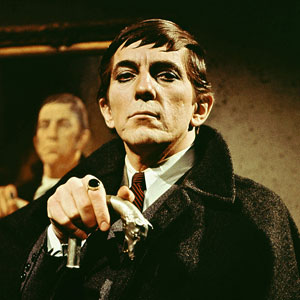
One of the pop culture icons of my childhood is gone. It was announced today that Jonathan Frid died April 13 in his home in Canada. He was 87.

Frid was, of course, Barnabas Collins on the classic supernatural daytime drama “Dark Shadows.”

His death came just a few weeks before the May 11 release of the Tim Burton, Johnny Depp big-screen version of the venerable soap. Frid, along with other regulars from the TV series, appears in the movie, which is pitched as a much more light-hearted take on the gothic drama.

“Dark Shadows” aired late afternoon weekdays from 1966 to 1971. Frid didn’t join the cast until several months in, however, when groundskeeper Willie Loomis (John Karlen) accidentally released him by opening his coffin.

I’ve noted before that the show was a special one for me. I came home from elementary school every day, sat down at the coffee table in my living room and watched the show while I did my homework.

My deepest appreciation for the series, however, came when it aired in syndication years later. Then I recognized all the tricks and treats the series contained: Wild storylines that involved not only vampires like Barnabas but witches, werewolves and ghosts and even time travel.

“Dark Shadows,” like many soaps at the time, was videotaped with little room for error or fixing of same. Actors would sometimes forget their lines or bump into furniture or doors while making a dramatic exit from a scene. I loved the show anyway.

I still remember with bitter disappointment watching the last episode. This was 1971, of course, before the Internet and news of show business — particularly a geeky daytime drama — was hard to come by.

The final episode reflected an effort to tie up loose ends. The last storyline for the show had all the actors playing their ancestors in the past. Near the end of the episode, bite-type neck wounds are inflicted on someone. Is a vampire loose at Collinwood?

But the voice-over narration contradicted that ominous development and predicted a happy ending for Bramwell Collins, played in this storyline by Frid:

There was no vampire loose on the great estate. For the first time at Collinwood the marks on the neck were indeed those of an animal. Melanie soon recovered and went to live in Boston with her beloved Kendrick. There, they prospered and had three children. Bramwell and Catherine were soon married and, at Flora’s insistence, stayed on at Collinwood where Bramwell assumed control of the Collins business interests. Their love became a living legend. And, for as long as they lived, the dark shadows at Collinwood were but a memory of the distant past.

The words had an element of finality to them and I suspected the worst. The following Monday I tuned in and, sure enough, the show was not on.

My disappointment was massive. I even wrote a letter to the Indianapolis TV station that aired the show, asking if it would return. I don’t recall getting an answer.

“Dark Shadows” — all 1,200-plus episodes — is now available on DVD for the enjoyment of fans.

I’m leery of what Burton and Depp have done with the remake, but I’ll probably see it.

And if he does indeed appear in the movie, Frid will be a welcome sight.

So I’ll mourn his passing and enjoy my memories of my afternoons with Barnabas and family and all the enjoyment Jonathan Frid gave me over the years.

‘Night of the Comet,’ ‘Buffy,’ Black Widow: Butt-kicking heroines

With “The Avengers” coming up on May 4, it’s interesting to note that one of the first clips from the movie officially released, a couple of weeks ago, was one of Black Widow, the non-superpowered, female member of that particular boys club, easily escaping from some bad guys and demolishing them in the process.

It’s a pretty good action scene, if mild compared to what we’ve subsequently seen involving Thor, Iron Man and particularly the Hulk.

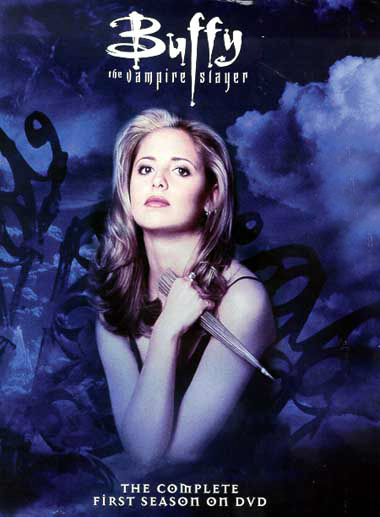
But there was some nice symmetry to the clip’s release considering that “The Avengers” was directed by Joss Whedon, creator of “Buffy the Vampire Slayer.”

There’s been some backlash to Whedon’s signature use of petite female characters as ass-kicking heroines, including Buffy and other slayers from that series and “Angel” as well as River, the programmed killing machine in “Firefly.”

But it’s interesting to note that Whedon has cited in at least one interview “Night of the Comet” as one of the influences on the creation of “Buffy” the lame movie and terrific 1997-2003 TV series.

Not long after the series ended, Whedon told IGN:

So, you know, when I hit on Buffy the Vampire Slayer, it was right around the time when Revenge of the Bimbos, or Attack of the Killer Bimbos or something – there were a lot of movies coming out that were proto-silly ’50s style titles. They were on the video store shelves. I worked at a video store. I would watch them, and I’d be like, “You know what? This is just another bimbo movie. These women aren’t empowered at all. They just made up a funny title.” I was like, “I would like to make a movie that was one of these crappy, low-budget movies, that like the Romero films, had a feminist agenda, had females in it who were people, and had all the fun, all the silliness. Night of the Comet was a big influence. That actually had a cheerleader in it. With a title that would actually make people take it off the video store shelves, because it has to sound silly and not boring. 

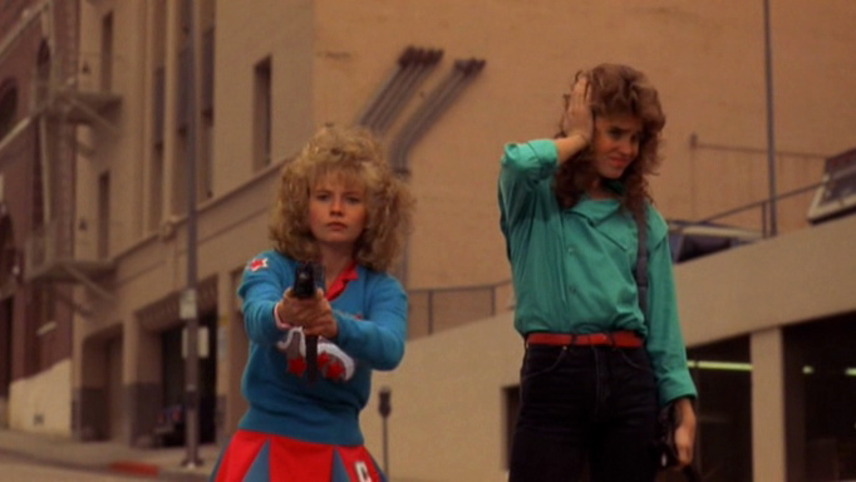
“Night of the Comet,” released in 1984, was the story of two Southern California teenagers, sisters Regina (Catherine Mary Stewart), known as Reggie, and Samantha (Kelli Maroney), known as Sam, who survive the end of the world, brought on by global exposure to a comet that reduces most of the world’s population to red dust and turns the rest into zombies.

Reggie and Sam, after a moment of shock and loss, quickly set out to survive in the post-apocalyptic world and connect with other survivors.

Although they’re teenagers — and the movie was released during the “Valley Girl” craze — Reggie and Sam are level-headed, even matter-of-fact, about the end of the world. There’s the customary all-you-can-shop scene, played to “Girls Just Want to Have Fun,” set at the mall, but George Romero’s “Dawn of the Dead” succumbed to the same idea a few years earlier.

And even though Sam is a cheerleader, the sisters are hardly pushovers. Raised by a career military man, the two quickly find supplies — although Sam is scornful of Reggie’s choice of automatic weapon, noting, “Daddy would have gotten us Uzis” — and are more than capable of defending themselves and other, less capable strays they come across.

Director Thom Eberhardt’s movie is amiably low-budget. You know they filmed the deserted downtown L.A. street scenes on a Sunday morning, for example, and you admire their ingenuity.

Whedon — who I’m pretty sure is an outspoken feminist — is a fan of empowered women. Even if they’re five feet tall and a hundred pounds. As long as they can wield a mean Uzi, kung-fu vampires into the afterlife or hold their own with the likes of Captain America and the Hulk, Whedon believes that size doesn’t matter — and neither does gender.

‘Mad Men’ goes for shock value with ‘Signal 30’

Just when you thought this season’s “Mad Men” couldn’t get any more … out there than last week’s choke-tacular “Mystery Date,” comes tonight’s episode, “Signal 30.”

The title refers to the blood-and-guts-filled, 1960s-era drivers education movie that pompous little ad man Pete sees in preparation for getting his drivers license in time for life in the ‘burbs. But tonight’s episode had mayhem all the way through.

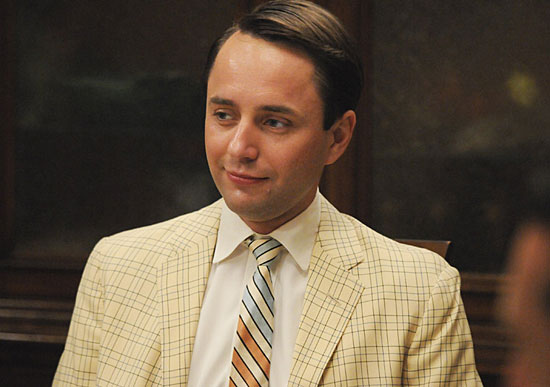
Let’s start with Pete (Vincent Kartheiser), who can be an awfully hard character to take. I take that back. Pete is almost impossible to like, with his grasping, career-climbing ways and pissy attitude. So it was kind of fun to see him squirming and taking his licks — literally — tonight.

First there was Pete’s attempts to seduce the high school girl in his class, only to be outdone by … a high school boy, who ends up feeling up the object of Pete’s jailbait leanings. All the while, Pete watches, frustrated, from one row back in the classroom.

Then there’s Roger and Pete’s partaking of hookers at a high-class whorehouse. That unlikely twosome and Don take Lane’s client, a Jaguar executive, to a brothel. Don — still living the honeymoon life with “zoobie zoobie” Megan — sits at the bar and behaves himself while Pete, Roger and the Jag guy plunge into the beds of what would appear to be high-class 1960s Manhattan call girls.

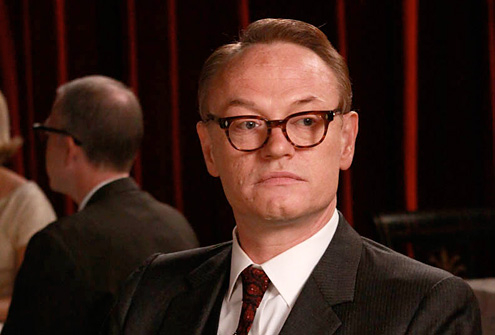
Then there’s Pete’s comeuppance at the hands of Brit Lane Pryce (Jared Harris, who is just wonderful). When the Jaguar exec’s infidelity is discovered by his wife the account goes up in smoke and Lane throws down on Pete.

The resulting fight, right in the Sterling Cooper Draper Pryce offices, shows Lane delivering unto Pete a sound thrashing and is bookended by great quips from Roger: “I suppose cooler heads should prevail, but I want to watch this” and “I had Lane.”

Other highlights:

Pete showing off his wall-length cabinet record player to visitors to his home.

This season’s daring “Mad Men” fashion experience continues as Don becomes the latest wearer of a crazy plaid sportscoat.

This season’s desperation level is high. Roger’s a mess, Pete’s trying to pick up schoolgirls, Lane’s fixation on the wallet a few episodes ago and, tonight, Lane’s passionate move on Joan.

Ad man Ken’s second career as a science fiction writer. Ken’s proud wife brags about it, prompting Roger to tell him to knock it off, saying that a career in advertising is satisfying enough when things are going well.

“I remember that,” Roger says before stalking out.