Tag Archives: bookstores

I come here not to bury the mass market paperback, but to praise it

This is sad news. Not nearly as sad or despairing as much of what we see in the news in recent years, but sad nonetheless.

The mass market paperback is dead.

This might not surprise some of you who react, “Yeah, I know, I haven’t seen one in a bookstore in a while,” or “What is a mass market paperback?” For those young enough that they don”t remember the mass market paperback, I’m fearful you’re reading this past your bedtime.

Publishers Weekly likely broke the news to most of us who remember mass market paperbacks – I’m going to refer to them as just paperbacks pretty soon now, for expediency’s sake – in a December article that noted that the ReaderLink company said it would no longer distribute mass market paperbacks. The format’s share of the market had dropped dramatically over the past couple of decades as larger-format paperbacks, sometimes referred to as trade paperbacks, and ebooks had usurped the market that had been dominated for many decades by mass market paperbacks.

Paperbacks had been the format of choice for much of the 20th century. They were less expensive than hardbacks but more cheaply made and thus less durable. But they had an ease of use, a convenience and an aura that were hugely appealing to most of us who were buying books in the last few decades of the past century. In 1966, the Beatles released a single, “Paperback Writer,” that ironically but lovingly paid tribute to the format. You didn’t hear the Beatles singing about their desire to be a hardcover writer, did you? No you did not.

As many know, paperbacks – measuring about 4 inches by 7 inches, just the size to fit in a pocket so you could always have a book at hand – were introduced before mid-century but might have become the hottest book trend ever in the 1940s and 1950s, continuing that hot streak into the 1960s and 1970s.

Paperbacks went to our workplaces, where they were handy to read on our lunch hour. They went on our commutes, where they occupied many a train and bus rider. They went to school and war in backpacks and pockets. They went everywhere, in part because of their convenient size and in part because they were so incredibly inexpensive to buy. I just looked at one of my oldest and most rare paperbacks this morning, a copy of Harlan Elliison’s “Rockabilly” from 1961. The cover price was 35 cents.

The vast majority of paperbacks I bought in the late 1960s and 1970s were priced at 65 cents, 75 cents, 95 cents. Paperbacks I bought into the 1990s were still only a few dollars, inexpensive compared to hardcovers and large-format trade paperbacks that, in my buying experience, were confined to scholarly or pop-culture works about movies, TV shows and comic books. At least that’s what still fills my bookshelves. I recently noted my copy of “The Marx Brothers at the Movies,” a 1975 Berkley trade paperback of a 1968 hardcover original, cost me just $3.95.

I have hundreds of books. Some are of recent vintage but the majority date from the 1960s to the 1990s. Among people my age, that’s probably not uncommon. Paperbacks entertained and informed us. Some of my favorites are early Stephen King novels and short story collections, the work of Robert A Heinlein and Ray Bradbury and Dean Koontz.

And I wasn’t alone. Publishers Weekly says 387 million mass market paperbacks were sold in 1979, compared to 82 million hardcovers and 59 million trade paperbacks. The 1975 movie tie-in of Peter Benchley’s “Jaws” sold 11 million copies in its first six months

Publishers Weekly notes that the paperback began losing its share of the market with the growing popularity of trade paperbacks and ebooks, the latter of which boomed in the early 2000s. And of course the shrinking number of bookstores – a trend which has, happily, reversed course – further eroded paperback sales.

Folks who’ve read this site before know I’m a fan of bookstores, especially used bookstores, and they’ll forever be a place to find books in all formats, including the once-beloved paperback, also known as the mass market paperback.

That’s where you’ll find me, looking to recapture a little of a past that’s quickly disappearing.
Going viral, social media, dystopia and books

I went viral on social media – two different social media, with two different posts – over the Fourth of July weekend.

(This is not a pat myself on the back post. I think there’s something interesting that’s happened here, beyond the viral-ness.)

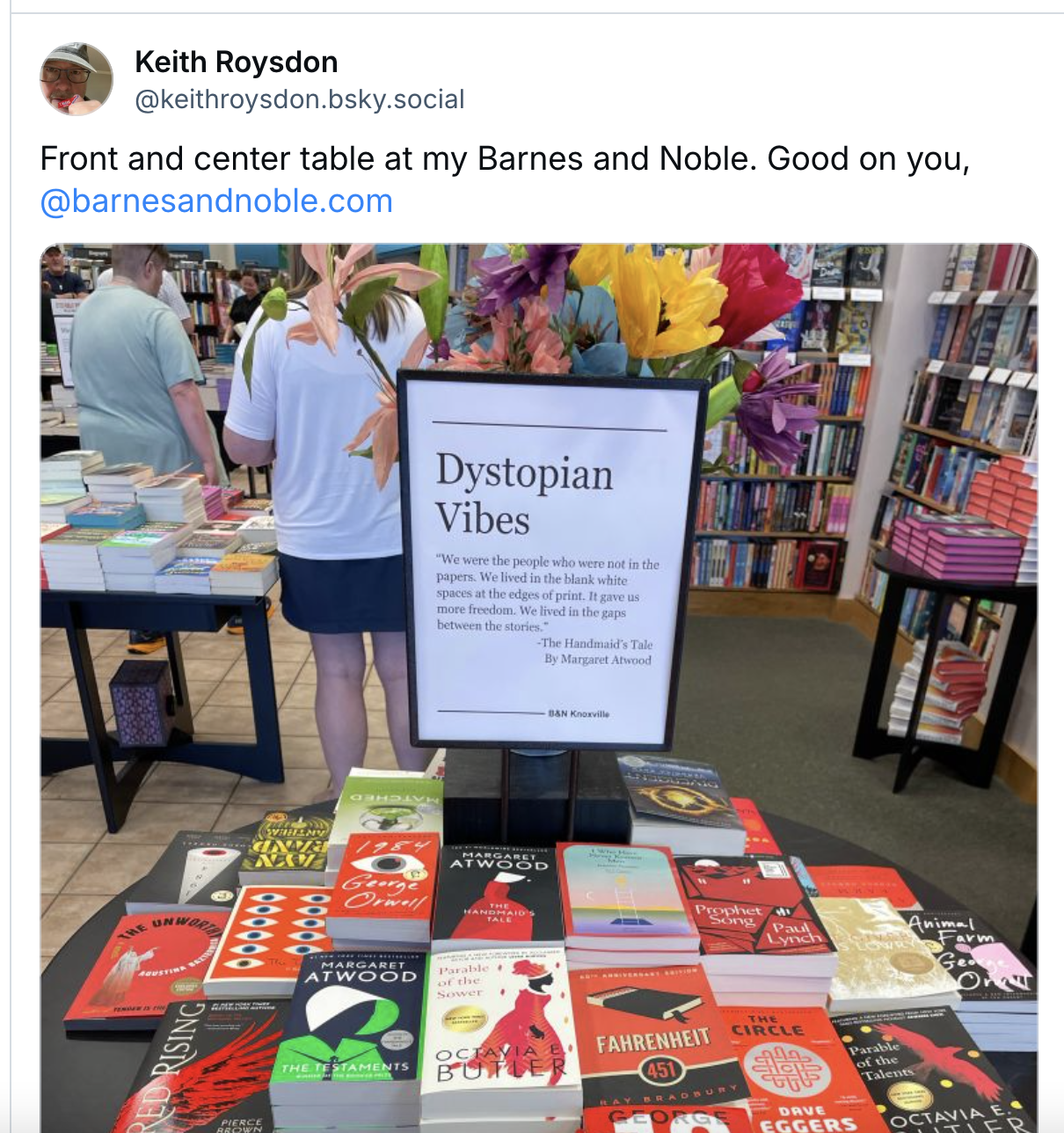
The first post that went viral is the one above. On Saturday, I was in the Barnes & Noble bookstore near me and took a picture of the first table inside the door. If you can’t tell from the picture, it’s a display marked “Dystopian Vibes” and offers books including “1984,” “Animal Farm” and the works of Margaret Atwood and Octavia E. Butler.

I thought I’d snap a picture and post it and thank Barnes & Noble for putting these books out there so prominently. Yes, that placement encourages sales. Yes, it’s ultimately a big corporation trying to move copies of books. But it’s something.

I thought the post might get some traffic, but I never get a lot of engagement, even with 3,000 Bluesky followers.

By Sunday afternoon, this was the response:

380 accounts reposted my post, which got 2,700 likes.

This is a multiple of thousands the reaction I was expecting. I had to mute notifications on the post.

That wasn’t all, though.

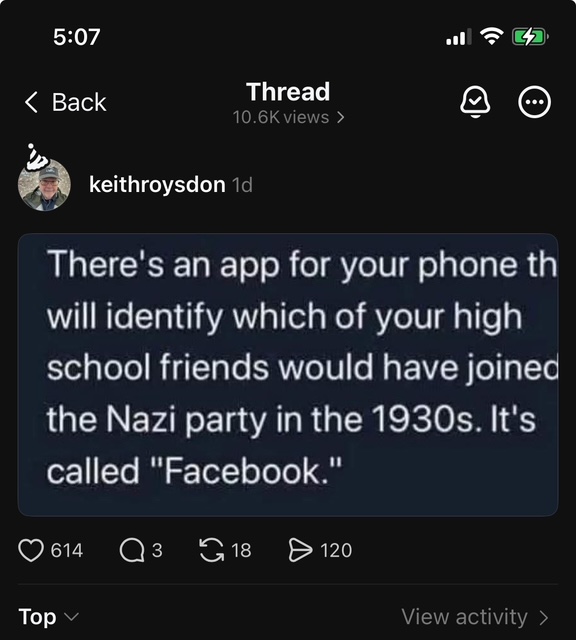
I saw a bitterly amusing meme on a friend’s Facebook account – there was no indication on the account who originally posted it – and I posted it on various social media, including Instagram, which shares posts to the social media app Threads (which I don’t use much).

Here’s the post, and the reaction:

Believe me when I tell you, I usually don’t get 600 likes on Threads, a social media I barely use.

So what’s the upshot to all this, besides a little more engagement and traffic to the companies that own Bluesky and Threads, the latter the detested Meta? (The even more detested Twitter turned up with very little notice of either post, by the way.)

The upshot, it seems to me, is that there’s a lot of interest and engagement in posts about our currently untenable, dangerous and yes, dystopian path.

That’s a good thing, that people are engaging in posts critical or even acknowledging the path this country is on.

And, as a bonus, the Bluesky post shows a ton of engagement about books that forecast, define and address our society.

There’s nothing more encouraging than the realization that people are engaging with literature that calls to light our current peril.

So maybe a small percentage of the frogs in this slowly boiling pot of water are aware they’re in a slowly boiling pot of water. I hope.

The pleasure of finding your book for sale – especially unexpected places

I’m not sure I remember the exact details, but when my first true crime book, co-authored with my longtime writing partner Douglas Walker, came out in 2016, it was pretty thrilling to see the book for sale in bookstores, drug stores, gift shops and online.

It’s one thing to have a book out there and to sell it and sign it, but realizing our publisher, History Press, had actually gotten the first book, “Wicked Muncie,” in stores and online sites, was pretty amazing. History Press kicks all kinds of ass in getting books in stores, by the way. All four of our true crime books found a good home with them.

Another highlight was finding our books offered by libraries, which are very nearly my favorite places on the planet. A while back, I realized our third true crime book, “The Westside Park Murders,” was available through the Chicago Public Library. I’m still boggled over that.

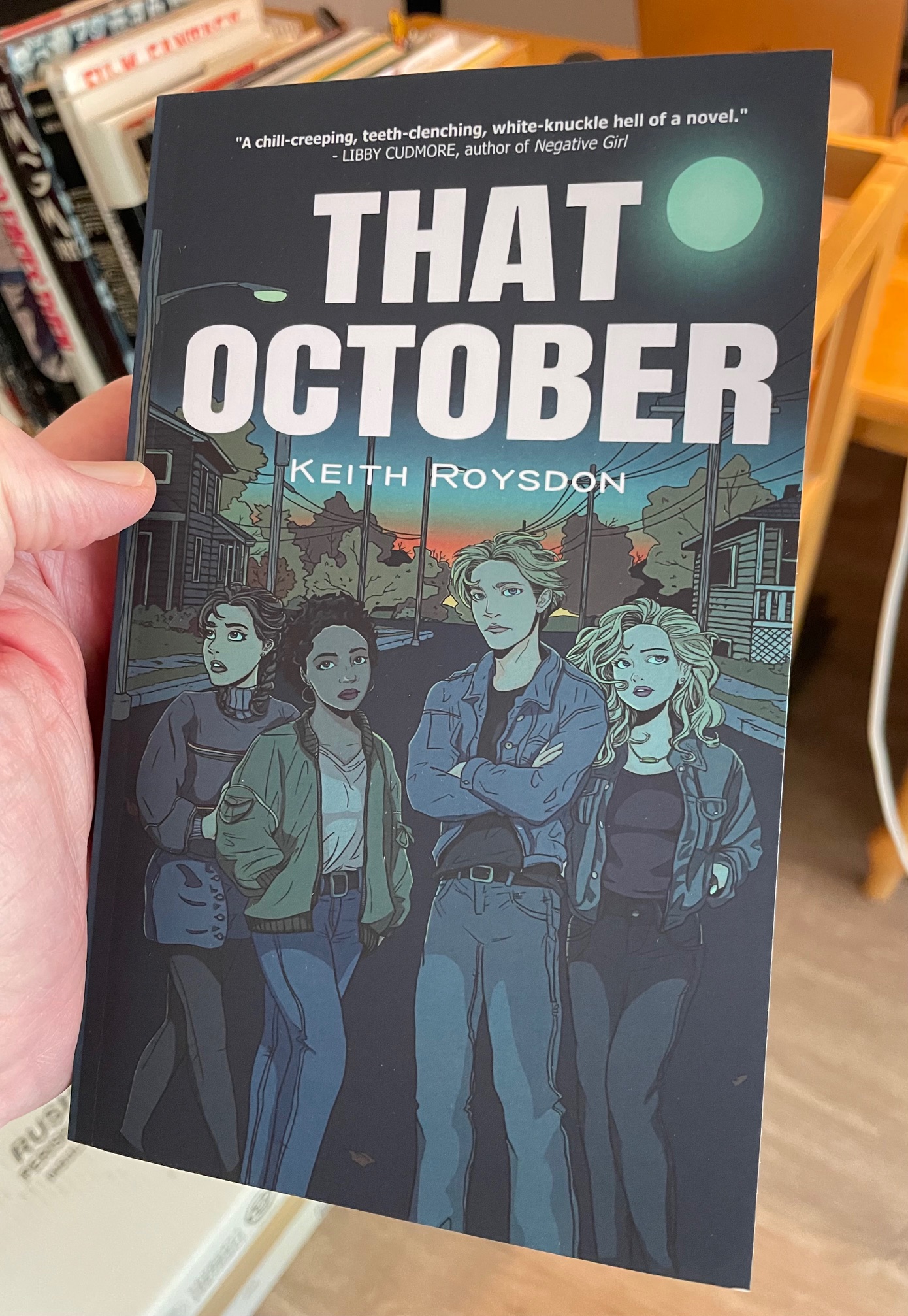
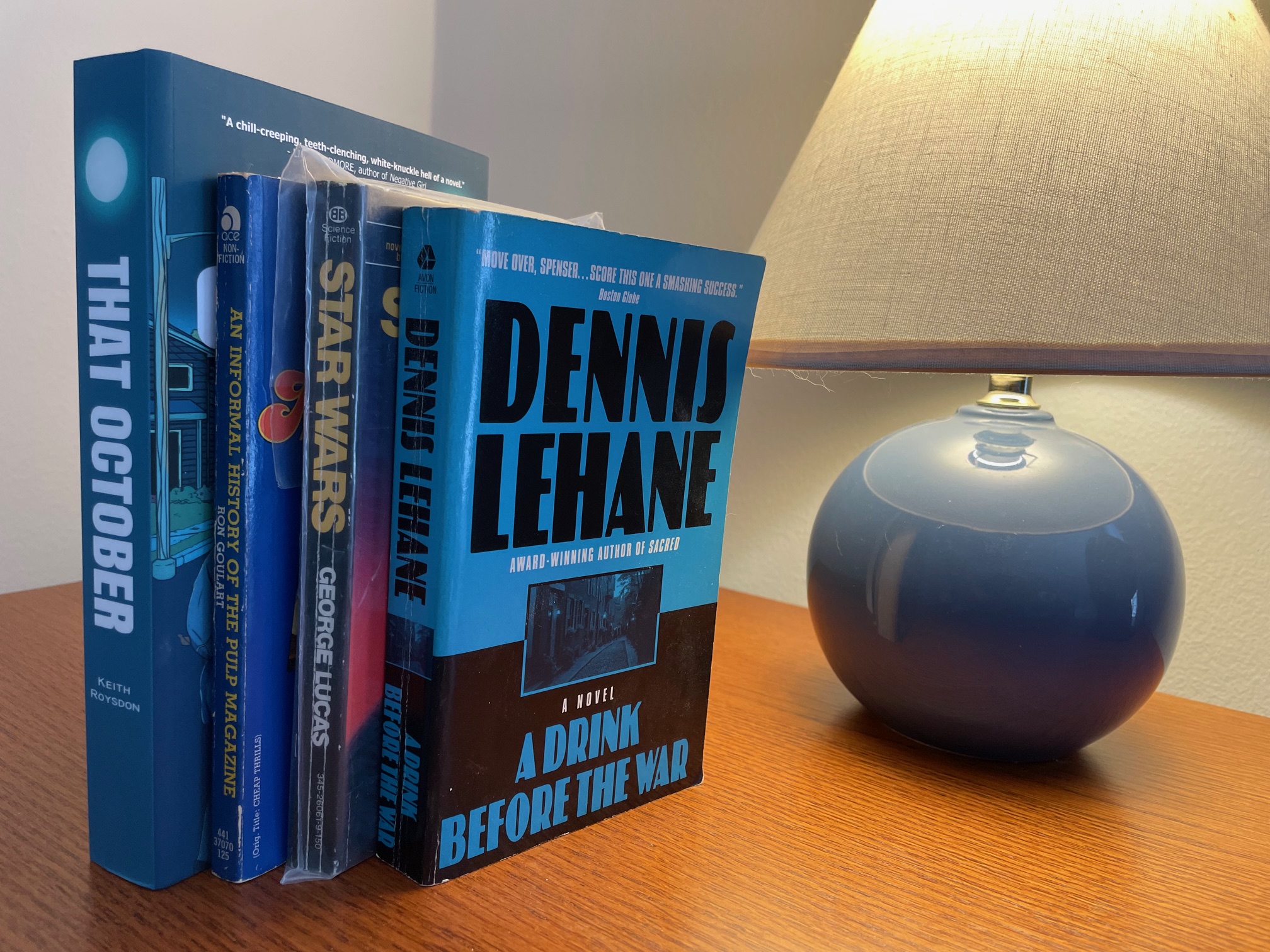
So it’s been fun, with THAT OCTOBER, my new 1984-set high school crime novel, finding the book on all kinds of bookselling sites. I wasn’t certain if I would have to take steps to ensure this because THAT OCTOBER is self-published.

But I didn’t have to. At some point recently I was asking the folks at Ingram Spark, the venue I used to publish the book, if they could tell me when it would be available for pre-order. They responded and noted that it already was available and showed me where Amazon was selling it.

Since that time, I’ve been excited to see that not only Amazon, a site I have qualms about, but Barnes & Noble, Bookshop, Powell’s Books and Waterstones, the famous Brit seller of books, all offer it (for pre-order right now, as publication date is June 1).

So I’ve been on social media, posting links to most of those booksellers and screenshots. It was as especially exciting to see that Powell’s, a bookseller I’ve visited in Portland, Oregon, and have done business with online, offered it.

Oddest place I’ve found the book for sale so far: Saxo, where the book is available for about 259 Danish Krone.

It’s silly, I know, to be so excited about this, but I didn’t think it would ever happen.

Next I’ll be telling you how excited I am to find THAT OCTOBER for sale at Half Price Books or McKay’s.

Some good news: Barnes & Noble growing, which means reading, bookselling growing

We hear so much bad news, all the time, that I wanted to share some good news with you.

After the latest depressing study about how few people read books, I have to say that it seems like somebody out there is reading, because bookselling is a growth industry all of a sudden.

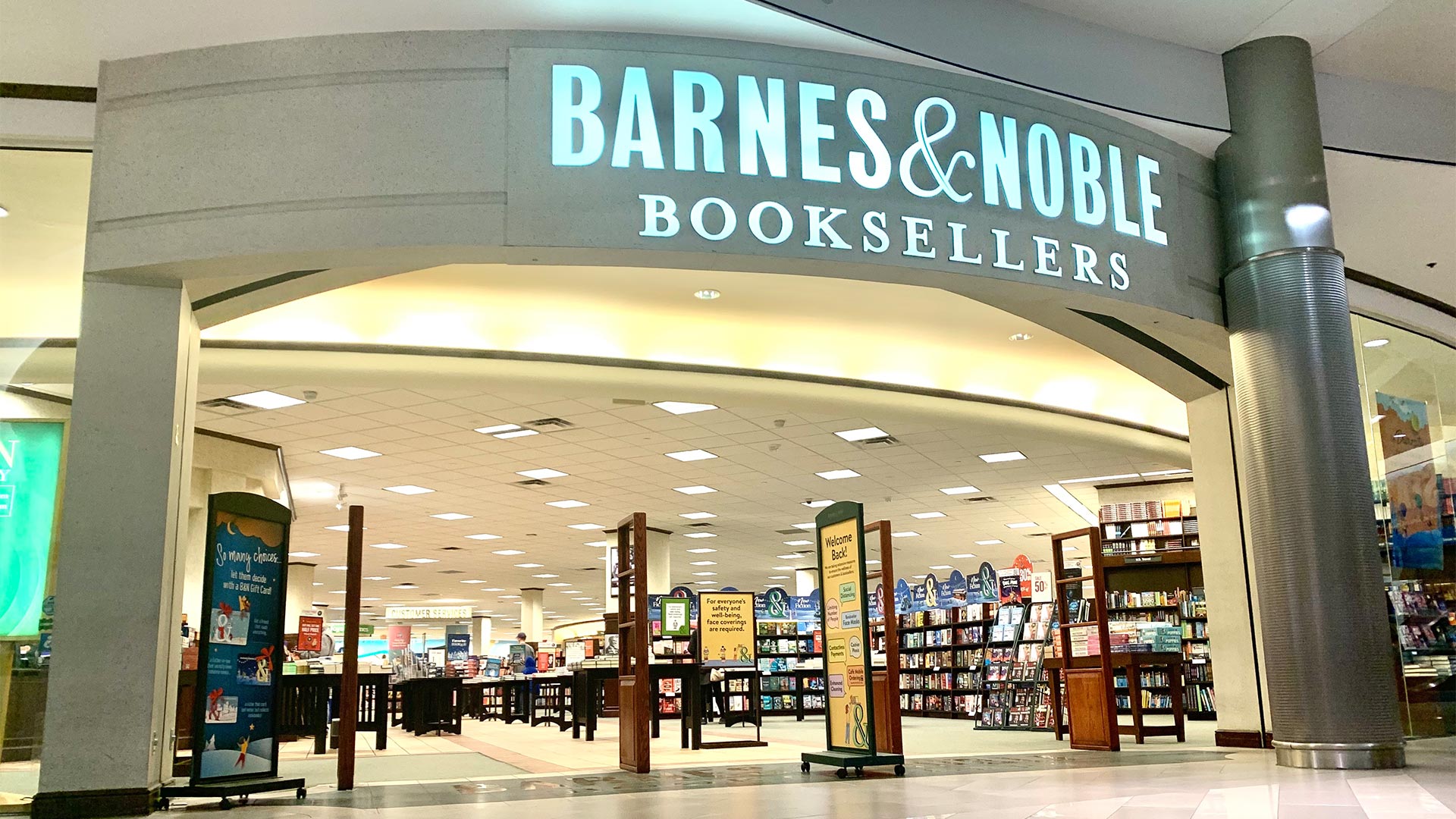
Barnes & Noble, the longtime bookstore chain that was a fixture of many malls and shopping centers before struggling a few years ago, is on an aggressive growth curve.

USA Today reported this week that the bookstore company plans to open 60 new stores in 2025. B&N has about 600 stores, up by several that opened in 2024.

Where I live, the city is getting a second B&N, in the most prosperous and thriving part of the city … not far from its existing location in the most prosperous and thriving part of the city.

This means a few things:

No company like B&N makes decisions to expand on the basis of hope. B&N has done some demographic research, run the numbers and thinks there’s market for even more books.

The company made that decision on the basis of sales and probably surveys and analysis of foot traffic, and that’s a pretty clear indicator that sales are good and the book business is good.

Maybe coolest of all is that B&N thinks there’s enough call for books that it doesn’t have to exist solely on online sales.

The last time I bought a couple of books, it was through the online arm of Powell’s City of Books, the PNW-based mega book retailer. I’ve spent a little time and money in McKay’s, a used bookstore chain, lately too.

And I continue to be on the lookout for my favorite retail spaces of all time, small and independent bookstores. Unfortunately we’ve had two that I know of close in the city in the past couple of years.

Yes, Barnes & Noble is a big company, although not as big and possibly not as soulless as Amazon. And yeah, other stores and companies sell books.

I’m glad people are buying books, no matter where they get them. I’m glad people are reading. (Not surprising sentiments for an author who has a new book coming out in the next couple of weeks, I know.)

If some of that increased interest in books, reading and book-buying benefits a big company like B&N, I’m glad of that.

Don’t forget though – patronize your locally-owned booksellers.

Bookstore apocalypse: Making a run for the Borders

Boy, things were hopping at the Borders bookstore today.

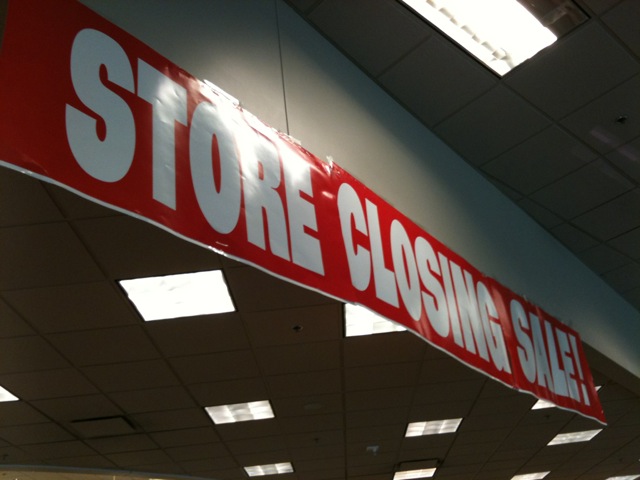
If that statement makes you go “Huh?” then you’ve been paying attention to news about the book-selling industry. Borders, the nation’s second-largest chain, announced in July it would shut down and close its nearly 400 stores.

Experts say the company made a lot of bad moves in the past decade, including its response to the Internet. First Amazon kicked the butts of most big chain stores and now e-books are outselling paper and cardboard books.

While I have a real appreciation for some bookstores — Powell’s in Portland, Oregon, Tattered Cover in Denver, Malaprops in Asheville, North Carolina, to name a few — I can’t say I felt a special affinity for Borders. Barnes and Noble feels more like a “real” bookstore to me.

But I hate to see a bookstore go out of business. The closing of a bookstore means one less place to browse and touch and sample and buy books.

I’ve certainly contributed to the downfall of bookstores. While we still buy books, I’ve tried to save money in recent years by stepping up my library use.

So it was with mixed emotions that I found myself, out of the blue, at the going out of business sale at Borders today.

We decided to visit Hamilton Town Center on the north side of Indianapolis and were walking around when we realized that Borders — not Barnes and Noble — was the bookstore at that mall. We figured it would already be closed but it wasn’t. It is in its death throes.

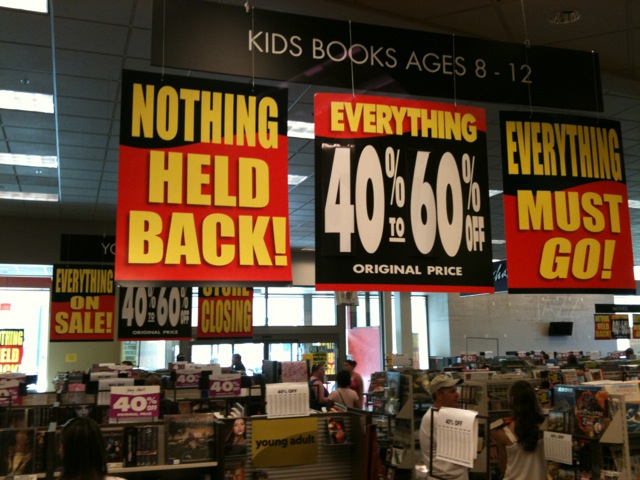
“Going out of business” banners and signs are plastered everywhere and shoppers bustled about, checking out the somewhat-depleted shelves.

We bought some books, DVDs and CDs. Yes, it was like shopping in an elephants graveyard, times three. And no, there wasn’t a rack of eight-track tapes, thank you very much.

As we made our purchases and the clerk behind the register thanked us and wished us a good day, I wondered if he didn’t really mean, “Thanks for coming by! Too bad you didn’t spend a hundred bucks here when it counted!”