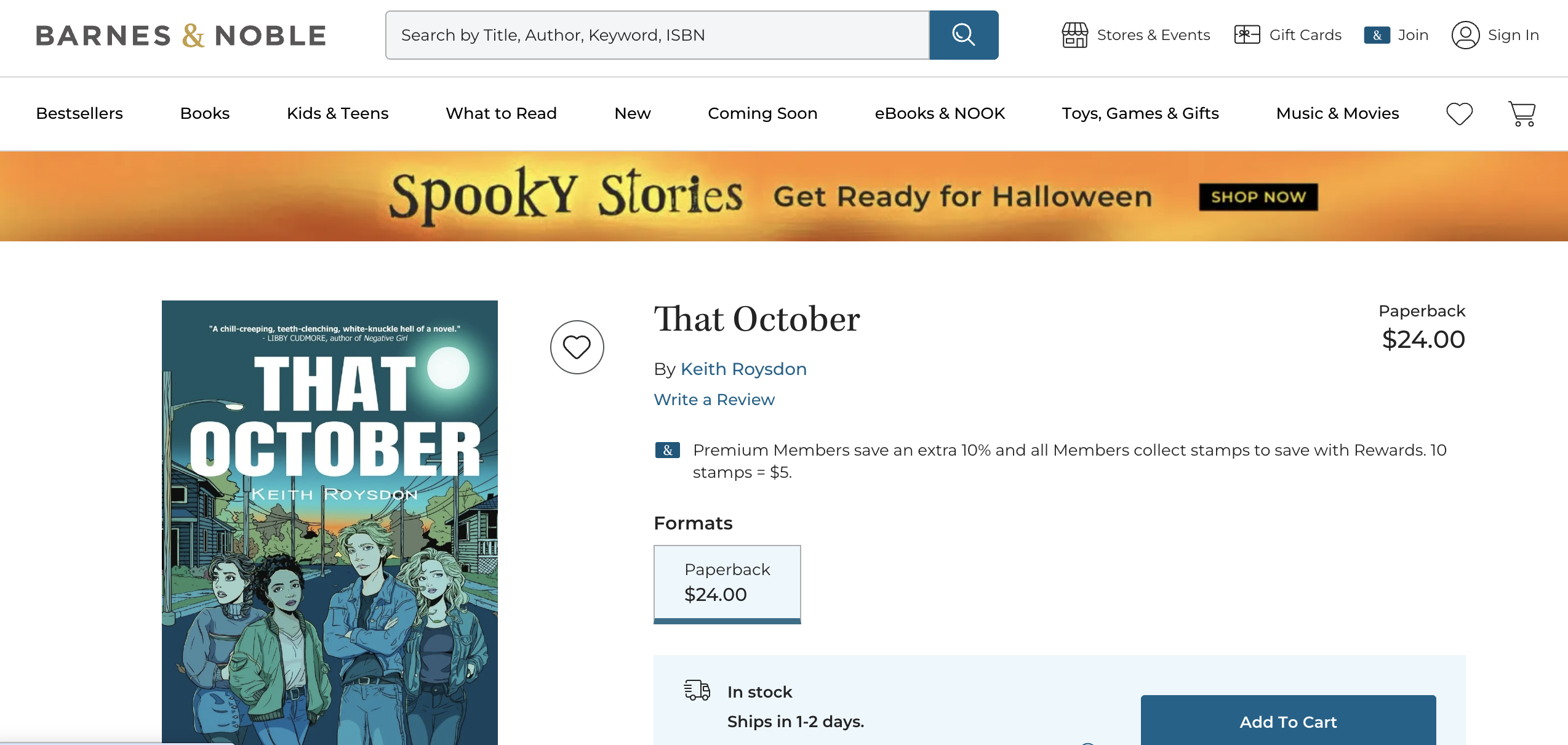
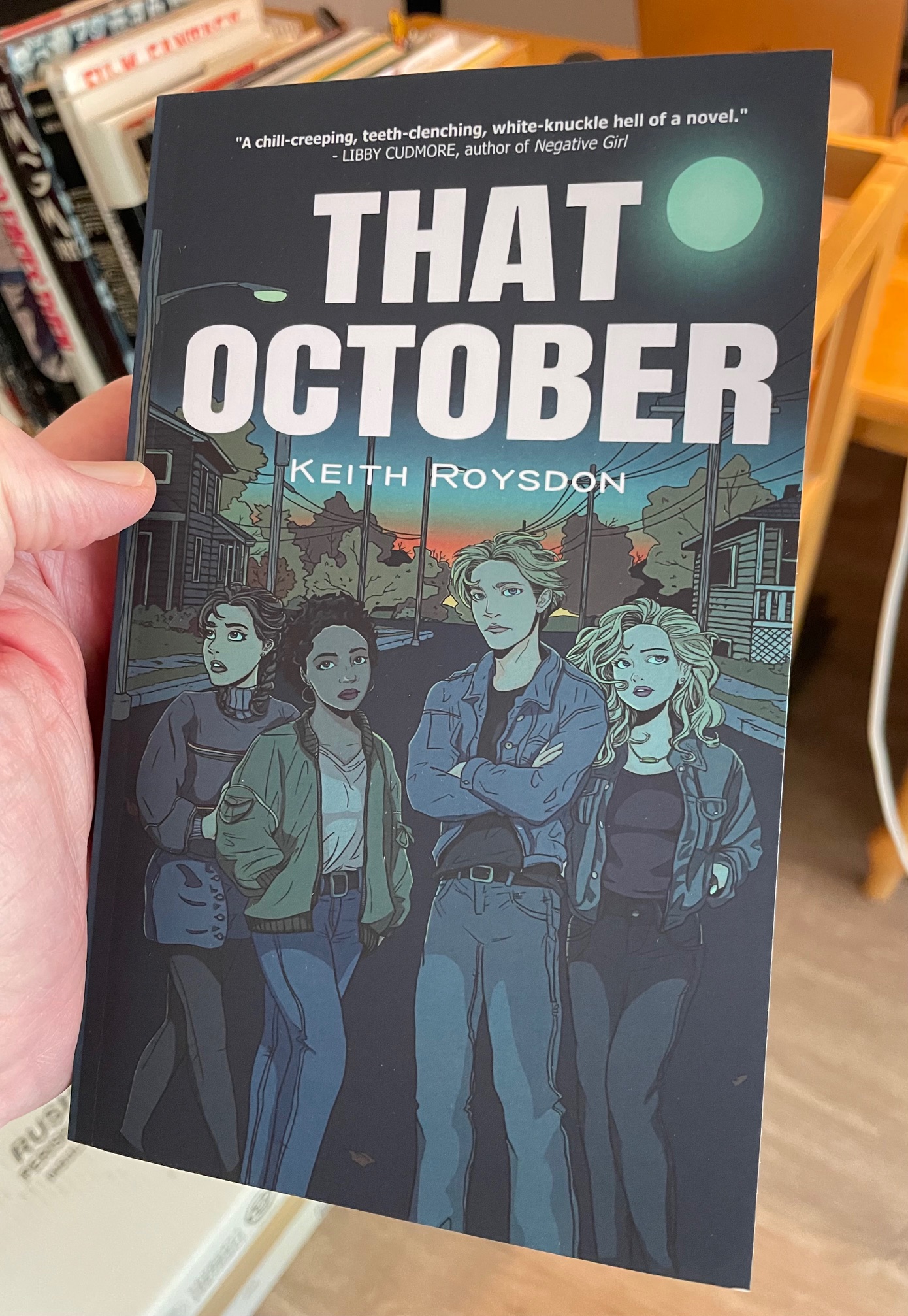
Thanks to my Constellate Creatives cohort Jill Blocker for reminding me that it’s almost THAT OCTOBER.
I mean, we’re speeding toward October with a strong tailwind and it’s a good time to remind people that my 2025 novel, a YA thriller that I’ve more often than not referred to as a high school crime novel, is out there in the world. Poor little THAT OCTOBER, which has been out for 15 months-plus now, has taken a backseat to my promotion of SEVEN ANGELS, which came out three months ago.
But THAT OCTOBER – set in October 1984 – is a good fall season read, with Halloween, Elvira Mistress of the Dark on MTV, football, the TERMINATOR and peak 1980s pop music as the mood overlaying the crime story at its heart: When a classmate is killed and another disappears, six high school friends – frustrated by how lackadaisical the adults in town are acting – decide to investigate on their own with the hope of solving their friend’s murder and bringing another friend home.
Along the way, they stumble upon dark secrets not only in their town but also in their own families.
The wonderful author Heather Levy said THAT OCTOBER was “perfect for fans of STRANGER THINGS,” although the only monsters in my novel are the human kind.
You can find THAT OCTOBER literally anywhere books are sold. Here are some salient spots:
Ink Drinkers Anonymous, the Black-woman-owned bookstore in my hometown of Muncie, Indiana, through bookshop dot org.
So does Amazon, which offers it in paperback or ebook.
And The Hive Bookshop, my friendly neighborhood bookstore here in town. The Hive has signed copies, as does Ink Drinkers and Aw Yeah Comics, the latter two in Muncie, Indiana.
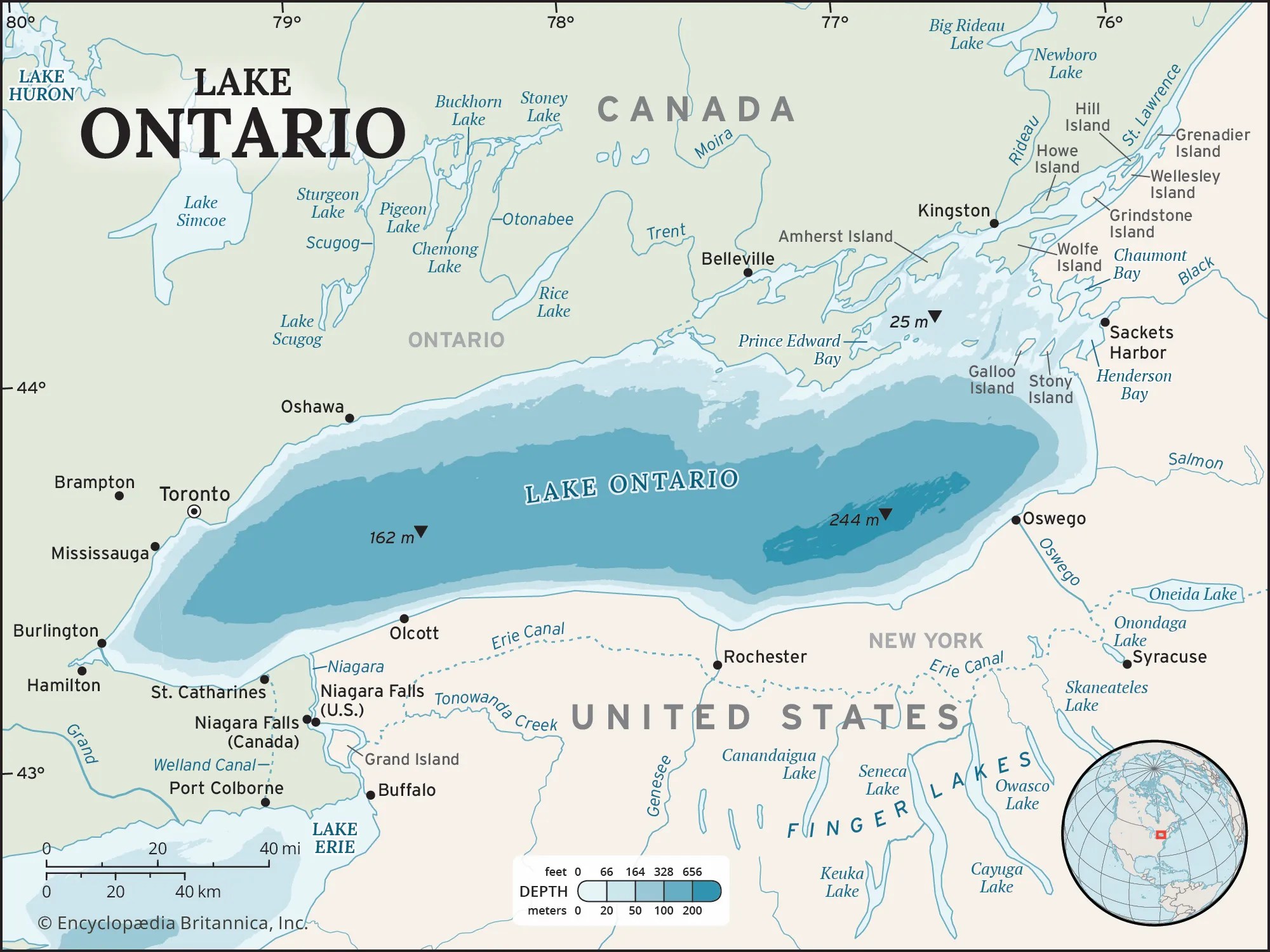
Despite that Britannica drawing of beautiful Lake Ontario, I’ll reassure you up front here that I won’t rehash every element of the idiotic and juvenile threats the current occupant of the White House has made against Canada. I won’t even repeat the ones from just today. Before 2015, I didn’t think it was possible to live in both the stupidest and most depressing and dangerous timeline but that’s the situation we find ourselves in.
But I will note this, and as far as I know, this isn’t the fault of anyone except some nameless, faceless mid-level manager or bureaucrat. I haven’t yet found a simple explanation of why this is the case, but it’s annoying as hell to me and a writer friend who tried to buy a copy of SEVEN ANGELS, my crime novel that came out June 1.
This writer friend in Canada had happily told me that she’d ordered a copy of the book either well before or sometime not long after it went live on Amazon as well as bookshop dot org and Barnes & Noble and many other sites I’d urge anyone to use before considering ordering from Amazon, whose owner has profited from harming smaller, indie booksellers and at the same time undermined democracy with his craven support of the current U.S. president.
Anyway, at some point my writer friend, puzzled, asked if there was any reason why Amazon Canada would be taking so long to send the book. Not that I know of, I replied. Every time I checked, either the American or Canadian Amazon sites, SEVEN ANGELS was available for sale.
Weeks and weeks passed. I checked with her periodically and she still hadn’t received her copy. She’d show me a screenshot of her order form with an inevitably far-future delivery date. And the date slid backward.
This is the status quo last week, ar the end of August, when my friend told me that Amazon Canada was now forecasting a delivery date of October 2 – four full months after the book’s publication date. (Amazon Canada is also charging way more than any U.S. bookseller, but I’m assuming that’s either standard operating procedure or the result of the Rancid Babyman’s tariff tantrums.)
In the meantime, as Amazon Canada was predicting an October 2 delivery for an order placed on August 24, the U.S. version of Amazon was forecasting an August 31 delivery date.
Also in the meantime, my Canadian author friend, after I told her I was going to write a piece titled “Another Reason for Canadians to Hate Us,” replied, “Maybe I should follow up with an article saying We love Americans and would love our neighbours to kindly read our books.”
We love y’all too, my Canadian friend. And we love how you sneak those extra u’s in American words. (Kidding.)
But what’s the reason for this bizarre difference in how this works for Canadian readers?
In November 2024, the site Cybernews reported, “It turns out that if you live in certain countries, you won’t be able to order certain books from Amazon’s US storefront – especially if they revolve around sensitive subjects like erotica, Christianity, the occult, and LGBTIQ issues.
According to The Citizen Lab at the University of Toronto, a laboratory focusing on the openness and security of the internet, Amazon deploys a special system on its “amazon.com” storefront to restrict shipments of certain products to specific regions.
While researchers found more than 17,000 such products, the most common product category restricted was books, especially the ones related to the aforementioned subjects.
In February 2026 on the Amazon forum site, Amazon reported that some ebook purchases are geographically restricted (although this isn’t an e-book issue; the e-book of SEVEN ANGELS isn’t even out yet and will come later this year). A Reddit post also notes that its a roll of the dice to determine if you’ll be able to order some items: you have to enter your Canadian address and then see if your purchase would be deliverable.
A Quora post outlines the absurdity of this situation, advising that while Canadians can order from the U.S. version of Amazon – recognizable by the .com suffix rather than .ca – “If, however, you want to get Amazon U.S. prices and save on customs and brokerage fees, you can do what many Canadians do: time your shopping so you can have the products shipped to a U.S. address while travelling in the U.S. Many hotels, for example, will accept packages for guests (make sure to check first). Along border cities there are many businesses on the American side that simply accept packages for a client and hold them until they can be picked up.”
None of this explains why Amazon Canada continues to offer the books and promises a delivery date that it constantly fails to make.
So do we live in a global economy or not? And can ridiculous threats complicate matters even more?
BTW, I’d have long since just mailed her a copy of SEVEN ANGELS, but the shipping cost would be multiples of the cost of the book itself. And my friend is waiting to see what happens this time to delay her order. But she’s committed to getting her hands on SEVEN ANGELS.
And that’s the sign of a friend, a highly valued thing to have in a time when U.S. leaders seem to be going out of their way to offend as many friends as possible.
I had intended to follow-up my weekend post about getting my books in a local bookstore by suggesting what authors might do to achieve the same thing, but I’ve delayed that for the moment. First things first, and just like a house on fire, the dual plagues of AI and Amazon get our attention at the moment.
For a few weeks now, book lovers and people who hate AI have been despairing at reports about how companies that steal, buy or pirate books to train generative AI – thus putting creative people at risk of losing their livelihoods – have been buying and scanning books. The revelation comes out of the landmark class action lawsuit Andrea Bartz and other writers filed against Anthropic. Bartz and company won a $1.5 billion settlement on behalf of many, many writers whose work was stolen by the AI company.
Details of Anthropic’s practices came out in the discovery process, and they’re horrifying: The company was buying hundreds of thousands of copies of books, some of them older and out of print, and they’re cutting off the spines and feeding the pages into AI-making programs. The books are utterly destroyed. The judge in the Bartz case ruled that this practice was legal because the company had bought copies of the books, not stolen them. (They’re using older books to ensure no AI writing gets fed into the AI consumption process, of course.) Videos of this process – chopping spines off books and the ultimate shredding of the pages – are disgusting and disheartening.
And of course Anthropic isn’t the only AI company doing this.
Today, thanks to an ingenious investigation by 404 Media, we also know that Amazon is doing it. Maybe not a surprise – Amazon and its owner are widely regarded as awful; most of us who do business through them do so only reluctantly, or at least that’s how I feel – but the confirmation from 404 Media, which was also shared by Publishers Lunch this morning, is damning,
This is the lead of the 404 Media story published today:
Amazon is buying massive quantities of books, scanning them for AI training data, and destroying them in the process.
(I’ll link to the 404 Media story at the end of this piece.)
404 Media cleverly hid an AirTag-type tracker in an old book that was to be sold to Amazon’s book-buying operation. 404 was able to track the book as it and many others were shipped around the country and ended up in Las Vegas, where it went to an Amazon warehouse used by an operation called VGT3. That’s the operation’s logo above. Charming, huh?
Amazon didn’t really address the process or its value to anyone but Amazon in its response to 404.
(404 had, in July, reported on an increase in sales of old books and speculated that the increase in sales was due to AI-generating companies buying books it could scan and destroy. And again, I’ll note that the books being chopped and scanned and shredded were published before 2022 or so to AVOID THE WRITING BEING TAINTED BY AI.
As 404 reported: These booksellers suspected AI companies were behind these large bulk purchases because of the high number of books they were buying, the seemingly random choice of books, and the fact that these buyers, unlike libraries and universities, did not seem price sensitive at all. But booksellers couldn’t say for certain who was behind the large purchases because the marketplaces where they sell their books keep the buyers anonymous. When an order comes in, a bookseller ships the sold books to a warehouse operated by the marketplaces, where books are sorted and then sent to the buyer.
In July, one bookseller told me they received a very large order of around 1,000 books on Biblio, one of these marketplaces. The seller agreed to put an Apple AirTag provided by 404 Media in one of the books included in this order so we could see where the book was going. And by extension, which company, AI or otherwise, was behind this massive order.
404 Media granted the bookseller anonymity because they worried sharing this information would harm their business.
404 found online comments from Amazon employees about the VGT3 facility that virtually all they do there is scan books.
Many thousands of books are being bought, scanned and destroyed by Amazon at that facility and probably others. And that doesn’t even account for other companies that are doing the same.
And as 404 reported:
That employees are scanning the barcodes or ISBNs on books — a unique serial number given to every published book — before scanning their content gives further credence to another theory put forth by booksellers: AI companies are trying to methodically scan every printed book in the world by working through the list of ISBNs. One bookseller told me they suspected this was the case because the very large orders they were getting never included very rare books that do not have ISBNs.
I already didn’t feel good about Amazon, where a large amount of my work can be purchased. Their practices toward employees and authors and the sheer mass accumulation of wealth by its owner were long-known and queasy-making.
Here’s another reason, thanks to the reporting by 404 Media and dissemination to the publishing industry by Publishers Lunch, to dislike Amazon.
I’m not sure I remember the exact details, but when my first true crime book, co-authored with my longtime writing partner Douglas Walker, came out in 2016, it was pretty thrilling to see the book for sale in bookstores, drug stores, gift shops and online.
It’s one thing to have a book out there and to sell it and sign it, but realizing our publisher, History Press, had actually gotten the first book, “Wicked Muncie,” in stores and online sites, was pretty amazing. History Press kicks all kinds of ass in getting books in stores, by the way. All four of our true crime books found a good home with them.
Another highlight was finding our books offered by libraries, which are very nearly my favorite places on the planet. A while back, I realized our third true crime book, “The Westside Park Murders,” was available through the Chicago Public Library. I’m still boggled over that.
So it’s been fun, with THAT OCTOBER, my new 1984-set high school crime novel, finding the book on all kinds of bookselling sites. I wasn’t certain if I would have to take steps to ensure this because THAT OCTOBER is self-published.
But I didn’t have to. At some point recently I was asking the folks at Ingram Spark, the venue I used to publish the book, if they could tell me when it would be available for pre-order. They responded and noted that it already was available and showed me where Amazon was selling it.
Since that time, I’ve been excited to see that not only Amazon, a site I have qualms about, but Barnes & Noble, Bookshop, Powell’s Books and Waterstones, the famous Brit seller of books, all offer it (for pre-order right now, as publication date is June 1).
So I’ve been on social media, posting links to most of those booksellers and screenshots. It was as especially exciting to see that Powell’s, a bookseller I’ve visited in Portland, Oregon, and have done business with online, offered it.
Oddest place I’ve found the book for sale so far: Saxo, where the book is available for about 259 Danish Krone.
It’s silly, I know, to be so excited about this, but I didn’t think it would ever happen.
Next I’ll be telling you how excited I am to find THAT OCTOBER for sale at Half Price Books or McKay’s.
I haven’t spent a lot of time on Amazon lately, in great part because I haven’t liked what I’ve heard about the way the retailing and publishing giant has squeezed publishers and authors after years of putting the hurt on independent bookstores. The fact that I didn’t buy any books or music through Amazon this past Christmas – and a few months before that – is decidedly immaterial to Amazon, of course.
I have gone back to Amazon recently however – without breaking out my credit card – to check out two projects from Amazon’s burgeoning original movie/TV production house.
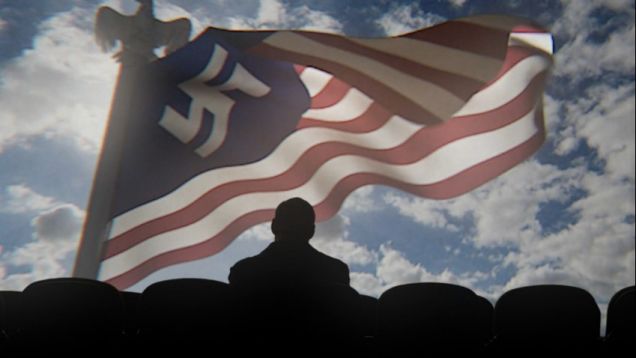
One is “Bosch,” a series based on Michael Connelly’s Harry Bosch crime novels. Another is “The Man in the High Castle,” based on Philip K. Dick’s 1962 alternate history novel.
It’s a testimony to the lasting fascination with World War II that “The Man in the High Castle,” the book and the Amazon pilot I saw, are still so vital.
When the book by Dick – the author of the stories behind classic films like “Blade Runner” – was published in 1962, World War II vets were still strong and vital men and women, the driving force in our society, albeit soon to be supplanted by their children, the generation that came of age in the 1960s. But in 1962, the heroes of World War II and the scars of the war still loomed large.
Dick’s story is set in a world where Japan and Germany defeated an overmatched Great Britain and Russia and an unprepared United States. The US is divided between a Japanese colony on the west coast and a German colony on the east. In between is a rough neutral zone.
The Amazon pilot – which streamlines Dick’s story – tells the story of two people: Juliana, who journeys by bus from San Francisco to Canon City in the neutral zone to complete a mission started by her sister, who is killed by Japanese authorities, and Joe, a young New Yorker who seeks out a dangerous mission for anti-German resistance underground and drives a truck to Canon City.
Each is carrying a newsreel, “The Grasshopper Lies Heavy,” which seems to show the US and its allies triumphant over the Nazis and Japanese. But that didn’t happen, did it?
The newsreel – a book in Dick’s original novel – is the product of a mysterious figure known as “The Man in the High Castle.” What his role in the story is and what happens to Juliana and Joe are still unknown to Amazon viewers because the creators – including former “X-FIles” producer Frank Spotnitz – have barely scratched the surface of Dick’s book. We’re not even sure if there will be more episodes to follow the Amazon pilot.
The most chilling moment in the pilot is when Joe is stopped by a swastika-wearing sheriff who acknowledges he was a US soldier in the war. “Can’t even remember what we were fighting for now, though.”
Joe notices ashes drifting down around them and asks what they’re from.
The hospital, the sheriff replies. Just the regularly scheduled burning of “cripples and the terminally ill (and other) drags on the state.”
“The Man in the High Castle” is visually stunning, from the opening credits to the newsreel images to the lived-in look of the US under occupation. The look of the series pilot is big-screen-movie-quality.
The characters are intriguing and the story is fine, although I felt like I saw the last-shot twist coming.
Maybe we’ll see where “The Man in the High Castle” takes us.