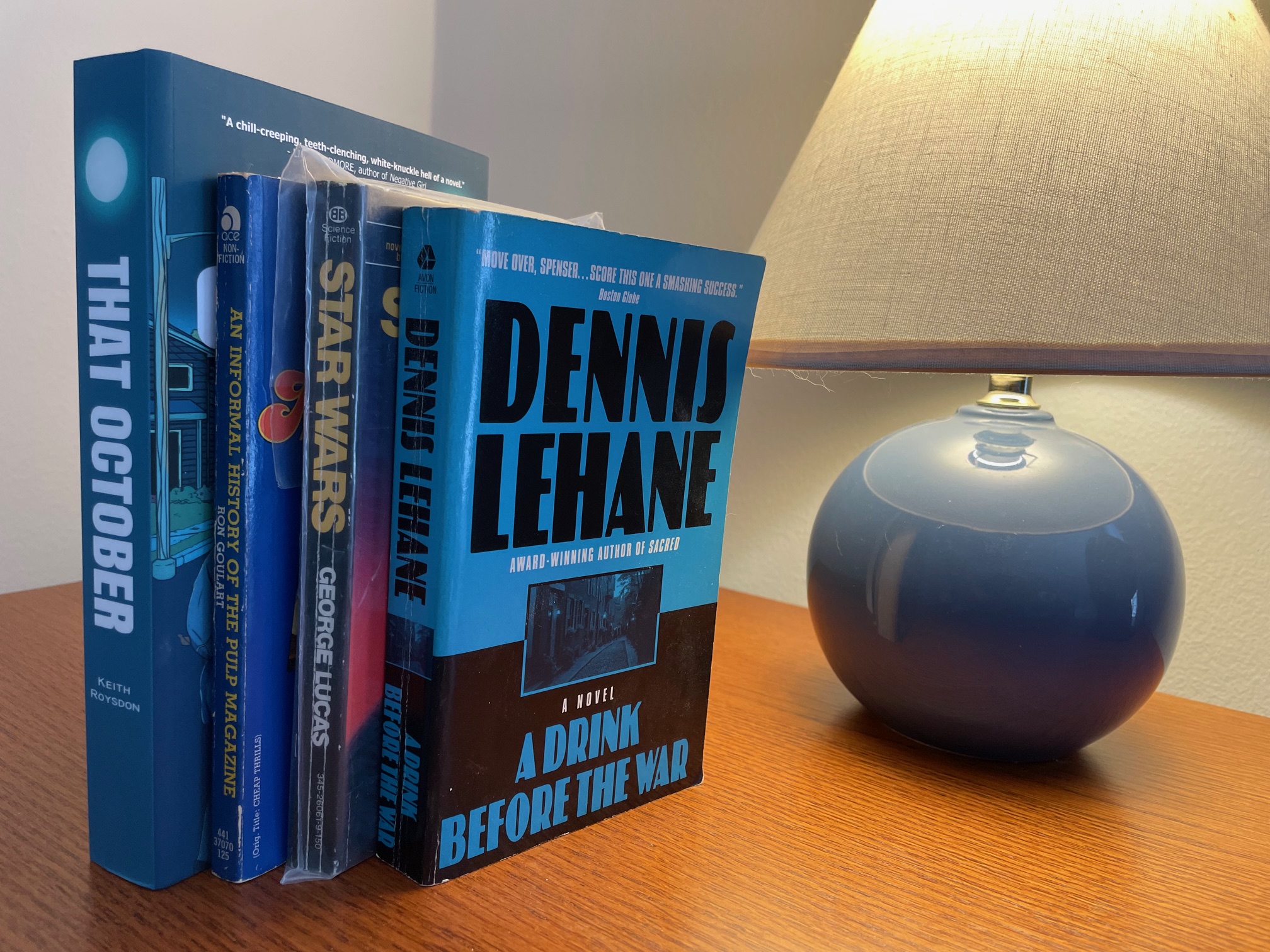
I always enjoy when friends and readers note on social media they’ve received a copy of one of my books, like the new one, SEVEN ANGELS, but I don’t usually post about it here.
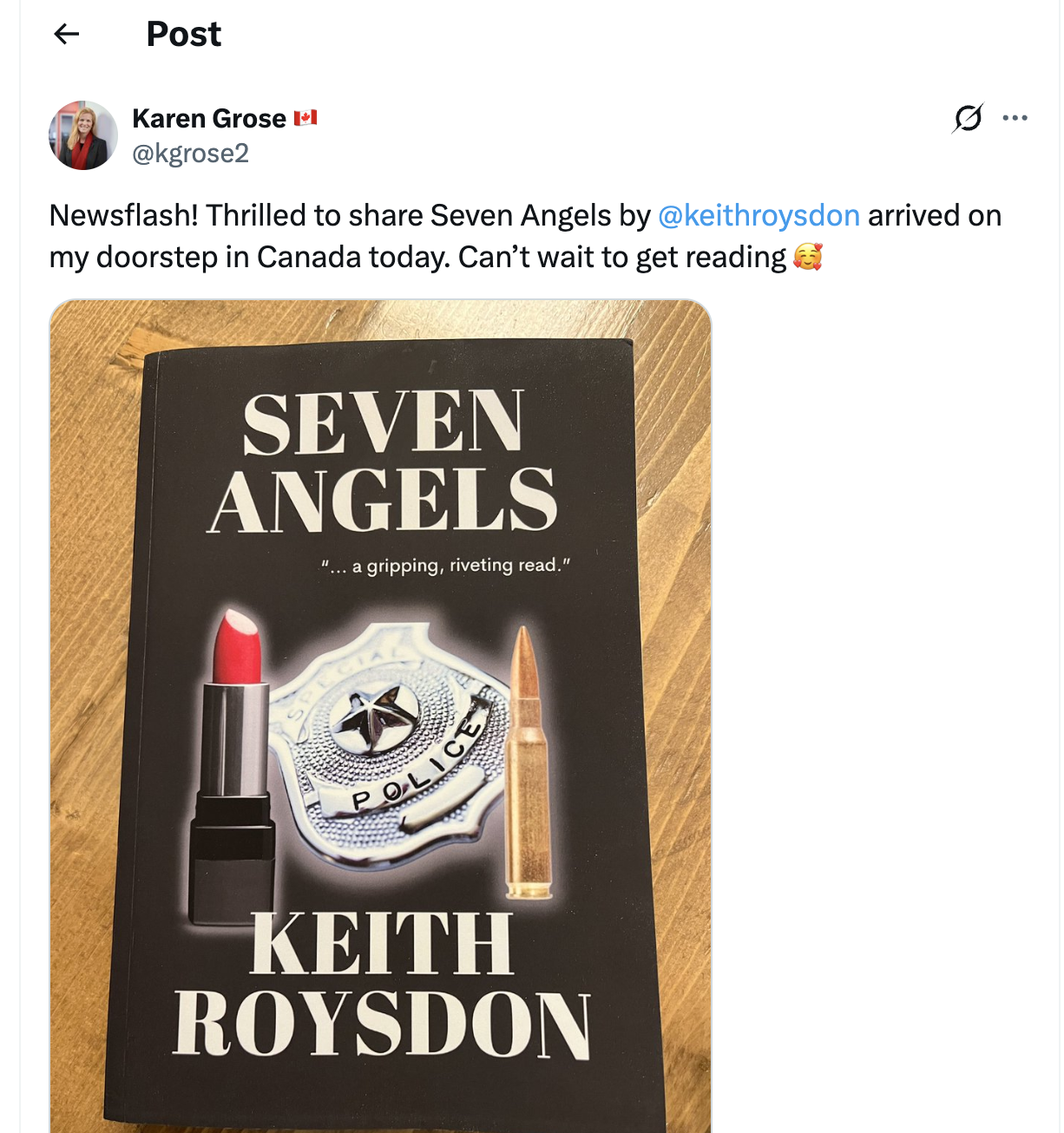
Today, I am, because my friend Karen Grose, a rightfully proud Canadian author of several bestselling novels like ALL JUNE LEFT BEHIND and FLAT OUT LIES as well as WHAT WE KEEP SILENT, which is near the top of my Towering To Be Read Stack, posted on social media last night that she’d finallly received a copy of my crime novel SEVEN ANGELS.
Earlier this week, I posted here about my Canadian writer friend, who I’d been talking to for months about why Amazon Canada kept delaying delivery of my book that she’d ordered. I was stumped. Karen was stumped.
Maybe all it took was for me to post about it here, because Karen received the book something like the day after I posted about the delay. I’m certain the two are related, right?
Anyway, I told Karen that I hope she enjoys the book – now that she finally received it – and I’m looking forward to reading hers.
If I were to turn this space into a full reporting of every assault on books and literacy and writing and publishing and privacy and freedom of choice, I’d never get anything done. The folks at Book Riot – that’s their image above – are doing a good job of keeping track of every petty tyrant’s ambitions to tell you what you can and can’t read.
But I will note this: In a month of frustration and anger at the attack on books and our freedom – and you bet your ass those two are connected – by everything from greedy AI companies (who need to go broke and out of business sooner rather than later, please and thank you) and petty tinpot wannabe dictators over their own little fiefdoms, there’s little that has presented as so ignorant and intolerant as “We’re coming for the books,” uttered recently by repugnant Republican Texas Lt. Governor Dan Patrick.
Here’s how the Texas Tribune reported it on August 19:
Lt. Gov. Dan Patrick on Wednesday vowed to pass legislation punishing public schools that do not remove graphic books from their shelves by knocking them down a notch in the state’s annual school performance ratings, which the state uses to seize control of underperforming districts.
Flanked by easels displaying printed covers of books he found obscene, the lieutenant governor said school boards and administrators have not been following a 2025 law aimed at weeding out lewd books from the shelves in Texas’ more than 9,000 campuses attended by some 5.5 million schoolchildren.
“It’s the law and we expect you to follow the law. So we’re coming for the books,” Patrick said during a news conference at the Texas Capitol. “We ask that you do it on your own and remove these books.”
The law from last year, Senate Bill 13, granted school boards the authority to approve and remove books based on complaints they receive, such as those from parents and activist groups. Before, those powers largely belonged to school librarians. But Patrick said an overwhelming majority of school boards have not taken any action, as the law nears one year in effect.
Patrick is no stranger to controversy over his ignorant, intolerant and politically questionable acts. I’ll leave it to more comprehensive online sources to tell you about that.
Book Riot notes that this is “manufactured panic over the content of books in school libraries,” and there’s certainly some head-shaking in noting that Patrick was conducting a publicity stunt for his podcast. The far-right activist/busybody who stood on stage with him was his next podcast guest and she’s put together a list of 2,200 “dirty books” that Patrick is touting as the state’s unofficial list of books that will get school libraries in trouble.
All of you know this space has become increasingly noisy lately regarding authoritarian-wannabe and oligarchs’ attacks on books and writing and publishing and privacy and freedom, because please have no doubt that anytime a politician and would-be authoritarian wants to ban books in school libraries, what they really want to do is control every aspect of your life, from your reading material to who you marry and how and when you reproduce.
Huge sweeping generalization there? I’m not gonna go the easy route and compare these wannabe dictator moves to the best-known authoritarian movement of the 20th century, But that’s what’s at work here.
So to cop a phrase from the old gun lobby bumperstickers, “You can have my books when you pry them out of my cold, dead fingers.”
As Kelly Jensen so ably put it in that Book Riot piece:
If laws like SB 13 are about local control, then why does one partisan activist brag about having been engaged in censorship attempts at 163 schools where she doesn’t have a student or pay taxes toward? Why does one partisan activist get to decide which 2,200 books are illegal in Texas?
This isn’t about local control. It’s about Republican control of anything and everything, down to local availability of books.
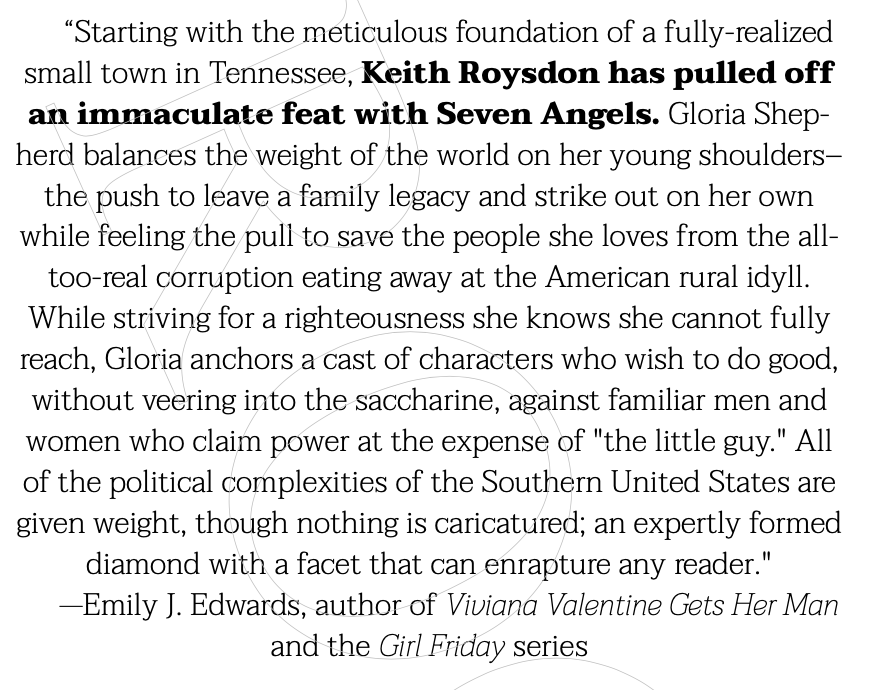
As part of a series, I’m highlighting some blurbs from authors who’ve read my new novel SEVEN ANGELS, out June 1 from Constellate Publishing. Today, Ms. Emily J. Edwards.
Maybe I violate some unspoken rule here when I note that some of the people who’ve read my book and been kind enough to blurb it are friends, like Colin Harker and Emily J. Edwards. But who would not want to claim them as friends?
Emily is a friend I met through social media and we chat a lot about writing and publishing. We trade pieces and snippets we’ve written to give each other some thoughts and she’s so smart and savvy.
I was recently a guest on her upcoming podcast, Silver Screen Sleuths, and we had a blast recording it.
She wrote the “Girl Friday” series of 1950s-set crime novels, led by “Viviana Valentine Gets Her Man,” and you should see out those books because they’re spot-on recreations of the time and setting, New York City.
Emily had written short stories and has a new novel in the works that you will, trust me, love.
This is sad news. Not nearly as sad or despairing as much of what we see in the news in recent years, but sad nonetheless.
The mass market paperback is dead.
This might not surprise some of you who react, “Yeah, I know, I haven’t seen one in a bookstore in a while,” or “What is a mass market paperback?” For those young enough that they don”t remember the mass market paperback, I’m fearful you’re reading this past your bedtime.
Publishers Weekly likely broke the news to most of us who remember mass market paperbacks – I’m going to refer to them as just paperbacks pretty soon now, for expediency’s sake – in a December article that noted that the ReaderLink company said it would no longer distribute mass market paperbacks. The format’s share of the market had dropped dramatically over the past couple of decades as larger-format paperbacks, sometimes referred to as trade paperbacks, and ebooks had usurped the market that had been dominated for many decades by mass market paperbacks.
Paperbacks had been the format of choice for much of the 20th century. They were less expensive than hardbacks but more cheaply made and thus less durable. But they had an ease of use, a convenience and an aura that were hugely appealing to most of us who were buying books in the last few decades of the past century. In 1966, the Beatles released a single, “Paperback Writer,” that ironically but lovingly paid tribute to the format. You didn’t hear the Beatles singing about their desire to be a hardcover writer, did you? No you did not.
As many know, paperbacks – measuring about 4 inches by 7 inches, just the size to fit in a pocket so you could always have a book at hand – were introduced before mid-century but might have become the hottest book trend ever in the 1940s and 1950s, continuing that hot streak into the 1960s and 1970s.
Paperbacks went to our workplaces, where they were handy to read on our lunch hour. They went on our commutes, where they occupied many a train and bus rider. They went to school and war in backpacks and pockets. They went everywhere, in part because of their convenient size and in part because they were so incredibly inexpensive to buy. I just looked at one of my oldest and most rare paperbacks this morning, a copy of Harlan Elliison’s “Rockabilly” from 1961. The cover price was 35 cents.
The vast majority of paperbacks I bought in the late 1960s and 1970s were priced at 65 cents, 75 cents, 95 cents. Paperbacks I bought into the 1990s were still only a few dollars, inexpensive compared to hardcovers and large-format trade paperbacks that, in my buying experience, were confined to scholarly or pop-culture works about movies, TV shows and comic books. At least that’s what still fills my bookshelves. I recently noted my copy of “The Marx Brothers at the Movies,” a 1975 Berkley trade paperback of a 1968 hardcover original, cost me just $3.95.
I have hundreds of books. Some are of recent vintage but the majority date from the 1960s to the 1990s. Among people my age, that’s probably not uncommon. Paperbacks entertained and informed us. Some of my favorites are early Stephen King novels and short story collections, the work of Robert A Heinlein and Ray Bradbury and Dean Koontz.
And I wasn’t alone. Publishers Weekly says 387 million mass market paperbacks were sold in 1979, compared to 82 million hardcovers and 59 million trade paperbacks. The 1975 movie tie-in of Peter Benchley’s “Jaws” sold 11 million copies in its first six months
Publishers Weekly notes that the paperback began losing its share of the market with the growing popularity of trade paperbacks and ebooks, the latter of which boomed in the early 2000s. And of course the shrinking number of bookstores – a trend which has, happily, reversed course – further eroded paperback sales.
Folks who’ve read this site before know I’m a fan of bookstores, especially used bookstores, and they’ll forever be a place to find books in all formats, including the once-beloved paperback, also known as the mass market paperback.
That’s where you’ll find me, looking to recapture a little of a past that’s quickly disappearing.
I won’t pretend to sum up the weird state of small publishing here. If you’re been following the world of indie and small publishing, you know that 2025 has seen some small imprints go out of business – in some cases leaving authors unpaid – and others purport to try to fill that void.
I’m not sure that Constellate Creatives’ publishing arm, Constellate Publishing, the enterprise I’m affiliated with, will fill that void. For one thing, we can’t be all things to all people.
But as we started Constellate’s venture into editing – developmental editing and copy editing — and publishing and marketing a few months ago, it became obvious that somebody needed to be around to step in and catch a few worthy projects. Or maybe juggle chainsaws.
It’s making for a 2026 I’m really excited about. Constellate Publishing will publish my novel SEVEN ANGELS but there’s a diverse lineup of books on tap for the first two quarters of 2026, including a book of mindful self-help, a book of poetry, my novel and two by Jill Blocker, a reissue of her WHAT WAS BEAUTIFUL AND GOOD and her new novel, HAPPILY AFTER EVER. The latter is what’s increasingly termed a “new adult” book and will appeal to readers post-YA in their reading interests.
I’m proud to have noticed that every book besides mine is written by a woman and even mine has a cast of woman as protagonists.
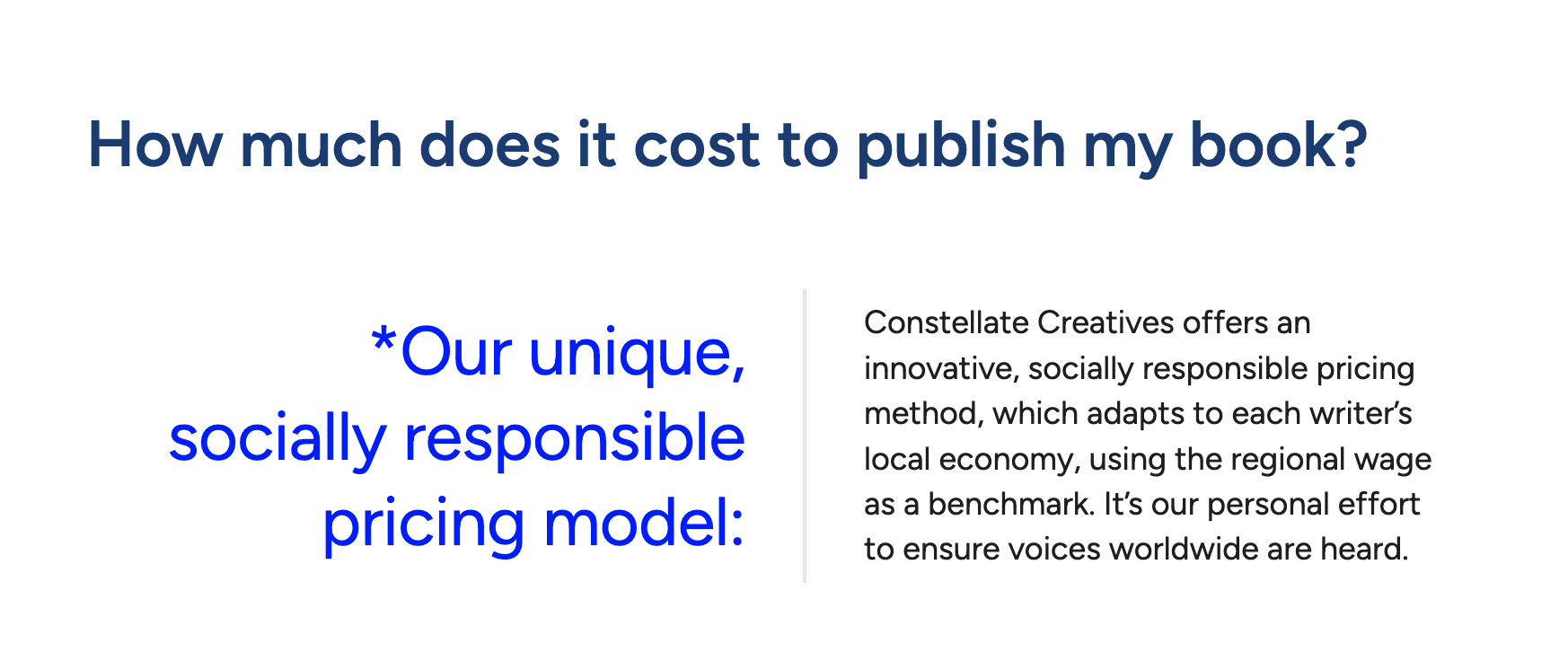
And note the slide I’ve posted above: Constellate Creatives is offering editing, publishing and marketing services, or some combination of those, and at socially-responsible fees based on the regional wage in each writer’s local economy.
Some of us love to edit copy and help with developing your work. Others (raises hand) love marketing. Yes, I’m weird like that. We can’t promise that PR about your book will land on large market-share sites like KTLA, where our news release announcing our slate for the first half of 2026, was picked up. But we’ll be pitching your work and you won’t have to deal with the dreaded marketing.
There’s a button somewhere on the CC site that will lead you to a free consultation. We might be able to answer some questions for you.