Tag Archives: creative-writing

A simple way to refute any allegation of AI use? Paper trail, baby

Not so long ago, as publishing companies were feeding manuscripts into AI programs to determine if AI was used to write the manuscripts – not surprisingly, in some cases, the AI came up with a “positive for AI” diagnosis, strangely enough often in the case of first-time POC authors – the discourse among writers was how to prepare to defend yourself in case of AI allegations.

“Save your drafts,” the simple response came. Each of the four or five or 10 times you wrote a new draft, each one was proof that it was your hand that crafted the writing.

But what if you don’t draft?

Maybe it’s because of my “this must be written now” practice of writing for newspapers, I don’t draft, at least in the sense of rewriting a stem to stern version of a work several times.

NOTE ADDED AFTER POSTING: I do go over and over everything I write, usually by rereading what I’ve written previously to put myself in the frame of mind to write anew. Does this count as drafting? Dunno.

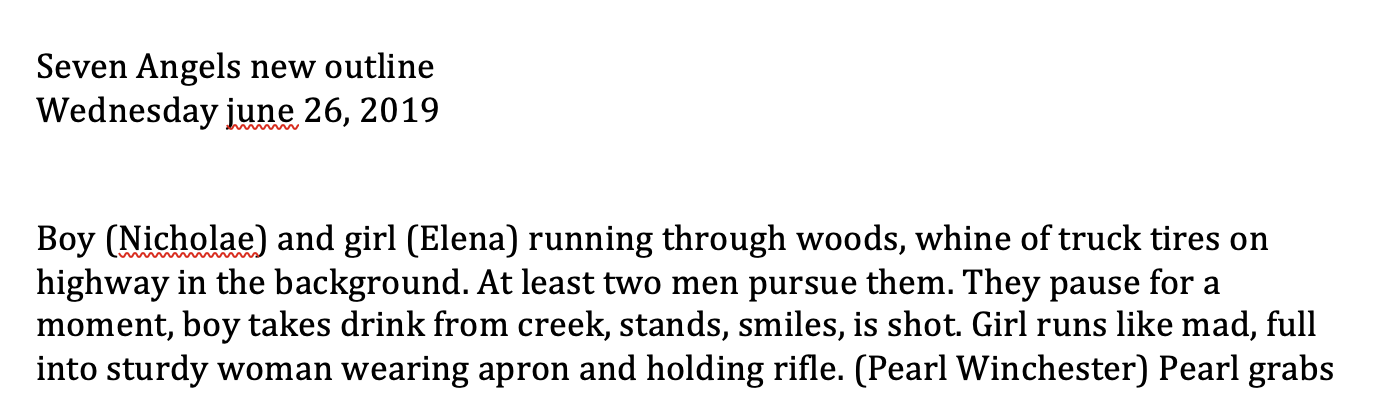
I do have my outline for my first (and most recently published) novel SEVEN ANGELS, as seen above, dated from June 2019, saved in the SEVEN ANGELS folder on my MacBook Pro.

But is there a more certain, beyond subterfuge, way of proving that a book was written in increments, day by day, for months?

I didn’t realize at the time that I was building proof that I’d written SEVEN ANGELS – really, all my books and even many short stories and nonfiction articles – as I wrote it.

It’s long been my practice to email to myself the latest version of any book as I write another chapter or, on a less productive day, another set of paragraphs. Hell, even new sentences.

In my email, I’ve got the latest version of whatever I’m writing, every day, as I’ve written it.

There’s some added assuredness that could provide a time frame for my writing: social media.

Again, coming from the newspaper business, I’ve always been pretty transparent with my writing. So on Twitter, going as far back as 2009, and more recently Bluesky, I’ll often note on social media what I’ve working on. It’s an incremental timeline, not quite as explicit as the daily email to myself, but pretty close.

Not to mention notes to myself in physical notebooks, which I’ve been using since even before I began writing novels in 2019.

So if the thought of creating a “paper trail” of drafts is intimidating to any writer, I’d suggest emailing yourself your latest version. It’s a good indication that you’ve been working on a project.

It has the added bonus of backing up your work in case your computer decides to jump off a cliff.

You’ve somehow stumbled upon the latest of more than 1,100 posts on keithroysdon dot com, stretching back to the early 2010s. Books, writing, movies, TV, obscure pop culture, Halloween, snark and more snark. I’m the author of crime novels THAT OCTOBER and SEVEN ANGELS, co-author of four true crime books including the award-winning THE WESTSIDE PARK MURDERS and hundreds of short stories, news articles and pop culture pieces in spots like CrimeReads, Daily Yonder and elsewhere. You can contact me by leaving a message anywhere on this site or by hollering at me on one of my too many social media outposts.
‘Nobody knows anything’ – and for writers, that’s both good and bad, as short stories are king and money talks

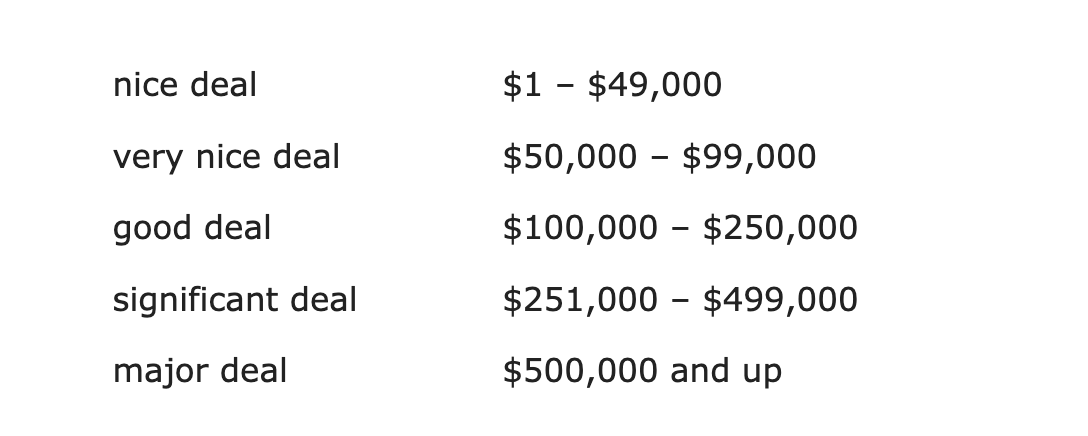
That chart there? That’s the definitions that the writing and industry newsletter Publishers Marketplace uses to gauge its reporting on the latest sales of manuscripts to publishing houses. PM reminds us once a week the guidelines for when it refers to a “nice deal” or a significant or major one.

So to disprove writer William Goldman’s “Nobody knows anything” I quote in the headline – a simplification of Goldman’s sentiments in his 1983 memoir ADVENTURES IN THE SCREEN TRADE – we know two things: Publishers Marketplace means it when they say a major deal is a major deal and if you ever see my name reported next to the phrase “major deal,” I can tell you that’s the last time you will hear from me other than occasional dispatches from my fortified writing tower.

The talk of the day in writing circles is a New York Times story titled, “Writers are making millions selling short stories to Hollywood,” and the story is, in effect, a trend story about how a few writers have had short stories optioned by producers for movies and TV adaptation – and in some cases, the stories haven’t even been published yet.

(I’m not going to link to the story, because my disgust with how the Times has sold its soul to the worst elements of our political life continues, but you can find a gift link to it, I’m sure, on social media. That’s what I did. Be aware that if you want to read the story, you’ll have to jump through a bunch of hoops, including giving the NYT your email address.)

This is the subhead of the NYT story and it really tells you everything you need to know: Publishers generally don’t race to acquire story collections these days, but studios appear eager to shell out for unpublished short works. They give a few examples.

It reminds me of this story I did a few weeks ago for CrimeReads: 7 crime writers talk about novels and short stories and what they love writing most

I’ll link to my CrimeReads piece at the end of this post.

The other piece that writers are talking about today is a GQ article, Will Books Survive? 34 Insiders, Experts, and Icons on the State of Literature in an Age of Uncertainty.

The article is strong from the start:

Something in the literary world isn’t adding up. On the surface, the numbers aren’t looking good. If you’re an American, there’s a roughly 38% chance you’ll read a novel or short story this year. If you’re an American man, that number slips to 28%. By most metrics, it’s a hard time for literature.

And yet.

There’s an undeniable energy bubbling up in New York, Los Angeles, London, and elsewhere. Readings are “sexy” now, supposedly, and a medley of exciting new publications have popped up, both online and in print. Ben Lerner and Emma Cline returned this year, and we’ve been graced with the strongest crop of debut novels in recent memory, from Caro Claire Burke’s culture-conquering Yesteryear to the jagged edges of Madeline Cash’s Lost Lambs to the vibrant energy of Sufiyaan Salam’s Wimmy Road Boyz. People spent the summer reading The Odyssey and crashing The London Review of Books website to read discourse about The Odyssey. So it can’t be all bad, right?

It’s a lengthy State of Books 2026 and worth reading. Here’s a link.

Remember I said the other day that everybody is picking their best books of the year? Here’s the Publishers Weekly list.

My CrimeReads story talking to seven crime writers about what they prefer, novels or short stories:

You’ve somehow stumbled upon the latest of more than 1,100 posts on keithroysdon dot com, stretching back to the early 2010s. Books, writing, movies, TV, obscure pop culture, Halloween, snark and more snark. I’m the author of crime novels THAT OCTOBER and SEVEN ANGELS, co-author of four true crime books including the award-winning THE WESTSIDE PARK MURDERS and hundreds of short stories, news articles and pop culture pieces in spots like CrimeReads, Daily Yonder and elsewhere. You can contact me by leaving a message anywhere on this site or by hollering at me on one of my too many social media outposts.
Kill your darlings? I say writers should resuscitate their darlings: the story behind Door to Door

Writers are always told to “kill your darlings.” That means, of course, that they should learn to be comfortable with cutting lines, paragraphs, chapters and even more if they get in the way of the story. Stephen King famously cut about 400 pages, or 150,000 words, from the manuscript of his magnum opus THE STAND for its original publication. His publisher said the novel was just too long. After THE STAND was hailed as the masterpiece it is, King restored a later edition to something like the original manuscript at 1,152 pages.

I think writers can get in the way of our own success – not only in terms of publication but also story merit – when we’re reluctant to kill our darlings.

That doesn’t make it an easy thing.

I wrote “Door to Door,” published this week by Pistol Jim Press – link at the end of this post – in 2024 for a call for submissions for stories about cults. It got rejected.

So when editor Martine Proctor and Pistol Jim honcho James Maxwell posted a call for stories about doors, portals and gates, it seemed like a good time to revive and sub “Door to Door.”

The only problem? The original was about a third again as long as the 1,000 words or so that the call for subs wanted.

So I cut two or three hundred words. For a story of that length, that’s a lot of dead darlings. It’s not the most I’ve cut from a story, though. I cut some dialogue and I cut a few details, but the point of the story still came through.

I liked the original version of the story and I like the new version. And feedback by people who’ve read it is good.

I should note here that the story was inspired by something that happened in real life: I was home one uncomfortably warm day a few years ago and a young woman came to the door selling magazine subscriptions or something. She literally looked like she was about to faint from the heat and I invited her in and gave her a glass of water.

No murder ensued, however, unlike in the story. No magazine subscriptions ensued either.

I very well might have written some other story for the Pistol Jim call for subs, but it worked out well to give the original, rejected story a shot. Albeit in a slimmed-down version.

Writers should still kill their darlings, especially when it’s necessary. (Says the guy who might publish a 108,000-word novel, GHOST SHOW, in the coming months.)

But even dead darlings can have a new life in some altered form.

Say, that sounds like a story idea …

Here’s my story “Door to Door” for Pistol Jim:

https://pistoljimpress.substack.com/p/door-to-door-by-keith-roysdon

Writing is one of the few privileges anyone can embrace

I’m not sure what I’d be doing if I wasn’t writing.

Talking about that possibility with family members in town for a visit yesterday, one of them wondered what I’d be doing if I hadn’t kept writing when I took a buyout from the newspaper business seven years ago. I went on to write three novels, a couple more true crime books, 73 or 74 pieces for CrimeReads, 55 for another site, eight or 10 for another (now defunct) site, a few for a couple of other sites … plus dozens of press releases, short stories and more.

What would I do if I wasn’t writing?

Well, reading, of course. That’s been the oldest constant in my life (other than breathing and eating), from the Marvel Comics a friend gave me in the 1960s to books and stories aimed at young people.

But I can’t imagine a life without writing.

It seems to me that writing is not only the dominant optional privilege in my life but it could be the privilege that anyone can enjoy.

(This thought goes hand in hand with my belief that ir you write, you”re a writer, regardless if you are published or even disseminated in any way.)

The fundamental act of writing changed me. Decades of news writing made me think better and all the qualities that go with it, especially the ability to look at a circumstance critically.

I don’t think I’m a great writer. I think I am, at best, a clever writer and a sympathetic writer. Sometimes. Writing helps make me that.

And the best thing about writing is that you can do it at very little cost. Of course, thinking about writing is writing, in my opinion, and I’ve got this (aging) MacBook that lets me put together words.

But really, if I didn’t have that tool, i could write in a notebook or even scraps of paper.

Writing isn’t precious. Writing doesn’t care how much money you can afford to write.

For me, writing is in some ways the most consistent thread in my life. In many ways, it’s the most satisfying, but it’s certainly the longest-running and the one that feels among the most important.

If you write, you’re a writer … and maybe you could use a boost

It’s been observed by smarter people than me that writing can be a daunting profession and avocation because of the isolation inherent in sitting at a desk all day, typing on your laptop or making notes in your journal.

It can be a challenge, and I’m not talking about writer’s block, although there is that, too.

The bigger challenge can be the feeling of working in a vacuum, the feeling that you’re writing and writing and rewriting and aren’t sure if you’re getting where you want to be with your story, your article or your book.

I’m known to say, “If you write, you’re a writer.” It doesn’t matter if you’ve been published or not, if you’ve had short stories or books published, to great acclaim or total *cricket noise.*

Cause I believe if you’re writing, or making notes, or thinking about writing and sending yourself ideas in texts and emails … well, you’re writing.

Sometimes you need a boost. I know I do. I’m lucky to have writer friends who read my stuff, from flash fiction to novels, and tell me what they think. I’m lucky to provide the same kind of support for my writer friends.

So a small group of us are now offering a boost to writers, no matter what stage they’re in.

I joined up with Constellate Creatives a while back and just the other day announced my affiliation with CC, which is owned and overseen by longtime friends of mine who are writers but also know other aspects of the writing life, from editing (developmental and copy editing) to publishing to marketing and everything in between.

Our goal is to help writers.

There’s a contact button on the Constellate Creatives site that I’m linking to below.

And I’ll tell you more in the weeks and months ahead.

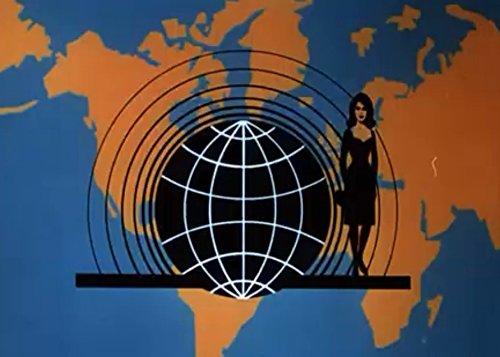
The image above isn’t the Constellate Creatives logo. It’s an image from the 1960s spy TV series “The Girl from UNCLE.” But it’s a pretty nifty bit of art and sort of communicates the international foundation of Constellate.

More info:

https://constellatecreatives.com/

I love the ’80s, especially for exploring fiction

Anybody who knows me knows that I really enjoy writing stories set in the 1980s.

My new book THAT OCTOBER is set – for the most part – in October 1984, although there’s some exposition in the book that leads readers back 20-plus years before that.

There’s a “Stranger Things” vibe that a couple of writer friends who kindly blurbed the book noted, although there are no monsters – except for the human kind – in “That October.”

Sara McKinley, my friend who created the wonderful cover for THAT OCTOBER, said she was thinking about “Paper Girls” and other “kids on bikes” stories as she was working on the art. (My kids in the novel are slightly older, although not by much, and more mobile.)

But besides THAT OCTOBER, I wrote another story, “Steel Victory,” which was published in the 2024 Slaughterhouse Press anthology “Maximum Firepower: An ’80s Action Anthology.” The premise behind the Brian G. Berry-created “Maximum Firepower” is that the tales we wrote were inspired by 1980s action movie tropes.

In my story “Steel Victory,” a Captain America-style super soldier escapes from a top-secret lab in 1986 Washington, D.C. This super soldier is no Steve Rogers, however, and when he goes missing he goes on a murder spree.

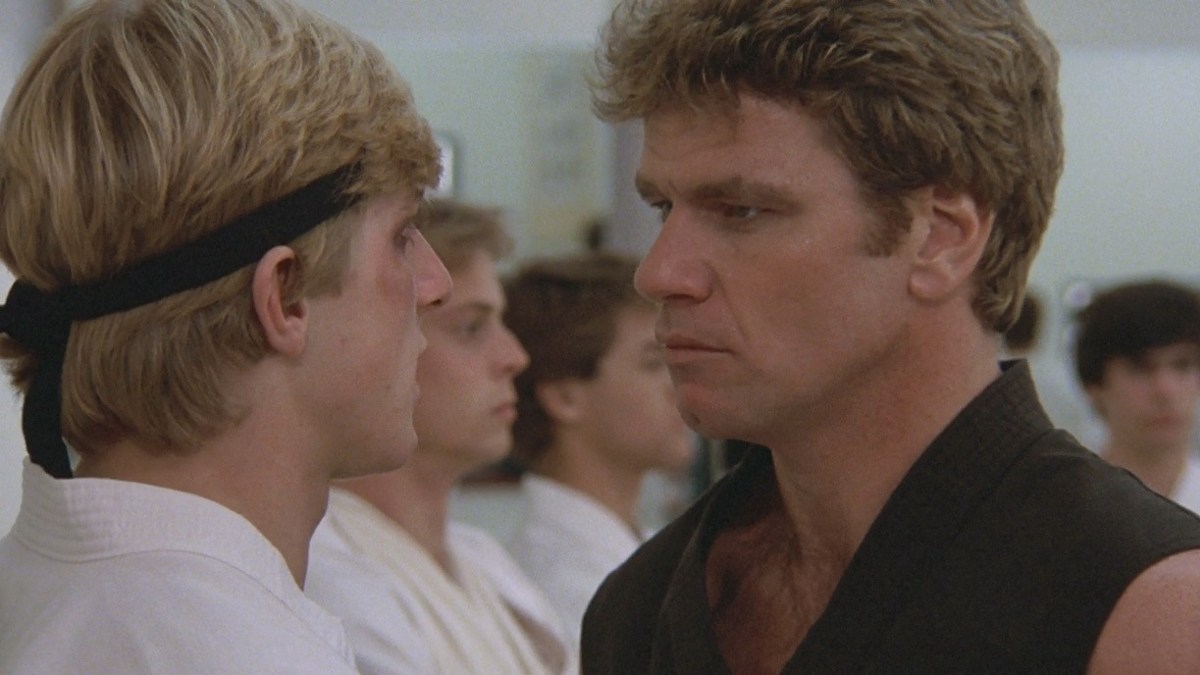
For the look of the missing super soldier, I pictured Martin Kove, the actor who played the bad guy in “The Karate Kid” and other 80s action pictures and recently returned in the “Cobra Kai” series.

It’s up to three women – the doctor who conceived the project, the “lab rat” who knows more about the project than anyone and the project’s head of security – to track him down in the darkness of D.C.

“Steel Victory” and THAT OCTOBER appealed to me because the time period was very defined and familiar to many of us, even those who were too young to experience it. Everybody knows the trappings of the decade, from “Terminator” movies to “Star Wars” on home video to the music of MTV.

As much as I find my cell phone and the Internet indispensable now, there’s something very freeing about writing about a time when the protagonist couldn’t just pull a phone out of their pocket and call or text some crucial information to someone.

I love research, and one of the things I discovered as I wrote “Steel Victory” was that I couldn’t round up a bunch of those government-issue black SUVs for the search party. SUVs, other than Jeep Cherokees, were not in wide use at the time. So my protagonists had to improvise.

It’s an intoxicating thing, to write about a period that’s so close yet so far away. I hope I get to do it again.

Here’s where you can get “Maximum Firepower” and my story “Steel Victory.”

Just like starting over – with a new novel

When I was looking for an image for this post, I was tickled to find the one above, illustrating an instructional video posted by InterDidacta.

I thought it was perfect because this is the first time I’ve worked on a new novel since spring 2023, when I finished THAT OCTOBER.

It’s not just because THAT OCTOBER is close to being self-published that I’m starting a new one.

I’m starting a new novel – after flirting with the idea of writing another non-fiction book, my fifth following four true crime books – because, as I’ve noted here, I’ve changed my daily writing habits. I’m still writing most days, non-fiction articles for sites like CrimeReads and others, but I’m not writing as much short fiction as I did in 2024, for example, when I sold or placed more than a dozen short stories to several sites and anthologies. I’ve got more stories out there in the ether, stories I’ve subbed and haven’t heard back about, and another couple that have publish dates later in 2025.

And while I’ve got something to keep me busy, the urge to write fiction, especially some particular stories and characters, is still there.

So it’s a good time to write a new novel. I’m going to incorporate characters from some of my recent fiction, including SEVEN ANGELS, which won the 2021 Hugh Holton Award for Best Unpublished Novel from Mystery Writers of America Midwest, as well as some characters who have shown up in some other stories AND a bunch from a series of novels I wrote 20 years ago.

I’m posting here to help keep myself accountable. After I reach a promising point in these notes, I’ll turn them into a chapter-by-chapter outline. (I’m a committed plotter but I make changes and add and subtract chapters as I plot and write.)

So hopefully I’ll be motivated to keep going and update here occasionally.

The “how to type on a keyboard” video is more basic instruction than I’ll need, I think, but I’ll for sure remember that I’m starting new on this one, so baby steps will come first.