
For most authors, especially indie authors, getting your books on bookstore shelves is a huge end goal.
It can seem like an impossible goal because brick-and-mortar bookstores have only so much shelf space. Your book is competing for space with books by masterful writers and the most hyped – many times rightfully so – books in print.
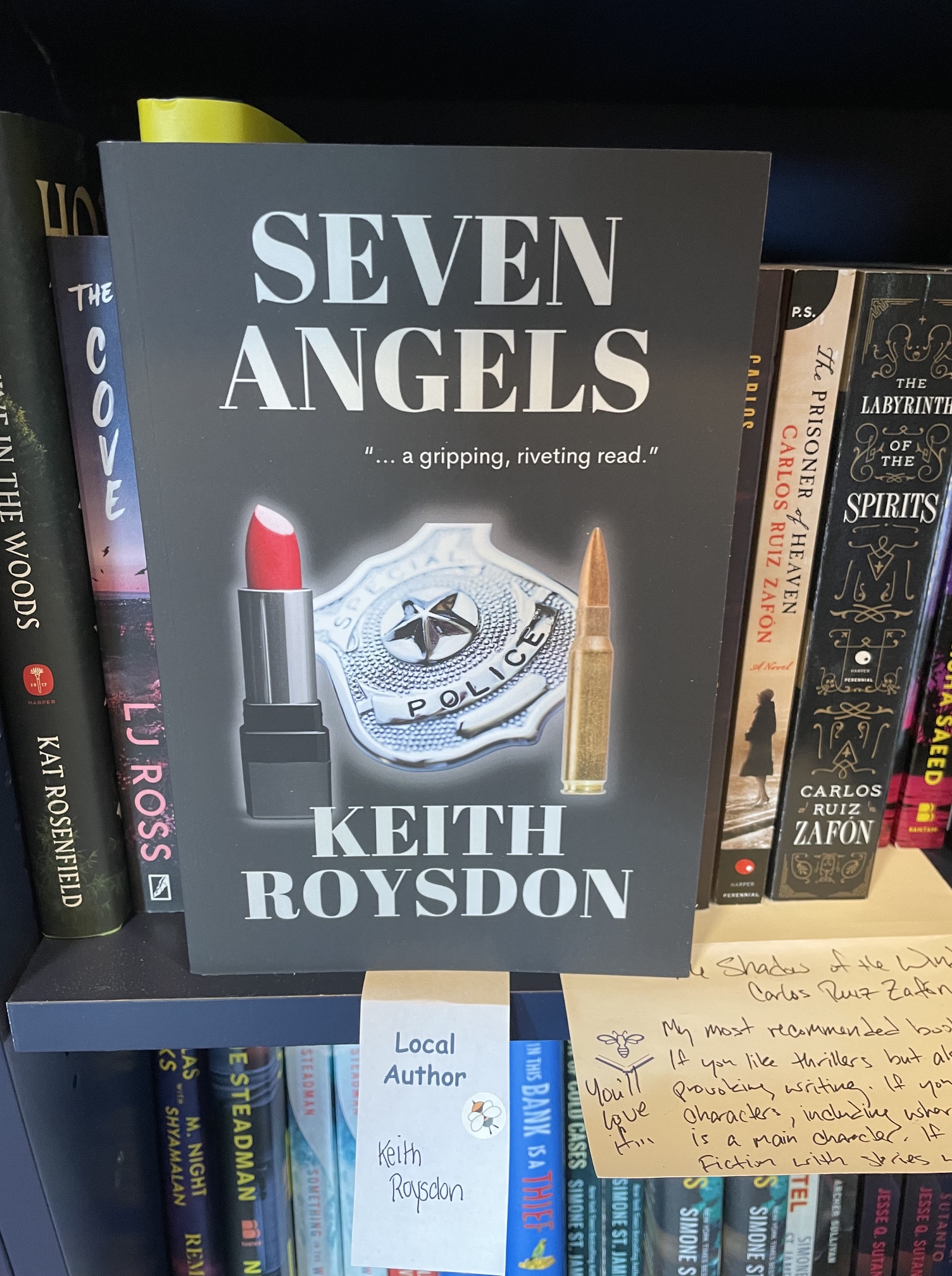
So as someone who’s recently placed my second crime novel, SEVEN ANGELS, on the shelves of the Hive Bookshop, a local woman-owned store here in Knoxville, I can tell you what steps I took that might have paid off and landed a spot on those shelves not only for SEVEN ANGELS but also my first crime novel, THAT OCTOBER.
(And yes, I say “might have paid off” because, ultimately, who can say why a bookstore owner or manager decides to stock the books they stock? I’m sure there are as many reasons for carrying a book as there are books.)
First, write your book. Finish your book. And work on it, with friends who are willing to read it – not to mention a pro editor, if you can afford it – until you’ve got a good book. Yes, I know that’s highly subjective, but in my case, the Hive owners asked if I could drop off copies of my two books so they could check them out. A few weeks later, they let me know they wanted to stock the books. One of the owners apparently read them, or at least enough of them to know a few customers might consider buying them.
And when I say “work on your book,” I’ll note that I outlined SEVEN ANGELS around 2009 and then returned to that outline to write the novel in 2019, after I’d taken a buyout from the daily newspaper business and could devote time to writing it. I added major characters and subplots years later, in 2022 and 2023 or thereabouts, that made the book more well-rounded. This isn’t a typical book-writing timeline for me, although it did take me about a year and a half to write THAT OCTOBER.
Secondly, timing is important. The Hive is literally a new bookstore, as opposed to the long-established other local indie bookstore that didn’t even respond to my request – in person and through their formal process – that they carry my work. Is a new bookstore less hidebound? Is a new bookstore more willing to take a chance on a new author? Certainly the Hive emphasizes that they’re very focused on community and local authors. Maybe your bookstore is new or they have a new decision-maker or they’re just willing to take that small gamble.
Third, cultivate relationships. I didn’t do a lot of that with the Hive, but I don’t think it hurt that I visited their store during their soft opening and bought a book, DUNGEON CRAWLER CARL, which I’d been wanting to read. Nothing’s better than when your bookstore knows you’ll not only support their store but also recommend their store to others.
Fourth, be understanding and don’t be pushy. Understand what an investment opening and maintaining a good bookstore is. As much as I wanted to, I didn’t “circle back” to the bookstore during the weeks after they had copies of my books and before they notified me they’d carry my books. I figured the owners had enough on their hands without having to respond to multiple email inquiries with an “are we there yet?” type message.
(I have traditionally been pushier with two stores back in my hometown of Muncie, Indiana. The wonderful folks at Ink Drinkers Anonymous and Aw Yeah Comics have been receptive not only when I ask if they’ll carry my books but also when I ask if they need more copies.)
Fifth, have good packaging and presentation. My cohort Jill Blocker and I published THAT OCTOBER and SEVEN ANGELS, the latter through Constellate Publishing, Jill’s book imprint spin-off of her Constellate Creatives company. (Link to Constellate is at the end of this piece.)
Sixth: Try to copy edit to avoid typos – we didn’t manage to have no typos, but I see professionally published books that have typos – and have someone – Jill in this case – who can format the book in an eye-pleasing manner.
Seventh: Have a good cover. I’m lucky that my artist friend Sara McKinley drew the cover for THAT OCTOBER based on my suggestion that I wanted something reminiscent of a dramatic X-Men comic book cover pose for the young protagonists. With SEVEN ANGELS, I knew I wanted a cover that paid tribute to those Robert B. Parker covers for the Spenser books that had one or two or three elements on a background. I found the three elements – a lipstick, a bullet and a badge – and Jill executed the cover.
Eighth: Your book might be totally bookstore-worthy but never find its way onto shelves. I thought that would be the case with mine. I didn’t give up, but I was pretty resigned to never seeing my cover in a bookstore.
And I was doubly thrilled when it happened and hope it happens for you if that’s your goal.
Here’s that Constellate link:
